RFID in Apparel & Fashion Retail India — Complete Implementation Guide
Published 6 Apr 2026Updated 24 Nov 20267 min read
Written and maintained by the RFID team at Identium Tech Solutions Pvt Ltd, New Delhi (India RFID Store).
Prices checked on 24 Nov 2026 against the catalogue.
Short answer: Item-level UHF RFID is the fastest way for an Indian apparel brand to move from 65–80% inventory accuracy to 99% or better, and in 2026 it is a mature, off-the-shelf stack: EPC Gen2 garment inlays or hangtags encoded with GS1 SGTIN numbers, readers with WPC Equipment Type Approval on the 865–868 MHz band, and a handheld or Bluetooth sled reader that counts a whole floor in 15–30 minutes. Garment tags such as the ID-1570-U8 list at ₹8 + GST (minimum order 500 pcs) and the ID-SL15 sled reader at ₹38,999 + GST; measure count time and accuracy in a pilot to size the payback.
Indian fashion and apparel brands are adopting item-level RFID to compete with global retailers that have reached 99%+ inventory accuracy with it. From Zara to Decathlon, many of the world's largest fashion and sports retailers run on RFID, and Indian brands are following.
This guide covers how to implement RFID in an apparel business, which tags and readers to specify in 2026, and what it costs in India.
The problem RFID solves in apparel
A typical apparel retailer operates at 65–80% inventory accuracy. Auburn University's RFID Lab, a long-standing reference point for apparel inventory research, puts accuracy under traditional counting methods at around 65%, rising to as much as 99% once item-level RFID is in place. Low accuracy means:
- Stockouts of popular sizes while shelves look full
- Phantom inventory: items recorded as in stock but actually missing or misplaced
- Manual stocktakes that take days and need the store closed
- No reliable way to fulfil online orders from store stock (ship-from-store)
RFID addresses all of these by giving you item-level stock visibility in close to real time.
How apparel RFID works
- Tag application. At the factory or warehouse, each garment receives an RFID hangtag or care label with a unique EPC number. The EPC links to the garment's SKU, size, colour and price in the WMS.
- Inbound receiving. When a delivery arrives at the store, staff scan the whole carton with a handheld reader in seconds, without unboxing each item.
- Floor replenishment. Staff use handhelds to see which styles and sizes need topping up from the stockroom.
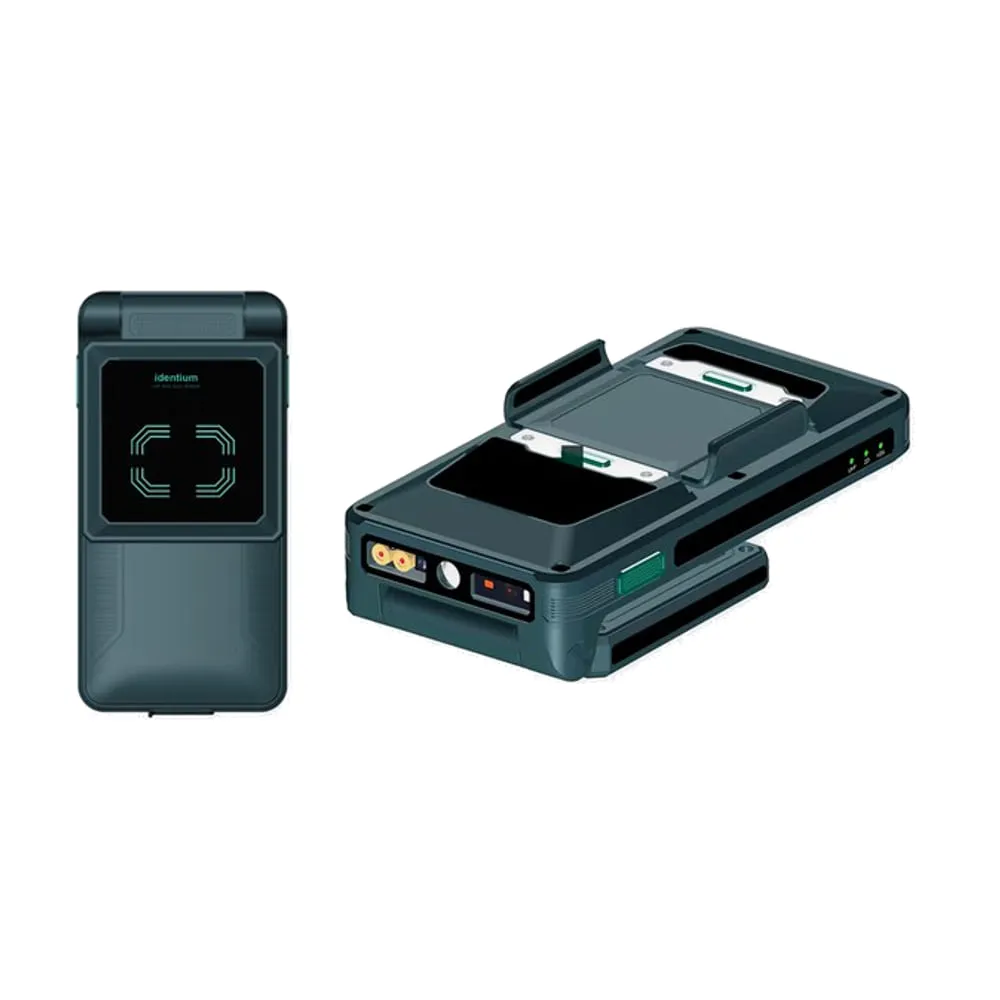
- Stocktake. Staff walk the floor with a handheld RFID reader, or a Bluetooth sled reader clipped to an ordinary smartphone. The whole store is counted in 15–30 minutes instead of hours.
- Loss prevention. RFID antennas at the exit raise an alarm when a tag that has not been sold passes through.
Connecting this to your existing systems: none of these steps replaces your POS or ERP. Tills keep scanning the barcode printed on the same hangtag, and RFID middleware posts only net stock changes to the one system that owns saleable stock. Our RFID middleware and ERP integration guide shows the interface that Ginesys, Unicommerce, Increff, Vinculum, Logic ERP, Tally and SAP each expose.
Apparel RFID tag options
| Tag type | Best for | Catalogue example and list price |
|---|---|---|
| UHF RFID woven label | Garments with sewn-in tags; replaces the brand label | ID-4015-U8 woven label, ₹8 + GST |
| UHF RFID hangtag | Swing tags; replaces paper price tags | ID-3050 apparel tag (printable, 30 × 50 mm), ₹6 + GST |
| UHF RFID care label | Interior sewn-in label with washing instructions | Quoted per project, printed with your care text; the ID-1570-U8 strip (₹8 + GST) can be sewn into a seam instead |
| UHF RFID sticker | Footwear, accessories, hard goods | 9634-H3 and 3045-H3 inlays, ₹7–₹8 + GST |
These are catalogue list prices for one example of each format, with a minimum order of 500 pcs; each tag's product page shows its current price.
Choosing the inlay
The inlay inside the tag matters more than the outer format. Garments are a difficult RF environment: fabric holds moisture, and tags sit close to the body on the hanger rail and in the fitting room. A longer antenna therefore reads more reliably than a small square inlay.
Our garment inlays reflect this. The ID-1570-U8 garment tag is a 15 × 70 mm strip made to be sewn into a seam or slipped into a hangtag, with a 1–4 m read range on garments. The 9634-H3 and 3045-H3 apparel inlays are compact options for hangtags and stickers, rated for reads of up to about 6 m. The ID-3050 apparel tag is a printable 30 × 50 mm format that can replace a paper swing ticket.
For uniforms, workwear and rental garments that go through commercial laundering, use a woven fabric laundry tag such as the UFLT-7515, rated for over 200 industrial wash cycles at 95°C, or the NXP UCODE 9xe sew-in and iron-on labels in our laundry tags range, rather than a paper hangtag.
Choosing the chip
NXP UCODE 9 remains the most widely stocked silicon for apparel and retail labels in India, with the widest choice of converted labels, while Impinj M800-series (M830/M850) labels are arriving in the market. Both families are safe choices for a store deployment; the inlay antenna and your reader set-up decide far more of the read performance than the chip generation.
Our NXP UCODE X vs Impinj M800 chip guide walks through the trade-offs for Indian buyers.
ROI for Indian apparel retailers
The return depends on your stores, your stock and how far you tag at source, so size it from a pilot rather than from industry averages.
What to measure in a pilot:
- Inventory accuracy against a full manual count
- Hours per full store stocktake
- Stockouts of fast-moving styles and sizes
- Shrinkage, with and without an EAS layer at the exit
For a published benchmark, Decathlon reports inventory accuracy rising from 86–90% to 99.9% in key locations, out-of-stock incidents down 30–40% and stock counts up to five times faster than manual methods, on a base of roughly 600 million source-tagged items a year.
An Indian chain will not tag at that scale, but the mechanism is identical: once every garment is counted every week instead of every quarter, replenishment, ship-from-store and markdowns all run on real numbers.
Loss prevention: RFID gates, EAS or both
To reduce shrinkage, pair RFID stock counting with an EAS layer at the exit. That can be RFID exit gates on their own, or RFID gates running alongside existing AM/RF pedestals; which fits depends on how much of your stock is tagged and what you sell. For a phased rollout, a UHF + EAS dual inlay lets one label serve both systems.
Our RFID EAS and loss-prevention guide sets out when to run both systems and when to phase AM/RF out. For store-level planning, see RFID for retail and apparel inventory management, or contact us to scope a store pilot.
What changed in 2026
- February 2026: next-generation apparel labels on show. At EuroShop 2026 (22–26 February), Impinj's partners demonstrated next-generation apparel labels built on the Impinj M830 chip, alongside small-item inlays for jewellery and cosmetics. For Indian buyers, the practical takeaway is that M800-series labels are now a stocked option next to NXP UCODE 9, and that a handheld supporting Impinj's Gen2X features will get the most out of them.
- January 2026: Gen2X spreads beyond one chip vendor. Impinj and EM Microelectronic announced a Gen2X licensing agreement, under which EM will build Gen2X into its RAINFC dual-frequency line and future endpoint chips, with commercial availability expected in 2027. Gen2X stays compatible with standard Gen2, so tags and readers you buy today are not stranded.
- April 2026: Decathlon's source-tagging benchmark. A case study published in April 2026 puts Decathlon at around 600 million RFID-tagged products a year, with 100% of its own-brand products tagged at the point of manufacture and more than 50,000 RAIN RFID readers across 1,000+ stores and 43 warehouses. The lesson for Indian brands with their own factories: tag at the factory, not at the store back door.
- July 2026: the EU Digital Product Passport moves from plan to infrastructure. The European Commission's ESPR Working Plan (adopted 16 April 2025) sets an indicative 2027 date for the textiles and apparel delegated act, with obligations applying 18 months after it enters into force, and the EU's central DPP registry is reported to have opened for organisation enrolment in July 2026. Indian apparel exporters should treat the serialised EPC already on their RFID hangtag as the future DPP carrier and start recording the data behind it now.
- September 2026: what is on the Indian shelf, and what has not changed. The India RFID Store catalogue now lists dedicated garment inlays (ID-1570-U8, 9634-H3, 3045-H3), sew-in and iron-on UCODE 9xe laundry labels, and the ID-SL15 Bluetooth 5.2 sled reader, which reads up to 15 m and runs on a 6,500 mAh battery. On the regulatory side nothing has moved: 865–868 MHz remains licence-exempt for RFID under G.S.R. 853(E) of 10 December 2021, readers still need WPC Equipment Type Approval through the self-declaration route that has run since February 2022, and a July 2026 industry review of the licence-exempt bands lists no new gazette notification affecting UHF RFID.
Related guides
- Why your clothes carry an RFID tag, and what garment vendors supply
- RFID inventory management for Indian retail: hitting 99% stock accuracy
- Top 10 RFID applications in Indian retail
- RFID self-checkout and billing counters
- EU Digital Product Passport and RFID for Indian exporters
- Walmart's 2026 RFID mandate for Indian suppliers
Frequently asked questions
How much does it cost to set up RFID in a single apparel store in India?
How are RFID hangtags encoded with SKU data before they reach the store?
Is RFID better than barcode for apparel inventory?
Which RFID frequency and tag standard should apparel retailers use in India?
Do I need WPC or BIS approval to use RFID readers in my retail store?
Can a Bluetooth sled reader replace a full Android handheld for store stocktakes?
RFIDApparelFashionRetail
Cite as: India RFID Store (Identium Tech Solutions Pvt Ltd), “RFID in Apparel & Fashion Retail India — Complete Implementation Guide”, https://www.indiarfidstore.com/rfid-resources/rfid-apparel-fashion-india, updated 24 Nov 2026.
Keep reading
More guides
More in Industries & use cases
- RFID Tags for Trees and Nursery Plants in India
- RFID Fuel Automation: Vehicle Tags at Petrol Pumps, India
- RFID Tool Tracking in India: Tool Cribs, MRO and FOD
- RFID Surgical Instrument Tracking: CSSD and Autoclave Tags
- Top 5 RFID Applications in India 2026 — Use Cases & Case Studies