NXP UCODE X vs Impinj M800: The 2026 UHF RFID Chip Guide for Indian Buyers
Published 9 Aug 2026Updated 22 Oct 20268 min read
Written and maintained by the RFID team at Identium Tech Solutions Pvt Ltd, New Delhi (India RFID Store).
Short answer: For almost every Indian deployment in 2026, both current chip families are a safe choice. NXP's UCODE line (UCODE 9, and UCODE X, announced on 11 January 2026) and Impinj's endpoint ICs (the M700 and M800 families) all operate across the global 860–960 MHz UHF range, which includes India's 865–868 MHz band. The chip decides a modest slice of your performance; the inlay antenna, the tag converter and your reader setup decide the rest. Specify a chip family, then qualify the finished tag on your own material.
This guide is for Indian procurement, operations, engineering and compliance managers who are about to freeze a tag specification for a warehouse, apparel, manufacturing WIP or fixed-asset rollout, and who have just been handed a quotation with a chip name printed on it.
If you are comparing the previous generation instead, our Impinj M700 vs NXP UCODE 9 comparison covers that pairing in detail. This article is the follow-up for the newer silicon.
What actually changed in UHF RFID chips between 2024 and 2026?
Two things changed that a buyer should care about. NXP announced UCODE X on 11 January 2026 as the newest addition to its UCODE family. And in November 2025 Impinj expanded its Gen2X feature set, extending it to the M770 and M780 endpoint ICs aimed at logistics and manufacturing. The band, the EPC Gen2 air interface and your existing readers did not change.
That last point matters more than the marketing. Both vendors still build to the same EPC Gen2 air interface, standardised as ISO/IEC 18000-63, so a UCODE X tag and an M800 tag will both be read by any compliant reader you already own. Nobody has to rip out infrastructure because a new chip launched.
What a new generation typically buys you is incremental: a little more sensitivity, better behaviour when large tag populations crowd into one read zone, die and antenna refinements that can help converters, and, on the Impinj side, optional protocol extensions. Treat the size of each gain as something to measure on your own line, not something to assume from a launch announcement.
Because UCODE X was announced very recently, treat any specification figure quoted second-hand on a distributor listing with caution. Ask NXP or your inlay supplier for the current datasheet before you write a number into a tender document. We would rather tell you a spec is unverified than repeat a figure we cannot source.
NXP UCODE X vs Impinj M800: how do the current chips compare?
UCODE X is NXP's newest UCODE generation, while UCODE 9 remains the widely converted workhorse of that family. On the Impinj side, the M800 family is the newer high-volume endpoint platform, and the M700 family, which includes the M770 and M780, is well established in logistics and manufacturing and gained Gen2X in November 2025.
Exactly where each part lands on sensitivity, memory and price is a datasheet question, not a blog question. The availability notes below reflect what we see in our own sourcing in India, not a published figure.
| Chip family | Vendor | Status in 2026 | Commonly specified for | Gen2X | Availability in India |
|---|---|---|---|---|---|
| UCODE 9 family | NXP | Mature, widely converted | Retail, apparel, logistics labels, general item tagging | No (Gen2X is an Impinj ecosystem feature) | Widest choice of inlays and converted labels in our experience |
| UCODE X | NXP | Announced 11 January 2026 | Newly announced; confirm target applications and specs with NXP | No | Early stage; expect limited inlay formats at first. Ask for the datasheet and when samples can be supplied |
| M700 family (incl. M770, M780) | Impinj | Mature; Gen2X extended to M770/M780 in November 2025 | Logistics, supply chain, manufacturing WIP | Yes, on M770 and M780 | Good availability through converters; commonly seen in India |
| M800 family | Impinj | Current-generation high-volume platform | High-volume item tagging and small-footprint inlays | Not confirmed here; ask Impinj or your converter which parts carry Gen2X today | Growing; depends on which converter your supplier uses |
Notice what the table does not contain: a single dBm sensitivity number or a memory-bit count presented as gospel. Both vendors publish those figures per chip variant, and they can differ between silicon revisions and between standard and extended-memory options. Pull them from the live datasheet for the exact part number on your quotation.
Is Gen2X worth specifying for an Indian deployment?
Gen2X is Impinj's set of extensions on top of standard Gen2, aimed at the hard cases: dense tag populations, weak or shadowed tags and noisy RF environments. Impinj presents it as an end-to-end feature that needs Impinj silicon in both the tag and the reader. If your readers are not built on Impinj chipsets, assume it buys you nothing until Impinj or your supplier confirms otherwise.
That is most of the decision. If you are buying UHF RFID readers built on Impinj reader chipsets and you are tagging a high-density application (a carton-heavy dispatch dock, a WIP line where dozens of trays pass a portal together, an apparel stockroom), asking for Gen2X-capable tags is a sensible hedge. Those tags should still behave as ordinary Gen2 tags on any other reader. Ask your supplier which part numbers carry Gen2X today, and whether choosing them changes your tag price at all; do not assume it either way.
If your fleet is mixed, you buy readers from several vendors, or your application is a straightforward fixed-asset audit with a handheld, Gen2X should not drive your tag choice. Buy on inlay performance, converter quality and supply.
Will a newer chip actually give me longer read range on the floor?
A newer chip usually improves sensitivity somewhat, which can translate into a modest range gain. But in a real Indian warehouse or plant, the inlay antenna design, the surface the tag sits on, tag orientation, reader antenna gain and local RF noise swamp that difference. A better inlay on an older chip will beat a worse inlay on a newer chip almost every time.
This is the single most common specification mistake we see. A buyer fixes "UCODE X" or "M800" in the tender, then accepts whichever inlay a supplier happens to stock with that chip, and gets worse results than the plant next door running a well-matched label on the previous generation. Compare formats in our UHF RFID inlays and labels range before you fix the chip. For example, the ID-1020-M830 and the ID-1470-M830 carry the same M830 chip in two inlay sizes.
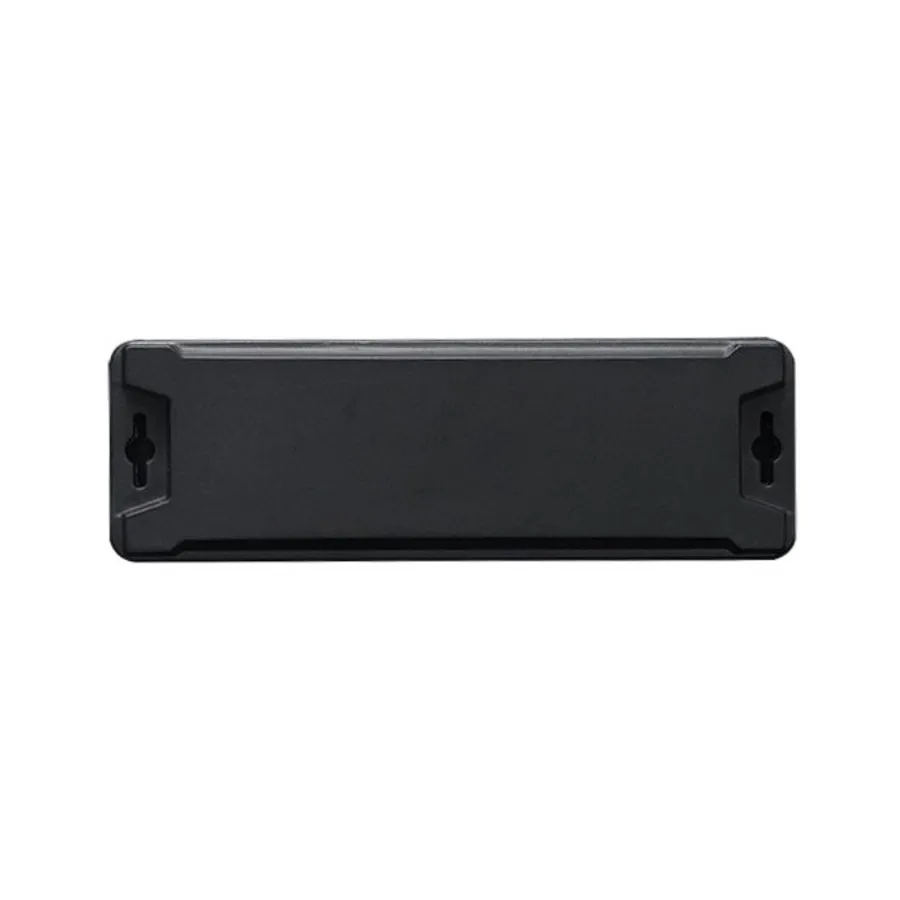
Metal and liquid make it starker still: on a steel trolley or a filled drum, a purpose-built on-metal RFID tag will outperform a paper label regardless of the silicon inside. The IDTS-13042 long-range on-metal tag (130 × 42 mm) is one such tag.
- Decide the physical tag format. Label, inlay, hard tag or on-metal, based on the surface and environment.
- Decide the chip family. Only then pick UCODE or Impinj, and the generation.
- Run a read test. Use your actual product, packaging and read distance before you commit to volume.
Do these chips work with India's 865–868 MHz band and Indian regulations?
Yes. India's licence-free UHF RFID band is 865–868 MHz, and every chip discussed here is a global 860–960 MHz part, so band compatibility is not a differentiator between UCODE X, UCODE 9, M700 and M800.
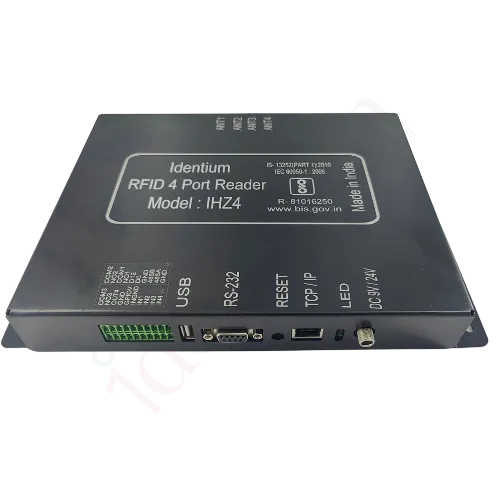
What carries compliance weight is the reader, not the tag. Passive tags have no transmitter of their own; the reader radiates, so it is the reader that needs the relevant WPC ETA and, where applicable, BIS registration, and the reader that has to sit inside the power limits set out in the current WPC notification. If you are importing or reselling reading equipment, work through our notes on WPC ETA and BIS certification for RFID readers in India before you place an order.
We have deliberately not quoted limit figures or timelines here. Requirements are updated from time to time, so verify the current position with the official WPC and BIS sources, or ask us to confirm, before you rely on it for a purchase decision.
How do I verify which chip is actually inside the tags I am quoted?
Ask for the inlay part number, not just the chip name, and then verify a sample yourself. Any Gen2 reader can read the tag's factory-programmed TID memory, whose leading bytes carry the manufacturer and model identifier for the chip. That takes minutes and settles the question without having to trust the quotation. Run this checklist before you release a purchase order:
- Get the inlay manufacturer and part number in writing, plus the antenna dimensions and substrate.
- Get the chip datasheet for that exact variant; memory configuration and sensitivity differ between siblings in the same family.
- Confirm the EPC memory size you actually need. Longer serialisation schemes and any user memory requirement must be checked before you print, not after.
- Read the TID on a sample and confirm the chip model matches the quotation.
- Test on your own product, packing material and read distance, at your real tag density, not on an empty test bench.
- Confirm continuity of supply for the specific inlay. A newly launched chip can mean a longer wait for less common formats.
- Check whether you need encoding and pre-printing, and who does it: you, us, or the converter.
India RFID Store supplies both NXP-based and Impinj-based tags, and we will tell you plainly when the older generation is the better commercial choice for your application. You can request RFID samples and run the read test on your own line before committing.
When does the chip choice really matter for your project?
Chip choice matters when you are tagging at very high volume, when tag density in a single read zone is extreme, or when you have a specific memory or security requirement. For a typical Indian warehouse, asset register or retail stockroom of a few tens of thousands of tags a year, the inlay and the reader setup will decide your success far more than the silicon.
- It matters if you are buying millions of labels a year; small per-chip differences compound into real money.
- It matters if you run Impinj-based readers and want Gen2X behaviour in dense portals.
- It matters if you need extended user memory or on-tag security features, which exist only on specific variants.
- It matters less for handheld cycle counts, fixed-asset audits and desktop encoding, where range is short and populations are small.
- It matters least when your bottleneck is tag placement on metal or liquid. Fix the physics first.
If you are still deciding between formats, our team can map your application to a shortlist of two or three tag options and quote against your volume. See bulk RFID pricing, or browse the full range of UHF RFID tags. We would rather send you samples than sell you the wrong tag.
Related guides
Frequently asked questions
Is NXP UCODE X available to buy in India right now?
Is Impinj M800 better than the M700 family?
Do UCODE X and M800 tags work with my existing RFID readers?
Does the chip brand change the price of an RFID tag in India?
Do I need BIS or WPC approval for the tags themselves?
Should I wait for UCODE X before starting my project?
UHF RFIDRFID ChipsNXP UCODEImpinjBuyer GuideIndia
Cite as: India RFID Store (Identium Tech Solutions Pvt Ltd), “NXP UCODE X vs Impinj M800: The 2026 UHF RFID Chip Guide for Indian Buyers”, https://www.indiarfidstore.com/rfid-resources/nxp-ucode-x-vs-impinj-m800-rfid-chip-guide-india-2026, updated 22 Oct 2026.
Keep reading
More guides
More in Tags, labels & cards
- RFID Cards Explained — UHF vs HF vs LF vs MIFARE (India Buyer Guide 2026)
- FASTag & Vehicle RFID in India — How It Works, Cost & Setup (2026)