RFID Cards Explained — UHF vs HF vs LF vs MIFARE (India Buyer Guide 2026)
Published 18 Jul 2026Updated 4 Oct 20267 min read
If you are sourcing RFID cards in India for access control, employee ID, cashless payment, loyalty or asset tracking, the most important decision is the operating frequency. An RFID card is not one universal product. It is a family of technologies that look identical on the outside (a standard CR80, 85.6 × 54 mm PVC card) but behave very differently depending on the chip and frequency inside.
Choose the wrong frequency and your cards will not read on your existing readers, will not deliver the range you need, or will cost far more than the application justifies. This guide breaks down the main RFID card types (LF, HF/MIFARE and UHF) with specifications, Indian use cases and a comparison table, so you can specify the right card the first time. For ordering printed cards for an existing terminal, see our RFID card printing guide for eSSL and ZKTeco readers.
How RFID cards work
Every passive RFID card contains two things: an antenna (a coil or dipole of etched aluminium or copper) and a silicon chip (the IC). The card has no battery. When it enters the electromagnetic field of a reader, the antenna harvests energy, powers up the chip, and the chip modulates a response back to the reader. With no battery to run down, a passive card's working life is set by physical wear rather than charge.
The frequency of that field defines the card category. Three bands dominate the card market in India:
- LF (Low Frequency): 125 kHz / 134.2 kHz, inductive coupling, short read range.
- HF (High Frequency): 13.56 MHz, inductive coupling; includes the MIFARE and NFC ecosystem.
- UHF (Ultra High Frequency): 860–960 MHz worldwide, 865–868 MHz in India; backscatter coupling, long read range.
LF RFID cards (125 kHz): EM4200 and T5577
Low frequency was the first RFID technology to reach mass adoption in India, and it is still common because it is cheap, robust and forgiving. LF cards read reliably near metal and water. The trade-off is a very short read range (typically 2–10 cm) and weak or non-existent security.
EM4200 (read-only)
The EM4200 (and its predecessors EM4100/EM4102) is a read-only chip with a factory-programmed unique ID. You cannot change the number; you simply read it. This makes EM4200 a good fit for basic time and attendance, low-cost access control, gym and society entry, and any system where the card is just a unique credential checked against a database. It is generally the lowest-cost card chip, and plain EM4200 cards are part of our LF card range.
T5577 (read/write)
The T5577 is a rewritable 125 kHz chip. It can be programmed and reprogrammed, can emulate several LF protocols, and is the usual choice when you need to write a chosen LF ID onto fresh stock, for example to match an existing numbering plan or configure hotel locks. It costs a little more than EM4200 but adds flexibility. The same writability means a T5577 can copy an EM card, so do not rely on LF cards where cloning matters.
HF RFID cards (13.56 MHz): the MIFARE family
High frequency at 13.56 MHz is the workhorse of modern secure access and payment. It offers a practical read range of up to about 10 cm, fast data transfer, memory for storing data on the card itself and, on the right chips, real cryptographic security. The dominant family is NXP's MIFARE, and understanding its sub-types is essential before you buy any HF card.
MIFARE Classic (1K / 4K)
MIFARE Classic is one of the most widely deployed contactless cards. The 1K version offers 1 KB of EEPROM organised into 16 sectors; the 4K version offers 4 KB across 40 sectors. Each sector is protected by two keys (A and B), so one card can hold access rights, canteen credit and library data in separate sectors.
It suits offices, campuses and closed-loop payment. The original CRYPTO1 cipher is broken, so for high-security deployments step up to DESFire.
MIFARE Plus
MIFARE Plus is the security-upgrade path from Classic. It can run in a Classic-compatible mode on existing infrastructure and then switch to AES-128 encryption, letting you migrate a legacy system to modern cryptography without replacing every reader at once.
MIFARE DESFire EV1 / EV2 / EV3
MIFARE DESFire is the high-security choice for transit ticketing, government ID and sensitive-site access. It supports AES-128 and 3DES hardware encryption, a flexible file system that holds several applications on one card, mutual authentication and Common Criteria EAL5+ certification on the newer generations.
If your project involves payments, sensitive facilities or any credential that must resist cloning, specify DESFire.
NTAG / NFC cards
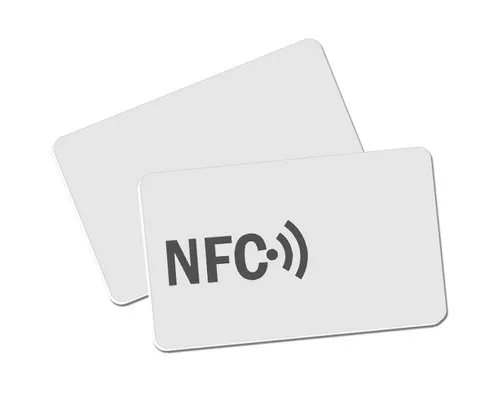
For consumer-facing tap experiences such as digital business cards, product authentication, smart posters, review links and loyalty, NTAG213/215/216 chips are NFC Forum compliant and readable by modern NFC smartphones. No dedicated reader is needed, which makes NFC cards a good fit for marketing and customer engagement.
UHF RFID cards (865–868 MHz): long-range identification
When you need to read a card from a distance (hands-free personnel access at a turnstile, vehicle access at a boom barrier, or bulk reading of many credentials at once), move to UHF cards. In India, UHF RFID operates in the licence-exempt 865–868 MHz band under G.S.R. 853(E), 2021. With a suitable fixed reader and antenna, UHF cards typically read from around 1 metre up to 8–10 metres.
Most UHF cards use the EPC Gen2 (ISO 18000-63) air-interface protocol with chips such as NXP UCODE 8/9 or Impinj Monza. They carry an EPC memory bank (typically 96–128 bits) plus optional user memory.
The trade-offs versus HF: UHF is more affected by the human body, metal and liquids, and long range can be a liability where you need precise single-card reads. For parking, campus vehicle access and personnel tracking over distance, UHF is the practical choice. Pair UHF cards with the right UHF reader and tune the effective range to your gate geometry.
Dual-frequency RFID cards
Many Indian organisations run more than one system: a 125 kHz LF door access installed years ago plus a newer 13.56 MHz MIFARE canteen system, or a UHF vehicle gate alongside HF building access. Rather than issue two cards per person, a dual-frequency card embeds two independent chips and antennas in a single CR80 body.
Common combinations are LF + HF (125 kHz EM/T5577 with 13.56 MHz MIFARE) and HF + UHF (MIFARE with EPC Gen2). One card on one lanyard works with two systems, which is the simplest way to bridge legacy and newer infrastructure without ripping out readers. Dual-frequency cards are a common specification for large campuses, IT parks and manufacturing plants.
RFID card comparison table
| Parameter | LF cards | HF / MIFARE cards | UHF cards |
|---|---|---|---|
| Frequency | 125 kHz | 13.56 MHz | 865–868 MHz (India) |
| Read range | 2–10 cm | Up to about 10 cm | About 1–10 m |
| Typical chips | EM4200, T5577 | MIFARE Classic 1K/4K, Plus, DESFire, NTAG | UCODE 8/9, Monza (EPC Gen2) |
| Memory | 64-bit ID / small R/W | 1 KB–8 KB | 96–512+ bit EPC plus user memory |
| Security | Low (read-only ID) | Classic: CRYPTO1 (broken); Plus/DESFire: AES/3DES | Basic (password-lockable) |
| Standard | Proprietary | ISO 14443A | ISO 18000-63 / EPC Gen2 |
| Metal/water tolerance | Good | Moderate | Sensitive (needs tuning) |
| Relative cost | Lowest | Medium | Medium to low in bulk |
| Best for | Basic access, attendance | Secure access, payment, ID | Vehicle and long-range access |
Printing and encoding your RFID cards
An RFID card usually does two jobs: it identifies a person visually and electronically. That means printing (name, photo, logo, barcode) and encoding (writing or programming the chip data).
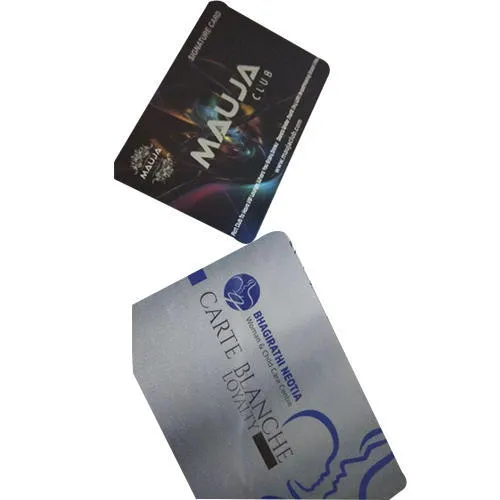
- Printing: use a direct-to-card or retransfer card printer with dye-sublimation ribbons for photo-quality ID cards. Blank white CR80 PVC RFID cards are made for standard ID card printers (Evolis, Zebra, Fargo, Matica, Magicard and similar); print a sample before a full batch. For factory-printed cards, see the printed RFID ID card.
- Encoding: LF T5577 and HF MIFARE cards are field-writable with a desktop encoder or reader/writer. An EM4200 UID and a UHF EPC can be read directly; UHF and DESFire cards can also be encoded and serialised before delivery. Cards can be ordered pre-encoded, pre-numbered (printed UID or running numbers) or with a printed QR code.
Matching the card to the use case
- Office / factory access control: HF MIFARE Classic 1K for standard sites; DESFire EV3 for high security.
- Time and attendance, gym, society: LF EM4200, the lowest-cost and most rugged option.
- Closed-loop / cashless payment, canteen: MIFARE Classic 4K or DESFire for stored value with encryption.
- Government / transit / metro ID: MIFARE DESFire EV2/EV3.
- Vehicle and parking access, hands-free entry: UHF EPC Gen2 cards or windshield tags.
- Loyalty, marketing, smart business cards: NTAG NFC cards read by smartphones.
- Multi-system campuses: dual-frequency LF+HF or HF+UHF cards.
Buying RFID cards from an Indian supplier
Buying from a domestic supplier means GST invoicing, samples you can test on your own readers before a bulk order, and print, encoding and packaging customised to your project without import paperwork. For UHF cards, make sure the reader you pair them with is set to India's 865–868 MHz band.
Browse the full RFID cards range (LF, HF, MIFARE, UHF and dual-frequency), request samples to test on your readers, or send your quantity and specification through the bulk RFID pricing page.
Related guides
Frequently asked questions
Which RFID card frequency is best for access control in India?
What is the difference between MIFARE Classic and MIFARE DESFire?
What is the read range of a UHF RFID card?
Can one RFID card work with two different systems?
Can RFID cards be printed on a standard ID card printer?
Do RFID cards need BIS or WPC certification in India?
RFID CardsMIFAREUHF RFIDHF RFIDLF RFIDAccess ControlIndia RFIDBuyer Guide
_CUB1e.webp)