RFID for Attendance Management in India — Complete Setup Guide 2026
Published 11 Apr 2026Updated 12 Nov 202610 min read
Written and maintained by the RFID team at Identium Tech Solutions Pvt Ltd, New Delhi (India RFID Store).
Prices checked on 23 Nov 2026 against the catalogue.
Short answer: An RFID attendance system records each person's in and out times when they tap an RFID card at a reader, and writes the timestamped record into your attendance software or HRMS. On India RFID Store a plain 13.56 MHz HF attendance card lists at ₹10 + GST per card (minimum order 500 pcs) and an HRD20 USB desktop reader at ₹2,000 + GST, before 18% GST; attendance software is quoted per project. Unlike a fingerprint scanner it reads in under half a second through gloves and dust, and because it stores a card number rather than a fingerprint template, it avoids most of the biometric-data obligations tightening under India's DPDP Rules, 2025.
Why RFID for attendance management?
Manual attendance, whether paper registers, fingerprint scanners or manual swipe cards, is slow, error-prone and often gamed. RFID attendance systems are a faster, more reliable and often lower-maintenance alternative.
This guide explains how to set up an RFID attendance system for schools, colleges, offices and factories in India, and what changed for buyers in 2026.
How RFID attendance works
Each employee, student or visitor is issued an RFID card or wristband. On entry or exit they tap or wave the card near a reader mounted at the entrance. The reader captures the unique ID, logs the time and sends the record to the attendance software in real time.
RFID attendance process flow
- Issue cards. Each employee or student receives a personalised RFID card (HF 13.56 MHz or UHF).
- Install readers. A reader goes at each door or gate: desktop, wall-mounted or built into a turnstile.
- Tap in and out. The card is presented at entry and exit and captured in under 0.5 seconds.
- Record. The data goes to the attendance software on a local server or in the cloud.
- Report. The software produces present/absent lists, late arrivals, overtime and shift compliance.
Types of RFID cards for attendance
| Card type | Frequency | Best for | List price (+ GST) |
|---|---|---|---|
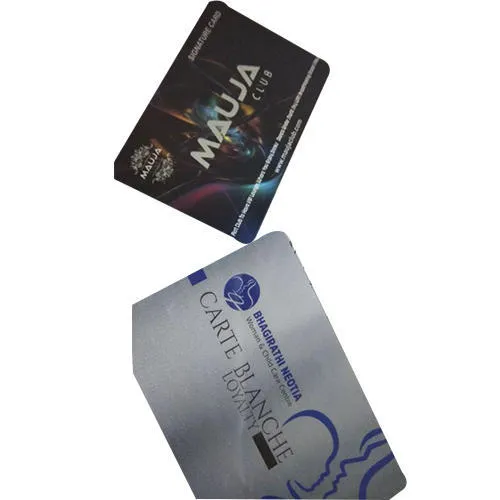
| HF card: MIFARE Classic, Plus or DESFire EV3 | 13.56 MHz | Offices, schools, colleges | ₹10–₹30 + GST |
| LF card (EM4100) | 125 kHz | Basic attendance, low security | ₹10 + GST |
| UHF card or tag | 865–868 MHz (India) | Vehicle or bulk entry, longer range | ₹20–₹30 + GST |
| RFID wristband | HF/LF | Hospitals, events, school children | ₹22–₹65 + GST |
Each range runs from the plain card to the printed or higher-security version in that row; photo personalisation, custom artwork and higher-security chips cost more, and every card and wristband line is sold from a minimum order of 500 pcs. The UHF row shows India's 865–868 MHz band. The same tags also read on European (ETSI) equipment, whose 865–868 MHz band matches it, but do not buy US-band 902–928 MHz-only tags for an Indian site.
Which chip should you specify in 2026?
For a new deployment the chip choice matters more than it used to. Plain MIFARE Classic 1K remains the cheapest and most widely stocked HF card and is perfectly adequate where the card only marks attendance and opens nothing.
Where the same card also unlocks doors, releases a turnstile or carries a canteen balance, specify MIFARE DESFire EV3 (AES-128 encryption, Common Criteria EAL5+ certified) or MIFARE Plus instead. LF 125 kHz EM4100 is read-only and easily cloned; treat it as a legacy option for low-stakes sites and for replacing cards on an existing LF installation, not as a choice for a fresh build.
Hardware required for RFID attendance
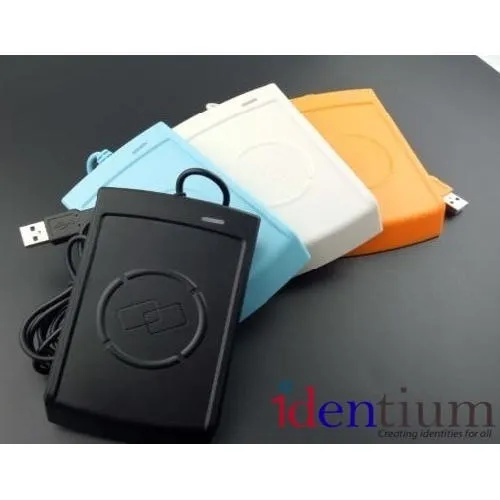
- RFID reader: a desktop or wall-mounted HF/LF reader at each entrance. See the HF RFID readers and the wider RFID readers range.
- RFID cards or wristbands: one per employee or student, custom-printed with name and photo.
- Computer or server: to run the attendance software and store records, or a cloud service.
- Network: LAN or Wi-Fi to connect readers to the server.
- Turnstile or flap barrier (optional): physical access control integrated with the RFID reader.
- Display screen (optional): a 7-inch touch screen at the reader showing name, time and photo for confirmation.
- Handheld or sled reader (optional): for roll-call away from a fixed door, such as evacuation musters, contractor headcounts and off-site shifts.
RFID attendance for different environments
Schools and colleges
- Students carry RFID cards or wristbands linked to their enrolment number
- Attendance is marked automatically at the classroom door or campus gate
- Parents receive an SMS or app notification when their child enters or leaves campus
- Absentee reports are generated automatically for teachers and administration
- Recommended: HF 13.56 MHz cards (MIFARE Classic 1K for attendance-only campuses, DESFire EV3 where the card also opens hostel or lab doors) with wall-mounted or desktop readers
The RFID for schools and colleges page brings together student ID cards, attendance, bus tracking, library and lockers.
Offices and corporates
- Employee cards double as the access-control and attendance credential
- Integration with HRMS platforms (SAP, Darwinbox, greytHR, Keka, Zoho People) via API
- Shift management: early arrivals, late marks and overtime
- Multi-floor and multi-gate tracking on a central dashboard
- Statutory reporting: a muster roll with actual in/out times and an overtime record that reconciles to payroll
Factories and industrial plants
- Rugged readers rated for outdoor and humid locations (typically IP65)
- Contractor and visitor management alongside permanent staff
- Zone-specific access, recording which production areas workers enter
- Safety compliance: every worker accounted for during evacuation drills
RFID vs biometric for attendance: which is better?
| Feature | RFID attendance | Biometric (fingerprint) |
|---|---|---|
| Speed | Fast (under 0.5 s) | Slower (2–5 s per scan) |
| Works with gloves or dirty hands | Yes | No |
| Hygiene / touchless | Yes | No, contact required |
| Buddy-punching risk | Possible (card sharing) | Prevented |
| Suitable for factories and workshops | Excellent | Poor (dirty or worn fingers) |
| Personal-data burden under DPDP | Lower (card number only) | Higher (biometric template) |
| Reader cost | From ₹2,000 + GST for an HRD20 USB desk reader on India RFID Store | Not sold here; quoted by biometric vendors |
The honest trade-off has not changed: biometrics stop impersonation outright and RFID does not. What has changed is the paperwork on the biometric side. A fingerprint or face template is personal data under the Digital Personal Data Protection Act, so a biometric punch-in now brings notice, consent, retention-limit and breach-reporting duties that a card number does not.
Many Indian employers are settling on a hybrid: RFID for the daily in/out flow at busy gates, and biometrics only on a handful of high-security doors where impersonation genuinely matters. The companion guide on DPDP Rules and biometric attendance walks through that decision in detail.
Two points sharpen the cost side. First, penalty exposure: the Government's explainer on the DPDP Rules (PIB, 17 November 2025) puts the highest penalty under the DPDP Act at up to ₹250 crore for a data fiduciary that fails to maintain reasonable security safeguards, and up to ₹200 crore for failing to notify a personal data breach. A breached store of fingerprint templates is therefore an expensive failure, while a list of card numbers carries less personal data. Second, hardware: the catalogue's plain HF attendance card lists at ₹10 + GST per card (minimum order 500 pcs), and an HRD20 USB desktop reader for enrolling cards lists at ₹2,000 + GST.
Proxy risk, meaning card sharing, is managed rather than eliminated. Print a photo on every card so a guard or supervisor can match face to card (the printed RFID ID card takes a logo, name, photo and number), put the reader where a supervisor or camera sees each punch, and reconcile punches against shift rosters. Where impersonation genuinely matters, keep a biometric reader on that door; the DPDP guide explains how to run both credentials in one system.
How much does an RFID attendance system cost in India?
Price the hardware from two catalogue lines and your headcount, before 18% GST. Cards are sold from a minimum order of 500 pcs, so a 100-person site still buys 500 cards; the spares cover new joiners and lost cards.
- HF attendance card: ₹10 + GST per card, minimum order 500 pcs
- HRD20 USB desktop reader: ₹2,000 + GST per desk
- Attendance software: quoted per project
| Headcount | HF cards to order | Readers | Software |
|---|---|---|---|
| 100 people | 500 (the minimum order) at ₹10 + GST each | One HRD20 per desk at ₹2,000 + GST | Quoted per project |
| 500 people | 500 at ₹10 + GST each | One HRD20 per desk at ₹2,000 + GST | Quoted per project |
| 1,000 people | 1,000 at ₹10 + GST each | One HRD20 per desk at ₹2,000 + GST | Quoted per project |
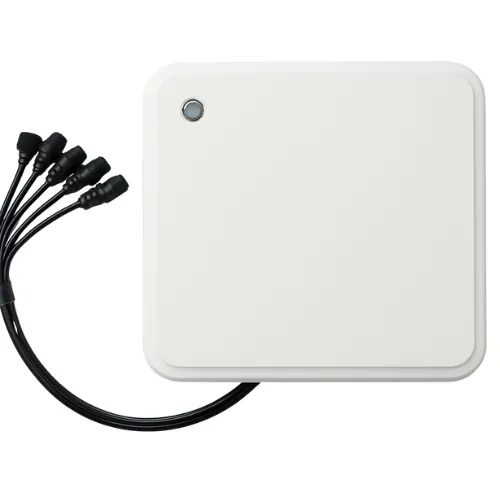
For hands-free reads at an entrance instead of a tap at a desk, use an IF9A integrated UHF reader at ₹24,000 + GST per entrance with UHF cards (₹20–₹30 + GST per card) in place of HF cards. For a walk-through gate, the HLR200 gate reader lists at ₹2,20,000 + GST.
Budget separately for the items that are easy to forget: cabling and a PoE switch or power supply at each door, mounting and civil work, an annual allowance for lost and damaged cards (schools and factories should expect a steady trickle of re-issues), and one-time HRMS integration effort if your payroll system needs a custom connector. For larger deployments with 500+ employees, multiple gates or HRMS integration, request a project quote.
Hardware for your attendance setup
- Cards: HF cards, including HF RFID cards for time attendance, LF cards for existing 125 kHz sites, and the full RFID cards range
- Readers: HF RFID readers, such as the HF desktop reader-writer for card enrolment
- Wristbands: RFID wristbands for hospitals, events and younger students
What changed in 2026
- Attendance records got their own rulebook (Central Rules notified 8 May 2026). India's four labour codes came into force on 21 November 2025, and the Code on Wages (Central) Rules, 2026 and the Occupational Safety, Health and Working Conditions (Central) Rules, 2026 followed on 8 May 2026. They keep an Attendance Register-cum-Muster Roll among the surviving statutory registers, expressly permit registers and notices to be kept electronically, and set record retention at five years from the last entry. Overtime is payable at twice the ordinary rate of wages once a worker crosses eight hours in a day or forty-eight in a week. In practice, your attendance software must export actual in/out times and an overtime record that reconciles to payroll, not just a daily present/absent flag. State rules were still being framed at the time of writing, so confirm your state's version before you finalise report formats.
- DPDP Rules, 2025 put a clock on biometric attendance (notified 13 November 2025). MeitY notified the Digital Personal Data Protection Rules on 13 November 2025 with an eighteen-month phased rollout: the Data Protection Board from November 2025, the consent-manager framework under Rule 4 from 13 November 2026, and the remaining substantive obligations from 13 May 2027. Fingerprint and face templates are personal data under the Act, so employers running biometric punch-in are working towards notice, consent, retention and breach-reporting duties that a card-number-only system largely avoids. This is the main reason many Indian sites are re-opening the RFID-versus-biometric question in 2026.
- Reader certification is migrating standards (MeitY notification October 2025, BIS guidelines March 2026). Under the Compulsory Registration Scheme, IT and electronics goods are moving from IS 13252 (Part 1):2010 to IS/IEC 62368-1:2023, with both standards accepted until 1 November 2028. Ask any reader supplier which standard the model's BIS registration is held against and, for UHF units, whether the model has valid WPC ETA cover. The WPC ETA and BIS certification guide explains what the certificates should say.
- The MIFARE Classic backdoor changed the default card recommendation (disclosed August 2024). Security researchers at Quarkslab published a hardware backdoor in the FM11RF08S and several older MIFARE Classic-compatible chips that lets anyone with a few minutes of physical access to a card recover its user-defined keys. It cannot be patched in software. Classic 1K is still fine where the card only marks attendance, but any card that also opens a door, releases a turnstile or holds a balance should be MIFARE DESFire EV3 or MIFARE Plus.
- Hands-free UHF for musters and roll-call. Fixed door readers tell you who walked through a door, not who is standing at the assembly point. The ID-SL15 Bluetooth sled reader (Bluetooth 5.2, more than 200 tags per second, 6,500 mAh battery, available in an 865–868 MHz India/EU variant) clips to an Android or iOS phone so a supervisor can sweep a shop floor, bus or assembly point and reconcile headcount on the spot. Price it alongside your door readers if evacuation musters or contractor headcounts are part of the brief; staff then need UHF cards or tags rather than HF-only cards.
Related guides
Sources
Cite as: India RFID Store (Identium Tech Solutions Pvt Ltd), “RFID for Attendance Management in India — Complete Setup Guide 2026”, https://www.indiarfidstore.com/rfid-resources/rfid-attendance-management-india, updated 12 Nov 2026.
Frequently asked questions
What are the ongoing costs of running an RFID attendance system?
How do I prevent buddy punching with RFID attendance cards?
Is RFID or face recognition better for office attendance?
Will my existing employee ID cards work with a new RFID attendance reader?
Do RFID attendance readers need WPC approval in India?
Does an RFID attendance system satisfy the labour codes' record-keeping requirements?
What does an RFID attendance card cost in India?
RFID AttendanceAccess ControlSchoolsSetup Guide
Keep reading
More guides
More in Industries & use cases
- RFID Tags for Trees and Nursery Plants in India
- RFID Fuel Automation: Vehicle Tags at Petrol Pumps, India
- RFID Tool Tracking in India: Tool Cribs, MRO and FOD
- RFID in Apparel & Fashion Retail India — Complete Implementation Guide
- Top 5 RFID Applications in India 2026 — Use Cases & Case Studies