RFID Reader Price in India 2026 — UHF, HF & LF Buyer's Guide
Published 10 Apr 2026Updated 24 Nov 202611 min read
Written and maintained by the RFID team at Identium Tech Solutions Pvt Ltd, New Delhi (India RFID Store).
Prices checked on 24 Nov 2026 against the catalogue.
Short answer: On India RFID Store, RFID readers (also called RFID scanners or RFID machines) list at ₹1,500 + GST for a 125 kHz LF USB desktop reader, ₹2,000–₹4,500 + GST for HF desktop readers, ₹10,500–₹28,000 + GST for UHF desktop readers, ₹12,000–₹68,000 + GST for UHF handheld and Bluetooth readers and ₹30,000–₹1,45,000 + GST for four-port fixed readers, all before 18% GST. For UHF, buy a reader set to India's licence-exempt 865–868 MHz band whose exact model has WPC ETA and BIS registration, because that is what tender committees and internal auditors ask you to produce.
This guide breaks down what each type of RFID reader costs in India in 2026 (UHF integrated, fixed, gate, handheld, sled and desktop readers, plus HF, NFC and LF readers) and what moves a reader up or down its price band, so you can match the reader to your budget and application.
The price ranges below are the list prices of the Identium RFID readers of each type on India RFID Store, before GST, filled from the catalogue so they match the product pages. Not sure which kind of reader you need? Start with RFID machine or scanner: which reader do you need.
RFID reader types and price ranges in India (2026)
| Reader type | Frequency | Typical read range | Catalogue range (list, + GST) | Best for | Example model | List price | Minimum order |
|---|---|---|---|---|---|---|---|
| UHF integrated reader (inbuilt antenna) | UHF 865–868 MHz (India) | 1–6 m | ₹21,115–₹45,000 + GST | Doorways, shelves, conveyors, Wiegand access points | IF9A (1 port) | ₹24,000 + GST | 1 unit |
| UHF fixed reader (2–4 antenna ports) | UHF 865–868 MHz (India) | 3–12 m | ₹30,000–₹1,45,000 + GST | Dock doors, production lines, multi-antenna zones | IHZ4 (4 ports) | ₹55,000 + GST | 1 unit |
| UHF gate or portal system | UHF 865–868 MHz (India) | 3–8 m | ₹2,20,000 + GST (complete gate); assembled portals quoted per project | Entry and exit gates, dispatch doors, toll and parking lanes | HLR200 gate reader | ₹2,20,000 + GST | 1 unit |
| UHF handheld reader | UHF 865–868 MHz (India) | 1–12 m | ₹12,000–₹68,000 + GST | Inventory counting, mobile asset audits | CX1000 handheld | ₹30,000 + GST | 1 unit |
| UHF desktop reader | UHF 865–868 MHz (India) | 0–1 m | ₹10,500–₹28,000 + GST | Point of sale, tag encoding stations | 103 desktop reader (103UDR) | ₹15,000 + GST | 1 unit |
| HF desktop reader | HF 13.56 MHz | 0–10 cm | ₹2,000–₹4,500 + GST | Smart cards, library, hotel keys | HRD20 | ₹2,000 + GST | 1 unit |
| NFC reader | NFC 13.56 MHz | 0–5 cm | ₹15,000 + GST | Contactless cards, mobile NFC, QR-plus-NFC desks | FX100 Android NFC handheld | ₹15,000 + GST | 1 unit |
| LF reader | LF 125 kHz | 0–10 cm | ₹1,500–₹2,800 + GST | Access control, attendance, animal tags | IDTS-LFPPR (125 kHz, USB) | ₹1,500 + GST | 1 unit |
| Bluetooth UHF reader or sled | UHF + Bluetooth | 1–15 m | ₹12,000–₹38,999 + GST | Phone-paired scanning, field audits, retail counts | ID-SL15 sled | ₹38,999 + GST | 1 unit |
Each catalogue range runs from the lowest to the highest list price of that reader type on this store. Many UHF reader modules are designed for the wider 860–960 MHz global range; a reader used in India must be set to the 865–868 MHz band. For multi-unit orders, request a quotation.
The example columns show one catalogue model per reader type with its current list price before GST and its minimum order; the full price list has every model. Approval details are on the certifications page.
UHF RFID readers: the most common choice for business
UHF RFID readers are the most widely used readers in Indian businesses. They offer long read ranges, read hundreds of tags per second and work with the EPC Gen2 standard used worldwide.
In India they must be set to the licence-exempt 865–868 MHz sub-band, which matches the ETSI 865–868 MHz allocation, so tags and readers built for Europe generally interoperate with Indian deployments.
UHF integrated readers
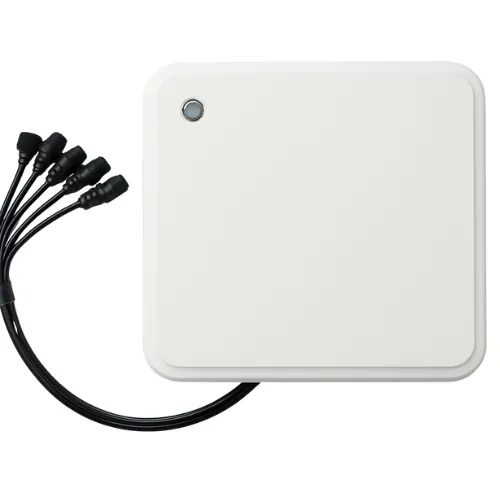
On this store, integrated readers list at ₹21,115–₹45,000 + GST. Integrated readers combine the RF module, antenna and housing in one die-cast or ABS enclosure, so there is no external antenna to mount and no coaxial run to tune. They are the workhorse of Indian deployments: gate posts, shelf edges, conveyor sides and door frames.
Entry-level units with a 3 dBi antenna and Wiegand 26/34 or RS485 output sit at the bottom of the band. Two-port models that let you add one external antenna sit mid-band, and Wi-Fi or inbuilt-4G variants near the top. The single-port Identium IF9A integrated reader is BIS and WPC approved, and the catalogue also lists two-port, Wi-Fi and 4G versions of the IF9A. Specialist units, such as the ceiling-mounted phase reader and the AI inventory box with a receipt printer, are priced above this band.
UHF fixed multi-port readers
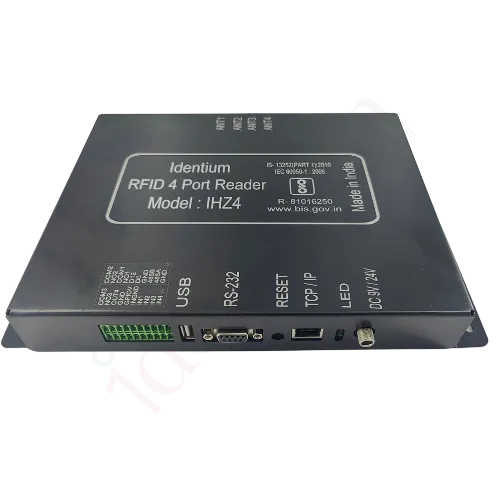
Four-port fixed readers list at ₹30,000–₹1,45,000 + GST on this store. These two- to four-port readers are used where one zone needs several antennas: a dock door covered from both sides, a portal with floor and overhead coverage, or a production line with a read point at each station.
Identium's IHZ4 four-port reader is built on the Impinj E710 module, reads several hundred tags per second, and is BIS and WPC approved. The N704-based IHZ4N four-port reader sits at the bottom of the band, standard PoE or RJ45 E710 units above it, Wi-Fi variants above those, and AI-enabled readers such as the IHZ4AI, whose built-in AI features adjust RF parameters to the use case, at the top. Connectivity options include RS232, RS485, TCP/IP, PoE and Wi-Fi.
UHF gate and portal systems
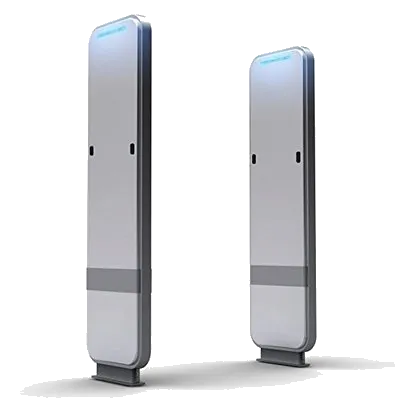
A "gate reader" can mean two very different things, which is why quotes vary so widely. At the low end you assemble a portal yourself from a two-port integrated reader such as the two-port IF9A (₹30,000 + GST), a pair of antennas such as the 9 dBi circular antenna (₹8,000 + GST each) and mounting hardware, with the frame and civil work quoted per project.
At the high end you buy a complete pedestal gate system with the reader, antennas, housing and controller pre-integrated, which is where complete gates such as the Identium HLR200 gate reader (₹2,20,000 + GST) sit. Price depends on read range, number of antenna ports, IP rating and whether the frame and civil work are included in the quote. The gate, portal and tunnel reader guide covers the choice in detail.
UHF handheld readers
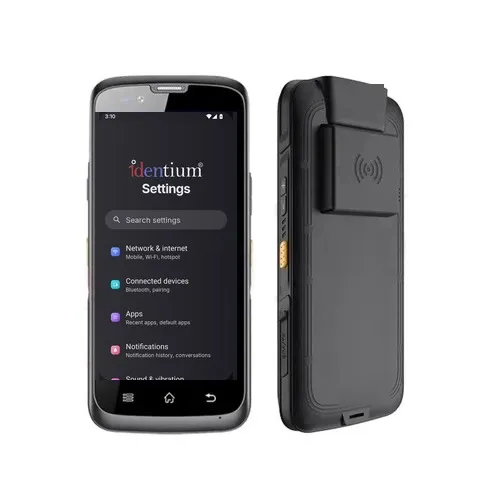
UHF handheld and Bluetooth readers list at ₹12,000–₹68,000 + GST on this store. Handheld RFID scanners are used for mobile inventory audits, stocktaking and asset verification. Simple pistol-grip Bluetooth readers that pair with a phone you already own sit at the bottom of the band. Android handhelds with a single antenna and a 3–8 m range occupy the middle.
Rugged Android units with an integrated 2D barcode engine and an 8–12 m range sit near the top, with RFID tablets and smart trays above them. Long-range industrial handhelds beyond 12 m are priced higher still. Our handheld reader price guide gives the full tier-by-tier breakdown, and the handheld readers category lists current models. In the Identium range, the CX1500N UHF handheld reader runs IDOS, Identium's OS built on Android 15, with transmit power up to 33 dBm and a 1D/2D barcode imager, and it is BIS and WPC approved.
Bluetooth sled readers
Sled readers clip a UHF engine onto the phone or tablet your team already carries, which keeps the cost of a mobile deployment down because you are not buying a second computer.
The current top of the Identium range is the ID-SL15 Bluetooth sled reader: Bluetooth 5.2, up to 15 m read range, software-adjustable output up to 33 dBm, a 6,500 mAh battery and IP54 sealing. It lists at ₹38,999 + GST.
UHF desktop readers
UHF desktop readers list at ₹10,500–₹28,000 + GST on this store. Desktop readers sit next to a PC and read one tag at a time at close range, which suits encoding new tags, issuing assets and point-of-sale verification, where you must not accidentally read the shelf behind the counter.
Plain USB units sit at the bottom of the band, RJ45 and RS232 models a step above, and Wi-Fi variants near the top; larger reading trays used for jewellery and high-value stock counting are priced higher. See the UHF desktop readers category.
HF and NFC readers: for cards, libraries and payments
HF (13.56 MHz) and NFC readers are used for smart cards, employee ID, hotel key cards, library management and contactless interactions. Their range is short (up to about 10 cm), which suits controlled, close-range reading where only the card presented should be read.
- HF desktop readers (MIFARE, ISO 14443A/B, ISO 15693): ₹2,000–₹4,500 + GST
- IP-networked HF readers for kiosks and library counters, such as the IDTS-HRW560 with Wi-Fi and PoE: ₹10,000 + GST
- QR-plus-RFID desktop readers for PC-connected applications, such as the IDTS-QR-36: ₹15,000 + GST
- Dual-frequency readers (HF + LF), such as the IDTS-DFE8 reader, writer and card emulator: ₹7,515 + GST
Current models are in the HF RFID readers category.
LF readers (125 kHz): for access control and attendance
Low-frequency (125 kHz) readers are widely used in existing access control and attendance systems. They are the most affordable readers available, with entry-level USB units such as the LF USB desktop reader at ₹1,500 + GST. They are common with EM4100, HID Prox and T5577 cards, and for animal ear-tag reading in dairy and livestock projects.
What affects RFID reader price in India?
- Frequency: LF readers cost least, then HF/NFC, then UHF.
- Read range: longer range costs more, because it needs more powerful RF circuitry and better front-end filtering.
- Reader chip: Impinj E-series modules cost more than basic modules but deliver higher tag-read rates and sensitivity.
- Antenna ports: one-port and four-port readers differ significantly in price.
- Connectivity: roughly in rising order of cost, RS232, RS485, USB, TCP/IP, PoE, then Wi-Fi or 4G.
- Enclosure and IP rating: industrial IP65/IP67 readers cost more than indoor desktop units.
- Compliance: BIS registration and WPC ETA for the exact model add value and are expected in tenders.
- Quantity: multi-unit and project orders are quoted per project; see bulk RFID pricing.
- GST: RFID readers sit in the 18% GST slab, so always confirm whether a quote is inclusive or exclusive.
UHF vs HF vs LF: which reader do you need?
- Use UHF if you need to read many tags at a distance: warehouse, logistics, retail, asset tracking and tolling.
- Use HF/NFC if you work with smart cards, hotel keys, library books or NFC-enabled devices.
- Use LF (125 kHz) if you have an existing access control or attendance system using EM4100 cards.
For the full comparison, read UHF vs HF vs LF RFID: which frequency do you need?
Buying RFID readers from India RFID Store
- Sold under the Identium brand by Identium Tech Solutions, New Delhi. Ask us about the origin of a specific model.
- Compliance paperwork: Identium readers are BIS and WPC approved. Details are on the certifications page.
- Help before you order: we can match a reader to your tags, mounting and software.
- Test before a roll-out: UHF RFID evaluation kits pair an Identium reader with a sample pack of UHF RFID labels and any free software the reader needs (no licence fee), so you can check reads on your own items first.
Ready to buy or need a custom quote? Browse all RFID readers or submit an RFQ for project pricing.
What changed in 2026
- January 2026: NXP launched UCODE X. Announced on 11 January 2026 from New Delhi, the RAIN RFID tag chip is built on the GS1 Gen2v2 standard and adds faster encoding, faster inventory counts and the Untraceable privacy command, while supporting smaller inlays. If you are buying a reader this year, ask whether its firmware exposes Gen2v2 commands, so you can use every tag feature you pay for.
- May 2026: NHAI's first barrier-free toll lane went live. The Multi-Lane Free Flow (MLFF) launch at the Choryasi fee plaza on NH-48 in Gujarat pairs FASTag RFID readers with front-and-rear ANPR cameras and LiDAR vehicle classifiers, with Gharaunda on NH-44 in Haryana next and roughly 25 fee plazas targeted in the current financial year. That is pushing demand toward multi-port fixed readers and complete gantry systems rather than single-lane units; see our MLFF gantry guide.
- March 2026: BIS issued migration guidance for IS/IEC 62368-1:2023. Following MeitY's notification of 29 October 2025, the new safety standard replaces IS 13252 (Part 1):2010 for electronics and IT goods under the Compulsory Registration Scheme, with a concurrent-running period until 1 November 2028. Both standards remain valid until then, so when you compare quotes, ask which standard the supplier's BIS R-number is issued against.
- September 2026: GST on readers is unchanged at 18%. The GST rationalisation of 22 September 2025 collapsed the old four-slab structure into 5% and 18% principal slabs, and RFID readers remain in the 18% slab. Budget 18% on top of every ex-GST figure in this guide, and confirm whether a quoted number is inclusive or exclusive before you build the budget.
- September 2026: the Identium reader line-up now tops out higher. The catalogue now lists the ID-SL15 Bluetooth 5.2 sled reader, Impinj E710-based four-port readers, ceiling-mounted phase readers and AI inventory boxes, so the realistic ceiling for a fixed-reader budget is higher than it was two years ago, while entry-level handheld and desktop pricing has held steady. WPC approval itself is unchanged: ETA is still obtained by self-declaration on the Saral Sanchar portal against an accredited RF test report. The detail is in our WPC ETA and BIS certification guide.
Related guides
Sources
Cite as: India RFID Store (Identium Tech Solutions Pvt Ltd), “RFID Reader Price in India 2026 — UHF, HF & LF Buyer's Guide”, https://www.indiarfidstore.com/rfid-resources/rfid-reader-price-india-2026, updated 24 Nov 2026.
Frequently asked questions
How much does a complete RFID system cost in India, not just the reader?
How do I connect an RFID reader to my computer or ERP software?
Should I buy a handheld RFID reader or a fixed gate reader?
Which reader reads my existing 125 kHz access control cards?
Is WPC approval mandatory for UHF RFID readers in India?
Does the BIS move to IS/IEC 62368-1 change what I should buy in 2026?
What is the cheapest RFID reader?
What does an RFID sensor cost?
RFID Reader PriceUHF Reader IndiaRFID Scanner PriceHandheld RFID Reader
Keep reading
More guides
More in Prices & buying
- Library RFID System Price in India: Four GeM Bids from October 2026, Read Line by Line
- NFC Google Review Cards, Stands and Visiting Cards: A Wholesale Guide for Indian Resellers
- NFC Tag Price in India (2026): NTAG213/215/216 by Format and Quantity, and How to Program One