RC522 vs PN532 vs UHF Reader Module: Which RFID Module for Your Project
Published 22 Oct 202610 min read
Short answer: For a 13.56 MHz card or key-fob prototype that only has to read MIFARE Classic or NTAG-type tags, the RC522 is the simplest board. Choose the PN532 when the project must also read ISO/IEC 14443B or FeliCa cards, exchange data with a phone or act as a tag itself. Use a 125 kHz module for EM4100-format proximity cards and fobs, which neither 13.56 MHz board can see, and a UHF module when tags must be read from metres away rather than centimetres. All four are development parts; a finished product needs a finished reader.
Every RFID module answers one question before anything else: which frequency and which tag standard. A board that is perfect for one card family cannot see another, so many "my reader does not detect the card" problems in student and maker projects are a mismatch, not a wiring fault. This guide compares the four module types that makers in India ask us about, using the public data sheets of the chips on them, and spells out what each one cannot read.
The four modules at a glance
| RC522 | PN532 | 125 kHz (EM4100 format) | UHF (EPC Gen2) | |
|---|---|---|---|---|
| Frequency | 13.56 MHz | 13.56 MHz | 125 kHz | 865–868 MHz in India |
| Tags it reads | ISO/IEC 14443 A: MIFARE and NTAG | ISO/IEC 14443A/MIFARE, ISO/IEC 14443B, FeliCa | EM4100-format read-only IDs | EPC Gen2 UHF tags and labels |
| Other modes | None (reader/writer only) | Card emulation, NFC peer-to-peer | None | None |
| Host interface | Chip: SPI, I²C, UART; boards usually bring out SPI | SPI, I²C, high-speed UART; boards usually switch-selectable | UART serial, typical for the class | UART serial, typical for the class |
| Supply | 2.5–3.6 V (3.3 V typical) | 2.7–5.5 V (chip) | 5 V, typical for the class | 3.3–5 V, as sourced |
| Typical distance | Up to 50 mm (data sheet) | Up to 50 mm as a reader (data sheet) | A few centimetres, typical for the class | Metres, set by power, antenna and tag |
| Does not read | 14443B, FeliCa, 125 kHz, ISO 15693, UHF | 125 kHz, ISO 15693, UHF | 13.56 MHz, UHF, 134.2 kHz FDX-B animal tags | 13.56 MHz and 125 kHz cards |
Chip figures are from the data sheets listed under Sources; "typical for the class" figures describe the common development boards and are confirmed for the board we quote.
RC522: the 13.56 MHz starter board
The RC522 reader IC is the chip on many low-cost 13.56 MHz modules. Its data sheet describes a reader/writer for contactless communication at 13.56 MHz that supports ISO/IEC 14443 A, MIFARE and NTAG, including MIFARE Classic encryption in read/write mode. That covers the common access cards, key fobs and NFC stickers, which is why it is the usual first board for a door, locker or attendance prototype. Our RC522 reader-writer module is the generic SPI version.
The chip offers three host interfaces: SPI up to 10 Mbit/s, I²C (up to 400 kBd in fast mode) and a serial UART. Typical boards bring out SPI on an 8-pin header. The chip runs from 2.5 to 3.6 V, 3.3 V typical, so the board's logic is 3.3 V: a 5 V microcontroller board needs level shifting on the SPI lines. The data sheet gives a typical operating distance of up to 50 mm, depending on antenna size and tuning, and the small PCB antenna on hobby boards decides where in that range you land.
What it cannot do: the data sheet lists ISO/IEC 14443 A only, so ISO/IEC 14443B cards and FeliCa are out, and so are ISO/IEC 15693 library labels. It is a reader/writer, so it cannot pretend to be a tag for a phone. It cannot see 125 kHz cards or UHF tags at all.
PN532: the full NFC controller
The PN532 is a complete NFC controller with its own microcontroller core. Its data sheet lists six operating modes: ISO/IEC 14443A/MIFARE reader/writer, FeliCa reader/writer, ISO/IEC 14443B reader/writer, MIFARE Classic 1K or 4K card emulation, FeliCa card emulation, and ISO/IEC 18092 peer-to-peer. Our PN532 NFC module is the generic board with I²C, SPI and UART selected by switch.
Three details matter in practice. For ISO/IEC 14443B the chip handles layers 2 and 3 but not anticollision, which your firmware has to implement if more than one B card can be in the field. Card emulation lets a phone read the prototype as a tag, but the data sheet notes that full secure card functionality needs a separate secure IC, so emulation is for prototypes, not for replacing a secure card. And the chip runs from 2.7 to 5.5 V with an on-chip regulator, so boards usually work with both 3.3 V and 5 V microcontrollers; check the board's own regulator.
The data sheet gives a typical operating distance of up to 50 mm as a reader and about 100 mm in card emulation, both depending on antenna size and tuning. Like the RC522, it does not list ISO/IEC 15693, and it cannot read 125 kHz or UHF tags.
125 kHz module: EM4100-format cards and fobs
Low-frequency proximity cards and key fobs at 125 kHz commonly carry an EM4100-format ID. The EM4100 chip is a read-only transponder: it is powered by the reader's field through its coil and sends back the 64 bits programmed into it at the factory. Its data sheet gives an operating frequency of 100–150 kHz and data coded as Manchester, Biphase or PSK at 64, 32 or 16 carrier periods per bit. A 125 kHz reader module, such as our 125 kHz UART reader module, decodes that and sends the ID to your microcontroller as a short serial string.
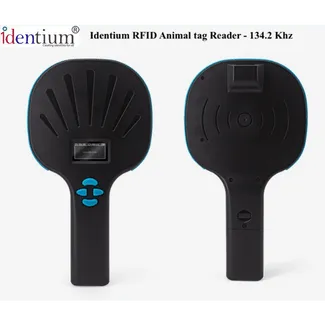
What it cannot do: an EM4100 card is read-only, so the ID cannot be changed or written; rewritable 125 kHz cards use a different chip. The module does not read 13.56 MHz cards, UHF tags or the 134.2 kHz FDX-B tags used for animals, which need an animal reader such as our RA91. And because an RC522 or PN532 cannot see 125 kHz at all, check which kind of card your building already uses before you choose a board.
UHF module: metres instead of centimetres
A 13.56 MHz or 125 kHz module reads a card held to it. A UHF module reads EPC Gen2 tags from a distance, which is what a shelf, a gate, a vehicle or an inventory prototype needs. A typical UHF label chip shows the difference: the UCODE 9 data sheet lists EPC Gen2v2.1 support and a read sensitivity of −24 dBm, meaning the chip wakes up on a very small amount of received power. Our UHF UART development module is the generic board for microcontroller projects.
Two things are different from HF. First, range is not a property of the module: it comes from the module's output power, the antenna, the cable and the tag, and our link-budget guide and read-range calculator show how to work it out. Second, the band is regulated. India's UHF RFID band is 865–868 MHz under G.S.R. 853(E) of 2021, with readers allowed up to 2 W e.r.p. in four 200 kHz channels centred at 865.7, 866.3, 866.9 and 867.5 MHz. Choose a module set up for that band, and tags specified for 865–868 MHz or full-band 860–960 MHz, from our UHF labels and inlays.
When the prototype has to become an installation, the IDTS-RM26 reader module adds Ethernet, RS-485, Wiegand and a relay with 0–26 dBm output, and the RM26 evaluation kit bundles it with an antenna, tags, a power adapter and the antenna cable. Multi-port boards are listed under UHF RFID reader modules.
Which module for your project
Door, locker or attendance prototype with 13.56 MHz cards
The RC522, if the cards are MIFARE Classic or NTAG-type. Read the UID or a sector and match it in your code.
Anything that talks to a phone
The PN532: card emulation lets the phone read your device, and peer-to-peer mode exchanges data with another NFC device.
Existing 125 kHz staff cards or fobs
The 125 kHz module. Neither 13.56 MHz board will see these cards, whatever the library.
Reading items at a distance
A UHF module with an external antenna, then the RM26 for the installation.
Two cases none of these boards covers. Library book labels are usually ISO/IEC 15693, which neither 13.56 MHz data sheet lists, so ask us for a reader that supports it. And FASTag and other vehicle tags are UHF, so no 13.56 MHz or 125 kHz board will read them. If you are unsure which frequency a card uses, our frequency guide explains the families, and the NFC tag guide covers NTAG types and programming.
Before you blame the wiring
Most first-build problems come down to a handful of checks, all of which follow from the data sheets above:
- Is it the right frequency? A working 13.56 MHz module shows nothing at all for a 125 kHz card, an ISO/IEC 15693 label or a UHF tag. Try a card you know is MIFARE Classic or NTAG before changing any code.
- Is the supply right? The RC522 chip is specified from 2.5 to 3.6 V, so a 5 V feed on a 3.3 V board is outside its rating. The PN532 chip tolerates 2.7 to 5.5 V, but check the board's own regulator.
- Does the bus match the code? On a PN532 board the interface switches must match the bus your library uses: I²C, SPI or UART. On an RC522 board, SPI is the usual choice.
- Are you reading the UID or the data? Reading a card's UID needs no keys. Reading or writing the sectors of a MIFARE Classic card uses its keys, which the RC522 and PN532 support in reader/writer mode.
- Is the card close enough? Both data sheets give up to 50 mm as the typical reader distance with a tuned antenna. A small PCB antenna on a hobby board reads at the short end of that, so hold the card flat and close.
- More than one B card? The PN532 leaves ISO/IEC 14443B anticollision to your firmware, so present one card at a time unless you have written it.
Cards and tags to test with
- NFC card, 13.56 MHz in NTAG, MIFARE Classic, DESFire or ICODE SLIX versions: ₹20 + GST. The NTAG and MIFARE Classic versions are ISO/IEC 14443A and suit both 13.56 MHz modules; the ICODE SLIX version is ISO/IEC 15693 and does not.
- Plain 13.56 MHz PVC card: ₹10 + GST; name the chip your module reads when you ask for a quote.
- 125 kHz LF card for the 125 kHz module: ₹10 + GST; name EM4100 as the format your module reads when you ask for a quote. Key fobs are in LF RFID tags.
- UHF labels and inlays for the UHF module, each with its chip named on the page.
Cards, tags and labels are consumables, so they are sold in production quantities: minimum order 500 pcs. For one or two test cards or tags, use our sample request. Modules are quoted from 1 unit.
Type approval in India
Equipment Type Approval (ETA) from WPC applies to the finished reader model you deploy or import; development modules are sold for prototyping. Ask us before you build a commercial product around one. Our WPC ETA and BIS checklist explains what a finished reader needs and what to ask a supplier for.
From prototype to product
A development module proves the idea. A product needs a reader with a housing, a tuned antenna, a known interface and the approvals that apply to it. For 13.56 MHz the HRD20 USB desktop reader (₹2,000 + GST) and the other HF, NFC and LF readers are the production step; for 125 kHz, the LF USB desktop reader (₹1,500 + GST). The LF reader reads card numbers into a PC without installing software or drivers, and the HRD20 comes with free demo software, plus an SDK for its read/write model; our guide to reading RFID cards into Excel covers the PC side. For UHF, start from the RM26 kit or one of our evaluation kits.
Ready to buy for a board project? The RFID for Arduino, ESP32 and Raspberry Pi page lists the modules, tags and cards with prices and order rules.
Sources
- MFRC522 product data sheet, Rev. 3.9, 27 April 2016 (ISO/IEC 14443 A/MIFARE and NTAG, host interfaces, 2.5–3.6 V supply, up to 50 mm), accessed 22 October 2026
- PN532/C1 NFC controller product data sheet, Rev. 3.6, 28 November 2017 (six operating modes, 2.7–5.5 V, up to 50 mm, about 100 mm in card emulation), accessed 22 October 2026
- EM4100 read-only contactless identification device data sheet (copy hosted by a distributor: 64-bit read-only, 100–150 kHz, Manchester/Biphase/PSK), accessed 22 October 2026
- UCODE 9 product data sheet SL3S1206, Rev. 3.5, 12 February 2025 (EPC Gen2v2.1, read sensitivity −24 dBm), accessed 22 October 2026
- G.S.R. 853(E), 10 December 2021: 865–868 MHz Short Range Devices (Exemption from Licence) Rules, 2021 (2 W e.r.p., four channels), accessed 22 October 2026
Frequently asked questions
Can the RC522 read 125 kHz cards?
RC522 or PN532: which is better for an Arduino or ESP32 project?
How far does an RC522 or PN532 module read?
Can an RFID module read FASTag or other UHF tags?
Does a development module need type approval in India?
Which module reads library book labels?
RFID ModuleRC522PN532Arduino RFIDUHF RFID
Keep reading
More guides

More in Readers & hardware
- Can a Phone Read UHF RFID Tags? Sled vs USB-C vs Handheld (India 2026)
- RFID Tags Not Reading? A Practical Troubleshooting Guide for Indian Deployments
- RFID Gate, Portal & Tunnel Readers: The 2026 India Buying Guide for Dock Doors & Choke Points
- RFID Software & Middleware Explained (2026): Turning Tag Reads into ERP/SAP/WMS Data in India
- RFID Antenna Guide — dBi, Polarization & Read Zones Explained (India 2026)
- How to Choose the Right RFID Reader — Read Range, Antenna Ports & IP Rating Explained (India)