RFID Software & Middleware Explained (2026): Turning Tag Reads into ERP/SAP/WMS Data in India
Published 18 Jul 2026Updated 8 Oct 202611 min read
RFID hardware only reads tags. Turning millions of raw radio reads into trustworthy business data (accurate stock counts, gate movements, asset locations) is the job of RFID software and middleware. This guide is for Indian IT managers, systems integrators and operations heads who have bought, or are buying, readers and tags and now need to understand how reads flow from the antenna to SAP, an ERP, a WMS or Tally without drowning the network in duplicate events.
Why you cannot connect an RFID reader directly to your ERP
A fixed UHF reader with four antennas can generate anywhere from 50 to more than 1,000 reads per second. A single tag sitting near a dock door might be read 400 times in ten seconds. If you piped that stream straight into your ERP or Tally, you would get 400 "goods received" events for one carton.
RFID middleware sits between the reader and your business systems to solve exactly this. It deduplicates, filters and adds context (which door, which zone, which direction), and only then hands a clean, meaningful event to the application layer.
Think of middleware as a translator and a bouncer. It speaks the reader's low-level protocol on one side and your ERP's API on the other, and it refuses to let noise through.
Reader-to-cloud architecture: the four layers
Almost every deployment, whether a jewellery showroom in Hyderabad or a 3PL warehouse in Bhiwandi, follows the same layered flow:
- Device layer. Fixed UHF 4-port readers, handheld readers and gate readers capture EPC data from tags. Most industrial readers today expose LLRP (Low Level Reader Protocol) or a vendor REST/MQTT interface.
- Edge / middleware layer. Software running on the reader itself, a nearby edge PC or an industrial gateway. It handles filtering, smoothing, direction logic and buffering when the internet drops, which is critical at Indian sites with patchy connectivity.
- Integration / cloud layer. A broker or application server (often MQTT plus a REST API, or a cloud IoT hub) that receives clean events and routes them.
- Business system layer. SAP, Oracle, Microsoft Dynamics, a WMS, Tally or a custom app that records the transaction: receipt, dispatch, cycle count or asset check-out.
What "filtering" actually means
Filtering is where a raw firehose becomes usable. Good middleware applies several techniques in sequence:
- Deduplication: collapse hundreds of reads of the same EPC within a time window into a single "seen" event.
- Read smoothing / debounce: require a tag to be seen N times before it "arrives" and to be absent for M seconds before it "departs", so a tag flickering at the edge of range does not toggle constantly.
- RSSI thresholding: ignore weak, far-away reads (low signal strength) so a tag in the next aisle is not counted at your dock door.
- Direction / sequencing: use two antenna zones or a sensor to decide whether stock moved in or out through a gate, which is the difference between a receipt and a dispatch.
- Business rule enrichment: map the raw EPC to a SKU, batch, GRN number or asset ID before sending it onward.
Middleware vs writing your own code
Indian teams often ask whether they should buy a middleware product or let their software vendor "just read the port". Here is an honest comparison.
| Factor | Dedicated RFID middleware | Direct custom integration |
|---|---|---|
| Filtering and smoothing | Built in and field-tested | You build and debug it yourself |
| Multi-reader management | Central console, health monitoring | Manual per-device scripts |
| Offline buffering | Usually included | Must be engineered |
| Upfront cost | Higher (licence or subscription) | Lower to start |
| Best for | 10+ readers, multi-site, mission-critical | 1–3 readers, single fixed use case |
| Time to go live | Faster | Slower, more testing |
For a small single-door pilot with one or two desktop readers, a lightweight direct integration is fine. Once you scale across floors, cities or warehouses, middleware pays for itself in reliability and support.
Integrating RFID with SAP, ERP, WMS and Tally in India
SAP and large ERP
SAP integrations typically post clean RFID events through SAP's standard interfaces: IDocs, BAPIs, OData or SAP Auto-ID Infrastructure (AII), which SAP still documents for RFID in S/4HANA EWM. The middleware never touches SAP tables directly; it calls the approved API so your finance and inventory records stay auditable.
WMS (warehouse management)
A WMS usually exposes REST or SOAP endpoints for putaway, picking and cycle counts. Middleware maps a gate event to a WMS transaction. For example, a full pallet read at the outbound gate triggers a single "dispatch confirmed" call instead of 40 carton scans.
Tally and Indian SME accounting
Most Indian SMEs run Tally. Tally accepts data through its XML/HTTP request interface (Tally.ERP 9 and TallyPrime), so middleware can push a consolidated stock voucher or GRN after a physical count.
A common, practical pattern: a staff member does a bulk cycle count with a handheld, the middleware reconciles it, and only the net adjustment posts to Tally. That keeps your GST returns and stock ledger clean.
GST and traceability
Because RFID gives item- or batch-level movement history, it strengthens your GST and e-way bill documentation. Pairing serialised tags with your invoicing means every dispatched carton is provably linked to a document, which is valuable during audits.
Which interface each system expects for RFID events
Every business system below accepts a clean, summarised event, not a stream of raw reads. The table lists the inbound interface each vendor documents, the RFID event it can carry, and whether a reader can realistically call it without an edge app or middleware in between.
| System | Inbound interface | RFID event it carries | Direct from reader? |
|---|---|---|---|
| SAP S/4HANA EWM | OData APIs: Warehouse Inbound Delivery – Read, Update (A2X), which can change an item quantity and post goods receipt, and Warehouse Order and Task (A2X), an OData V4 service that creates and confirms product or handling-unit (HU) warehouse tasks. SAP's EWM operations guide also lists inbound IDocs from non-SAP systems to confirm a warehouse task (/SCWM/WMTCID01) or move a handling unit (/SCWM/WMSUID01). | A carton or pallet read at the dock, posted as a quantity check and goods receipt against the inbound delivery, or as a confirmed HU warehouse task | No. The goods-receipt call needs the inbound delivery number and task confirmation needs the warehouse task, neither of which a reader knows, so middleware must deduplicate reads, apply RSSI and direction rules and map each EPC to its HU first |
| SAP ERP / ECC | IDocs, or BAPIs such as BAPI_GOODSMVT_CREATE, which creates one material document per call and leaves the commit to the calling program | Goods receipt against a purchase order, goods issue or transfer posting after a count or gate event | No. The caller has to build the full material document and commit it |
| Oracle Fusion Cloud Warehouse Management | REST API: POST .../wms/lgfapi/v10/entity/iblpn/receive receives LPNs against an inbound shipment or a purchase order | An LPN (carton or pallet licence plate) read at the receiving dock, posted as an LPN receipt | Rarely. Each call needs the facility plus a shipment or PO reference that the reader does not know, so an edge app builds the request |
| Blue Yonder / Increff | Blue Yonder exposes its capabilities as reusable APIs through Blue Yonder Connect, its integration layer. Increff publishes REST APIs with JSON payloads, including PUT /updateInventories for store available-to-promise stock | SKU-level stock per location after a count; inward and GRN status | No. Increff's store API takes an available-to-sell quantity per SKU for each store, not EPC reads, so middleware first rolls EPCs up into SKU counts; plan the same aggregation for Blue Yonder |
| Tally (TallyPrime) | XML over HTTP to TallyPrime's built-in HTTP server (default port 9000) | A consolidated stock voucher or GRN after a reconciled count | No. Tally takes a voucher, not a read; reconcile the count in middleware and post only the net adjustment |
SAP also has its own RFID component. SAP's current S/4HANA EWM documentation still describes integrating EWM with SAP Auto-ID Infrastructure (AII), which controls RFID devices such as printers and scanners, encodes and decodes EPCs, and triggers EWM actions such as confirming a warehouse task, loading, unloading and packing after a read. EWM and AII communicate through web services or an RFC connection. Where AII is not part of your SAP landscape, middleware calls the OData APIs, IDocs or BAPIs above.
The same two rules hold for all five systems:
- Post at the granularity the system was built for (a delivery, a handling unit, a voucher or a SKU quantity), never an individual read.
- Keep the EPC-level history in the middleware, where it stays available for audits.
Adding RFID to an existing Indian retail stack (POS + ERP + OMS)
You do not replace your POS or ERP. RFID sits above them: dual barcode-plus-RFID hangtags keep till billing on barcode, while handheld and gate reads go to RFID middleware, which posts only net stock changes to your ERP or OMS through its API.
If you run a POS, an ERP and an order-management system (OMS) for marketplace and ship-from-store orders, RFID adds a read layer above them, not a new system of record. Map each store process to the system that owns it before go-live:
| Process | Runs on | System of record | Integration surface |
|---|---|---|---|
| Source tagging and vendor inward | Vendor or in-house RFID printer-encoder writing a GS1 SGTIN-96 EPC under the brand's own company prefix, with the barcode printed on the same label; labels can also be supplied pre-encoded | ERP item master (style, size, GTIN) | ERP exports the SKU and GTIN list to the encoder; the EPC-to-SKU map goes to middleware by file or API |
| Store receiving against ASN | Handheld or dock reader reads the sealed carton | ERP GRN, or the OMS where it owns store stock | Middleware compares EPCs with the ASN and posts one GRN, with shorts and excess, through the inward API |
| Weekly cycle count | Handheld sweep of sales floor and backroom | Whichever single system is authoritative for saleable stock | Middleware posts only the net variance per SKU, for example as an inventory adjustment in Unicommerce or a stock voucher in Tally |
| POS billing | Barcode scan at the till, unchanged; an RFID counter reader is optional | POS | POS sale lines flow to middleware so sold EPCs leave RFID stock; nothing is written back to the POS |
| Exit EAS | UHF RFID gate at the store door | None; the gate only reads | The POS shares billed EPCs so the gate suppresses alarms for paid items |
| Online order allocation | OMS allocating marketplace and ship-from-store orders | OMS, for channel availability | The OMS receives store stock from the authoritative system and never receives the same RFID adjustment a second time |
One stock authority, one write. Decide whether the POS/ERP or the OMS is authoritative for saleable store stock, and let middleware write RFID adjustments to exactly one of them. The other system receives stock through its existing POS, ERP and OMS sync. If both receive the same cycle-count adjustment, the variance is counted twice and online availability drifts away from the shelf.
How common Indian retail systems accept RFID data
This is the integration surface each vendor documents publicly. Integration runs through each system's own interface, called by RFID middleware or your integrator; tell us your stack and we will confirm the integration path.
- Ginesys / Ginesys One: Ginesys states that RFID support is not inherent in its Zwing cloud POS and that it offers custom integrations with specific RFID systems, and Ginesys One connects third-party applications through APIs and managed integration services. Integration runs through the API access Ginesys provides.
- Unicommerce: documented REST API. POST /services/rest/v1/inventory/adjust takes ADD, REMOVE, REPLACE or TRANSFER per SKU and shelf, with a bulk variant for many SKUs, so a reconciled count maps to ADD or REMOVE lines.
- Increff: REST APIs with JSON payloads. ERP inward orders are pushed in and GRN updates are posted back, and a store POS pushes available-to-promise stock with PUT /updateInventories.
- Vinculum (Vin eRetail): REST APIs published in Swagger, including Update Inventory, Adjustment detail and ASN Create; multi-record requests return a RequestId that is checked with the Check Request Status API.
- Logic ERP: its published API documentation lists PUSH APIs such as Receipt Stock, Issue Stock and Physical Verification PUV, called as POST requests with Basic Auth.
- Tally (TallyPrime): XML over HTTP to Tally's built-in HTTP server; post one consolidated stock voucher after the count.
- SAP: OData APIs or SAP Auto-ID Infrastructure (AII) on S/4HANA EWM, and IDocs or BAPIs on ECC, as set out in the interface table above.
For tag encoding, see our GS1 SGTIN-96 encoding guide; for exit gates, the RFID EAS and loss prevention guide; and for the store-level business case, RFID inventory management for Indian retail.
What to look for when choosing RFID software
- Reader-agnostic: supports LLRP and common Indian-market readers, so you are not locked to one brand.
- Standard protocols: MQTT, REST and webhooks for easy connection to any ERP.
- Edge buffering: stores reads locally and syncs when your link returns, which is essential given Indian connectivity realities.
- Configurable filtering: RSSI, dwell-time and direction rules you can tune per site without new code.
- Security: TLS in transit, role-based access, and on-premises or India-hosted cloud options for data-residency comfort.
- Local support: a partner who understands WPC and BIS requirements for readers and can visit or support you in your time zone.
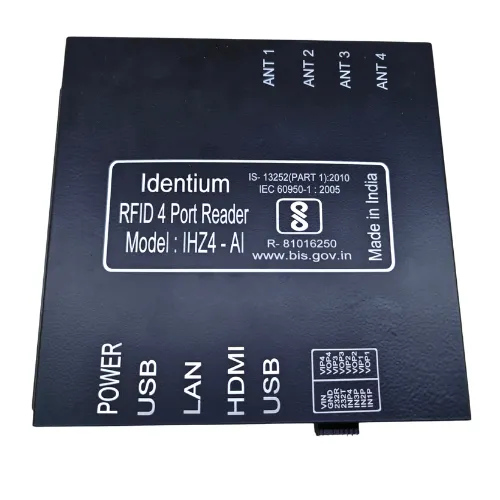
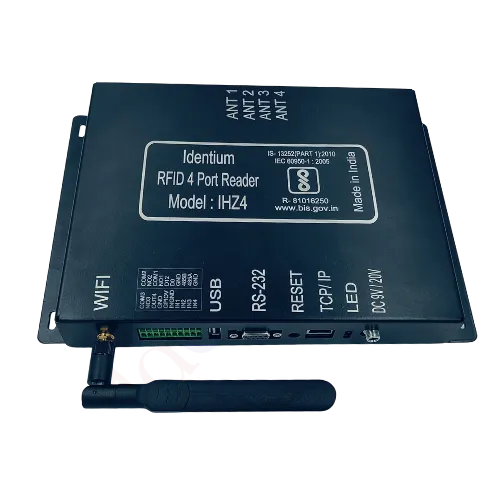
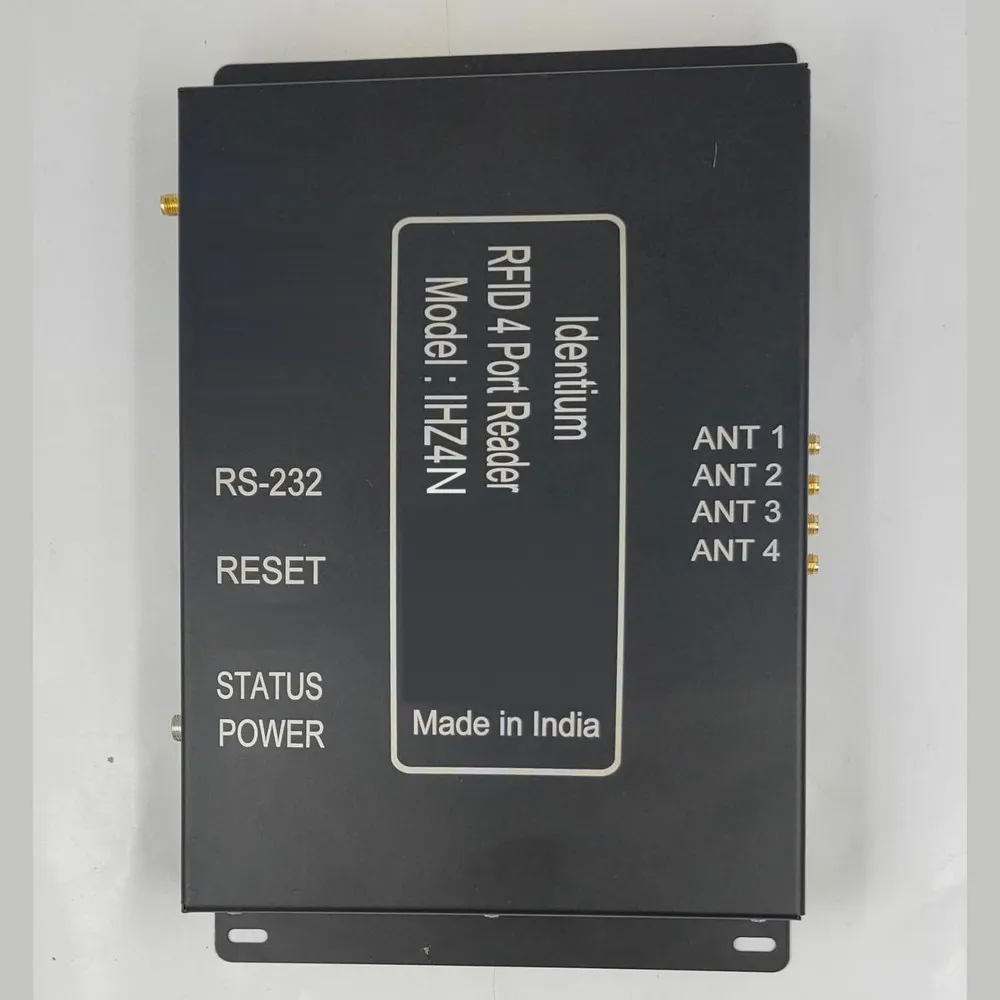
India RFID Store, the online store of Identium Tech Solutions, supplies the hardware side of this stack: RFID readers, UHF RFID tags and reader modules. Check each reader's listed interfaces (USB, RS232, Ethernet, SDK) against your integration plan before you order, so your integrator or our team can wire it into SAP, your WMS or Tally cleanly. For tracked equipment rather than stock, see the asset management solution; either way, the software layer is where the value is realised.
A realistic cost picture
Software is often the underestimated line item. A basic single-site reader integration or agent is the smallest cost; a configurable middleware platform is usually licensed by the number of readers and sites; and cloud/SaaS RFID platforms are commonly billed per reader or per month. Always budget for integration effort with your ERP partner and a proper pilot, and never skip the pilot. For budget ranges across hardware, software and integration, see how much an RFID project costs in India.
Ready to connect your readers to your business systems? Talk to Identium Tech Solutions about hardware and an integration plan for your ERP, SAP, WMS or Tally. Contact us with your site and software stack for a tailored quote.
Related guides
Frequently asked questions
Do I have to replace my barcode POS or ERP such as Ginesys or Unicommerce to use RFID?
Can an RFID reader post directly into SAP EWM, or do we need middleware?
What is the difference between an RFID reader and RFID middleware?
Can RFID integrate with Tally for Indian SMEs?
Do I really need middleware, or can my ERP read the RFID reader directly?
How does RFID middleware handle poor internet at Indian sites?
Is RFID hardware sold in India approved for legal use?
How long does an RFID-to-ERP integration take to go live?
RFID softwareRFID middlewareERP integrationSAP integrationWMSRFID India
_1rNsTG.webp)