How Much Does an RFID Project Cost in India (2026)? Realistic INR Budgets + ROI Framework
Published 18 Jul 2026Updated 4 Oct 20266 min read
Short answer: An RFID project in India typically costs ₹1.5–4 lakh for a focused pilot, ₹4–20 lakh for a single dock or an item-level retail store, and ₹25 lakh to over ₹1 crore for a multi-dock DC or factory, before 18% GST. Cost it as five separate buckets, and judge it on payback from labour saved, shrinkage recovered and inventory accuracy gained.
"How much will an RFID project cost?" is the first question every operations, IT or procurement head asks. The honest answer is that it depends on scale, environment and how much software integration you need.
This 2026 guide breaks down realistic INR budgets for every line item (tags, readers, antennas, printers, software and integration) and gives you a practical ROI framework built around Indian labour costs, shrinkage and accuracy. It is written for retail, manufacturing, logistics, warehousing and healthcare teams moving from "should we do RFID?" to "what will it actually cost, and when does it pay back?"
The five cost buckets of any RFID project
Every RFID deployment in India, whether a single-door asset tracking pilot in Pune or a multi-warehouse rollout across Mumbai, Delhi and Chennai, breaks into five buckets. A realistic figure comes from costing each one separately rather than chasing a single per-tag number.
- Tags and labels: the recurring consumable, priced per piece.
- Readers: fixed, handheld, desktop or integrated, priced per unit.
- Antennas and cabling: needed for fixed four-port readers and gates.
- Printers: only if you encode and print tags in-house.
- Software and integration: middleware, dashboards and the ERP/WMS connection.
RFID hardware cost in India: realistic INR ranges for 2026
The ranges below are typical 2026 market figures for UHF hardware set to India's licence-exempt 865–868 MHz band, before GST. Actual quotes vary with chip type (for example Impinj M730 or M750), memory, IP rating and order volume, so treat them as starting points.
Each product page on the store shows its current list price, and project volumes are quoted per project.
| Component | Type / example | Typical India price (2026) |
|---|---|---|
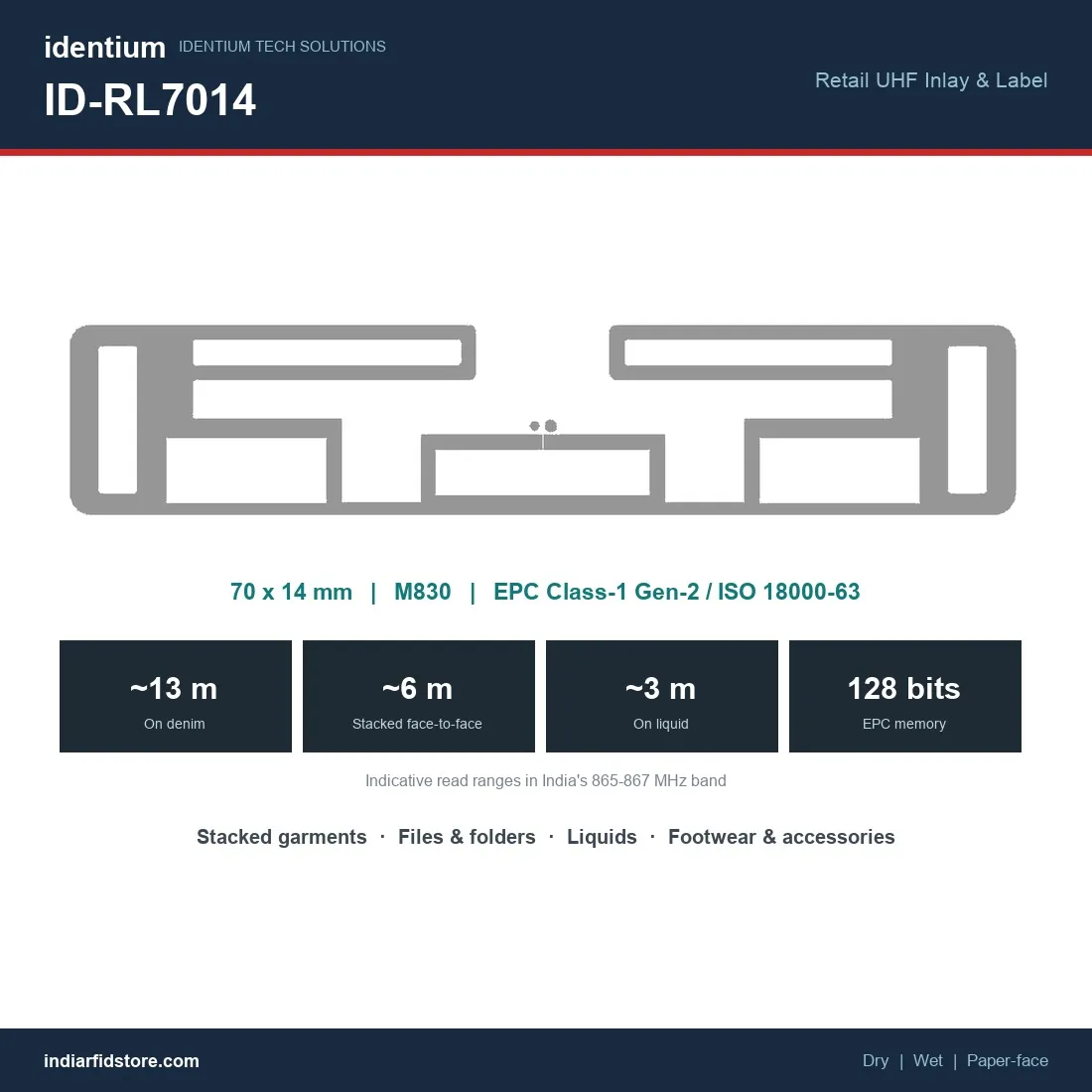
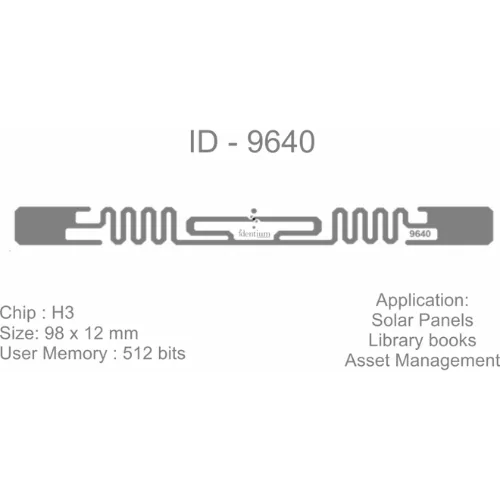
| UHF paper label or inlay | Retail, carton, apparel | From about ₹4; typically ₹6–15 per piece |
| On-metal tag | Tools, IT assets, cylinders | ₹40–250 per piece |
| Specialty tag | Laundry, jewellery, PCB/ceramic | ₹25–400 per piece |
| Handheld reader | Android UHF terminal | ₹40,000–1,50,000 per unit |
| Fixed four-port reader | Dock, gate, production line | ₹45,000–1,30,000 per unit |
| Desktop or integrated reader | Encoding, POS, single door | ₹12,000–60,000 per unit |
| RFID antenna | Circular polarised, 8–9 dBi | ₹4,000–12,000 per piece |
| RFID printer | Desktop to industrial encoder | ₹80,000–3,00,000 per unit |
Where the tag spend really lands
For high-volume, item-level use (apparel, retail, WIP tracking), tags are a recurring cost, not a one-time one, so annual tag consumption often dwarfs the hardware. As an illustration, a retailer tagging 5 lakh items a year at about ₹7 each spends roughly ₹35 lakh a year on UHF RFID inlays and labels alone.
For asset tracking (a fixed pool of tools, IT equipment or returnable assets), tags are a one-time purchase, and rugged on-metal RFID tags dominate the bill of materials. Work out which model you are in before budgeting, because it changes everything else.
Software and integration: the underestimated line item
Hardware is visible, so it gets budgeted; software is where projects quietly overrun. The cost depends on whether you buy off-the-shelf software, subscribe to a SaaS platform, or commission custom middleware and ERP/WMS integration with SAP, Tally, Zoho or a home-grown system.
- Basic reader-to-cloud dashboard: ₹1–4 lakh, or a SaaS subscription from about ₹5,000–25,000 a month.
- Middleware and business logic (zoning, dwell, alerts): ₹3–10 lakh.
- Deep ERP/WMS integration and custom workflows: from ₹8 lakh, rising to ₹30 lakh or more for large deployments.
- Annual maintenance (AMC): budget 15–20% of the software cost each year.
Also allow for GST (18% on most RFID hardware and software), the site survey, cabling, mounting and staff training. A useful rule of thumb: on integration-heavy projects, services and software often equal or exceed the hardware. Our guide to RFID software and middleware explains what each layer does.
Sample project budgets by use case
To make this concrete, here are ballpark all-in first-year budgets (hardware, software and integration, excluding GST) for common Indian scenarios.
| Scenario | Scope | Indicative first-year budget |
|---|---|---|
| Asset tracking pilot | 1 handheld, 500 metal tags, basic app | ₹1.5–4 lakh |
| Single-dock warehouse | 1 gate or four-port reader, 2–4 antennas, middleware | ₹4–10 lakh |
| Retail store, item level | Handhelds, printer, 50,000+ labels a year, POS integration | ₹8–20 lakh |
| Multi-dock DC or factory | 6–12 readers, gates, ERP integration, AMC | ₹25 lakh to ₹1 crore+ |
An RFID ROI framework: labour, shrinkage and accuracy
RFID should be judged as an investment that returns a number, not as a cost. In practice the payback almost always comes from three levers, so quantify each one for your own operation.
1. Labour saved
Manual barcode scanning or clipboard counting is slow. RFID reads hundreds of tags per second, so a stock count that took a three-person team a full day can drop to under an hour.
If you save 20 person-hours a week (about 1,040 hours a year) at a loaded cost of ₹150–300 an hour, that is roughly ₹1.5–3.1 lakh a year, often enough to justify a mid-sized deployment on labour alone.
2. Shrinkage and loss reduced
Retail and warehousing in India routinely lose 1–3% of inventory value to shrinkage, misplacement and theft. On ₹5 crore of annual inventory, even a 1% reduction is ₹5 lakh recovered every year. Gate readers and regular cycle counts make loss visible and deter walk-outs.
3. Accuracy and availability improved
Inventory accuracy commonly rises from about 65–75% with manual counts to 95–99% with RFID. Better accuracy means fewer stockouts, fewer emergency purchases, less capital locked in overstock and fewer dispatch errors, each with a rupee value you can estimate from your own error and return rates.
Putting it together
- Annual benefit = labour saved + shrinkage recovered + accuracy gains.
- Payback (months) = (total project cost ÷ annual benefit) × 12.
- Well-scoped deployments in India usually target a payback of 8–24 months. If your model shows more than 36 months, narrow the scope or start with a focused pilot.
The safest approach is a small paid pilot: prove the numbers on one line, one store or one warehouse dock, then scale with confidence. India RFID Store sells the handheld readers and UHF RFID tags a pilot needs, and the RFID ROI calculator gives you a first payback estimate.
How to keep your RFID budget under control
- Match the tag to the surface: paper labels on cartons, on-metal tags on machinery. The wrong tag fails and inflates cost.
- Right-size the readers: one handheld may replace three fixed readers for periodic counts; reserve gate readers for true choke points.
- Check compliance per model: for UHF readers, ask for the exact model's WPC ETA and BIS registration. Paperwork that matches the model avoids customs and interference problems later, and tenders ask for it.
- Print in-house only if volumes justify it: otherwise buy pre-encoded tags and skip the printer capex.
- Phase the rollout: pilot, measure, then scale. Never go big-bang.
Ready to build a costed plan for your operation? Share your use case through the quote request form for a realistic INR quote, an ROI estimate and a right-sized pilot.
Related guides
Frequently asked questions
What is the minimum budget to start an RFID project in India?
How much do UHF RFID tags cost per piece in India in 2026?
Is RFID hardware subject to GST and import duty in India?
How long does it take for an RFID project to pay back?
Do I need a separate reader and antenna, or an all-in-one unit?
Can RFID integrate with my existing ERP or WMS like SAP or Tally?
RFID cost IndiaRFID budgetingRFID ROIUHF RFIDRFID implementation2026