RFID for Warehouse & Inventory Management in India — Complete Implementation Guide 2026
Published 18 Jul 2026Updated 3 Oct 20269 min read
Indian warehouses are under real pressure. E-commerce fulfilment SLAs, GST-driven consolidation of godowns into larger regional distribution centres and rising labour costs have exposed the limits of manual and barcode-based stock control. If your team still walks every aisle with a scan gun, takes days to close a physical stock count and writes off inventory that "disappears" on paper, RFID is the most direct operational upgrade available to you in 2026.
This guide is written for Indian operations, purchase and IT decision-makers. It explains what RFID warehouse management involves: the problem it solves, the hardware you need, a realistic step-by-step deployment plan, the ROI case in rupees, and which tags actually work on Indian goods. Every component discussed here is sold on India RFID Store in versions built for the Indian 865–868 MHz band.
The warehouse problem RFID actually solves
Barcodes need line of sight and one-at-a-time scanning. A worker must physically see, orient and trigger each label. In a busy Indian DC handling thousands of SKUs across mixed cartons, that creates predictable pain:
- Slow, error-prone stock counts. A full cycle count with barcodes can take a small team several days, and the count is already out of date by the time it closes.
- Shrinkage and mismatches. Manual entry errors, mis-picks and untracked movement routinely cause a 1–3% inventory discrepancy that only surfaces at audit.
- Slow inbound and outbound. Every carton at the dock door is scanned individually, creating queues and truck-detention costs.
- No real-time visibility. Your WMS shows what was scanned hours ago, not where a pallet is right now.
RFID removes the line-of-sight constraint. A UHF RFID reader can identify hundreds of tags per second through cartons and shrink-wrap, without anyone aiming at anything. That one physical difference is what turns a two-day stock count into a 30-minute walk-through, and a manual dock-door check into an automatic gate read.
How RFID works in a warehouse
Every item, carton or pallet carries a passive UHF RFID tag: a label with a tiny chip and antenna and no battery. A reader transmits radio energy through a connected antenna; nearby tags harvest that energy and reply with their unique EPC (Electronic Product Code). The reader passes those reads to your WMS or ERP over the network. Because reads are bulk and automatic, inventory updates itself as goods physically move.
In India, UHF RFID operates in the licence-exempt 865–868 MHz band (G.S.R. 853(E), 2021). Hardware sold for the US band (902–928 MHz) cannot legally operate here. EU-band hardware overlaps India's 865–868 MHz range, but each reader model still needs its own WPC Equipment Type Approval before it is used in India. Buying India-band equipment protects read performance and keeps you compliant.
The hardware you need
A complete warehouse RFID system is built from a small set of standard building blocks. Here is what each one does and where it goes.
1. Fixed UHF RFID readers
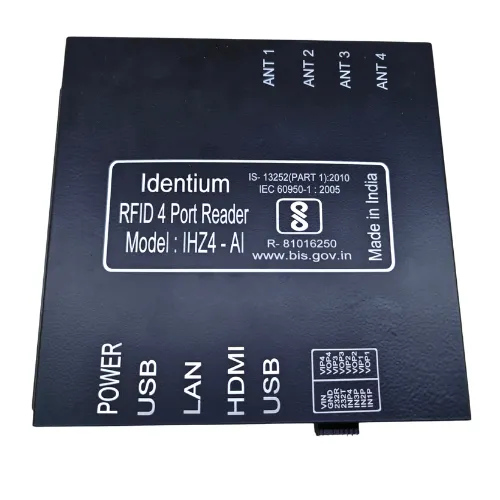
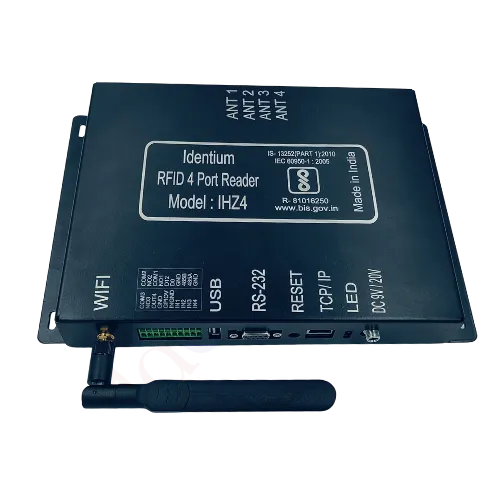
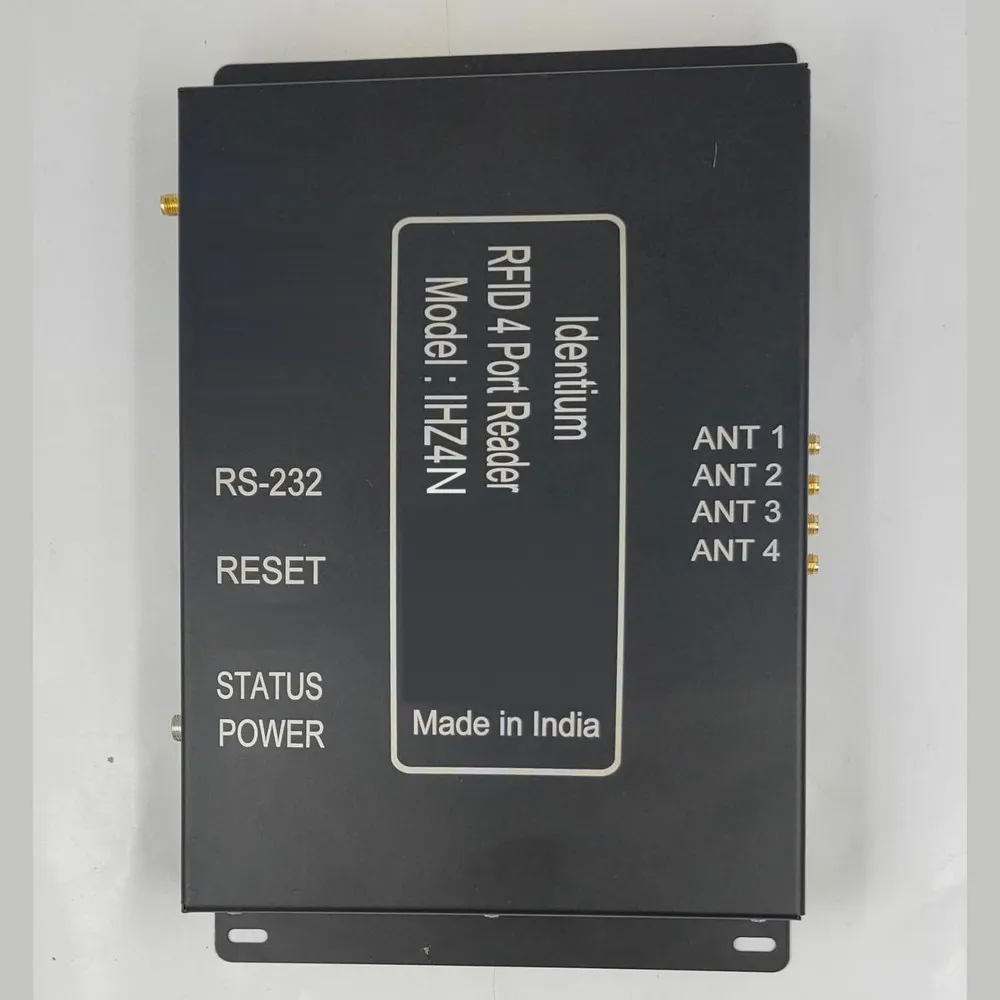
The workhorse of any installation. A fixed reader (typically 2-port or 4-port) sits at a dock door, conveyor or shelf array and drives several external antennas. Four-port models let one reader cover an entire portal or smart-shelf bay. Browse fixed units in UHF RFID readers. For simpler single-zone reads, an integrated reader with an inbuilt antenna combines both in one enclosure and is quicker to mount.
2. RFID antennas
Antennas shape the read field. Circular-polarised antennas tolerate tags at any orientation, which suits mixed cartons on a pallet. Linear-polarised antennas give longer range when tag orientation is controlled, as on a conveyor. Choosing and aiming antennas correctly is often the difference between a 95% and a 99.9% read rate. See the RFID antenna range for gain and polarisation options.
3. Dock-door and gate portals
A portal is a frame at an entry or exit point that mounts 2–4 antennas plus a motion or photo-eye trigger, wired to a fixed reader. As a forklift or pallet passes through, every tag is read and the WMS logs the movement automatically, with no scanning stop. This is the highest-ROI point in most Indian DCs. Ready-built units are listed under RFID gate readers.
4. Handheld RFID readers
For cycle counts, put-away, pick verification and locating a specific item, staff use mobile RFID handheld readers. A worker walks an aisle and the device counts every tagged item in seconds, with a "Geiger-counter" search mode to home in on one carton. Handhelds are the fastest way to prove ROI in phase one because they need no fixed infrastructure.
5. UHF RFID labels and tags
The consumable that goes on every item. Standard paper or PET wet-inlay UHF RFID labels suit cartons and non-metal goods and can be printed and encoded in-house. Metal shelving, tools, containers and electronics need specialised on-metal RFID tags that stand off the surface. Tag choice is covered in detail below.
6. RFID printer-encoder
To print human-readable labels and encode the EPC in one pass, an RFID label printer sits at your labelling or despatch station. This lets you produce compliant labels on demand instead of stocking pre-encoded tags.
Tag type comparison for warehouses
Choosing the wrong tag is the most common cause of disappointing RFID pilots in India. Metal and liquids detune ordinary labels. Use this table to match the tag to the surface and use case.
| Tag type | Best for | Typical read range | Surface | Relative cost |
|---|---|---|---|---|
| Paper/PET wet-inlay label | Cartons, apparel, FMCG, documents | 4–8 m | Non-metal, dry | Lowest |
| On-metal hard tag | Racking, tools, IT assets, gas cylinders | 3–6 m | Metal | High |
| On-metal printable label | Metal cartons, appliances, drums | 2–5 m | Metal | Medium to high |
| Anti-liquid or tyre tag | Liquids, chemicals, tyres, pharma | 2–5 m | Liquid-adjacent | High |
| Reusable pallet or container tag | Returnable pallets, crates, bins | 5–10 m | Plastic or wood | Medium (reusable) |
| Jewellery or small-item label | Jewellery, small high-value SKUs | 0.3–1.5 m | Metal or mixed | Medium |
Read range depends on reader power, antenna gain, environment and tag placement. The figures are general guidance for the India band, not the specification of any single tag.
Step-by-step deployment plan
A disciplined rollout de-risks the investment and gets you a measurable win before you scale. This is the sequence we recommend to Indian buyers.
- Define the use case and KPI. Pick one measurable goal: cut stock-count time, eliminate dock-door mis-shipments, or reach 99%+ inventory accuracy. A tightly scoped phase one is far more likely to succeed than a "tag everything" big bang.
- Run a site survey and RF assessment. Map dock doors, aisles, racking material and interference sources. Metal racking and RF noise from motors and Wi-Fi affect read zones. The survey decides antenna count, placement and reader power settings.
- Select tags and test placement. Test candidate tags on your actual products: a label that reads perfectly on a carton may fail on a foil pouch. Confirm the placement gives consistent reads before ordering in volume.
- Pilot in one zone. Deploy readers, antennas and a handheld at a single dock door or aisle. Integrate reads with your WMS or ERP; most support middleware or a simple API. Run in parallel with your existing process to validate accuracy.
- Measure against the KPI. Compare pilot data with the baseline. Well-run pilots typically show read accuracy above 99% and count times cut by 80–95%. Use this evidence to justify the full rollout budget.
- Scale and build it into SOPs. Roll out portal by portal and aisle by aisle. Standardise labelling at goods-in so every item enters the building already tagged, train staff, and build RFID checks into your SOPs.
For a week-by-week version of this plan, including WMS integration and the parallel run, see how to implement RFID in your warehouse.
ROI: the business case in rupees
RFID is a capital purchase, so the maths must stand up. The returns come from four levers:
- Labour savings. Cycle counts that took a four-person team two days can drop to a 30-minute solo walk with a handheld, freeing hundreds of person-hours a year.
- Accuracy and shrinkage. Moving from about 95% to 99%+ inventory accuracy cuts write-offs, emergency purchases and mis-shipment penalties.
- Throughput. Automated dock-door reads speed up inbound and outbound, reducing truck detention and overtime.
- Working capital. Real-time visibility lets you carry less safety stock for the same service level.
A focused single-zone deployment (one 4-port reader, four antennas, a handheld and a starter roll of labels) is an entry-level investment that many Indian DCs recover within 6–18 months, mainly through labour and shrinkage savings. Passive labels cost only a few rupees each and readers are a one-time asset, so the cost per item falls the more you scale. To model your own numbers, use the RFID ROI calculator or see realistic INR budgets for RFID projects.
Why India-band, type-approved hardware matters
Cheap imported readers tuned for US frequencies are a false economy in India. They can underperform on the 865–868 MHz band and expose you to compliance risk. When you compare readers, check three things:
- Band. The reader must operate in 865–868 MHz, the band Indian UHF deployments use.
- WPC ETA for the exact model. Type approval is granted per model, not per brand. In this catalogue, the CX1500N, IF9A, IHZ4 and MUBR01 readers and the RUCA9 antenna hold WPC ETA.
- BIS registration where it applies. Identium's BIS registration covers the 103UDR, CX1000, CX1500N, CX806T, HLR20, IF9A, IHZ4, MUBR01, R58H and UBR12 readers. Tags, labels and cards have no BIS category.
Buying from a supplier based in India also means GST invoicing and local technical support, which is what protects a rollout from the "it read fine in the demo" failures that plague grey-market imports.
Is your reader legal to operate in India?
Every fixed reader, gate portal, handheld and RFID printer-encoder in this guide transmits radio energy, so each model needs WPC Equipment Type Approval (ETA) before it is imported, sold or deployed in India, and ETA is granted per model, not per brand. A reader locked to the US 902–928 MHz band is not legal to operate here and will not be granted ETA in that configuration. Passive labels and tags need no approval.
Ask your vendor for the ETA certificate naming the exact model on the quotation before you raise the purchase order. The WPC ETA and BIS compliance checklist for RFID readers covers the full document list, the BIS route for printers and what to do if you have already bought a 902–928 MHz unit.
Which setup should you choose?
Match the deployment to your main pain point:
- Slow stock counts: start with handheld readers and UHF labels. Lowest cost, no fixed installation, fastest proof of value.
- Dock-door errors and slow inbound/outbound: deploy a gate portal with fixed readers and antennas.
- High-value or metal assets: invest in on-metal tags and fixed shelf readers for continuous visibility.
- Full DC automation: combine portals at every dock, smart shelves and handhelds for exceptions, and standardise tagging at goods-in.
Getting started
RFID is no longer an experimental technology in Indian warehousing; it is a proven upgrade that pays back through labour and accuracy. A successful rollout starts with a scoped use case, the right tag for your goods, and correctly tuned India-band hardware with local support behind it.
India RFID Store supplies the complete stack: fixed UHF readers, antennas, handheld readers and UHF RFID labels. Add the items to your quote list, or request samples to test tags on your own products before you order in volume.
Related guides
Frequently asked questions
What frequency does RFID use in Indian warehouses?
Can RFID read tags through cartons and shrink-wrap?
How accurate is RFID inventory counting?
Do I have to replace my existing WMS or ERP?
What does a basic warehouse RFID system cost to start?
How long does deployment take?
RFID warehouse managementinventory management IndiaUHF RFIDwarehouse automationRFID implementationsupply chain
_1rNsTG.webp)