UHF RFID 4-Port Fixed Reader IDTS-IHZ4N (N704)
A four-port fixed UHF RFID reader for dock doors, conveyors and production lines, built on the N704 module in the IHZ4 housing. Its 865–868 MHz version reads ISO 18000-6C and 6B tags at over 400 a second and connects over Ethernet, RS-232 or RS-485.
Price on request
Minimum order: 1 piece · the final price for your quantity is confirmed in the quote
View datasheet PDF · 224 KB- 7-day replacement · 1-year warranty against manufacturing defects
- Blue Dart next-day delivery
Key features
- N704 third-generation UHF RFID reader chip (4-port module)
- 4 × SMA ports, > 30 dB isolation, up to 33 dBm, −85 dBm sensitivity
- 865–868 MHz India (ETSI-band) version; up to 20 m read in the maker's 9 dBi antenna test
- Read rate > 400 tags/s; a 600-tag group identified within 3 s (multi-tag)
- Ethernet 10/100, RS-232 and RS-485; Wiegand on request
- 2 opto-isolated inputs and 2 relay outputs for sensors, lamps and gates
- Chip
- N704 third-generation UHF RFID reader chip (4-port module)
- Protocol
- ISO 18000-6C (EPC C1 Gen2), ISO 18000-6B
- Frequency
- 865–868 MHz (India/ETSI-band version); 902–928 MHz (US-band version)
- Read range
- Up to 20 m (EPC tags; maker's test with a 9 dBi linear antenna, cable loss < 1 dB, no interference); depends on antenna, tag and site
Overview
What is inside the IDTS-IHZ4N 4-port UHF RFID reader
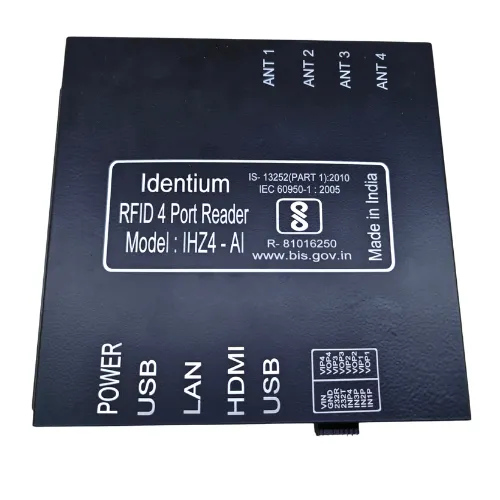
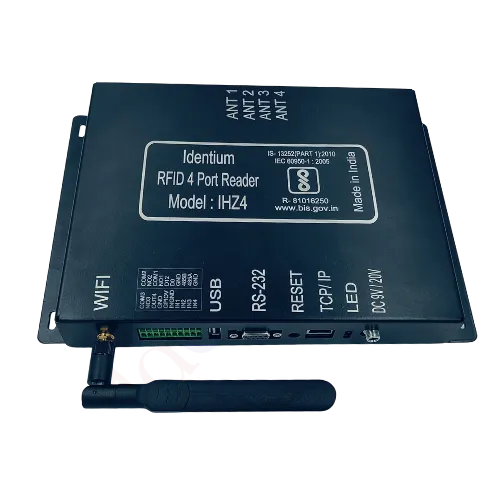
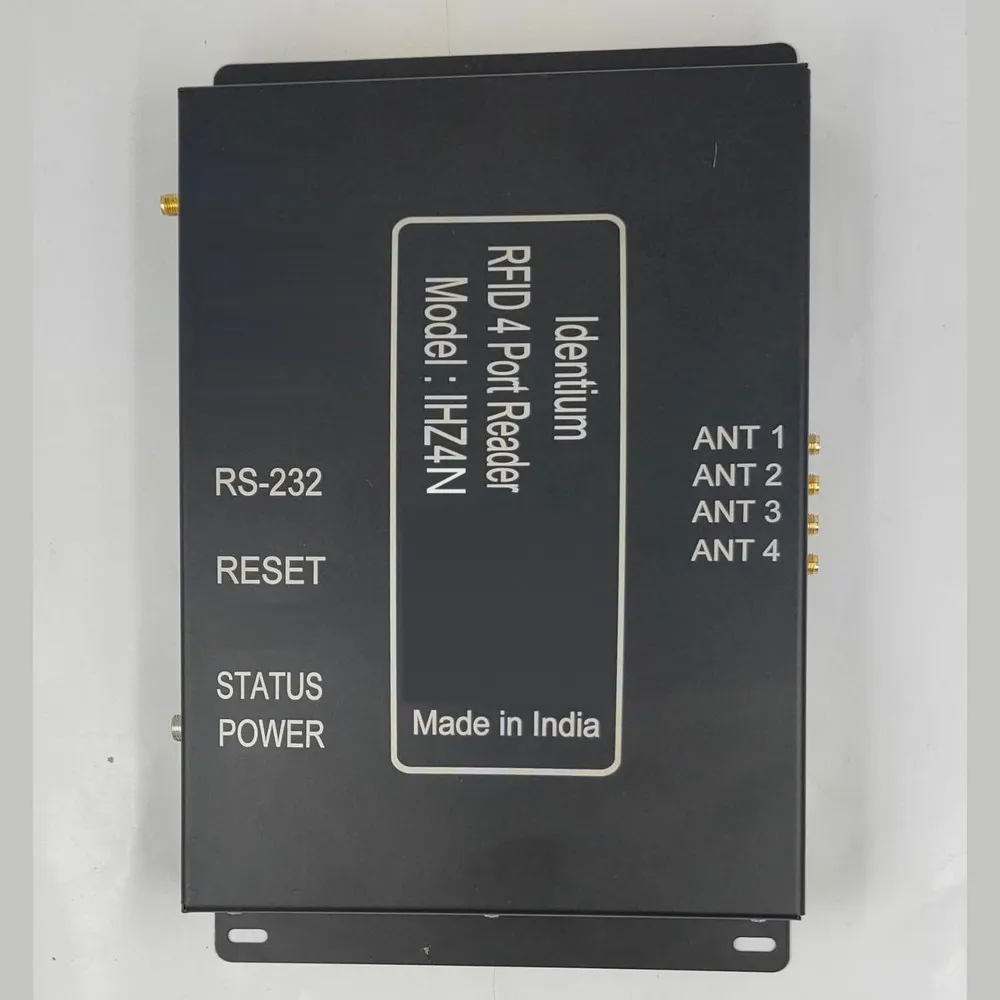
The IDTS-IHZ4N is the N704 version of our four-port fixed reader. Outside, it is the IHZ4's aluminium, anti-shock housing with four SMA antenna ports. Inside is an N704 third-generation reader module with four ports, plus an interface board for Ethernet, serial and I/O. Tags can be read and written over ISO 18000-6C (EPC Gen2) and ISO 18000-6B.
Planning read points with four antennas
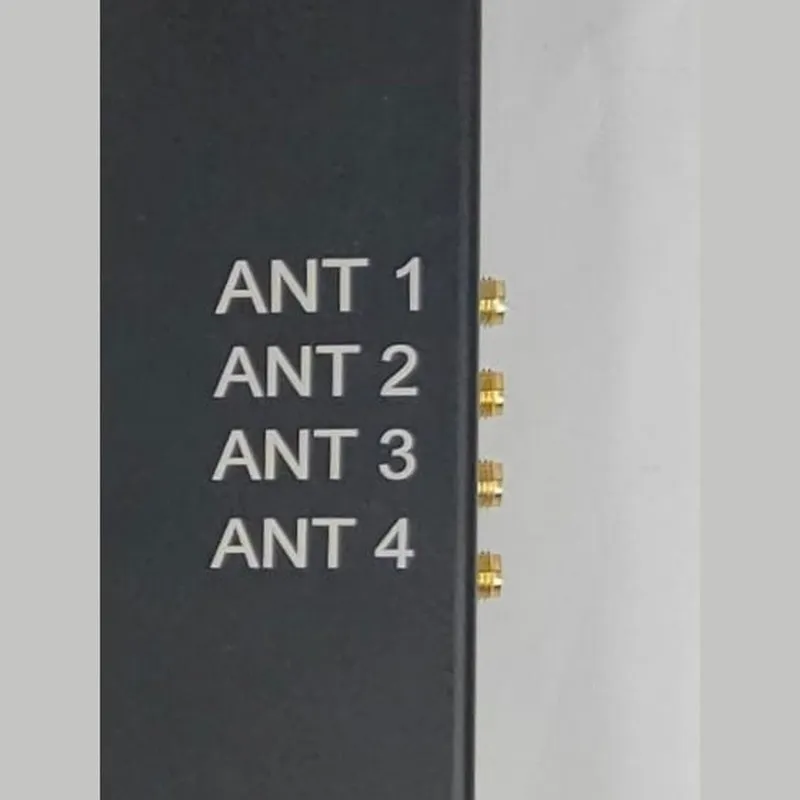
Four ports suit places that tags pass in a predictable way: a dock door with an antenna on each side, a conveyor, a production-line station or a file-room door. Aim each antenna at its own zone. The port-to-port isolation of more than 30 dB limits leakage between the reader's antenna ports, while antenna placement and output power keep the zones apart. Dense-reader mode helps where several readers share a hall, and the multi-tag rate suits a pallet of cartons passing a dock door.
The listed range is the maker's test figure; a site survey with your own tags decides the antenna layout. When commissioning, use antenna-connection detection to confirm each cable before trays are closed. Pick the zone antennas from our RFID antenna range.
Connecting it to your network or controller
- Ethernet 10/100: for a server, WMS or middleware on the site LAN.
- RS-232: for a PC or controller close to the reader.
- RS-485: for PLCs and serial networks over long cable runs.
- Wiegand: only if ordered, as a customisation for access or attendance controllers.
Inputs and relays at the read point
The two opto-isolated inputs can be triggered by a sensor such as a photo-eye, loop detector or door switch (check the sensor's output type against the input requirements when you order), so your software can start reading when something arrives and stop once it has passed. Combined with output power trimmed to the doorway, this keeps tags in the next bay out of your data. The two relay outputs can switch a lamp or hooter, or signal a barrier controller; their ratings are in the specs table, and heavier loads need a contactor.
IHZ4N or IHZ4: which to choose
IDTS-IHZ4N
N704 engine; Ethernet, RS-232 and RS-485; two inputs and two relays; Wiegand only as a customisation. Choose it when Ethernet or serial links and two I/O pairs cover the read point.
IDTS-IHZ4
Impinj E710 engine in the same housing. It adds USB for bench set-up, Wiegand as standard, three inputs and three relays, and a higher listed read rate and read range. Choose the IHZ4 when you need any of those.
Both are listed with our other 4-port UHF RFID readers.
Typical applications
- Warehouse dock doors
- Conveyor lines
- Production lines
- Library and file rooms
- Attendance and access gates
- Apparel stock rooms
- Vehicle and asset gates
Specifications
Datasheet (PDF)| Model | IDTS-IHZ4N |
|---|---|
| Chip | N704 third-generation UHF RFID reader chip (4-port module) |
| Protocol | ISO 18000-6C (EPC C1 Gen2), ISO 18000-6B |
| Frequency | 865–868 MHz (India/ETSI-band version); 902–928 MHz (US-band version) |
| Output power | 0–33 dBm (±1 dB), adjustable in 1 dB steps |
| Receive sensitivity | −85 dBm |
| Port isolation | > 30 dB, port to port |
| Modulation | DSB-ASK, PR-ASK |
| Decoding | FM0, Miller 2/4/8 |
| Data rate | 40 / 160 / 320 / 400 kbps (baseband) |
| Work mode | Fixed frequency or frequency hopping |
| Read speed | > 400 tags/s |
| Multi-tag | 600 tags in 3 s (anti-collision) |
| Read range | Up to 20 m (EPC tags; maker's test with a 9 dBi linear antenna, cable loss < 1 dB, no interference); depends on antenna, tag and site |
| Write range | Up to 10 m (same test conditions); depends on antenna, tag and site |
| Ports | 4 × SMA antenna ports |
| Interface | Ethernet 10/100 Mbps (TCP), RS-232 (9,600–460,800 baud, default 115,200), RS-485; Wiegand on request (customisation) |
| I/O | 2 opto-isolated inputs, 2 relay outputs (DC 30 V / 1 A, AC 125 V / 0.75 A) |
| Functions | RSSI, tag data filtering, dense-reader mode (DRM), antenna-connection detection, temperature/humidity protection, auto-idle power saving |
| Power input | DC 5–24 V, from a supply of at least 30 W; recommended adapter 12 V / 2 A (100–240 V AC input) |
| Power consumption | 9 W (reader module at +33 dBm) |
| SDK | SDK packages for several development languages, plus demo software |
| Housing | Aluminium, anti-shock design |
| Indicators | Power and status |
| Dimensions | 170 × 120 × 25 mm |
| Operating temperature | −20 °C to +70 °C |
| Storage temperature | −40 °C to +85 °C |
| Humidity | 10–95% RH, non-condensing |
_1rNsTG.webp)