Skip to content
India RFID Store

Shop by category

RFID Readers61
RFID Tags168
Labels & Stickers204
Cards12
Wristbands25
Active RFID & BLE
Printers & Locks
Evaluation Kits7
Solutions

RFID File tracking System

A complete RFID system for physical files: tagged folders are logged as they leave or enter a room, a handheld reader finds a file on the shelf, and cloud software keeps the record. For record rooms and archives.

Buying guide ↓

RFID File tracking System: prices and models (prices, excl. 18% GST)

1 product · from ₹1,50,000 + GST

How the RFID File Tracking System works

  1. 1

    Label each file

    Stick a slim UHF label on every file jacket or folder and register it in the software with its file number, department and shelf location.

  2. 2

    Log movement at the door

    A gate reader at the record-room entrance records each tagged file going out and coming back, building up a movement history for every folder.

  3. 3

    Search with a handheld

    When a file cannot be found, look up its number on the handheld and walk the room; the handheld helps you pinpoint the tag on the shelf where the folder is sitting.

  4. 4

    Audit the shelves

    Sweep a rack with the handheld to compare what is there against the register, so the software can flag files missing from that shelf or sitting in the wrong place.

Hardware you need

File labels

The ID 73x21-H10 label (73 × 20 mm, Alien Higgs 10 chip) is thin enough to sit on a file jacket and is encoded with that file's ID.

All UHF RFID Inlays & Labels

Handheld finder

The CX1500N Android handheld registers new files, runs shelf audits and helps locate a single folder in a room full of racks.

All RFID Handheld Readers

Doorway gate

The HLR200 gate at the record-room door reads tags within a zone of up to 4 m and tells files going out from files coming in.

All RFID Gate Reader

Label printing

The IT4RL desktop printer-encoder prints the file number and writes the tag in one job, which helps when labelling an existing archive.

All RFID Printers & Encoders

Complete system

The RFID file tracking system for offices and record rooms covers UHF file tags, fixed readers at chosen capture points, a handheld for pinpointing files and cloud software.

All RFID File tracking System

The software

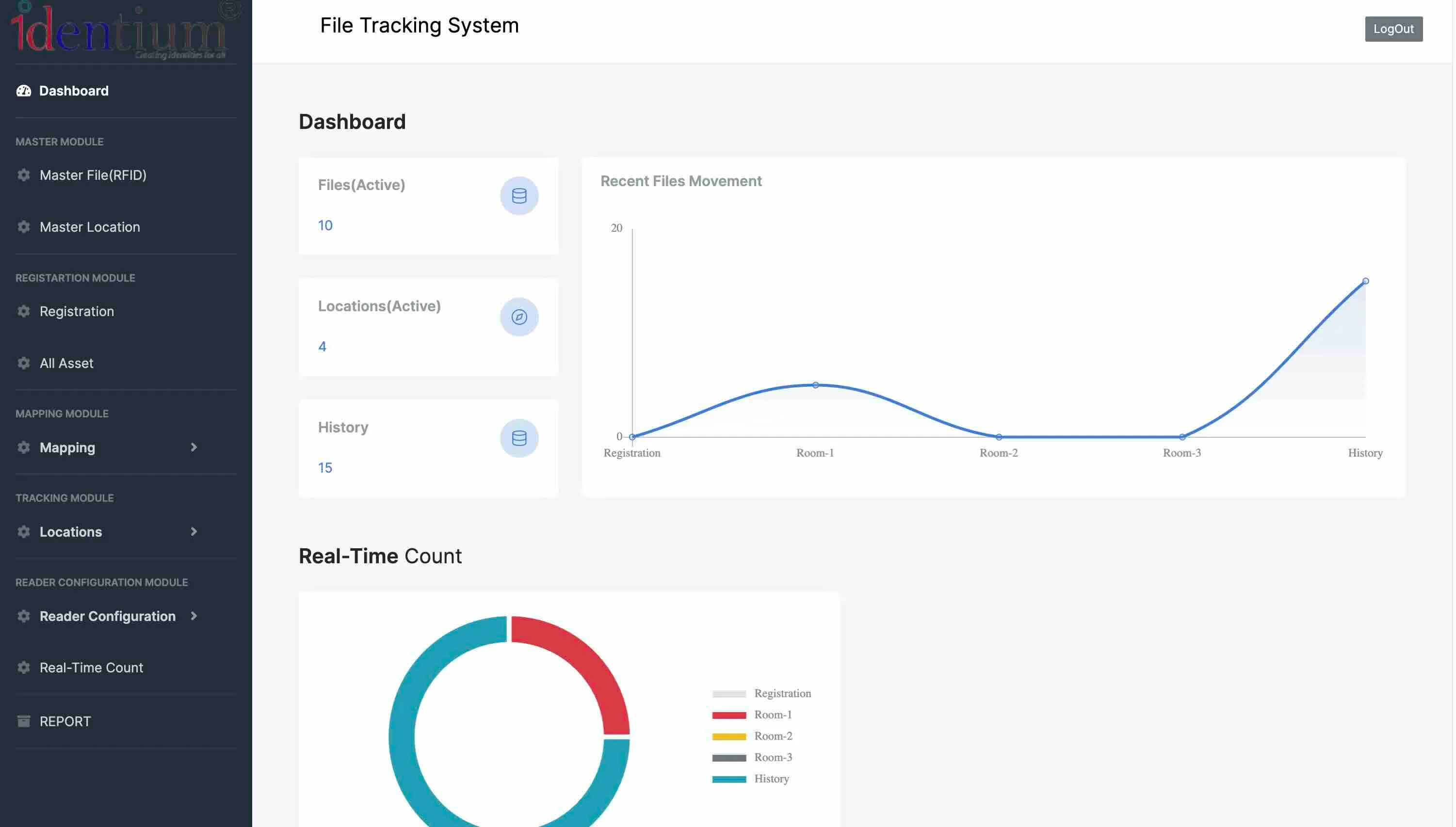
The file tracking software on IdentiumOne combines reads from antennas on the shelves, readers at the doorway and handhelds, so staff can search a file ID and see where it was last seen along with a record of who handled it and when. IdentiumOne also describes APIs for linking this location data to the systems an office already runs, such as case management, core banking, hospital records or government file tracking. For the complete workflow, screenshots and a demo, see the RFID file tracking page on IdentiumOne.

RFID file tracking software and demo on IdentiumOne

Why teams use it

  • Every file carries a movement history showing when it left the record room and when it came back
  • Misfiled folders can be found with a handheld instead of a shelf-by-shelf search
  • Shelf audits show what is missing or out of place without opening each file
  • Labels go on the outside of the jacket, so the papers inside stay untouched

Watch it working

RFID File Tracking System
RFID File Search - CX1500N Handheld

How an RFID file tracking system works

Paper registers and manual searches break down once a record room holds thousands of files. An RFID file tracking system replaces them with a tag on every file and readers at the points where files move, so a file can be traced without asking around.

  1. Tag each file. A UHF RFID label goes on every file or folder and is linked to its file number in the software.
  2. Log movement at capture points. Fixed RFID readers at identified doors or counters record a file automatically when it is taken out of or brought into a room.
  3. Find a file on the shelf. When a file is needed, a handheld RFID reader pinpoints its tag within the room or rack.
  4. Keep the record. Cloud-based software shows where each file was last recorded, and every movement is stored digitally.

The complete solution is listed as the RFID File Tracking System for Offices & Record Rooms and is sized to your number of files, capture points and handheld readers.

Components you can order

File labels

The UHF RFID File Tracking Label (73 × 20 mm) on the Alien Higgs 10 chip, supplied on rolls for printers and encoders. More sizes in UHF RFID labels.

Encoding and printing

Encode labels at a desk with the driver-free UHF Desktop Reader 103, or print the file number and encode the tag in one pass with the IT4RL desktop RFID printer.

Capture points

A UHF RFID gate reader HLR200, with in/out direction sensors, at the record-room door, or an integrated reader at an issue counter.

Handheld search

The MUBR01 (0–3 m, pairs with an Android phone) or an Android handheld such as the CX1000 locates a file within the room.

Where it is used

  • Government record rooms, registries and court record sections
  • Bank loan and KYC file custody
  • Hospital medical records departments
  • Legal, HR and corporate archives

Planning a rollout

  • File count. Decides how many labels you need and how long the initial tagging will take.
  • Capture points. Every door or counter where files leave a room needs a fixed reader or gate. Fewer, controlled exits keep the system simple.
  • Search. Plan handheld readers by the number of rooms and how often staff need to find files.
  • Software. Decide early whether file records will stay in the cloud software or must also link to your existing e-office or document system, and mention it when you ask for a quote.

For government offices, the guide on RFID file and record-room tracking covers the topic in more detail.

Frequently asked questions

How does an RFID file tracking system work?
Each file carries an RFID tag, so its movement is recorded automatically instead of in a paper register. Fixed readers at identified capture points log a file when it is taken out of or put into a room, a handheld reader pinpoints a specific file inside the room, and cloud-based software stores every record digitally.
Can the system show where a specific file is?
Yes. The software shows where the file was last recorded, and a handheld RFID reader is then used to pinpoint the file's tag within the room or rack, which removes the manual search through cupboards.
Which tag should we put on files?
A slim UHF label, such as the 73 × 20 mm UHF RFID file tracking label, fixes to a folder cover or spine and can be printed with the file number on an RFID printer. Avoid placing labels directly over metal clips or fasteners.
What does an RFID file tracking system cost?
It depends on how many files are tagged, how many capture points need fixed readers and how many handheld readers you need, so the system is quoted per site. Labels, readers and printers are also listed individually with prices on their product pages.
Can we start with one record room?
Yes. Tagging the files in one room, adding a reader at its door and using one handheld lets you test the workflow before extending it to other rooms.

Your quote list

Saved on this device. No payment is taken online.

Your list is empty. Use “Add to quote” on any product, then send one request for everything.
