Skip to content
India RFID Store

Specialty RFID Labels

UHF RFID labels built for jobs a standard sticker does poorly: an LED cable label that helps a technician find the right wire, and a slim test tube tag for tubes, vials and sample racks.

Buying guide ↓
Products:
3
Price range:
₹8 – ₹15 + GST
Minimum order:
500 pieces (most products)
Frequency:
UHF, India band 865–868 MHz
Samples:
₹250 for 1–2 pieces, incl. shipping
Updated:

Not sure which one fits? Try the RFID tag finder →

Sold by India RFID Store, the online catalogue of Identium Tech Solutions Pvt Ltd, an RFID manufacturer in New Delhi, India, in business since 2010.

Specialty RFID Labels: prices and models (₹ per piece, excl. 18% GST)

3 products · from ₹8 + GST

Buying guide

Specialty RFID labels for cables and lab samples

Most UHF labels are flat stickers for cartons and pallets. The labels in this category are shaped for two awkward jobs: picking one cable out of a crowded rack, and tagging narrow, curved test tubes and vials. Both use EPC Class 1 Gen2 / ISO 18000-6C chips, so they work with standard UHF readers in India's 865–868 MHz band.

LED cable label

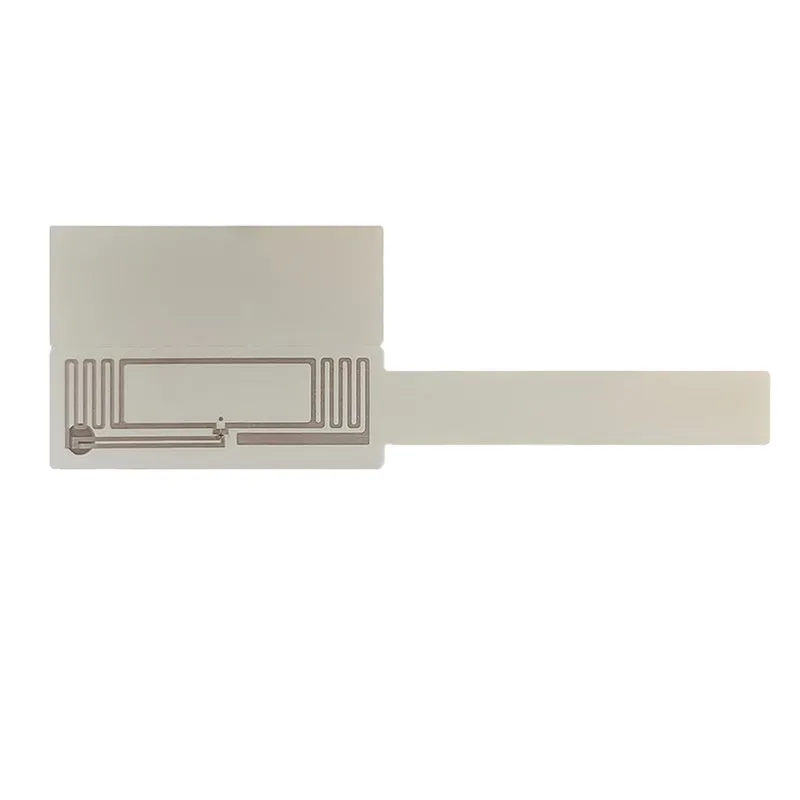
The UHF LED cable label ID-4111-KX puts a 41 × 11 mm antenna and an LED on a 95 × 30 mm die-cut label. Its KX2005XBL chip has 1312 bits of user memory for a cable reference or circuit ID, and the LED helps a technician spot the tagged cable among its neighbours.

Test tube tag

The UHF test tube tag ID-1540-U8 is a narrow 15 × 40 mm label on the NXP UCODE 8 chip. It is sized to wrap test tubes, vials and small sample containers, so a lab can read a rack of samples instead of scanning barcodes one by one.

Compare the labels

ModelChipSizeMemoryBuilt for
ID-4111-KXKX2005XBL41 × 11 mm antenna, 95 × 30 mm die-cutEPC 96–240 bits, user 1312 bitsCables and wires in racks, panels and trays
ID-1540-U8NXP UCODE 815 × 40 mmEPC 128 bitsTest tubes, vials and small sample containers

How to choose and deploy

  • LED support. The reader triggers the LED, so confirm that your handheld, reader SDK or software can send the command for the KX2005XBL chip before ordering cable labels in volume.
  • Liquids. Water absorbs UHF energy, so a tag on a filled tube reads at a much shorter distance than on an empty one. Labs usually read at rack or tray level. For bottles and larger liquid-filled containers, compare the anti-liquid label ID-7020.
  • Metal. Like other standard UHF labels, these lose performance directly on metal trays and enclosures. Keep the antenna area off bare metal, or use on-metal RFID tags for metal surfaces.
  • Encoding. Write your own cable or sample IDs with a reader from UHF desktop readers at the labelling bench, or with a handheld in the field. Keep a printed barcode on tubes if your analysers still need one.

What to order alongside

To read labels across a rack, tray or plant room, a UHF handheld such as the CX1500N Android UHF handheld is the usual choice; a desktop reader suits a fixed bench where tubes are checked in and out. For lab and hospital workflows, see RFID in healthcare and hospitals.

Other special-purpose labels in the store

Frequently asked questions

How does the LED on the ID-4111-KX cable label work?
The LED is driven by the tag's KX2005XBL chip when a compatible reader addresses that tag, so a technician can see which cable carries the ID being looked up. The reader or software must support the LED command for this chip, so check this before ordering in volume. The tag's ID can be read by any EPC Gen2 UHF reader.
Will the test tube tag read on tubes that contain liquid?
Yes, but at a much shorter distance. Water absorbs UHF energy, so a tag wrapped on a filled tube reads far less well than one on an empty tube or a flat surface. Labs usually read at rack or tray level with a desktop reader or a handheld held close to the samples. Test with filled tubes in your own racks first.
Which reader do I need for these labels?
Both labels use EPC Class 1 Gen2 / ISO 18000-6C chips, so any UHF reader working in India's 865–868 MHz band reads them. A UHF handheld suits racks and cable trays; a UHF desktop reader suits a lab bench or encoding station.
Can I encode my own cable or sample IDs?
Yes. Both labels can be written with a UHF desktop reader or a handheld that supports writing. The ID-4111-KX also has 1312 bits of user memory for a cable reference or circuit ID stored on the label itself.
Do these labels work on metal?
Standard UHF labels lose performance when stuck directly on metal. Keep the antenna area off bare metal trays and enclosures, or choose an on-metal RFID tag for metal surfaces.

Your quote list

Saved on this device. No payment is taken online.

Your list is empty. Use “Add to quote” on any product, then send one request for everything.