RFID Inventory Management for Indian Retail in 2026: How to Hit 99% Stock Accuracy, Cut Shrinkage, and Stay ONDC & GST-Ready
Published 18 Jul 2026Updated 4 Oct 20269 min read
If you run inventory for a retail chain in India, you already know the number that keeps you up at night: the gap between what your system says is on the shelf and what is actually there. Retailers relying on manual counts and barcode scans commonly operate at around 65–70% inventory accuracy. That gap quietly bleeds revenue through lost sales, dead stock and shrinkage you cannot trace.
In 2026, three forces — more affordable domestically made UHF tags, ONDC's real-time inventory expectations and tighter GST audit trails — have made RFID inventory management in India both viable and urgent.
This guide walks through how UHF RFID lifts stock accuracy past 99%, what hardware you actually need, a worked ROI model for a multi-store apparel chain, and a phased rollout plan. It is written for retail operations heads, apparel supply-chain managers and systems integrators who already know they have a problem and are now pricing the solution.
What inventory blindness costs Indian retailers
Inventory inaccuracy is not an IT inconvenience; it is a direct hit to your P&L. When stock records are wrong, three things happen at once:
- You lose sales on items customers want but the system says are out of stock.
- You tie up working capital in overstock of items that are not selling.
- You absorb shrinkage from theft and administrative error that you can never fully explain.
What inventory accuracy costs you per store per month
Consider a mid-sized apparel store doing ₹25 lakh in monthly revenue. Industry studies show that stores operating at around 70% accuracy lose 4–8% of potential sales to stockouts of items that were actually available somewhere in the store or backroom but invisible to staff. On ₹25 lakh, that is ₹1–2 lakh in lost revenue every month, per store.
Add shrinkage — typically 1.5–3% of retail value in Indian apparel — and administrative overstock, and a single store can quietly leak ₹3–4 lakh in value monthly. Multiply across five stores and the annual figure crosses ₹1.8–2.4 crore.
Why barcodes and manual audits break at scale
Barcodes require line of sight and one-at-a-time scanning. A full manual stock count of a 5,000-SKU store can take a team two to three days, during which the store is either closed or the count is already stale by the time it finishes. Staff cut corners, scan a carton and assume the contents, or skip the backroom entirely.
Barcodes also carry no unique serial — every medium blue shirt shares one code — so you cannot track an individual item through receiving, sales floor, POS and returns. At scale, this is why manual audits plateau around 70% and never climb higher.
How RFID fixes it: 99%+ accuracy, explained simply
UHF RFID replaces line-of-sight scanning with radio. Each item carries a passive tag with a unique serial number. A reader emits radio energy in India's 865–868 MHz UHF band, the tag draws power from that energy and responds, and the reader captures hundreds of tags per second — inside cartons, through fabric, without opening or aiming at anything.
Item-level visibility vs case and pallet level
Older RFID deployments tagged cases or pallets. Retail RFID tags every individual item. That item-level visibility is what unlocks 99%+ accuracy: you know not just that a carton of 40 shirts arrived, but that all 40 unique shirts arrived, which one sold at 3:12 PM, and which one came back as a return.
A cycle count that took three days with barcodes takes a single staffer with a handheld RFID reader about 30–45 minutes for the same 5,000-SKU floor.
A day in the life: receiving, cycle counts, POS, returns
- Receiving: a carton passes a reader and every item is verified against the ASN in seconds — no opening, no manual scan.
- Cycle counts: staff sweep the floor and backroom weekly with a handheld, and the system flags every discrepancy instantly.
- POS: items placed on a reader-equipped counter ring up together, and exit-mounted readers with RFID antennas flag unpaid tags.
- Returns: each returned item's unique serial confirms it is genuine and in policy, and puts it straight back into live stock.
Every one of these touchpoints writes an auditable, timestamped record.
Three forces making 2026 the year Indian retailers adopt RFID
Retail RFID has been technically ready for years. What changed in 2026 is the business case: three India-specific forces now align to make adoption a competitive necessity rather than an experiment.
Domestically made tags have brought per-item cost down
The single biggest historical objection to retail RFID was per-tag cost. Domestic production of 865–868 MHz UHF tags and labels has made item-level tagging viable even for mid-value apparel, without the duties and customs paperwork that come with imported inlays. When a tag costs a small fraction of the item's margin and prevents a lost sale, the ROI maths flips decisively. Current list prices for UHF RFID inlays and labels are shown on each product page.
ONDC and the demand for live stock data
The Open Network for Digital Commerce (ONDC) is pushing Indian retailers toward network-wide selling where live, accurate inventory is table stakes. If your listed stock is wrong, you take orders you cannot fulfil, rack up cancellations and damage your seller rating across the network.
Manual counts simply cannot feed a live inventory API. RFID's continuous, item-level visibility is the natural data source for the real-time stock feeds ONDC-connected commerce demands.
GST audit trails: RFID as an item-level record
GST compliance rewards traceability. Every RFID read is a timestamped, serial-level event — goods received, moved, sold or returned. That creates a granular, tamper-resistant audit trail that reconciles physical stock to your e-invoices and GST filings far more defensibly than periodic manual counts. When an assessment questions a stock movement, item-level RFID history is the kind of evidence that closes the query quickly.
RFID for apparel and fashion retail
Apparel and fashion are leading RFID adoption in India, and for good reason: high SKU counts, frequent restocking, size-and-colour variants that overwhelm barcodes, and margins that make each lost sale expensive. Soft inlay labels integrate cleanly into hang tags and care labels, and source tagging at the vendor means garments arrive shelf-ready.
Choosing the right apparel tag
For most garments, a UHF soft inlay label embedded in the hang tag or price ticket is the right choice — thin, flexible, printable and inexpensive at volume. Choose inlay size by read range: a larger antenna inlay reads from farther away, useful for exit and receiving portals, while compact inlays suit dense rail displays.
For jewellery and accessories, small high-sensitivity inlays or dedicated jewellery tags work better. Explore the wider UHF RFID tags catalogue to match tag type to your product mix.
Laundry-grade and reusable tags for uniforms and rental
Rental fashion, uniform pools and linen operations need tags that survive industrial laundry and hundreds of wash cycles. Laundry-grade UHF tags sealed against heat and moisture — see the laundry tags range — let you track each garment through wash, issue and return, cutting linen loss in hospitality and healthcare uniform programmes.
What you need to deploy: a starter hardware checklist
A retail RFID deployment has three hardware layers — tags, readers and printers. Here is how they map to store operations.
Tags, readers and printers
- Tags and labels: UHF soft inlays for most apparel; on-metal tags for shelving, fixtures and metallic goods; dual-frequency cards where you also need access control.
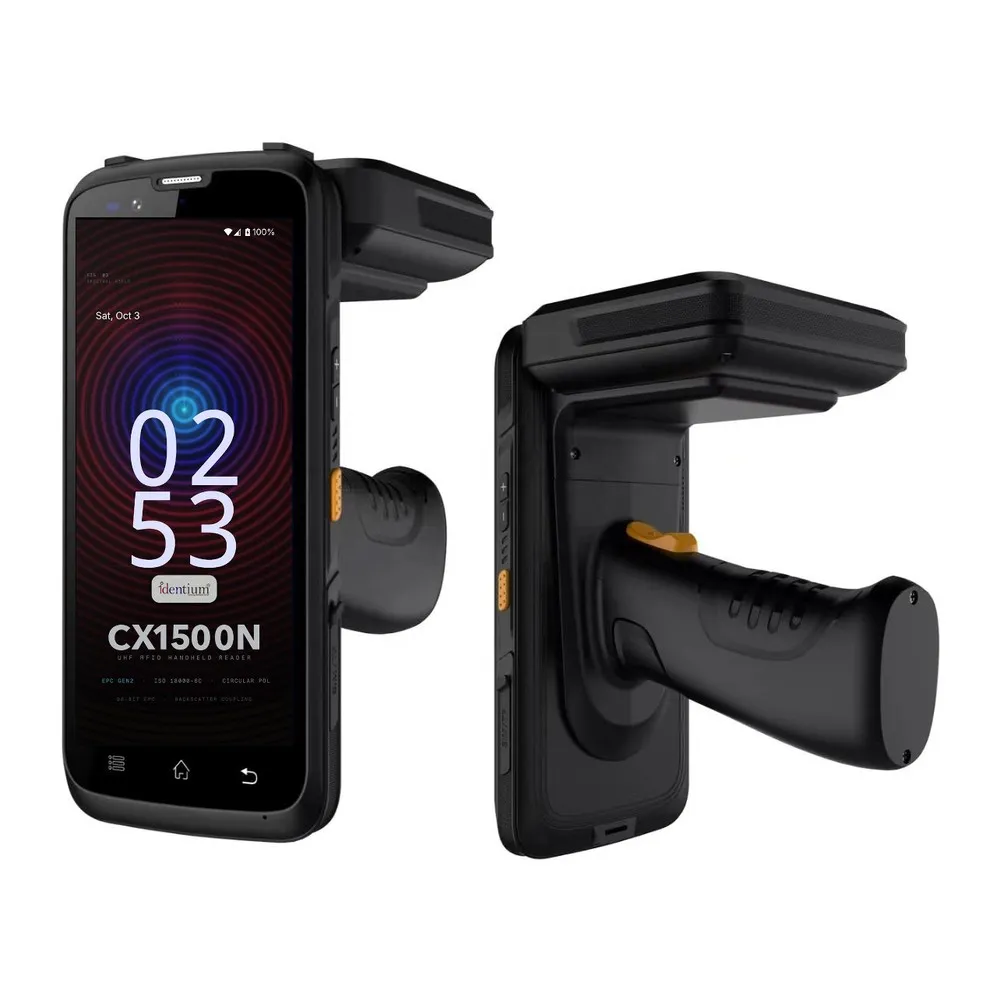
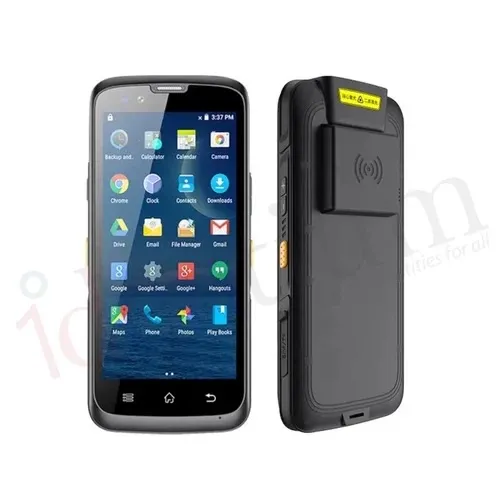
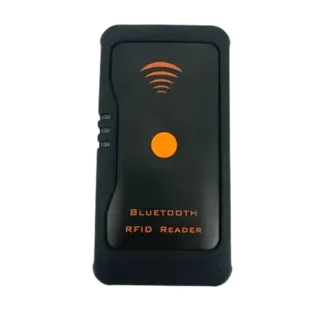
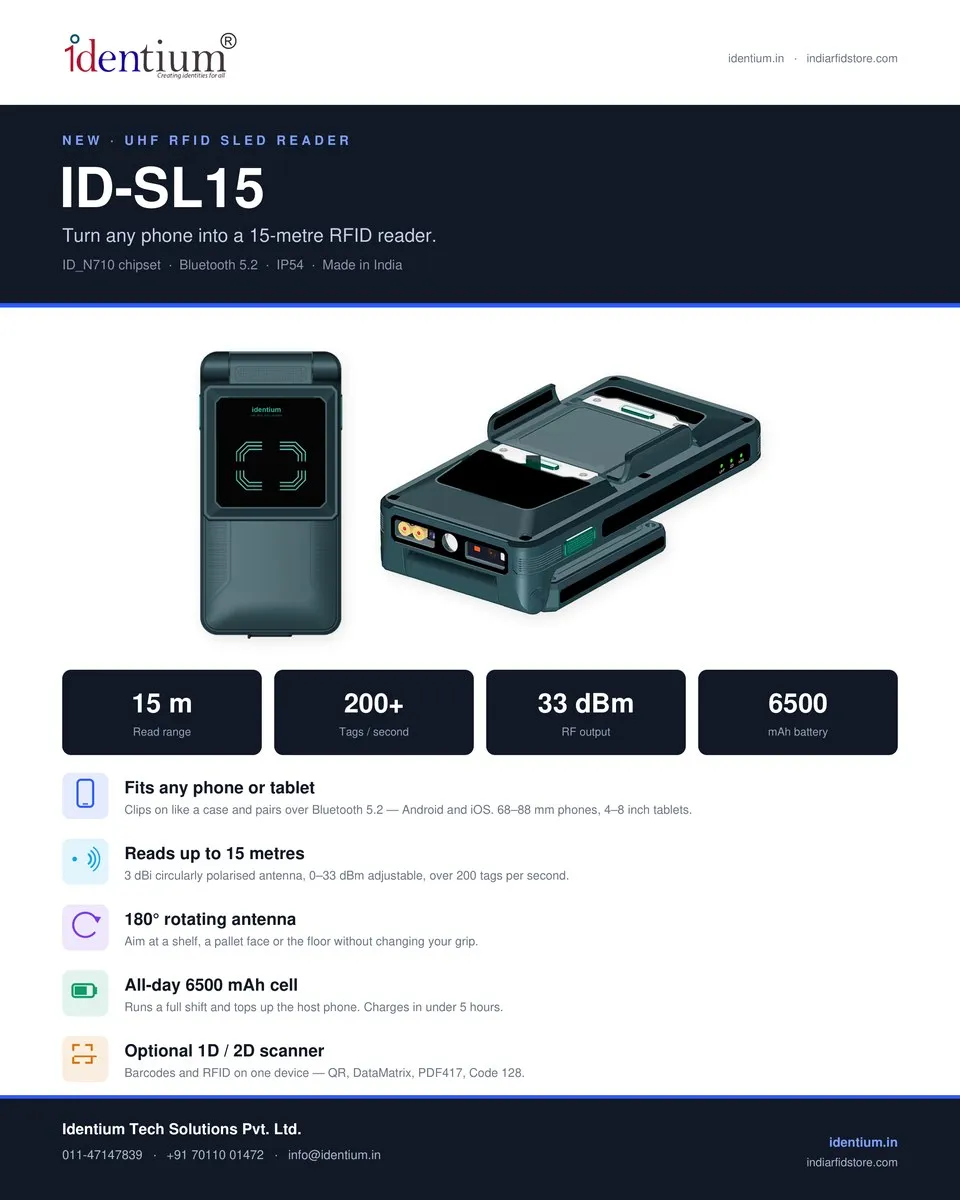
- Handheld readers for mobile cycle counts, receiving and locating specific items on the floor — see the RFID handheld readers range.
- Fixed and desktop readers — RFID readers and antennas at POS counters, exits and receiving docks for hands-free, continuous reading.
- RFID printers to encode and print your own inlay labels on demand — browse RFID printers for in-house tagging.
Comparing reader types for your store
| Reader type | Best for | Read pattern | Typical placement |
|---|---|---|---|
| Handheld reader | Cycle counts, receiving, item search | Mobile, operator-driven | Sales floor and backroom |
| Fixed reader + antenna | Exit loss prevention, dock-door receiving | Continuous, hands-free | Entrances, exits, docks |
| Desktop / Wi-Fi reader | POS checkout, single-item encoding | Short-range, on demand | Counter, back office |
Why 865–868 MHz compliance and reader approvals matter in India
India regulates the UHF RFID band through WPC (Wireless Planning & Coordination), which allocates 865–868 MHz for licence-exempt RFID use. Readers set to the US (902–928 MHz) band are non-compliant here, and tags optimised for other regional bands can perform poorly. Specify 865–868 MHz for every reader and tag you buy.
Approvals apply to readers, because readers transmit; passive tags and labels have no BIS category. Ask for the approval of the exact reader model you are buying. For Identium readers, BIS registration covers ten models (103UDR, CX1000, CX1500N, CX806T, HLR20, IF9A, IHZ4, MUBR01, R58H and UBR12), and the CX1500N, IF9A, IHZ4 and MUBR01 readers hold WPC ETA. Details are on our certifications and approvals page.
The ROI: a worked payback example
RFID's return comes from three levers: accuracy gains of 25–30 percentage points (which recover lost sales), shrinkage reduction of 30–50%, and labour savings from counts that take minutes instead of days.
A sample cost/benefit for a 5-store apparel chain
| Item | Assumption | Annual value (5 stores) |
|---|---|---|
| Recovered lost sales | +3% of ₹15 crore revenue via better availability | +₹45,00,000 |
| Shrinkage reduction | 40% cut on ₹22.5 lakh baseline shrinkage | +₹9,00,000 |
| Labour savings | Counts 6x faster across the year | +₹6,00,000 |
| Gross annual benefit | — | +₹60,00,000 |
| Tags (~5 lakh items at a blended rate) | One-time consumable | −₹30,00,000 |
| Readers, antennas, printers, software | One-time capital | −₹18,00,000 |
| Payback period | — | Under 10 months |
These are illustrative figures — your mix, margins and shrinkage will shift them — but they show why apparel deployments commonly target payback within a year. After year one, tags are the main recurring cost, and the accuracy and labour benefits compound. To run the numbers for your own stores, use the RFID ROI calculator.
Matching RFID to your retail format
Not every store needs the same setup. Use this quick decision guide:
- Single boutique or pilot store: start with UHF soft inlay labels, one handheld reader and a desktop encoder. Minimal capital and the fastest way to prove ROI.
- Multi-store apparel chain: handhelds for cycle counts in every store, fixed readers at exits for loss prevention, and in-house RFID printing so tagging does not depend on every supplier.
- Rental, uniform or linen operations: laundry-grade UHF tags plus handheld readers; skip exit portals and prioritise issue/return tracking.
- Warehouse or distribution centre feeding stores: fixed dock-door readers and antennas for automated receiving and dispatch verification.
If ONDC or live-inventory selling is on your roadmap, bring the continuous-read fixed infrastructure forward — you will need the real-time feed sooner than a purely offline store would.
Getting started: a phased rollout plan
- Pilot (months 1–2). Pick one store and one high-value category. Tag it fully, deploy a handheld and a desktop reader, and measure baseline vs post-RFID accuracy and count time.
- Validate (months 3–4). Expand to the full store, add exit readers, and integrate reads with your POS/ERP. Quantify recovered sales and shrinkage.
- Scale (month 5 onward). Roll the proven playbook across all stores, standardise on source tagging with suppliers, and connect the live inventory feed to ONDC and your GST reconciliation.
Measuring at each phase keeps the business case honest and builds internal buy-in.
Ordering hardware for a retail pilot
India RFID Store is the online catalogue of Identium Tech Solutions Pvt Ltd, a New Delhi RFID manufacturer and supplier in business since 2010. The catalogue covers the UHF inlays and labels, handheld and fixed readers, antennas and printers a retail rollout needs, for India's 865–868 MHz band.
Browse UHF RFID inlays and labels, handheld readers and fixed RFID readers, or request tag samples to test on your own garments and fixtures before you commit.
Related guides
Frequently asked questions
What does an RFID tag cost per unit in India?
What read range can I expect from UHF RFID?
Does RFID work on metal and near liquids?
Will RFID integrate with my existing POS/ERP?
Do RFID readers and tags need BIS or WPC approval in India?
RFID inventory managementretail RFID IndiaUHF RFID tagsapparel RFIDONDCGST complianceMake in India RFIDstock accuracyBIS-registered RFID readers