How to Choose the Right RFID Reader — Read Range, Antenna Ports & IP Rating Explained (India)
Published 18 Jul 20268 min read
Choosing an RFID reader is the most important hardware decision in an RFID deployment. Get it right and tags read cleanly at the speed of your operation; get it wrong and you chase phantom read failures for months. This guide explains how to choose an RFID reader the way an engineer would: by matching form factor, antenna configuration, read-range physics, IP rating and connectivity to your actual use case. It also covers the regulatory step many import buyers miss, WPC ETA and BIS compliance for UHF readers used in India.
Whether you are automating a warehouse dock door, tracking assets across a campus or building a retail checkout, the framework below will help you specify the correct reader the first time.
First, understand the frequency band
Before form factor, fix your frequency. RFID readers in India fall into three practical categories:
- LF (125 kHz): short range (a few cm), used for access control and animal tagging. The least affected by liquids and metal.
- HF / NFC (13.56 MHz): range up to about 10 cm, used for library management, cards, ticketing and contactless payment. See HF RFID readers.
- UHF (865–868 MHz in India): the workhorse for supply chain, asset tracking and inventory, with read ranges from 1 m to 12 m and more with passive tags.
India's UHF RFID band is 865–868 MHz, licence-exempt under WPC (Wireless Planning and Coordination) rules. It is the same range used in Europe under ETSI, but different from the US band (902–928 MHz). This matters: a reader tuned for the US FCC band will not perform to spec on Indian frequencies and may not be legal to use here. Any UHF reader you buy should hold WPC Equipment Type Approval (ETA) for its model, and BIS registration where that applies. Our UHF, HF and LF frequency guide goes deeper on choosing a band.
Fixed, handheld, integrated or desktop: choosing the form factor
The four main reader form factors solve very different problems, and picking the wrong one is the most common and most expensive mistake. Our fixed vs handheld RFID reader comparison covers the most frequent version of this decision in more detail.
Fixed readers
A fixed reader is a stationary unit with 2, 4, 8 or more external antenna ports. You mount it near a choke point, such as a dock door, conveyor or portal, and cable it to antennas placed around the read zone. Fixed readers deliver the highest throughput and are the backbone of automated, hands-free reading. If you need to read every carton passing through a doorway without an operator, this is your category: see UHF 4-port fixed readers.
Handheld readers
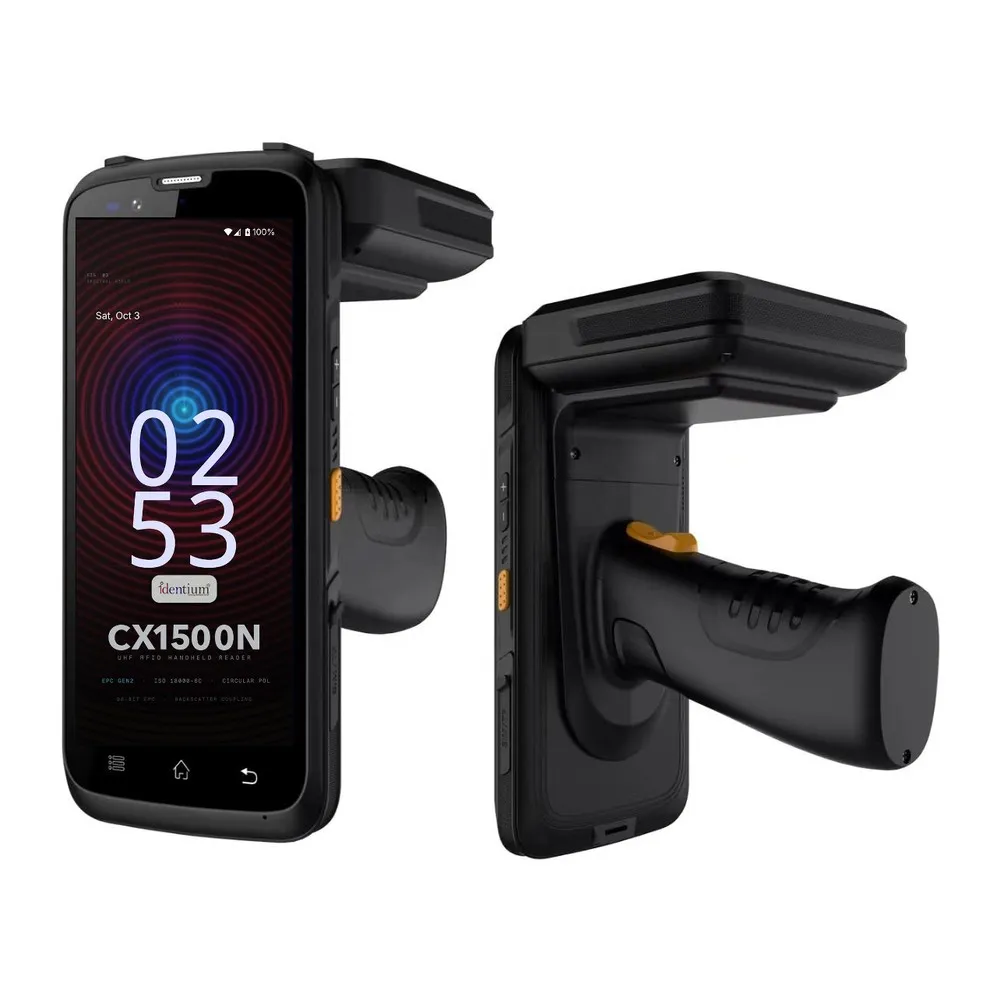
A handheld reader puts a reader, antenna, battery and often an Android computer into one mobile device. It is the right choice when the tags do not come to a fixed point and you go to them instead: stock takes, yard audits, tool-crib checks and field asset verification all need mobility. Browse RFID handheld readers.
Integrated readers
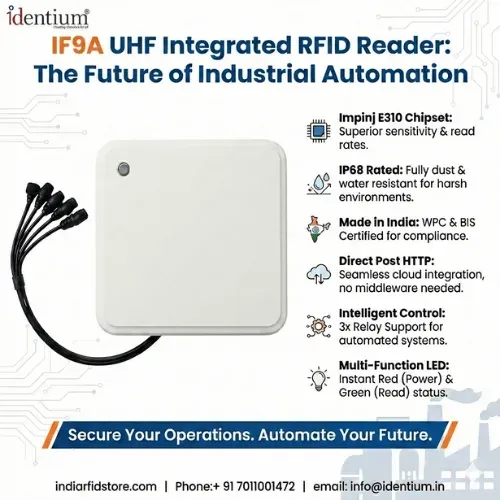
An integrated reader combines the reader electronics and antenna in one sealed enclosure. It installs in minutes, with no coax runs and no antenna alignment, which makes it a good fit for a single point such as one door, a parking barrier or one production station. You trade the flexibility of multiple antennas for much simpler installation. See integrated RFID readers.
Desktop / USB readers
A desktop reader is a small, short-range USB device for encoding tags, issuing cards or verifying single items at a counter. It is a table-top tool, not a coverage device, and suits tag commissioning, library issue desks and membership enrolment. See UHF desktop readers.
Reader form factor comparison
| Feature | Fixed reader | Handheld reader | Integrated reader | Desktop / USB |
|---|---|---|---|---|
| Mobility | Stationary | Fully mobile | Stationary | Table-top |
| Antenna ports | 2–8+ external | Internal (1) | Internal (1); some add 1 external | Internal (1) |
| Typical read range | Up to 10–12 m | Up to 5–8 m | 1–5 m | 2–10 cm |
| Throughput | Highest (hundreds of tags per second) | Moderate | Moderate | Single tag |
| Install complexity | High (cabling, tuning) | None | Low (plug and mount) | None |
| Best for | Dock doors, conveyors, portals | Stock takes, field audits | Single doorways, barriers | Tag encoding, counters |
| Operator needed | No (automated) | Yes | No | Yes |
Antenna ports: why port count defines your coverage
For fixed readers, the number of antenna ports determines how much physical space you can cover. Each port drives one external antenna, and the reader cycles (multiplexes) through the ports in sequence.
- 2-port readers: suit a single dock door, with antennas on both sides for full read-zone coverage.
- 4-port readers: the most popular choice; cover one wide portal with four antennas, or two doors with two antennas each.
- 8-port (and 16-port) readers: for dense environments such as multiple lanes, long conveyors or full-height pallet portals.
Two engineering points buyers overlook:
- Cable loss is real. Every metre of coax between reader and antenna attenuates the signal, so keep runs short and use low-loss LMR-400-class cable for long runs.
- Ports multiplex. A 4-port reader does not read all four antennas simultaneously; it round-robins. If you need genuinely simultaneous zones, size the reader, and its per-antenna dwell time, accordingly.
Match ports with the right antenna gain and polarisation from our RFID antenna range. Circular-polarised antennas tolerate random tag orientation, while linear antennas deliver longer range on tags with a known orientation.
Read range physics: what actually determines distance
"What's the read range?" is the most-asked and most-misunderstood question. Passive UHF read range is not a single number printed on a datasheet; it is the outcome of a power budget. The key drivers are:
- Reader output power: in India, radiated power in the 865–868 MHz band is capped at 2 W e.r.p. More power within the legal limit generally means more range.
- Antenna gain: a higher-gain antenna (for example 9 dBic rather than 6 dBic) focuses energy and extends range, but narrows the beam.
- Tag sensitivity and antenna design: a modern tag chip with −22 dBm read sensitivity far outperforms an older −15 dBm chip. Tag size matters too: a large on-metal tag reads far, a tiny inlay reads close.
- Environment: metal reflects and detunes; water and human bodies absorb. A tag that reads 8 m in free air may read 1 m on a liquid drum.
- Orientation: a linear-polarised antenna loses range if the tag is rotated 90°. Circular polarisation trades peak range for orientation tolerance.
The practical takeaway: never buy on headline range alone. Specify the reader–antenna–tag combination against your material and orientation, and test it on your own items before you scale; you can request RFID samples for that trial.
IP rating: matching the reader to its environment
The IP (Ingress Protection) rating tells you how well the reader enclosure resists dust and water. The first digit covers solids and dust, the second covers liquids. In Indian conditions (dusty warehouses, monsoon-exposed yards, humid coastal sites) this is not optional.
| IP rating | Protection | Suitable environment |
|---|---|---|
| IP41 / IP42 | Limited dust, dripping water | Clean indoor offices, retail counters |
| IP54 | Dust-protected, water splashes | General warehouses, indoor docks |
| IP65 | Dust-tight, low-pressure jets | Outdoor docks, dusty manufacturing |
| IP67 | Dust-tight, temporary immersion | Wash-down areas, exposed yards, rugged handhelds |
Rule of thumb: choose IP54 as the minimum for indoor industrial use, and IP65 or higher for anything outdoor or wash-down. Handhelds used in the field should be IP65 or better, with a suitable drop rating (for example, surviving a 1.2–1.5 m fall to concrete).
Connectivity: how the reader talks to your system
A reader is only useful if its data reaches your WMS, ERP or asset software. Check the interface options:
- Ethernet (PoE): the standard choice for fixed readers. One cable carries data and power, which simplifies installation, so look for Power-over-Ethernet support.
- Wi-Fi: essential for handhelds, and convenient for fixed readers where cabling is impractical.
- USB / RS232 / RS485: for desktop readers and legacy industrial integration.
- Bluetooth: common on sled-type readers and companion handhelds that pair with a phone or tablet.
- GPIO ports: on fixed readers, general-purpose inputs and outputs trigger lights, buzzers, sensors and gates, which is vital for automated portals.
- Protocol support: confirm LLRP, MQTT or a documented SDK or REST API so your developers can integrate cleanly. Android-based handhelds simplify custom app development.
Which RFID reader should you choose? Selection by use case
| Use case | Recommended reader | Ports / range | IP rating | Connectivity |
|---|---|---|---|---|
| Warehouse dock door / portal | Fixed (4-port) | 4 antennas, up to 10 m | IP54–IP65 | PoE Ethernet + GPIO |
| Annual stock take / inventory | Handheld | Internal, up to 6 m | IP65 | Wi-Fi / Bluetooth |
| Single doorway access / barrier | Integrated | 1 zone, 1–5 m | IP65 | Ethernet / Wiegand |
| Conveyor / production line | Fixed (2–4 port) | 2–4 antennas, tuned zone | IP54 | Ethernet + GPIO |
| Tag encoding / card issue | Desktop / USB | Internal, 2–10 cm | IP41 | USB |
| Field asset / tool tracking | Handheld (rugged) | Internal, up to 5 m | IP67 | Wi-Fi / 4G / Bluetooth |
| Outdoor yard / vehicle tracking | Fixed + high-gain antenna | Long-range antennas, 10 m+ | IP65–IP67 | PoE / fibre |
Don't forget compliance: WPC ETA and BIS
India-specific regulation is where many imported readers quietly fail. A UHF reader operating in the 865–868 MHz band needs WPC Equipment Type Approval (ETA) for its model, and many electronic products sold in India must also be registered with BIS under the Compulsory Registration Scheme. Buying from a grey importer can leave you with hardware that is US-band tuned, lacks the paperwork and has no local support.
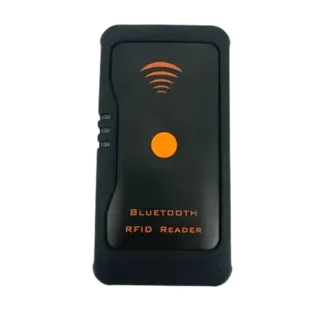
Ask for the ETA and BIS registration references of the exact model you are quoted. In our catalogue, the CX1500N handheld reader, IF9A integrated reader, IHZ4 multi-port fixed reader and MUBR01 portable Bluetooth reader hold WPC ETA, and they are among ten reader models registered with BIS. The full list is on our BIS-registered RFID readers page, and the WPC ETA and BIS compliance checklist explains what to ask a supplier for.
Ready to specify your reader?
The right choice comes from matching form factor, antenna ports, read-range physics, IP rating and connectivity to your application, not from a single headline spec. Tell us your use case, the material you are tagging (metal, liquid or general) and the environment, and we can suggest a reader, antenna and tag combination to test.
Browse RFID readers, handheld readers, integrated readers and matching RFID antennas, or send your requirement through a quote request.
Related reading
Frequently asked questions
What frequency do RFID readers use in India?
How many antenna ports do I need on a fixed reader?
What is a good read range for a UHF RFID reader?
What IP rating do I need for a warehouse?
Do RFID readers in India need BIS or WPC approval?
RFID ReadersBuying GuideUHF RFIDHandheld ReadersFixed ReadersIndia RFIDBIS WPCWarehouse Automation
_1rNsTG.webp)