RFID Antenna Guide — dBi, Polarization & Read Zones Explained (India 2026)
Published 18 Jul 2026Updated 4 Oct 20269 min read

The antenna is the most misunderstood component in a UHF RFID system, and the one that most often decides whether a deployment reads almost every tag or keeps missing them. Readers get the specifications and tags get the attention, but it is the antenna that shapes the invisible field of radio energy your tags sit inside. Get the antenna wrong and no amount of reader tuning will save the read rate.
This guide explains, in practical terms for Indian integrators and end users, how RFID antennas work: gain in dBi, circular versus linear polarization, near-field versus far-field behaviour, read-zone design, and the cabling and connectors that quietly make or break performance.
Everything here assumes India's licence-exempt UHF RFID band of 865–868 MHz, not the 902–928 MHz FCC band used in the US. That distinction matters when you buy an antenna, and we come back to it below.
What an RFID antenna actually does
A passive UHF RFID tag has no battery. It powers itself entirely from the radio energy radiated by the reader antenna, so the antenna does two jobs at once: it delivers RF energy to wake the tag's chip, and it captures the extremely weak backscattered signal the tag reflects back. The reader is the engine; the antenna is the wheels that put that power on the road.
Because the tag is powered by the field, the antenna defines your entire read zone: its size, its shape and its reliability. Two systems with identical readers and tags can behave completely differently simply because one uses a 9 dBi circular-polarized panel and the other a 6 dBi linear one.
If you take one idea away from this article, make it this: you design read zones with antennas, not with readers. Browse the RFID antenna category to match a model to your zone.
Gain (dBi) explained, and why more is not always better
Antenna gain, measured in dBi (decibels relative to an isotropic radiator), describes how tightly an antenna focuses its energy. An antenna does not create power; it redistributes it. A high-gain antenna concentrates the reader's output into a narrow, far-reaching beam, while a low-gain antenna spreads the same power over a wider but shorter zone.
Think of it like a torch. A 12 dBi antenna is a spotlight, with a long throw and a narrow cone. A 6 dBi antenna is a floodlight, with a short throw and a wide spread. Neither is better; they solve different problems.
- 6 dBi: wide beamwidth (about 70–100°) and short read range. Suits small portals, counters and shelves where you want a broad but shallow field.
- 8–9 dBi: the workhorse. A balanced beamwidth of about 65–70° and solid range; this is what most Indian dock-door and warehouse portals use.
- 12 dBi: a narrow beam (about 30–40°) and long range. Used for lane control, parking barriers and long conveyor tunnels, where you need reach and want to reject stray tags.
Gain and the Indian power limit
Under the 2021 licence-exemption rules (G.S.R. 853(E)), UHF RFID readers in the 865–868 MHz band may radiate up to 2 W e.r.p., which is about 33 dBm e.r.p. or roughly 35 dBm EIRP. Radiated power is the reader's conducted output plus antenna gain minus cable loss.
So bolting on a 12 dBi antenna does not let you exceed the legal ceiling; it forces you to turn the reader power down to stay within it. For example, a reader set to 30 dBm (1 W) feeding an 8 dBi antenna through 2 dB of cable radiates about 36 dBm EIRP, so its output has to come down by about 1 dB. Higher gain buys you beam shape and cable-loss headroom, not unlimited range.
Circular vs linear polarization
Polarization describes the orientation of the electromagnetic wave the antenna radiates. It is the specification that most directly affects real-world read reliability, and it is where most first-time buyers go wrong.
Linear polarization
A linear antenna radiates energy in a single plane, horizontal or vertical. It couples very efficiently with a tag whose antenna is aligned to the same plane, giving it the longest range for a given gain. Rotate that tag 90° and the read rate collapses.
Linear antennas are the right choice only when tag orientation is fixed and predictable, such as a conveyor where every carton is fed the same way, or a print-and-apply label line.
Circular polarization
A circular-polarized (CP) antenna radiates a wave that rotates continuously as it travels, sweeping through every orientation. It therefore reads tags regardless of how they are turned, which makes it the practical winner for the many deployments where boxes, garments, files and pallets arrive in random orientations.
The trade-off is roughly 3 dB less effective range than a linear antenna of the same gain, because at any instant only part of the rotating field aligns with the tag.
Rule of thumb for Indian deployments: if tag orientation is unpredictable, choose circular; if it is fixed and you need maximum range, choose linear. When unsure, circular is the safer default and covers most use cases.
Near-field vs far-field
Near-field and far-field describe how the tag couples to the antenna, and they are not interchangeable.
Far-field is conventional UHF operation. The tag harvests propagating radio waves and backscatters a reply, which gives UHF its metre-scale range. A standard panel antenna works this way, and nearly every portal, dock and warehouse read is far-field.
Near-field uses inductive or reactive coupling within a small fraction of a wavelength: a few centimetres at 865 MHz, where the full wavelength is about 35 cm. Near-field UHF antennas are built for item-level reading of small, densely packed, or liquid- and metal-heavy items where far-field struggles, such as pharmaceuticals, jewellery trays, blood bags, vials and cosmetics.
They produce a small, tightly bounded field that reads only what is right on top of the antenna. That is exactly the point when you must avoid reading the shelf below or the tray beside it.
| Characteristic | Far-field antenna | Near-field antenna |
|---|---|---|
| Coupling | Radiated wave (backscatter) | Inductive / reactive |
| Typical range | 0.5–10 m | 0–15 cm |
| Best for | Portals, docks, pallets, lanes | Item level; small, liquid or metal items |
| Zone control | Broad, may need shielding | Naturally confined |
| Example use | Warehouse dock door | Pharma vial tray, jewellery counter |
How to design a read zone
A read zone is the physical volume in which your system reliably reads tags. Designing one means shaping the field to cover what you want and exclude what you do not; stray reads from adjacent aisles are the most common failure in dense Indian warehouses. Work through these steps:
- Define the volume. Measure the actual space tags must pass through. A 1.2 m wide dock door needs a different field from a 3 m garment portal.
- Pick gain to match beamwidth. A wide door with short depth calls for lower gain (6–8 dBi); a long lane calls for higher gain (12 dBi).
- Choose polarization by tag orientation. Random orientation means circular; fixed orientation can use linear.
- Count your antennas and ports. A single dock door typically uses two antennas, facing each other or angled, for full coverage, and a large portal may need four. This is where a 4-port UHF RFID reader earns its place, with one reader driving four antennas across a wide opening.
- Tune power, then measure. Set reader power within the 2 W e.r.p. limit, then walk tags through the zone and log read rates. Reduce power or angle antennas inward to remove stray reads from neighbouring zones.
- Mind the metal and water. Concrete floors, metal racking and liquids reflect and absorb 865 MHz energy, so physical layout is part of antenna design, not an afterthought.
For compact spots such as a single billing counter, an access lane or a small file-tracking desk, an integrated RFID reader with a built-in antenna removes cable loss from the equation and is far easier to deploy. For anything that needs separate placement or several zones, pair a fixed RFID reader with external antennas.
Cable and connector selection
A frequently overlooked cause of poor read range in Indian installations is not the antenna or the reader but the coaxial cable between them. Every metre of cable eats RF energy, and at 865 MHz that loss adds up quickly.
- Cable type: use low-loss coax such as LMR-240 for short runs and LMR-400 for anything over about 3 m. Thin RG-58 loses roughly 0.5 dB per metre at UHF, so a 5 m run throws away around 2.5 dB and noticeably shortens your range.
- Keep it short: mount the reader close to the antenna. Every dB of cable loss is subtracted from both the outbound power and the returning tag signal, so the loss counts twice.
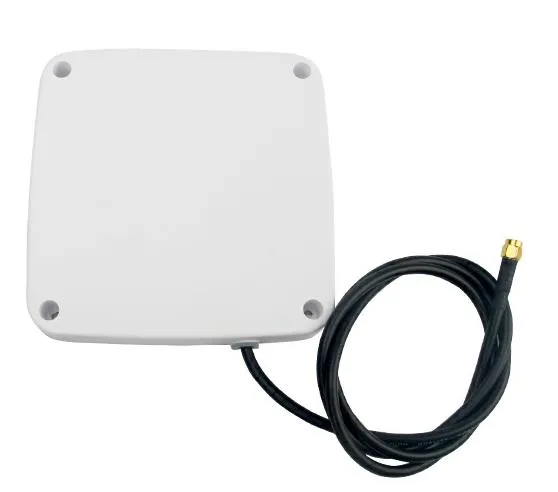
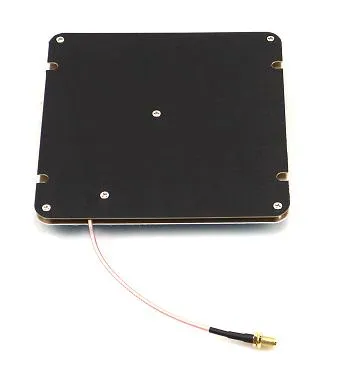
- Connectors: UHF RFID antennas typically use RP-TNC, N-type or SMA connectors. RP-TNC is common on fixed readers; N-type is rugged and preferred for outdoor or industrial runs. Confirm the connector type and gender on both reader and antenna before ordering the cable.
- Weatherproofing: for outdoor lanes and gates, use IP65-rated antennas and seal the connector junction with self-amalgamating tape. Water getting into the connector is a leading cause of field failures in the monsoon.
Antenna types by use case: comparison
| Antenna type | Typical gain | Polarization | Best use case (India) |
|---|---|---|---|
| Wide-beam panel | 6 dBi | Circular | Retail shelves, small billing counters, close-range portals |
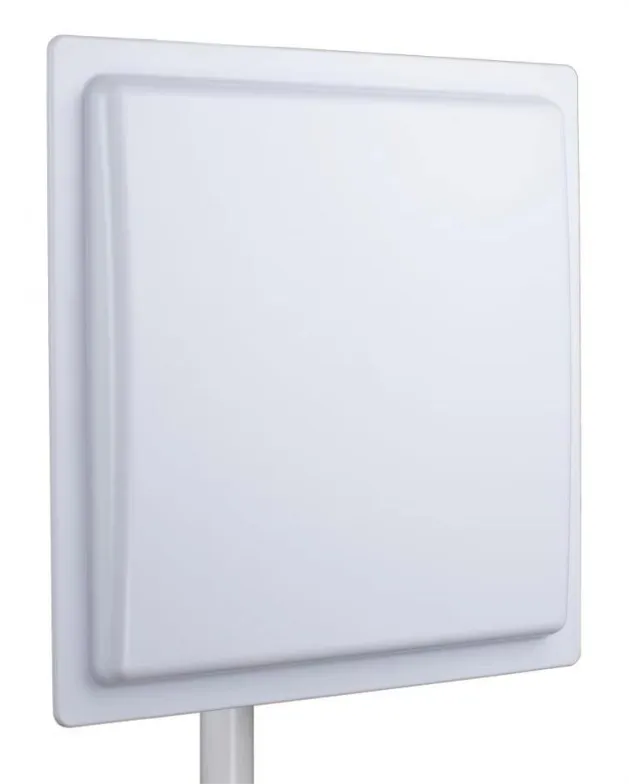
| Standard panel | 8–9 dBi | Circular | Dock doors, warehouse portals, garment gates (the default) |
| High-gain panel | 12 dBi | Circular or linear | Parking and toll lanes, long conveyor tunnels, boom barriers |
| Linear panel | 8–9 dBi | Linear | Fixed-orientation conveyors, print-and-apply lines |
| Near-field | Low / confined | Not applicable | Pharma, jewellery, files, item-level reading of liquid or metal items |
| Ceiling / dome | 6–7 dBi | Circular | Overhead zones, retail exits, hands-free checkout areas |
Which antenna should you choose?
Cut through the specifications with these quick decisions:
- Warehouse dock door or general portal: an 8–9 dBi circular panel, two antennas per door. This is the safe, proven default.
- Parking, toll or vehicle access: a 12 dBi high-gain antenna, ideally paired with a 4-port reader for lane coverage.
- Retail, library or file tracking at a counter: an integrated reader, or a 6 dBi wide-beam panel.
- Small, dense, or liquid and metal items: a near-field antenna, no exceptions.
- Fixed-orientation conveyor: a linear panel for maximum range.
When in doubt, start with an 8–9 dBi circular panel. It is forgiving and orientation-tolerant, and it covers the majority of Indian B2B deployments.
Matching antennas from the catalogue
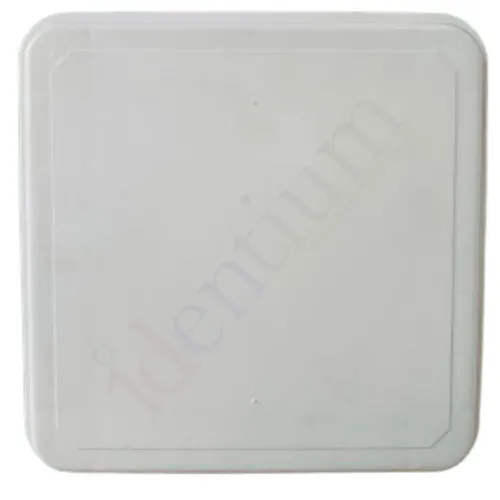
- UHF 9 dBi circular antenna (IDTS-RUCA9): 865–868 MHz, right-hand circular, 70° × 60° beam, N-female connector. The dock-door and portal default; this model has WPC ETA.
- UHF 12 dBi circular antenna (IDTS-RUCA12): 865–868 MHz, right-hand circular, 40° × 38° beam, N-female connector. For long lanes and vehicle gates.
- 5 dBi full-band panel antenna (IDTS-RA5134): 860–940 MHz, circular, 100° × 100° beam. For counters, shelves and wide, shallow zones.
- UHF near-field antenna (IDTS-RANF150): a 150 × 150 mm pad, available for the 865–868 MHz band. For item-level reading at a counter or tray.
Check the frequency band before you buy
Antennas tuned narrowly for the FCC 902–928 MHz band lose gain at India's 865–868 MHz frequencies, which is exactly where you need it. Before you order, check that the antenna's rated frequency range covers 865–868 MHz, either as an India/EU-band model or a full-band 860–960 MHz design, and confirm the impedance (50 Ω), connector and IP rating for your site.
The reader needs WPC Equipment Type Approval for the exact model; our WPC ETA and BIS compliance checklist explains what to ask your supplier for.
Related guides
Frequently asked questions
What frequency do RFID antennas use in India?
What is a good dBi gain for a warehouse RFID antenna?
Should I use circular or linear polarization?
How many antennas does one RFID reader support?
Why is my RFID read range shorter than the spec sheet says?
What connector do UHF RFID antennas use?
RFID AntennaUHF RFIDdBi GainCircular PolarizationRead Zone DesignRFID IndiaWPC ETA antenna RUCA9