UHF vs HF vs LF vs NFC RFID — Which Frequency Should You Choose? (India 2026 Guide)
Published 18 Jul 20267 min read
One of the most common, and most expensive, mistakes Indian businesses make when starting an RFID project is choosing the wrong frequency. A tag that reads perfectly on a factory conveyor at 6 metres may fail completely on a metal asset, and a smart card that works flawlessly at an office door is useless for tracking pallets across a warehouse. The frequency band is the most important technical decision in the project. It drives everything downstream: read range, speed, tag cost, reader cost, and whether the deployment is legal in India.
This guide breaks down the four RFID technologies Indian buyers evaluate in 2026: LF (Low Frequency), HF (High Frequency), NFC (a specialised subset of HF) and UHF (Ultra-High Frequency). It focuses on the question most buyers ask first, UHF vs HF RFID, and reflects what works on the ground in logistics, manufacturing, retail, healthcare and government projects.
Quick answer: To read many tags quickly from a distance (pallets, cartons, vehicles, laundry, fixed assets), choose UHF at 865–868 MHz in India. For a secure, short-range tap for access control, payments, ticketing or product authentication, choose HF/NFC at 13.56 MHz. For rugged, water- and metal-tolerant identification at very short range, such as animal tagging and vehicle immobilisers, choose LF at 125 kHz.
How each RFID frequency works
LF — Low Frequency (125–134 kHz)
LF is the oldest and most robust RFID band. It uses inductive (magnetic) coupling between the reader coil and the tag coil, which makes it tolerant of water, tissue and non-ferrous obstructions. That is why LF dominates animal identification (the ISO 11784/11785 glass transponders used for pet microchipping and livestock), vehicle immobilisers and closed industrial loops.
The trade-off is range, typically a few centimetres, and slow data rates. LF has no meaningful anti-collision, so it cannot read several tags at once.
HF — High Frequency (13.56 MHz)
HF also relies on inductive coupling, but at a much higher frequency, which allows faster data transfer and true anti-collision (reading several cards in the field). It is the workhorse of access control, library management, cashless canteens and closed-loop payments. Popular chips include NXP MIFARE Classic, MIFARE DESFire EV2/EV3 and ICODE SLIX (ISO 15693).
Range is typically up to about 10 cm, and that is a feature: the user must deliberately present the card, which improves security and prevents accidental reads.
NFC — Near Field Communication (a 13.56 MHz subset)
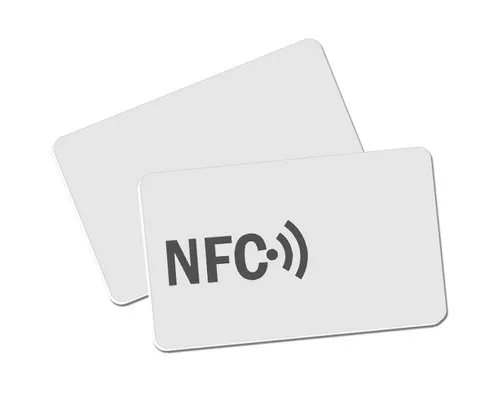
NFC is HF with a standardised, peer-to-peer-capable protocol layer designed so that smartphones can read and write tags. Every modern Android phone and iPhone can scan an NFC tag; NTAG213, NTAG215 and NTAG216 are the common chips. That makes NFC the natural choice for consumer-facing uses: product authentication, "tap for info" packaging, smart posters, digital business cards, warranty registration and anti-counterfeiting. Range is 1–4 cm by design.
UHF — Ultra-High Frequency (865–868 MHz in India)
UHF is the technology behind modern supply-chain and asset-tracking RFID. Instead of magnetic coupling it uses far-field backscatter, which gives much longer range (up to 8–12 m with a fixed reader) and the ability to read hundreds of tags per second. The dominant standard is EPC Gen2 / ISO 18000-63, with chips such as the Impinj Monza R6 and M700 series and NXP UCODE 8 and 9.
Passive UHF tags are also the cheapest per unit at volume, which is why retail, warehousing and logistics have standardised on them. The catch: plain UHF tags are sensitive to metal and liquid, so on those surfaces you need purpose-built on-metal tags.
The India frequency and regulatory picture
Radio spectrum is regulated country by country. In India, UHF RFID operates in the 865–868 MHz band, which is licence-exempt under G.S.R. 853(E) of 2021 for RFID readers up to 2 W e.r.p. That band matches the European ETSI 865–868 MHz allocation and differs from the US 902–928 MHz band, so a reader tuned for the US can leave you non-compliant and under-performing. The ETSI 865–868 MHz compatibility guide explains what this means for tags and readers moving between regions.
Licence-exempt does not mean unregulated. Each UHF reader model needs WPC Equipment Type Approval (ETA) and BIS registration under the Compulsory Registration Scheme, so ask for both certificates naming the exact model. In this catalogue, the CX1500N handheld, the IF9A integrated reader, the IHZ4 four-port reader and the MUBR01 Bluetooth reader hold both. The WPC ETA and BIS compliance checklist covers the details. HF/NFC (13.56 MHz) and LF (125 kHz) are globally harmonised bands and do not carry the same regional-band risk.
The big comparison table
| Attribute | LF | HF | NFC (HF subset) | UHF |
|---|---|---|---|---|
| Frequency | 125–134 kHz | 13.56 MHz | 13.56 MHz | 865–868 MHz (India) |
| Coupling | Inductive (near-field) | Inductive (near-field) | Inductive (near-field) | Backscatter (far-field) |
| Typical read range | 1–10 cm | Up to about 10 cm | 1–4 cm | Up to 8–12 m (fixed reader) |
| Read speed and bulk reading | Slow, single tag | Moderate, a few tags | Single tag (tap) | Very fast, hundreds of tags per second |
| Anti-collision | No or limited | Yes | Single tap by design | Yes (excellent) |
| Tag cost (passive, at volume) | Medium to high | Medium | Low to medium | Lowest per unit |
| Metal and liquid tolerance | Excellent | Good | Good | Poor (needs on-metal tags) |
| Common chips | EM4200, HITAG, ISO 11784/85 | MIFARE Classic, MIFARE DESFire, ICODE SLIX | NTAG213/215/216 | Impinj M700/R6, NXP UCODE 8/9 |
| Security options | Basic | Strong (AES on DESFire) | Moderate (signature, lock) | Basic to moderate (untraceable, kill) |
| Best for | Animal ID, immobilisers, harsh loops | Access, ticketing, closed-loop payment | Product authentication, marketing, phone tap | Supply chain, warehouse, assets, tolls |
UHF vs HF RFID: the head-to-head buyers care about
Most Indian RFID enquiries come down to a choice between these two. Here is how they compare:
- Range and throughput: UHF wins clearly. If items must be read from a distance, in bulk or while moving (a trolley of cartons through a dock door, a vehicle at a toll lane), only UHF is viable. HF needs a deliberate tap within about 10 cm.
- Security and privacy: HF wins. Short range and encrypted chip options such as MIFARE DESFire EV3 with AES make HF the standard for access control and payments. UHF's long range is a liability where you do not want casual reads.
- Cost at scale: UHF passive inlays are the cheapest tags available, which is why item-level retail tagging uses them. HF cards cost more per unit but can be reused for years.
- Surface sensitivity: HF handles the human body and small metal parts better out of the box. UHF needs on-metal tags for tools, IT assets and cylinders; they are readily available, but plan for them.
Many mature deployments use both: UHF for pallet- and asset-level tracking in the warehouse, and HF/NFC for employee access and point-of-authentication at the counter.
Decision tree: pick your frequency in under a minute
| Question | If yes | If no |
|---|---|---|
| 1. Do you need to read tags from more than about 30 cm away, or read many tags at once? | Go to question 2 | Go to question 3 |
| 2. Is the item mostly metal or liquid-filled? | UHF with on-metal tags | UHF with standard passive tags |
| 3. Should the end user scan it with an ordinary smartphone? | NFC (NTAG21x) | Go to question 4 |
| 4. Do you need encryption or secure access (doors, payments, ID)? | HF (MIFARE DESFire or Classic) | Go to question 5 |
| 5. Is it animals, immobilisers, or a wet or greasy industrial loop at very short range? | LF (125 kHz) | HF is the safe general-purpose default |
Best use cases by frequency
Choose UHF for
Warehouse and inventory management, pallet and carton tracking, fixed-asset and IT-asset audits, laundry and linen management, file and document tracking, vehicle and parking access, and toll-style lanes. Start with the UHF RFID tags range (and on-metal RFID tags for metal assets), and pair them with fixed or handheld RFID readers set to the 865–868 MHz Indian band.
Choose HF for
Office and factory access control, cashless canteens, membership and loyalty, library RFID, hotel key cards and event ticketing. HF RFID cards come in MIFARE Classic 1K/4K, MIFARE DESFire, NTAG and ICODE versions (the NFC cards listing compares them). Match the chip to the readers you already run, or pick a matching HF RFID reader.
Choose NFC for
Product authentication and anti-counterfeiting, "tap for info" packaging and smart posters, warranty registration, digital business cards and phone-based inspections. Browse NFC tags and labels built on NTAG213, NTAG215 and NTAG216 for reliable smartphone reads.
Choose LF for
Animal and livestock identification, vehicle immobilisers and rugged short-range industrial cycles where water and metal defeat higher frequencies. See the LF RFID tags range.
Cost planning: don't just count the tags
Buyers often compare the per-tag price and stop there, but the total cost of ownership includes the reader infrastructure. UHF fixed readers and antennas cost more upfront but read cheaper tags at scale, which pays off when you are tagging tens of thousands of items. HF readers are inexpensive and the cards last for years, which suits closed-loop access and payment systems. NFC needs no dedicated reader at all if your users have smartphones, making it the lowest-infrastructure option for consumer engagement.
Always pilot with real items in your actual environment before scaling. A two-week proof of concept prevents costly frequency U-turns, and you can request RFID samples to run one.
Shop by frequency
Frequently asked questions
Is NFC the same as RFID?
Which RFID frequency has the longest read range?
Can UHF RFID read tags on metal or liquid?
What UHF frequency is legal in India?
Should I use HF or UHF for access control?
RFID FrequencyUHF RFIDHF RFIDLF RFIDNFCRFID ReadersIndia RFIDBuying Guide