
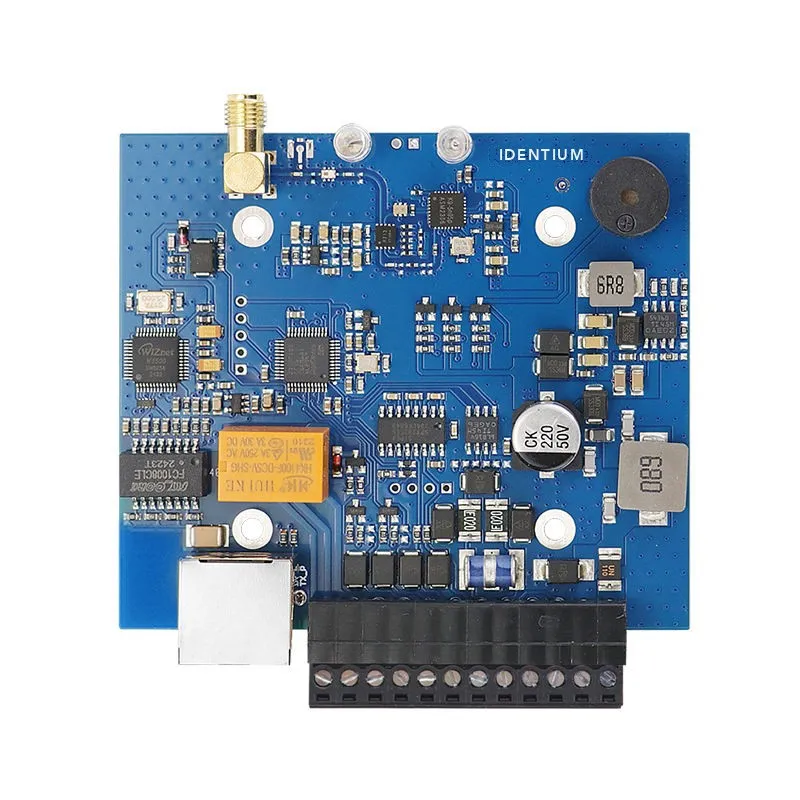
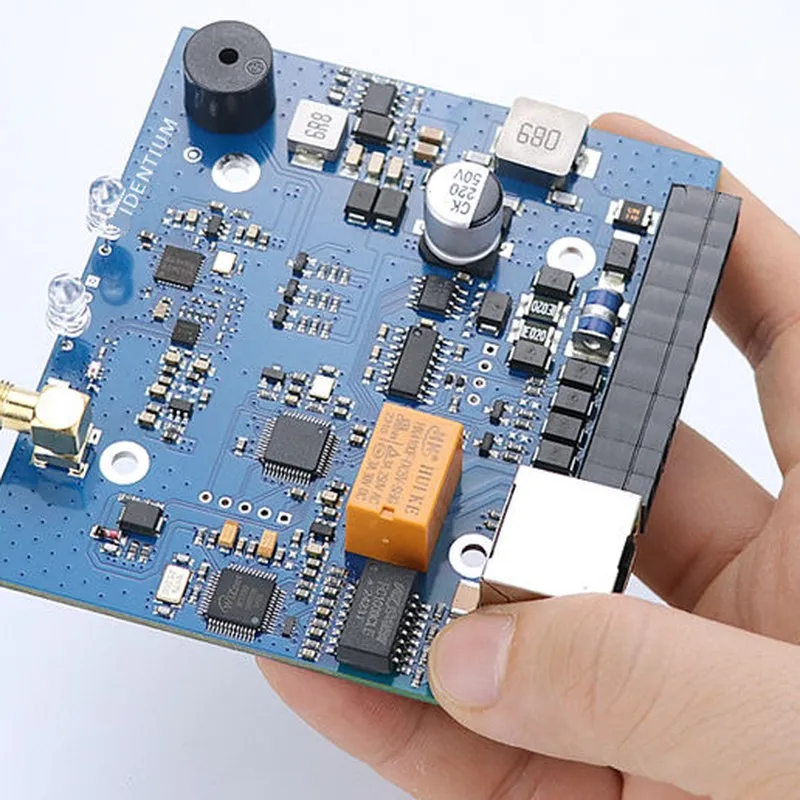
UHF RFID Reader Module IDTS-RM26 (Ethernet, RS485, Wiegand, Relay)
A board-level UHF RFID reader with one SMA port for an external UHF antenna, made for integrators. It reports over Ethernet, RS232, RS485 or Wiegand 26/34, switches a relay for a barrier or gate, and works with ID Tech and ZKRFID software.
Price on request
Minimum order: 1 piece · the final price for your quantity is confirmed in the quote
View datasheet PDF · 266 KB- 7-day replacement · 1-year warranty against manufacturing defects
- Blue Dart next-day delivery
Key features
- Split module: one SMA female port for an external UHF antenna of your choice
- Ethernet (TCP/IP), RS232, RS485 and Wiegand 26/34 on one board
- One relay (COM/NO/NC) to trigger a boom barrier or gate
- Active, passive (command) and trigger work modes; LED and buzzer prompts
- Compatible with ID Tech and ZKRFID software; SDK for your own software
- India version 865–868 MHz; output power adjustable from 0 to 26 dBm
- Protocol
- ISO 18000-6C (EPC Gen2)
- Frequency
- 865–868 MHz (India version); 902–928 MHz version for other regions
- Frequency hopping
- FHSS or fixed frequency
- RF chip
- K9
Overview
What the IDTS-RM26 UHF RFID reader module does
The IDTS-RM26 is a UHF RFID reader on a bare board, for integrators who build the reader into their own gate controller, cabinet or machine. It is a split module: the board carries the reader electronics and one SMA female antenna port, and you connect a separate UHF antenna chosen for the read zone. It reads and writes ISO 18000-6C (EPC Gen2) tags.
Read distance therefore depends on the antenna, its cable and the tag, not on the board alone. Pick an antenna from the RFID antenna range and test with your own tags.
Interfaces, Wiegand output and relay
- Ethernet (TCP/IP, RJ45): sends reads to a PC or server on the site network.
- RS232 and RS485: serial links to a controller, PLC or panel; RS485 suits longer cable runs.
- Wiegand 26/34: the output most access controllers accept from a card reader, so a tag read reaches the controller the way a card number does.
- Relay (COM/NO/NC): one contact set to trigger a boom barrier or gate opener. Wire it to the barrier or gate controller's open input, and ask us before switching a load directly.
Three work modes: active (it reads and reports on its own), passive (it reads when host software sends a command) and trigger (confirm with us how the trigger is fed: the 12-pin terminal lists no trigger input). LEDs and a buzzer show status.
Frequency, read zone and software
In India, order the 865–868 MHz version and use EPC Gen2 tags made for the same band: UHF tags are tuned to a band, and one made for 902–928 MHz usually reads shorter here. Turning the output power down keeps reads inside one lane on a multi-lane site. It is compatible with ID Tech and ZKRFID software; for your own application, use the SDK.
How it differs from the ICL1P, ICL4P and ICL8 boards
| Board | Antenna ports | Listed connectivity | Made for |
|---|---|---|---|
| IDTS-RM26 | 1 (SMA) | Ethernet, RS232, RS485, Wiegand 26/34, relay | Access control: parking lanes, gates, barriers |
| ICL1P | 1 | Wi-Fi, COM port or network; Bluetooth and 4G optional | Single read points |
| ICL4P | 4 | Wi-Fi, PoE, COM port or network; Bluetooth and 4G optional | Wide portals or up to four read points |
| ICL8 | 8 | Wi-Fi, PoE, COM port or network; Bluetooth and 4G optional | Multi-lane sites and conveyor lines |
Choose the IDTS-RM26 to feed an existing access controller or switch a barrier; choose an ICL board from the RFID modules range for Wi-Fi, PoE (ICL4P and ICL8) or several antennas on one controller. If you would rather not source a separate antenna, a boxed reader from the integrated RFID readers range is simpler to install.
Typical applications
- Parking entry and exit
- Vehicle access control
- Boom barriers and gates
- Tool cabinets
- OEM equipment
- RFID development kits
Specifications
Datasheet (PDF)| Model | IDTS-RM26 |
|---|---|
| Form factor | Split reader module (board level): external UHF antenna required |
| Function | Read and write |
| Protocol | ISO 18000-6C (EPC Gen2) |
| Frequency | 865–868 MHz (India version); 902–928 MHz version for other regions |
| Frequency hopping | FHSS or fixed frequency |
| RF chip | K9 |
| Output power | 0–26 dBm, adjustable |
| Antenna port | 1 × SMA female |
| Read range | Depends on the antenna, cable and tag used; test with your own tags |
| Interface | TCP/IP (Ethernet, RJ45), RS232, RS485, Wiegand 26/34 |
| Relay | 1 group, COM / NO / NC |
| Work modes | Active, passive (command), trigger |
| Indicators | LEDs and buzzer |
| Compatible with | ID Tech and ZKRFID software |
| SDK | Available for secondary development |
| Power | DC 9–24 V; consumption ≤ 4 W |
| Terminal | 12-pin, 3.81 mm: 1 +12V, 2 GND, 3 TXD, 4 RXD, 5 485−, 6 485+, 7 GND, 8 D0, 9 D1, 10 COM, 11 NO, 12 NC |
| Dimensions | About 87 × 85 × 16 mm (confirm with us before designing an enclosure) |
| Mounting | 3 mm mounting holes (ask us for the hole positions) |
| Weight | 50 g net, 100 g gross |
| Operating temperature | −20 °C to +70 °C |
| Storage temperature | −40 °C to +125 °C |
| In the box | Module, 1 UHF test card, factory QC certificate (antenna, cables and power supply not included) |
| Packaging | 150 × 110 × 40 mm box |
_Z1R2JiW.webp)
_Z121Eea.webp)