RFID Machine or Scanner? Which RFID Reader You Need (India)
Published 25 Oct 20267 min read
Written and maintained by the RFID team at Identium Tech Solutions Pvt Ltd, New Delhi (India RFID Store).
Prices checked on 22 Oct 2026 against the catalogue.
Short answer: "RFID machine" and "RFID scanner" are both everyday names for an RFID reader. Five kinds of device go by these names: a USB desktop reader, a pocket reader that works with your phone, a handheld, a fixed (integrated) reader and a walk-through gate. Choose by the job: a desktop reader to register cards at a counter, a pocket reader or handheld to count jewellery or stock, a fixed reader at a vehicle gate or dock door, and a gate reader for people and goods walking through a doorway.
Search for an RFID machine and you will find everything from a palm-sized USB reader to a gate that stands taller than a person. They all do the same basic thing: send out a radio signal, power the tags within range and pass the tag numbers to a computer, a phone or a controller. What separates them is the kind of tag they read, how far they read and where the numbers end up. This guide maps the words buyers use to the device that does the job, using the reader types in our catalogue, so you can ask for the right one.
What people mean by "RFID machine" and "RFID scanner"
Our RFID glossary treats both phrases as buyer vocabulary for a reader; this site says "reader" throughout. An RFID scanner is named by analogy with a barcode scanner, but it needs no line of sight, and a UHF reader picks up many tags at once. These are the five devices behind the words:
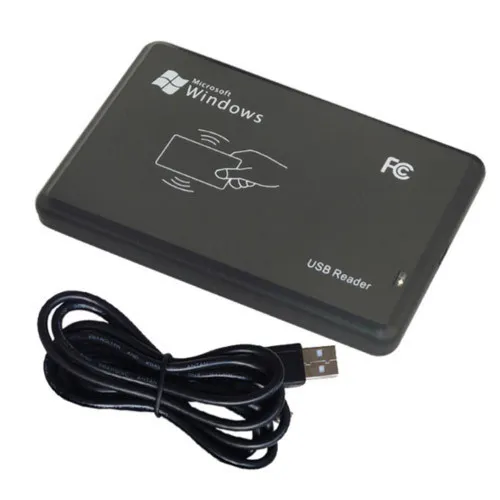
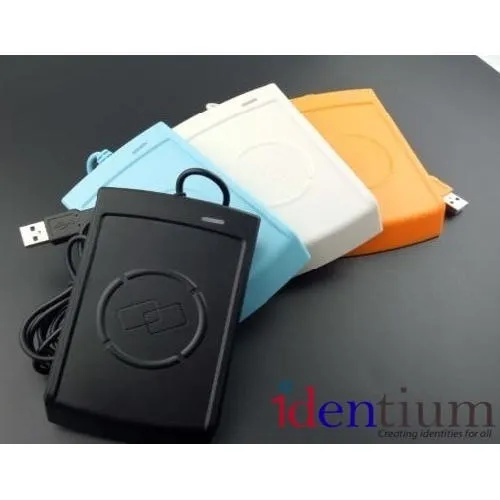
- USB desktop reader. It sits beside a PC and reads a card or tag held on it, within centimetres. Offices use one to register staff cards, libraries to issue books, and shops to check labels. The IDTS-LFPPR reads 125 kHz cards at 5–8 cm with no software or driver to install; the HRD20 reads 13.56 MHz cards at 5–10 cm.
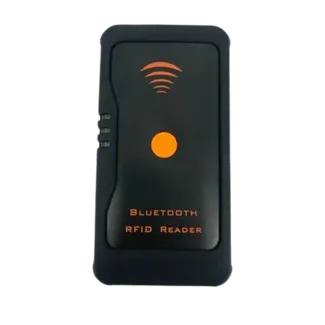
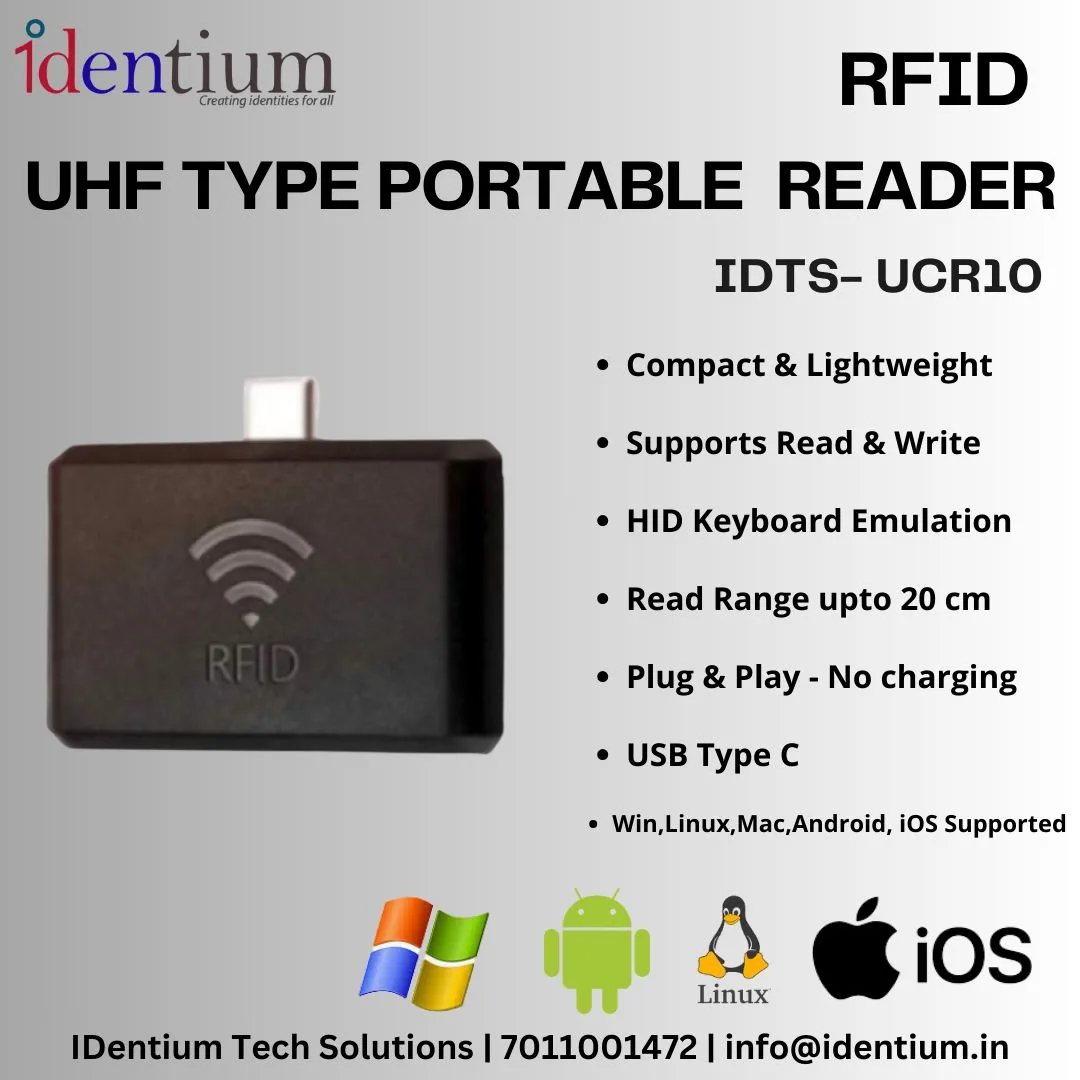
- Pocket reader for your phone. A small UHF reader without a screen: your phone's app does the work. The MUBR01 pairs with an Android phone over Bluetooth and reads at 0–3 m; the UCR10 plugs into a USB-C port and reads up to 1.5 m.
- Handheld reader. An all-in-one unit with its own screen, battery and app, often called an RFID gun. The CX1000 reads UHF tags at up to 6 m and runs IDOS, Identium's OS built on Android 15.
- Fixed or integrated reader. Mounted on a pole, wall or ceiling with the antenna built into the same case, so it reads without anyone holding it. The IF9A has a 9 dBi antenna and is rated up to 25 m effective, depending on the tag, mounting and surroundings.
- Gate reader. Panels that people or goods walk between. The HLR200 UHF gate reads up to 4 m, tells entry from exit with built-in sensors and flags unauthorised movement with its LED, buzzer and industrial alarm.
Which device for which job
Start from the job, not the device. The table pairs common jobs with the reader type that suits them and one example from our range.
| Job | Device | Connects to | Example | List price |
|---|---|---|---|---|
| Register 125 kHz staff or student cards at a desk | USB desktop reader | PC over USB, plug and play | IDTS-LFPPR | ₹1,500 + GST |
| Register 13.56 MHz MIFARE or NFC cards at a desk | USB desktop reader | PC over USB | HRD20 | ₹2,000 + GST |
| Check jewellery trays or shop shelves with your own phone | Pocket UHF reader | Android phone over Bluetooth | MUBR01 | ₹18,500 + GST |
| Quick counts on a phone or tablet, or building an app | Plug-in UHF reader | Phone or tablet USB-C port | UCR10 | ₹12,000 + GST |
| Walk-around stock counts in a shop, store room or office | UHF handheld | Works on its own (IDOS, 4G) | CX1000 | ₹30,000 + GST |
| Vehicle gate, dock door or parking entry | Fixed integrated reader | Ethernet with PoE, RS232, USB or Wiegand | IF9A | ₹24,000 + GST |
| Doorway for people or tagged goods, with in/out sensing and an alarm | Gate reader | Built-in direction sensors and alarm | HLR200 | ₹2,20,000 + GST |
Prices are catalogue list prices before GST, and the minimum order for a reader is 1 unit. Read ranges are the figures on each product page; the tag, the item it is fixed to and the surroundings decide what you get on site. Of the readers above, the MUBR01 and the IF9A are BIS and WPC approved, and the CX1000 is BIS approved.
An RFID machine for attendance
The first question is not the machine but the card your staff or students already carry, because a reader only reads its own frequency. Many low-cost attendance and door cards are 125 kHz proximity cards; MIFARE and NFC cards work at 13.56 MHz; long-range UHF cards are read from a metre or more away. If you are unsure, our RFID card buyer's guide explains how to tell them apart.
- Attendance at a desk or counter. A USB desktop reader is the simplest start: in keyboard mode it types each card number into a spreadsheet, so a register needs no software at all. Our guide to scanning RFID cards into Excel shows the set-up and the checks to make before you buy.
- Attendance at a door or turnstile. A wall reader sends each card number to the access-control panel, which records the time. The ID-UCR-RD901M UHF card reader (₹6,500 + GST) reads UHF cards and tags at 0–1 m and connects over Wiegand 26/34 or RS485. If your panel is an eSSL or ZKTeco unit, check card compatibility first with our card and controller guide.
- Hands-free attendance at a site gate. Workers or vehicles carrying UHF cards or tags are logged by a fixed reader as they pass, which suits factories, mines and campuses with many people arriving at once.
Our RFID attendance guide covers the full set-up, and if you are moving away from fingerprint machines, see DPDP rules and biometric attendance.
An RFID machine for jewellery stock
In a jewellery shop the "machine" is usually two devices. At the counter, a UHF desktop reader-writer checks and encodes the tag before it goes on a piece: the 103 desktop reader (₹15,000 + GST) connects to a PC over USB without a driver or separate power supply and reads up to 30 cm, and it is BIS approved. On the showroom floor, a pocket reader with a phone or a handheld counts the trays and finds missing pieces. Choose from the jewellery tags and labels to suit the pieces, and see our jewellery inventory guide for how a daily stock check runs.
An RFID scanner for a warehouse
Warehouses use both styles of reader. A handheld suits cycle counts and searches in racking, because staff walk to the stock; a fixed reader at a dock door records every pallet or carton that passes, with no one holding it. For large sites and high racking, the CX1500N handheld (₹58,000 + GST) reads at 0–25 m and is BIS and WPC approved; for several read zones from one unit, see the multi-port readers. Our page on fixed vs handheld RFID readers helps you decide, and the warehouse implementation guide covers the roll-out.
A reader for a gate
"Gate" means two different things. At a vehicle gate or parking entry, an integrated reader on a pole reads a windscreen tag and tells the barrier controller to open, usually over Wiegand or a relay; the IF9A is built for this. At a doorway for people or goods, a gate reader such as the HLR200 reads tags as they walk through and alarms on unauthorised movement. Our gate, portal and tunnel reader guide goes deeper into both.
Looking for FASTag? Read our guide to FASTag and vehicle RFID tags.
Three questions that narrow the choice
- What frequency are your tags or cards? 125 kHz and 13.56 MHz readers work at centimetres: NXP's data sheet for its NTAG213/215/216 NFC chips gives an operating distance of up to 100 mm. UHF RFID, also called RAIN, reads from a few centimetres to several metres and can identify up to 1,000 items per second, according to the RAIN Alliance. In India, UHF readers work in the 865–868 MHz band.
- Will people go to the items, or will the items pass a point? If staff walk to the stock, choose a handheld or pocket reader. If the stock moves past a door, gate or conveyor, choose a fixed reader or a gate.
- Where must the tag numbers end up? A spreadsheet, a phone app, an access-control panel or your own server each suit a different connection. Our guide to RFID reader interfaces explains Wiegand, RS-485, Ethernet, USB keyboard mode and PoE.
Still unsure? An RFID evaluation kit pairs a reader with sample tags so you can test on your own items first, and our 30-day pilot plan sets out the tests to run.
Where to compare reader prices
This guide is about choosing the device. For price ranges across every reader type, see RFID reader price in India; for handhelds and scanner guns, see the UHF handheld reader price guide. The full range is on the RFID readers page.
Sources
Cite as: India RFID Store (Identium Tech Solutions Pvt Ltd), “RFID Machine or Scanner? Which RFID Reader You Need (India)”, https://www.indiarfidstore.com/rfid-resources/rfid-machine-or-scanner-which-rfid-reader-do-you-need-india, published 25 Oct 2026.
Frequently asked questions
What is an RFID machine?
Is an RFID scanner the same as an RFID reader?
Which RFID machine do I need for attendance?
Which RFID machine is used for jewellery stock?
Can my phone work as an RFID scanner?
Do I need software to use an RFID reader?
RFID ReaderRFID ScannerBuyer GuideAttendanceJewellery
Keep reading
More guides
More in Readers & hardware
- RC522 vs PN532 vs UHF Reader Module: Which RFID Module for Your Project
- Can a Phone Read UHF RFID Tags? Sled vs USB-C vs Handheld (India 2026)
- RFID Tags Not Reading? A Practical Troubleshooting Guide for Indian Deployments