RFID for Jewellery Shops — Inventory & Anti-Theft Guide (India 2026)
Published 18 Jul 2026Updated 25 Sept 20268 min read

Ask any jewellery showroom owner in India what keeps them awake at night and two answers come up again and again: the daily stock count and shrinkage. A mid-sized showroom may hold 8,000 to 25,000 individual pieces (rings, chains, bangles, pendants, diamond jewellery), each one valuable and each one accountable in GST and hallmarking records. Counting that stock by hand with barcode scanners can take several staff hours every morning, and it still leaves room for miscounts and quiet losses.
RFID (radio frequency identification) tackles both problems. With the right tags and readers, a full physical count that once took four hours can be done in 15 to 30 minutes. This guide explains how RFID jewellery inventory works in an Indian showroom in 2026: the tags, smart trays, handheld counting, anti-theft gates, the hardware you actually need, and what the return looks like.
The jewellery stock-count problem
Jewellery retail is unlike any other category. The items are small, high-value and regulated. Every piece has to be reconciled daily, not only for security but because gold and silver stock is a financial asset that auditors, insurers and the owner all track closely.
With barcodes, each tag has to be scanned one at a time, in line of sight. A single tray of 60 rings can take 8–10 minutes. Multiply that across the showroom and the count becomes a multi-hour daily ritual that ties up staff, delays opening and invites human error. Barcodes also give you no defence at the door: if a piece walks out, you only find out at the next count.
RFID removes the core limitation. It does not need line of sight and it reads many tags at once, so a UHF reader can capture dozens of tags in a tray in under two seconds, straight through acrylic and packaging.
How RFID jewellery tags work on gold and rings
An RFID jewellery tag is a passive UHF label built to the EPC Gen2 / ISO 18000-6C standard. It contains a tiny chip and a printed antenna, with no battery. When a reader's antenna emits RF energy, the tag harvests it, wakes up and transmits its unique EPC number: the digital identity of that piece. In India, UHF readers work in the 865–868 MHz band.
The challenge with jewellery is metal. Gold, silver and platinum reflect and detune RF signals, so an ordinary retail label stuck on a ring will not read reliably. Jewellery therefore uses tags with tuned antennas and small form factors, designed to work when wrapped around or hung from metal.
Dumbbell tags: the jewellery workhorse
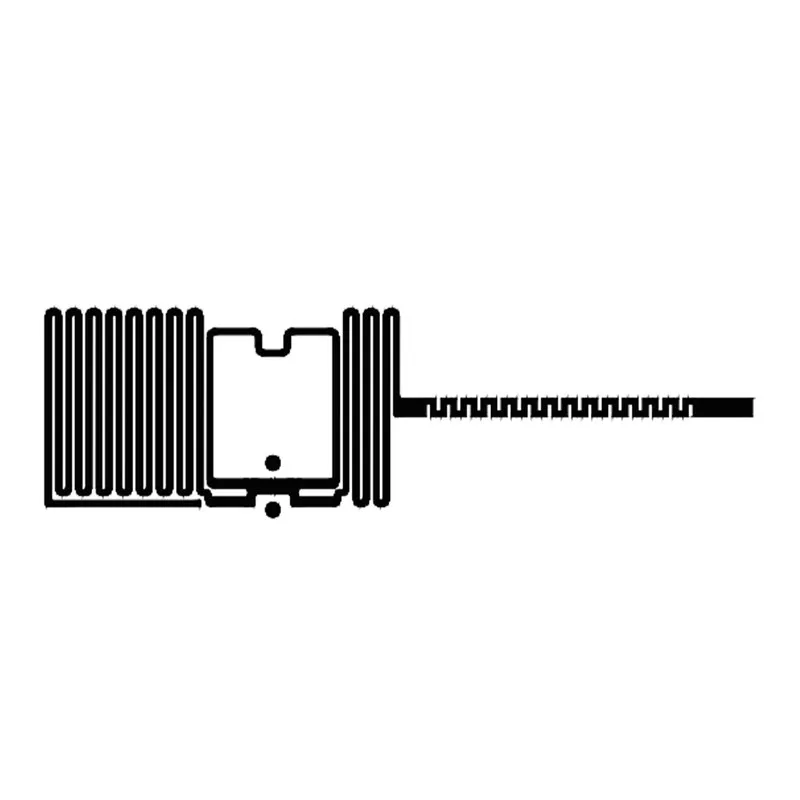
The most widely used tag in Indian jewellery retail is the dumbbell tag, also called a barbell or rat-tail tag. It is a slim paper or synthetic label, typically 45–75 mm long and 8–10 mm wide, with the RFID inlay at one end and a thread or plastic loop at the other. The narrow shape lets it loop through a ring, sit along a chain or tie to a bangle without hiding the piece or the price.
Typical specifications for a good UHF dumbbell tag:
- Chip: Impinj Monza R6 / R6-P or NXP UCODE 8/9
- Frequency: 860–960 MHz global tuning, which covers India's 865–868 MHz band
- Read range: 0.3–1.5 m on metal with a handheld; up to 3–4 m at a gate
- Memory: 96–128-bit EPC, plus user memory for internal codes
- Size: about 55 × 10 mm, with a printable price flap
The flat flap doubles as the printed price and barcode tag, so RFID replaces your existing paper tag rather than adding a second one. For example, the UHF RFID Jewellery Tag ID-1142-U8 is an 11 × 42 mm Monza R6-P tag that wraps around a ring or necklace cord. Labels, hard tags and reusable tags are all in RFID jewellery tags.
Smart trays for showcase-level accuracy
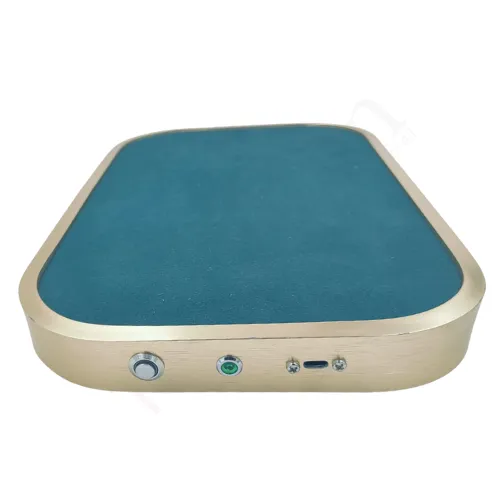
A smart tray is a reading antenna built into a display or counting tray. Place a tray of 40–80 tagged pieces on it and every item is read and reconciled against your system in a second or two. Sales staff use it at the counter to log which pieces left the safe, went into the showcase and came back. That closes the biggest shrinkage gap in jewellery retail: internal handling between the vault and the counter.
Two formats are common. A battery-powered tray sends its reads over Bluetooth to a phone or tablet, like the RFID Smart Tray for jewellery. A wired tray connects to the counter PC, like the UHF RFID Smart Tray CX111T (338 × 248 mm).
Handheld counting: the daily 20-minute stock check
The everyday tool of RFID jewellery inventory is the UHF handheld reader. Staff walk past showcases, drawers and safes, sweeping the handheld's antenna across the trays. Because RFID reads through acrylic, velvet and paper boxes, there is no need to open every case or handle every piece.
A good handheld reads hundreds of tags per second, so a showroom with 15,000 pieces can be fully counted in 15–30 minutes by one or two staff. The reader lists the items found and, more importantly, flags missing items against yesterday's list in real time, so a discrepancy is caught the same morning rather than weeks later at audit.
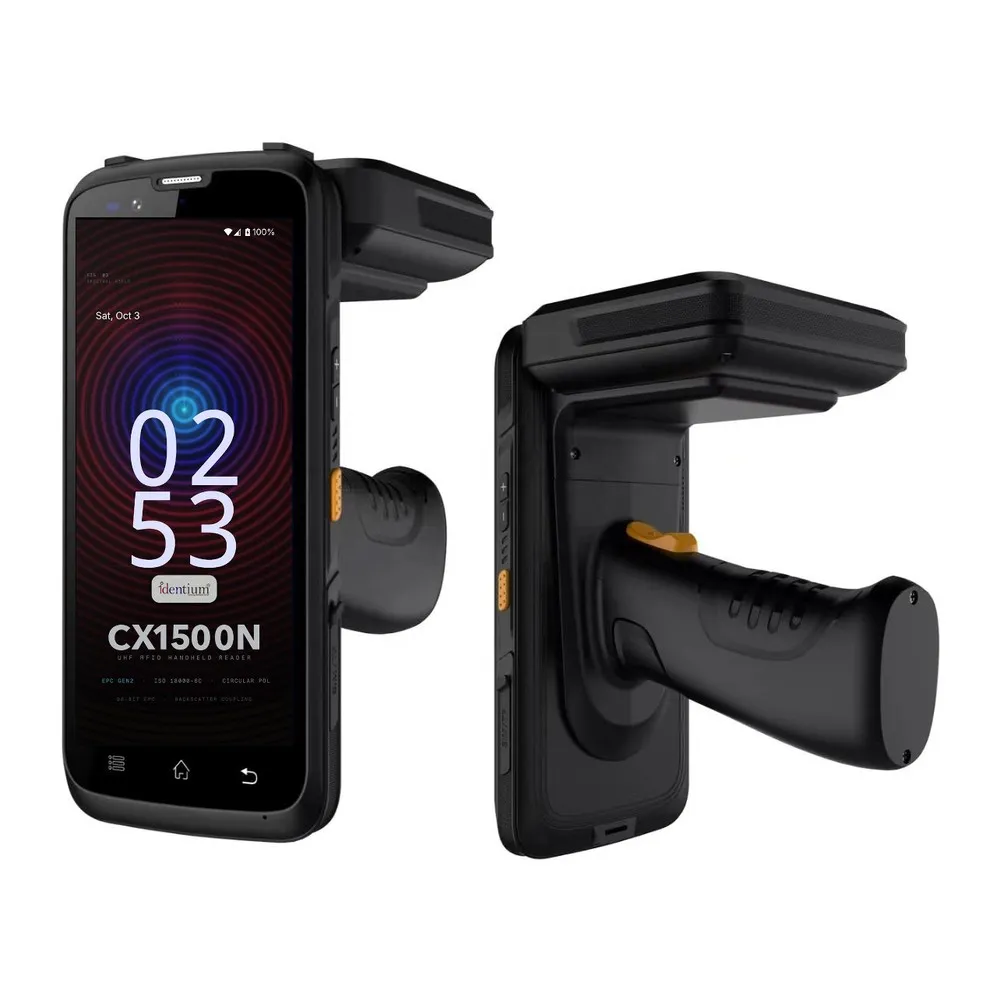
Look for an Android handheld with a large battery, a pistol grip for long sessions and a radio set to India's 865–868 MHz band. The CX1500N Android UHF handheld is BIS-registered and holds WPC ETA; other models are in RFID handheld readers.
Anti-theft gates at the showroom door
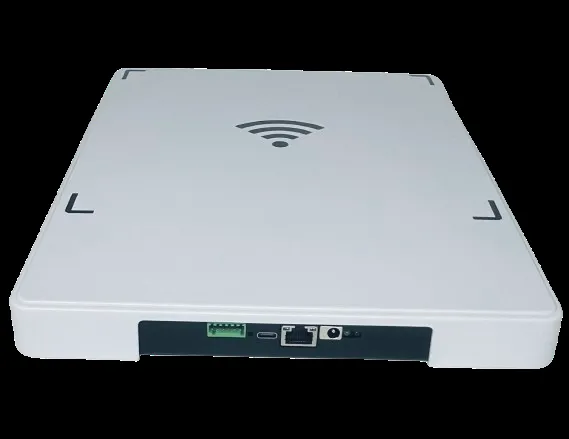
Inventory is half the job; loss prevention is the other half. A UHF RFID gate, or a discreet overhead or under-mat antenna array, at the showroom exit continuously scans for tagged pieces. If a piece that has not been billed crosses the threshold, the system raises an audible and visual alarm and logs the EPC and timestamp, which you can match to the CCTV footage.
Older EAS (electronic article surveillance) systems only beep. RFID tells you which ring or chain triggered the alarm, because every tag is unique, and that deters both external theft and internal pilferage. Gate performance depends heavily on the antennas: well-placed circular-polarised antennas give consistent coverage across the door width. See the UHF RFID Gate Reader HLR200, which has built-in in/out direction sensors and an alarm, and RFID antennas for custom layouts.
The hardware you actually need
A jewellery RFID setup is modular. Most showrooms start with tagging and handheld counting, then add smart trays and gates. The core components are:
- RFID jewellery tags: one per piece, and the only consumable
- UHF RFID printer: prints and encodes tags in-store, for example the desktop UHF RFID printer IT4RL
- UHF handheld reader: for daily counting and searching
- RFID smart tray: for counter-level issue and return logging
- RFID gate and antennas: for exit anti-theft
- Fixed reader: drives the gate antennas
- Software: an inventory application that ties into your billing or ERP
Linking tags to HUID records
RFID does not replace hallmarking, and a tag does not carry or validate a HUID. Instead, each tag's unique ID is mapped once, in your own software, to that piece's HUID, weight, purity and price. From then on a handheld sweep returns the pieces present and your system already knows which HUID each one belongs to, so reconciling physical stock against hallmarking and GST records becomes a query rather than a manual count. Keep the HUID as the record of legal identity and the EPC as the record of physical location. Our guide to gold hallmarking across 392 districts covers piece-level stock audits in detail.
Barcode vs RFID vs RFID with trays and a gate
| Capability | Barcode (current norm) | RFID handheld | RFID + smart tray + gate |
|---|---|---|---|
| Full count time (15,000 pieces) | 3–5 hours | 15–30 min | 15–30 min |
| Line of sight needed | Yes, one by one | No | No |
| Reads many items at once | No | Yes (hundreds per second) | Yes |
| Typical count accuracy | 95–98% | 99%+ | 99.5%+ |
| Real-time exit alarm | No | No | Yes, per item |
| Vault-to-counter tracking | Manual register | Partial | Automatic |
| Relative setup cost | Low | Medium | Higher |
ROI for a jewellery showroom
The return on RFID in jewellery is unusually clear because the labour and shrinkage savings are large and measurable. Take a typical Indian showroom with 15,000 pieces:
- Labour: a daily 3.5-hour count by three staff becomes a 25-minute count by one. That frees roughly 300 staff-hours a month for selling.
- Shrinkage: even 0.1% annual shrinkage on a modest inventory value runs to several lakh rupees. Per-item exit alarms and daily reconciliation cut it sharply.
- Faster audits: quick, dated, piece-level counts give auditors and insurers a record they can verify.
- Better sales: staff can find any piece a customer asks for instead of hunting through trays.
For many showrooms the tag-and-handheld starter setup pays for itself within 6–12 months on labour savings alone, before any shrinkage benefit is counted. Tags are the only recurring cost, and the cost of a tag is small next to the value of the piece it protects. The RFID ROI calculator gives a first payback estimate for your own stock.
Buying jewellery RFID hardware in India
- Frequency: UHF readers must work in India's 865–868 MHz band, which is licence-exempt for RFID under G.S.R. 853(E), 2021. Avoid imported readers fixed to the US 902–928 MHz band.
- Reader documents: ask for the specific reader model's BIS registration and WPC Equipment Type Approval. Tags and labels have no BIS category, so a "BIS-certified tag" is not a meaningful claim. The WPC ETA and BIS checklist explains what to ask for.
- Test on your own pieces: read performance on metal varies with the tag, the piece and the tray, so trial two or three tag types on real stock first. You can request RFID samples before ordering in volume.
India RFID Store is run by Identium Tech Solutions in New Delhi, which makes and supplies RFID tags, readers, antennas, printers and software. Start with jewellery tags and a handheld reader, add trays and a gate as you grow, or request a quote for a complete showroom.
Related guides
Frequently asked questions
Does RFID tagging replace HUID or hallmarking for jewellery in India?
Can an RFID count be reconciled against our HUID records?
Will RFID tags read reliably when attached to solid gold?
How fast is a full stock count with RFID?
Do RFID tags interfere with hallmarking or the price tag?
Can RFID stop internal (staff) pilferage?
Is RFID hardware legal to use in India?
How much does it cost to get started?
Can RFID integrate with my existing billing or ERP software?
RFID JewelleryInventory ManagementAnti-TheftGold TaggingUHF RFIDIndia RetailHandheld ReadersSmart Tray