RFID Tags for Trees and Nursery Plants in India
Published 25 Oct 20268 min read
Written and maintained by the RFID team at Identium Tech Solutions Pvt Ltd, New Delhi (India RFID Store).
Short answer: Indian tree censuses so far identify trees by a serial number or a geo-tagged survey record, not by RFID: Delhi's 2023 municipal census marked each tree with a serial number, and Mumbai's 2026 census records geo-tagged coordinates for every tree. No city-wide RFID tree census is sourced, though Himachal Pradesh's High Court directed in 2017 that every tree in Shimla's municipal limits be tagged with RFID, and a 2018 report described a trial on about 100 trees. Where a tag is wanted, use a cable-tie HF tag for saplings and nursery stock, a UHF stake label for pots and beds, or a nail-in disc for trunks and timber.
A tree census is only as good as the next survey's ability to find the same tree again. A painted number fades, a coordinate alone may not single out one tree in a dense group, and a register of thousands of trees is hard to keep in step with the ground. An RFID tag gives each tree, plant or log an identity a surveyor can read on the spot and match to its record. This guide sets out what Indian censuses record today, how serial plates, QR labels and RFID compare, which of our three plant and tree tags goes where, how to read and encode them, and what to write into a municipal tender.
What does a tree census in India record today?
- Mumbai (2026): the municipal corporation's census, reported by Wood Central in May 2026, covers almost three million trees across the city's 24 wards. It records canopy spread, height, age, species, health and geo-tagged coordinates for every tree, uses ground-penetrating radar to scan beneath trees, and is expected to run for about 18 months. The report mentions no physical tag on the trees.
- Delhi (2023): the Municipal Corporation of Delhi began its first tree census in its wards in December 2023, according to The Tribune. The horticulture department was to mark each tree with its serial number, with a manual count in the first phase and location and tagging through AI technology in the second. The report does not mention RFID.
- Shimla (2017–2018): in October 2017 a division bench of the Himachal Pradesh High Court, hearing a case on illegal felling of deodars, said that every tree within Shimla's municipal limits, apart from being numbered, must be tagged with radio frequency identification tags, and told the civic body to charge private owners for installing the tags on their trees (IANS, via Business Standard). In July 2018 The Pioneer described a Shimla pilot in which forest officers were tagging trees with numbers and implanting sensor chips meant to trigger an alarm. In December 2018 The Tribune described an experiment on 100 trees in the US Club area with a tag on each tree and one common reader; it reported that the active tags needed power and battery replacement, that cost was the barrier, and that the experiment had not gone further.
In these reports, numbers and coordinates are the norm, RFID has been ordered and piloted, and no city-wide RFID tree census has been reported. The Shimla trial also shows the trade-off between active tags, which can raise an alarm but need power, and passive tags, which cost less and suit an inventory but send no alert when a tree is cut.
Serial plate, QR label or RFID tag?
| Painted or embossed number | QR code label | Passive RFID tag | |
|---|---|---|---|
| How it is read | By eye, then typed in | Phone camera, in line of sight | RFID reader, or an NFC phone for NFC-chip tags; no line of sight needed at close range |
| Re-survey speed | Slowest: read, type, check | Fast when the label is clean and visible | Fast: the reader returns the ID straight into the survey app |
| Weather and growth | Fades and gets overgrown | Needs a clean, unscratched face | Still reads when dirty; the fixing must allow for growth |
| Cost per tree | Lowest | Low | Higher, plus readers |
| Typical use | Basic numbering | Public information about a tree | Repeat surveys, nurseries, timber and anti-theft records |
Many projects combine them: a printed number on the face of the RFID tag, so a person can still read it if the reader is not at hand. Our comparison of RFID and QR codes covers the trade-offs in more depth.
Which tag goes where: tie, stake or nail-in?
Our plant and tree tags come in three constructions. Each line below is from its product page, and each is priced on request.
| Tag | Construction | From the product page | Where it goes | Price |
|---|---|---|---|---|
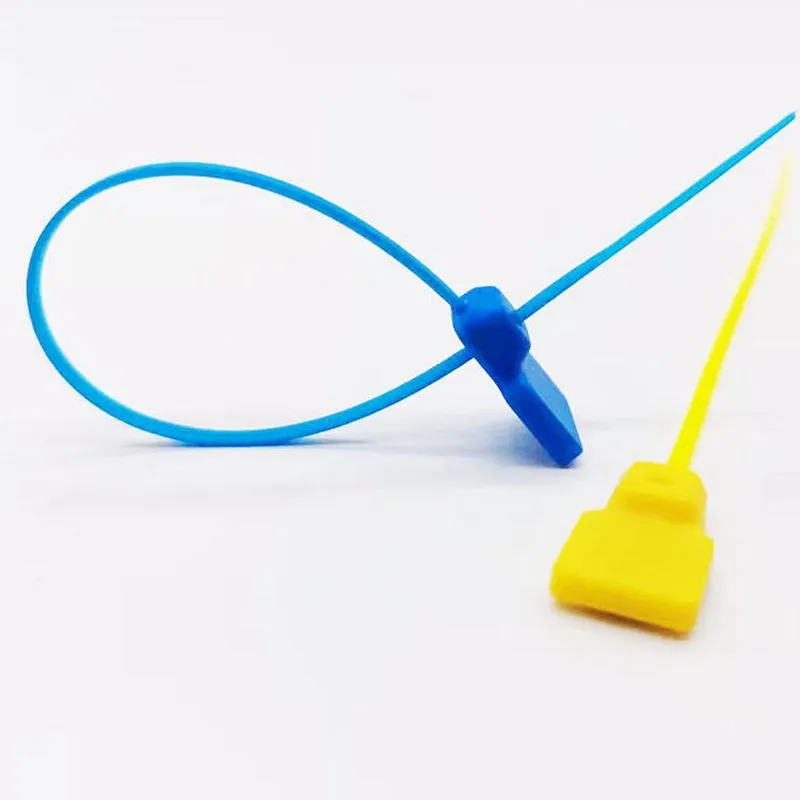
| IDTS-PTH165 plant and tree tag | HF tag sealed in the head of a self-locking nylon cable tie | 13.56 MHz, ISO 14443A; F08 chip with 1 KB memory as standard, NFC chip on request; read range 0–5 cm; approx. 165 mm overall, head 19 × 12 mm; one-way tie that does not release once pulled through; laser-printed number or logo; listed as waterproof and weatherproof | Saplings, nursery stock, branches, pot rims, seedling bundles | price on request |
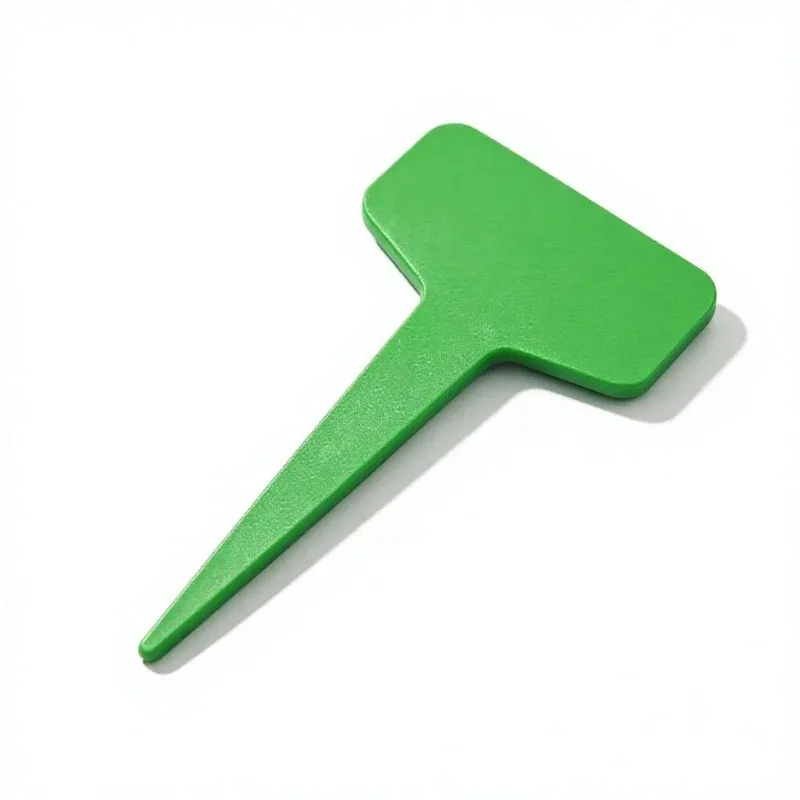
| IDTS-PSU8 plant label stake | UHF chip in a T-shaped ABS stake pushed into soil or potting mix | EPC Gen2 UHF for India's 865–868 MHz band; 128-bit EPC; stake length and head size confirmed in the quotation; read range depends on the reader and on soil moisture, so confirm it with a sample; not readable by phone NFC | Pots, beds and nursery rows read with a UHF handheld | price on request |
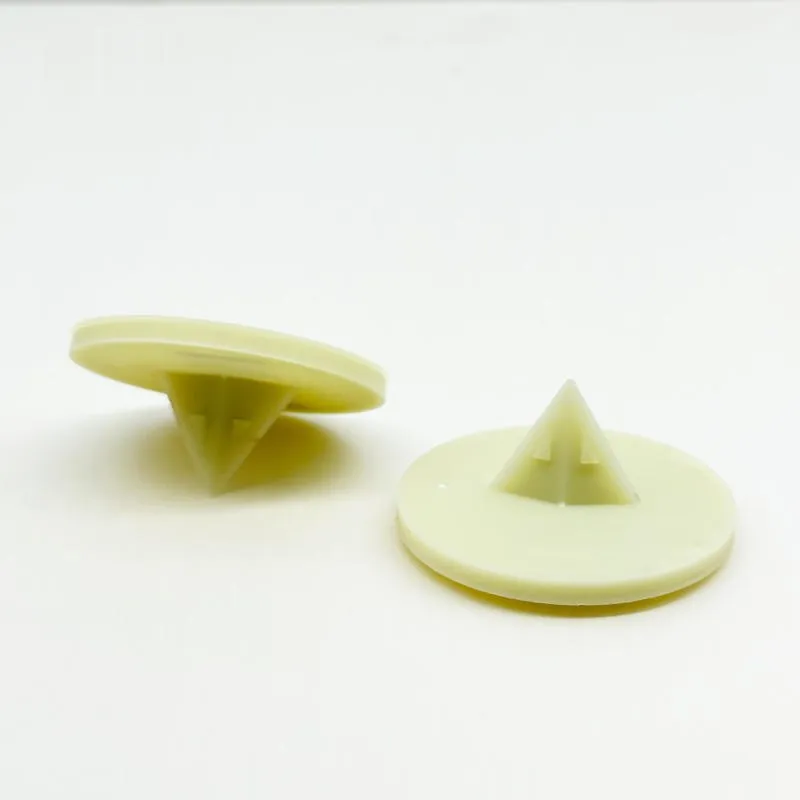
| IDTS-TND1 tree and timber tag | Round ABS disc with a pointed spike, driven into wood | HF 13.56 MHz with 1 KB memory as standard, UHF on request; HF read range 1–10 cm; size made to order and confirmed in the quotation; optional printed number or barcode | Tree trunks, log ends, sawn timber, poles and posts | price on request |
All three are sold with a minimum order of 500 pcs. The wider ranges are under HF and NFC tags and UHF RFID tags.
HF or UHF for trees?
HF tags, like the standard PTH165 and TND1, are read a few centimetres from the reader, one at a time. That suits a census in which a surveyor stands at each tree and reads its tag before recording girth, height and health. UHF tags, like the PSU8 and the UHF version of the TND1, can be read several at a time from further away with a handheld, which suits walking a nursery row. Water and wet soil weaken UHF signals, which is why the PSU8's read range is confirmed with a sample on your own beds. Choose one frequency per project, because the readers follow the tags.
How are the tags read and enrolled?
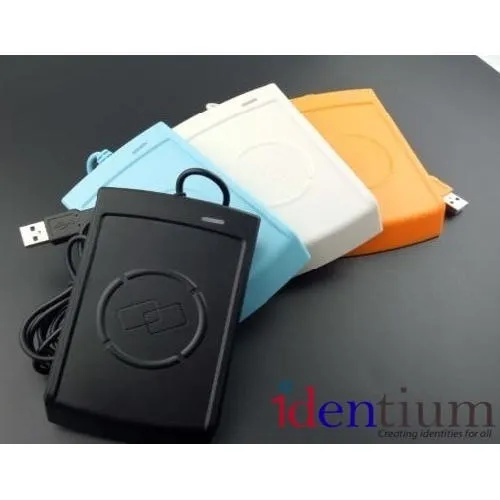
- Enrolment at the office: an HRD20 HF desktop reader (USB, 5–10 cm) reads each HF tag before it goes out, so its number can be entered in the register.
- Field reading, UHF: the CX1000 UHF handheld, or a phone paired with the UBR90H Bluetooth UHF reader (up to 2 m, depending on the tag and surroundings).
- Field reading, HF: an NFC phone can read the PTH165 only if it is ordered with the NFC chip option, as its product page says; otherwise use an HF reader that supports the chip in your quotation. Phone readability depends on the chip, so ask us before you plan a phone-based survey.
Confirm reader and chip compatibility with a sample before you order in bulk. More readers are in the HF, NFC and LF readers and handheld readers ranges.
What goes on the tag?
Keep the tag to an identifier and keep the record in the database. A census number that encodes the ward and a serial is easy for surveyors to read off the printed face, and the same number goes into the chip: into the EPC on a UHF tag, or into the 1 KB memory of the F08 chip on an HF tag. Species, girth, height, health, photographs and coordinates belong in the census software, which can be updated on every survey without touching the tag. For how UHF EPC numbers are structured, see our EPC encoding guide.
How do nurseries and plantations use plant tags?
For nurseries, tagging the batch rather than every seedling keeps the cost down: one stake per bed or tray identifies the batch, the nursery software holds its species and sowing date, and the stake moves with the batch. Individual cable-tie tags make sense for mother plants, grafted stock, trial plots and plants sold with a record, where each plant needs its own history. Plantations and orchards use the tie tag on a branch or the nail-in disc on a trunk, depending on the tree.
Timber and forestry
At a log yard, a nail-in disc on each log end carries the log's number through measuring, stacking and despatch, and a reader at the yard gate or weighbridge can record the vehicle that took it out; our weighbridge automation guide shows how despatch is automated for minerals, and the same gate-and-weighbridge approach can be applied to timber. Tags on living trees are a different matter, below.
Does a nail-in tag harm the tree?
We make no claim either way. Whether, where and how deep to fix a spiked tag in a living tree is a decision for your horticulture or forest officer, who should specify the spike length and the position. For saplings and young trees, a cable tie around a branch avoids the question. The PTH165's tie is one-way and cannot be loosened, so fit it with room to grow, check it on each survey, and ask your horticulture officer how loosely to fit it.
What should a municipal tender for tree tags specify?
- The tag construction per tree class (tie, stake or nail-in), the frequency and the chip, confirmed with samples on site.
- The number of tags: the tree count plus a spares allowance agreed on site.
- The census number format, the data fields and who owns the data.
- Who fixes the tags, to whose specification, and who checks that every tag reads after fixing.
- The readers for enrolment and for field surveys, and how reads reach the census software.
- The re-survey cycle, and how lost or damaged tags are replaced.
Municipal teams doing other RFID work may also find our guides on RFID tagging of stray animals and RFID house tags for waste collection useful.
Sources
- Wood Central, 26 May 2026: Mumbai Digital Tree Census Maps Every Tree to Curb the Urban Heat, accessed 25 October 2026
- The Tribune, 14 December 2023: MC starts tree census in Capital, accessed 25 October 2026
- Business Standard (IANS), 27 October 2017: Implant radio frequency tags on every deodar tree in Shimla, says Himachal HC, accessed 25 October 2026
- The Pioneer, 3 July 2018: Tech tree, accessed 25 October 2026
- The Tribune, 8 December 2018: When the woods were lovely, dark & deep, accessed 25 October 2026
Cite as: India RFID Store (Identium Tech Solutions Pvt Ltd), “RFID Tags for Trees and Nursery Plants in India”, https://www.indiarfidstore.com/rfid-resources/rfid-tags-for-trees-nursery-plants-tree-census-india, published 25 Oct 2026.
Frequently asked questions
How are trees tagged in a tree census?
What is the difference between a QR tree tag and an RFID tree tag?
Which RFID tag is used for nursery plants?
Can a mobile phone read a tree tag?
Does a nail-in RFID tag harm the tree?
Trees & ForestryNurseriesMunicipalHF RFIDUHF RFID
Keep reading
More guides

More in Industries & use cases
- RFID Fuel Automation: Vehicle Tags at Petrol Pumps, India
- RFID Tool Tracking in India: Tool Cribs, MRO and FOD
- RFID Surgical Instrument Tracking: CSSD and Autoclave Tags
- RFID for IT Asset Tracking in India: Laptops, Servers, Racks
- FASTag Readers at a Private Warehouse Gate: What CWC's Smart Warehousing Rollout Shows (2026)