Haryana RFID House Tags for Waste Collection and the SWM Portal
Published 22 Oct 20269 min read
Short answer: Rohtak is fixing an RFID tag on about 1.40 lakh residential and commercial properties so that every door-to-door collection is scanned and uploaded to Haryana's Solid Waste Management (SWM) portal, and in September 2026 the Chief Minister ordered that all payments to waste contractors go only through that portal. In Rohtak the private collection agency, not the corporation, installs the tags. Our reading, labelled as such below, is that the contractor is the likely buyer of house tags, crew readers and vehicle stickers. This guide sets out what the reports say and lists that bill of materials with catalogue prices.
This guide is for door-to-door waste collection contractors and concessionaires, and for the municipal officers who write their contracts, in Haryana and in other states working under the Solid Waste Management Rules, 2026. For the rules themselves, see our guide to the Solid Waste Management Rules 2026. Everything below is as read on 22 October 2026, and what a source does not say, this guide does not claim.
What Rohtak is doing
The Tribune reported on 10 November 2025 that RFID tags would be installed on "approximately 1.40 lakh residential and commercial properties across the district": homes, shops and institutions. The installer is the private agency that handles waste collection. Its spokesman said the agency "has employed over 35 workers, who visit different wards in teams to install the tags", and claimed that "over 2500 RFID tags were being installed on the properties on a daily basis".
The operating rule is the useful part. When the agency's vehicle collects garbage from a tagged property, the tag is scanned and "the data will automatically be uploaded to the SWM portal", so officials can see which properties have been served. Commissioner Dr Anand Kumar Sharma put it plainly: "Only after scanning the RFID tag will the garbage be collected, which is the responsibility of the designated agency." He said officials "will receive real-time ward-wise updates on collection status", and appealed to residents to have tags installed on their homes, shops and institutions "and ensure that they are not damaged".
An earlier Tribune report, of 20 October 2025, on the corporation's Suvidha Manch project-monitoring portal, had described the plan: the implementing agency would "install RFID tags at every household in each ward", sanitation staff would make sure every house in their ward was tagged, and the corporation would receive daily reports on collection.
What the reports do not say, so this guide does not claim it: how many of the 1.40 lakh tags were in place by any date, whether scan records are used to calculate the agency's payment, and which tag or reader models the agency chose.
Haryana's state push: GPS on vehicles, payments through the portal
Rohtak's tagging sits inside a state programme. On 27 June 2026 News On AIR reported that Chief Minister Nayab Singh Saini, reviewing solid waste management in Chandigarh, directed that "all garbage collection vehicles be equipped with GPS systems to enable regular monitoring", and ordered quarterly cleanliness rankings of urban local body wards, with the best wards and sanitation workers to be felicitated on 2 October.
On 25 September 2026 UNI reported from a further review chaired by the Chief Minister that he ordered "all payments to waste contractors be routed only through the Solid Waste Management Portal", with officials personally accountable and penalties for unnecessary delays. The report says that "GPS-enabled vehicles on 4G and 5G networks are already monitoring door-to-door garbage collection in 83 of 87 civic bodies" and that "1,646 Ward Committees are now active across urban local bodies".
Put the two together and the portal becomes the ledger: the vehicle's GPS trace shows the route, a house-tag scan shows the stop, and the contractor's bill passes through the same system. The part of the UNI report we could read does not say that house tags are mandatory statewide or that payment is computed from scans, and we have not seen an order saying so. But a contractor whose invoice already runs through a portal that holds the vehicle trace should expect house-level proof of service to be asked for, because Rohtak has shown it can be done across a district.
Why the contractor, not the corporation, usually buys the tags
This section is our inference from the Rohtak reports, not a stated policy, so weigh it as such. In Rohtak the collection agency installs the tags with its own workers, and the corporation supervises and receives the reports. That follows from how door-to-door contracts are usually written: the concessionaire is paid for service delivered, and the evidence of service is its responsibility.
The Solid Waste Management Rules, 2026 (S.O. 388(E) of 27 January 2026, in force from 1 April 2026) point the same way. Rule 8(h) makes the local body responsible for ensuring that a concessionaire or third party doing solid waste management registers with it "through centralised online portal", and for "ensuring that the fleet engaged in collection and transportation are equipped with tracking devices for cities having population more than 50,000", which may be extended to smaller bodies.
The duty sits with the local body, but the vehicles usually belong to the contractor, so the cost tends to land in the contract. The practical reading: if you bid for or run a door-to-door contract in Haryana, budget for house tags, a reader for each vehicle crew and a vehicle identity sticker, and ask the corporation which portal fields your scans must fill before you buy anything.
The bill of materials
A tag-per-house collection system has four parts. Prices are catalogue prices plus GST; tags and labels carry a minimum order of 500 pcs.
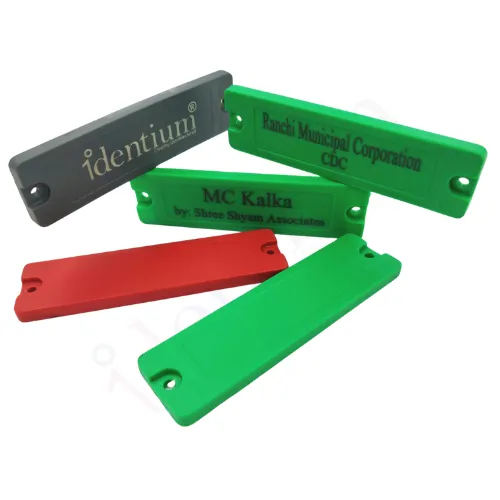
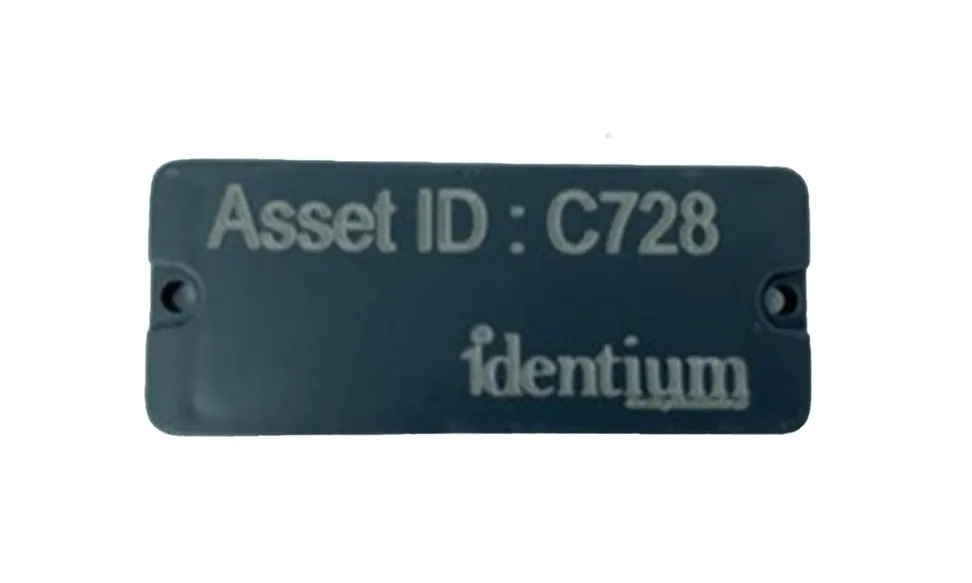
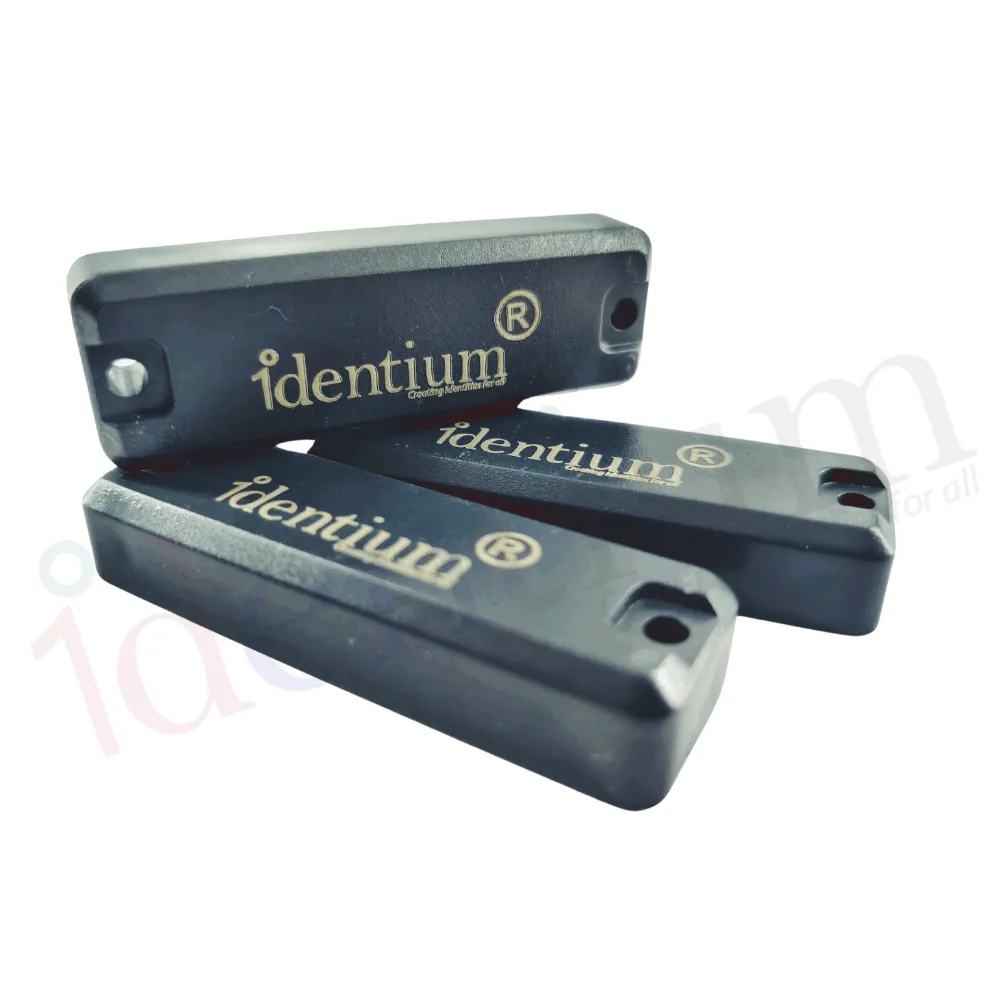
1. The house tag. One passive tag fixed at each property. The RFID Waste Management tags (₹30 + GST) are the catalogue's purpose-made item: a rugged, fixed-mount ABS tag of about 10 g for household and commercial bins, with a UHF or HF chip to match the collection readers, rated from −20 °C to +85 °C and packed 200 to a bag for survey teams. Where a scheme tags the gate rather than the bin, the same tag goes on the gate post or wall.
On plaster, wood or plastic, the RFID Small ABS Tag (₹30 + GST), a 60 × 25 × 3.5 mm rigid tag built with the chip you choose, is the slimmer alternative. On a steel gate or shutter, where an ordinary tag detunes, use the UHF On-Metal RFID Tag UMMT (₹60 + GST), an IP68 tag that reads up to 10 m on metal. For a district-sized roll-out the surface mix matters: survey a sample of wards first and order the types in proportion.
2. The reader with the vehicle crew. The scan happens at the kerb, in a few seconds, by the helper who takes the bin. The simplest unit is a Bluetooth reader paired to the crew's phone running the portal's app.
The UHF Bluetooth Reader UBR90H (₹12,000 + GST) pairs with Android 5.0+ and iOS 11+ phones, reads UHF tags up to 2 m and runs more than eight hours on its 2000 mAh battery; the UHF Bluetooth RFID Reader ID-UBRS100 (₹12,000 + GST) reads within about 1 m and can type each tag number into any app as keyboard input, which lets a pilot run on a plain form before the portal's app is ready.
If the crew needs a dedicated device with its own screen, the UHF Handheld RFID Reader CX1000 (₹30,000 + GST) ships with IDOS, which runs Android 15. Compare them in RFID handheld readers; readers are supplied against purchase, not as samples. If you choose HF house tags, the crew needs an HF reader instead, so decide the frequency once, for the whole district.
3. The vehicle identity. GPS identifies the vehicle to the portal, but the transfer station, the weighbridge and the depot gate also need to know which tipper has arrived. A printed UHF RFID windshield label (₹25 + GST), 110 × 40 mm with the vehicle number and a serial printed on it and a tamper-evident adhesive, read by a fixed reader at the gate, closes that gap. Other formats are in RFID vehicle tags and windshield stickers.
4. The data link. Each scan needs the tag ID, the vehicle, the crew, a time and a position, posted to the portal or batched until the phone is back in coverage. That is app work on the corporation's or its software vendor's side; the reader's job is to deliver a clean tag ID. Our guide to scanning tag numbers into a spreadsheet shows the simplest version for a pilot, and our RFID waste management system page describes the full set-up.
How the scan-to-portal flow runs on the street
The crew's phone shows the route. At each stop the helper lifts the bin and triggers the reader; the tag ID appears in the app with the property's address, and the app records collected, no waste out or bin not presented, then moves on. A tag that does not read is flagged for the survey team rather than argued over at the gate. At the end of the shift the app holds the list of properties served against the ward register: the daily report Rohtak's commissioner described.
Three practical points for an installation of this type. First, encode each tag with the property ID from the register instead of relying on the factory serial, so a replacement tag keeps the same ID; the UHF Desktop Reader 103 (₹15,000 + GST), a USB reader-writer that needs no driver or separate power supply, does the encoding at the ward office.
Second, fix tags at a consistent height and side of the gate so the helper does not hunt for them. Third, keep spare tags with the crew: a tag torn off a gate is a missed scan every day until it is replaced, which is why Rohtak's commissioner asked residents not to damage them.
What the rules ask, and what they leave to the contract
The Solid Waste Management Rules, 2026 require urban local bodies to arrange door-to-door collection of segregated waste in four streams (wet, dry, sanitary and special care) from all households and other premises, to register on the centralised online portal, and to put tracking devices on the collection fleet in cities above 50,000 people.
They do not prescribe RFID at each house, a scan-based payment formula or a tag standard; those come from the state portal and the contract. Haryana's portal-only payment order is a state direction reported by UNI, and we have not seen its text. If you are a contractor, ask for the portal's data specification in writing, including what counts as a served household, before you commit to a tag format.
Municipalities tagging animals for the same reporting reasons will find a parallel in our stray cattle and dog RFID tagging guide, and the tender mechanics, from local-supplier status to the documents a civic body checks, are in our guide to selling RFID to government buyers.
Shop the products in this guide
- RFID Waste Management tags: the house and bin tag, UHF or HF chip.
- RFID Small ABS Tag and UHF On-Metal RFID Tag UMMT: for plaster and wood, and for steel gates.
- UHF Bluetooth Reader UBR90H and ID-UBRS100: the crew's reader, paired to a phone.
- UHF Handheld RFID Reader CX1000: a dedicated handheld with its own screen.
- Printed UHF RFID windshield label: vehicle identity at the gate and weighbridge.
- UHF Desktop Reader 103: encoding property IDs at the ward office.
Bidding for a door-to-door contract? Send us the number of properties, the gate surfaces in your wards and the portal app's requirements, and request house-tag samples to test on real gates. All UHF RFID tags work in India's 865–868 MHz band.
Sources
- The Tribune, 10 November 2025: 1.40 lakh Rohtak properties to get RFID tags for waste collection tracking
- The Tribune, 20 October 2025: Development works of Rohtak Municipal Corporation to be monitored through online portal
- News On AIR, 27 June 2026: Haryana to equip all garbage collection vehicles with GPS tracking system
- UNI, 25 September 2026: GPS-tracked garbage trucks, portal-only contractor payments, WA grievance panels in Haryana
- Solid Waste Management Rules, 2026, S.O. 388(E) of 27 January 2026 (gazette text hosted by the Maharashtra Pollution Control Board)
Frequently asked questions
Who installs the RFID tags on houses in Rohtak?
Does Haryana pay waste contractors only through the SWM portal?
Which tag goes on a steel gate or shutter?
Do the Solid Waste Management Rules 2026 require RFID tags on houses?
Waste ManagementMunicipal RFIDHaryanaUHF RFID TagsPublic Sector
Keep reading
More guides
 Solid Waste Management Rules 2026: RFID and GPS Tracking for ULBs and Bulk Waste Generators in India12 min read
 Plastic Waste Management (Amendment) Rules 2026: Proving Reuse Targets on Returnable Jars, Crates and Kegs12 min read
 Trailer RFID Tags and AIS-140 Tractors: MoRTH Draft Status 20269 min read
More in Regulations & tenders
- FSSAI Non-Retail Container Labels 2027: Lot Numbers and RFID
- FASTag Parking System: How to Accept FASTag at Your Parking Lot
- Procam Timing Certificate Rules: RFID Bib Tags, Split Mats, 12-Hour Results by 31 March 2027