Selling RFID to Indian government buyers in 2026: Class-I, purchase preference and the document pack
Published 5 Sept 2026Updated 12 Oct 202610 min read
Short answer: An RFID bid to an Indian government buyer has to clear three gates at once: the Make in India preference regime, the radio-approval regime and the tender's own evidence conditions. Under the Public Procurement (Preference to Make in India) Order dated 19 July 2024, a Class-I local supplier has local content of 50% or more and a Class-II local supplier has 20% or more. Purchase preference applies to central government procurement above Rs 5 lakh, and above Rs 50 lakh for scientific institutions. Most RFID bids that fail, fail on the document pack rather than on price.
This guide is written for two readers: the government or PSU officer drafting an RFID specification, and the Indian vendor or system integrator answering it. It is not legal advice; check every threshold below against the current official text before relying on it.
Why do RFID bids get rejected on paperwork rather than price?
Because RFID is three regulated things at once:
- A radio product, because readers transmit.
- A manufactured product, sitting inside the BIS and quality-control-order ecosystem like any electronics hardware.
- A preference-regime product, because central procurement above the notified value must apply Make in India purchase preference.
Each regime has its own paperwork, authority and vocabulary, and disqualification usually happens at the intersection rather than inside any one of them.
The pattern is familiar to anyone who follows RFID requirements on GeM and departmental e-procurement portals. A strong technical offer is set aside because the radio approval sits in a trading partner's name, because the datasheet model number does not match the certificate, or because the declaration was signed in the wrong format. None of those are engineering failures. All of them are fixable a week before the bid closes and impossible to fix afterwards.
What is a Class-I local supplier, and how is it different from Class-II?
The Public Procurement (Preference to Make in India) Order — operative revision dated 19 July 2024, issued by DPIIT — sorts bidders by the local content in what they offer. A Class-I local supplier has local content of 50% or more; a Class-II local supplier has 20% or more. Purchase preference applies to central government procurement above Rs 5 lakh, and above Rs 50 lakh for scientific institutions.
| Point of comparison | Class-I local supplier | Class-II local supplier |
|---|---|---|
| Local content required | 50% or more | 20% or more |
| Established at bid stage by | Self-certification by the bidder | Self-certification by the bidder |
| When an auditor certificate comes in | Above Rs 10 crore, from the statutory or cost auditor | Above Rs 10 crore, from the statutory or cost auditor |
| Named in the price-matching step | Yes — the lowest Class-I local supplier is invited to match | Not the party named in that step |
| Practical bid consequence | Strongest position when a non-Class-I bidder is L1 | Local status declared, but no matching invitation |
Two things follow. First, the classification attaches to the offer, not the company badge: the same vendor can be Class-I on a locally manufactured tag line and something else on an imported reader line. Second, the percentage is a number you must defend line by line — a bill-of-materials exercise, not a marketing one.
That bites in RFID, because a typical BoQ mixes tags or cards in volume with readers, antennas, printers and support. Those lines rarely share a local content profile, so where the format allows an item-wise declaration, give one.
How is purchase preference actually applied when bids are opened?
The mechanism has exactly two branches, and most confusion in clarification meetings comes from paraphrasing them loosely.
| Situation at bid opening | What the order provides |
|---|---|
| L1 is a Class-I local supplier | The full quantity is awarded to L1. |
| L1 is not a Class-I local supplier | 50% of the quantity goes to L1. The lowest Class-I local supplier is invited to match L1's price for the remaining 50%, provided it is within a 20% margin of purchase preference. |
Read as bidding strategy, that says something specific: being cheapest is decisive only in the first branch. In the second, a Class-I local supplier who is not L1 still has a route to half the quantity — but only from inside the 20% margin. Priced far above the imported offer, Class-I status is worth nothing; priced close to it, it converts into volume.
Who certifies local content, and when does an auditor get involved?
Bidders self-certify their local content percentage at bid stage. Above Rs 10 crore, a certificate from the statutory auditor or cost auditor is required. That carries most of the compliance risk in a large RFID contract, because the self-certified number and the audited number have to be the same number.
So the arithmetic has to be defensible before you bid, not assembled after you win. A certificate is built on ordinary records:
- The bill of materials for each quoted item.
- Import invoices for chips, inlays, antennas, enclosures and modules.
- The domestic value-addition trail — conversion, assembly, encoding, testing, packaging and support delivered in India.
- One consistent calculation method across every BoQ line.
If the tag line is domestic conversion on imported inlays while the reader line is imported hardware with local firmware, those are two percentages and should be shown as two. Keep the working file: a percentage tied to invoices in a spreadsheet survives a clarification query; one typed straight into a form does not.
Is the Make in India preference order actually being enforced?
Yes, and there is a number attached. DPIIT scrutinised 3,103 tenders worth Rs 1,61,839 crore for PPP-MII compliance and found 1,366 non-compliant.
Read that from the buyer's side, because that is where the pressure lands: procuring entities are themselves reviewed on whether their tenders applied the preference regime correctly. The effect on vendors is predictable. Conditions get stricter about proof, clarification rounds ask for the basis of a declared percentage rather than accepting it, and a declaration the documents do not support stops being enough.
Does RFID hardware need WPC approval to be quoted?
Anything that transmits does. Fixed, gate, integrated, desktop, handheld and sled readers and RFID modules are radio transmitters; passive tags, labels, inlays and cards generally are not, since they backscatter rather than transmit. India's UHF RFID band allocated by WPC is 865–868 MHz, the same as the ETSI 865–868 MHz band, and a reader offered into an Indian tender should operate in that allocation.
Two things get bids rejected here, and neither is technical. The approval has to be real — a certificate for the actual model, not a statement that approval is under process — and it has to be traceable to whoever supplies the equipment, which matters when an integrator quotes another company's hardware.
How a reader gets certified is covered end to end in our guide to WPC ETA and BIS certification for RFID readers in India. For a bid, the only questions are whether the certificate exists, names the model quoted, and travels with the offer.
What should bidders watch on the standards and quality-order side?
Two developments are worth tracking without over-reading them. BIS maintains an 'Upcoming QCOs – Notified and Due for Implementation' list, last updated on 4 August 2026. Separately, DPIIT notified the Transition Facilitation (Quality Control) Order, 2026 as S.O. 3417(E) on 25 June 2026.
The practical instruction is simply to look. If an offer includes components that could fall under a quality control order — power supplies, enclosures, batteries, cables, plastics, electronic assemblies — check the current BIS list against your bill of materials, and check again whenever you requote. This page names no QCO and no implementation date on purpose: that detail changes and must be read from the source. For how QCO deadlines play out in stock, see our note on segregating pre-deadline godown stock.
What documents should a compliant RFID bid carry?
This is an advisory checklist, not a regulatory list — the tender's annexure governs. But an RFID bid carrying all of the following is rarely disqualified on paperwork:
- Manufacturer status evidence — registration, manufacturing proof, and a clear statement of which quoted items you make and which you supply.
- Local content declaration in the prescribed format, signed by the authorised signatory, stated per item wherever the format allows.
- Auditor certificate from the statutory auditor or cost auditor where the value crosses Rs 10 crore.
- Radio approval for every transmitting item quoted — each reader and module, by exact model.
- BIS and standards evidence where the tender asks for it, for the items it asks about.
- Test reports behind environmental and IP-rating claims — an IP number in a datasheet is a claim; a report is evidence.
- Datasheets whose numbers match the quote — frequency band, IP rating, antenna ports, chip type, memory, temperature range.
- OEM authorisation wherever the bidder is not the manufacturer of a quoted line.
- Make-and-model consistency across the BoQ, datasheet, approval certificate and price schedule.
The last item is the most common avoidable failure in RFID bids. A reader listed as one variant in the BoQ, described by a second in the datasheet and approved as a third on the certificate is, to an evaluation committee, three products. Run one consistency pass before submission, model number by model number, and index every BoQ line to its datasheet, approval and test report.
How should a government buyer write an RFID specification that gets real bids?
Specifications written in adjectives get adjectives back; specifications that describe the physical problem get comparable offers. If you are drafting one:
- State the frequency band. For UHF in India that is 865–868 MHz. Writing only "UHF RFID" invites offers built for other regional bands.
- Describe the environment and IP requirement — outdoor gate, store room, wash-down area, vehicle-mounted, high dust — instead of leaving it to the bidder.
- Specify the read zone, not a bare read-range number. Lane width, tag mounting height, orientation and the surface the tag sits on decide performance far more than a headline metre figure. Our guide on choosing an RFID reader by read range, antenna ports and IP rating lists the parameters worth naming.
- Ask for on-metal performance explicitly where assets are metal. Metal detunes ordinary label tags, and a specification that ignores it produces a failed pilot and a re-tender.
- Specify antenna port count for multi-lane gates and multi-door sites, so bidders size the reader instead of under-quoting it.
- Define acceptance — an agreed read population, tag positions and pass criteria at site are worth more than any brochure number.
- Ask for evidence, not adjectives — test reports, approval certificates, comparable references — and say which will be evaluated.
Our field guide to RFID fixed-asset tracking and physical audits sets out the equipment mix a realistic asset-register scope implies: a tag decision first, a reader decision second.
Where is public-sector RFID demand showing up?
Central and state RFID tenders were open through August and early September 2026 across areas including animal identification and traceability, mining fuel management, defence and railways. The hardware those areas imply shapes what a bidder keeps ready.
- Animal identification and traceability implies livestock ear tags plus rugged handheld and sled readers for field verification in poor connectivity — see our guide to RFID livestock and cattle ear tags in India.
- Mining fuel management and vehicle applications imply on-metal tags read by fixed readers at dispensing points and gates — the pattern in our guides to RFID and GPS for mineral transport vehicles and diesel bowser and HEMM fuel automation.
- Defence and railway asset registers imply ruggedised tags, including PCB and ceramic tags for tools, meters and equipment where adhesive labels will not survive, read with handheld and sled readers at verification time. Railway-specific encoding is covered in our guide to Indian Railways RFID tags.
What can Identium supply against an RFID tender?
India RFID Store is the online catalogue of Identium Tech Solutions Pvt Ltd, an RFID manufacturer and supplier in East of Kailash, New Delhi, in business since 2010. The catalogue covers the width of a typical tender BoQ:
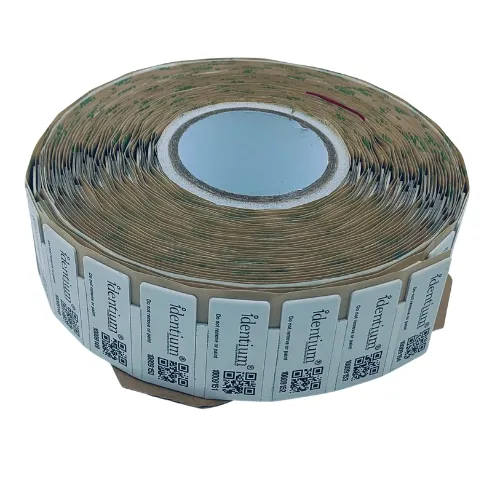
- UHF, HF and LF tags, labels and inlays, including on-metal and PCB/ceramic tags for PSU fixed-asset registers, tools, meters and equipment.
- RFID cards and wristbands.
- Handheld, sled, desktop, fixed and gate readers — sled readers suit field verification where a rugged handheld is specified.
- Antennas, printers, locks, modules and sensors.
Radio and standards evidence is model-specific. Identium's BIS registration covers ten reader models: 103UDR, CX1000, CX1500N, CX806T, HLR20, IF9A, IHZ4, MUBR01, R58H and UBR12. The CX1500N, IF9A, IHZ4 and MUBR01 readers and the RUCA9 antenna hold WPC ETA. Tags, labels and cards have no BIS category, so a clause asking for "BIS-certified tags" is worth raising at the pre-bid meeting. The current list is kept on our certifications and approvals page.
We make no eligibility claims on a web page. If you are evaluating Identium as a bidder, or as the OEM behind an integrator's bid, ask us for current certification and local-content documentation for the items in your tender and we will send what we can evidence. Before relying on any threshold or date here, verify it with the official source — DPIIT for the Order, BIS for quality control orders, WPC for radio approvals.
Working on a live RFID tender? Send us the technical annexure through the quote request form, marked tender enquiry. We will map it line by line to available models and the approvals that go with them, so you know before you bid which items are ready to quote and which need substitution.
Related reading
Frequently asked questions
What is a Class-I local supplier?
What is the purchase preference mechanism?
When does purchase preference apply?
Who certifies local content in a bid?
Is the Make in India preference order being enforced?
Does an RFID reader need WPC approval?
RFID government tendersMake in IndiaPPP-MIIClass-I local supplierpurchase preferenceWPC ETABISRFID procurement Indiagovernment RFID buyers