Impinj vs NXP RFID Chips — M700 vs UCODE 9 Comparison (India Buyer Guide 2026)
Published 18 Jul 2026Updated 4 Oct 20266 min read
Every UHF RFID tag you buy in India, whether it is a paper label on a garment, a rugged on-metal asset tag or a ceramic tag on a surgical instrument, is built around one tiny component that decides how it performs: the RFID chip, or IC (integrated circuit). Two companies dominate the global RAIN RFID silicon market, and almost every quality inlay you source in India uses one of them: Impinj (the M700 series) and NXP (the UCODE 8 and UCODE 9 families).
The chip is the biggest single technical factor behind read range, encoding speed, memory capacity and brand-protection features. This guide compares Impinj M700 and NXP UCODE 9 in plain language for Indian B2B buyers, with specifications, a comparison table and application-based recommendations. India RFID Store supplies inlays and tags built on both chip families, so the aim is to help you buy correctly, not to sell you one brand.
What the RFID chip actually does
A passive UHF RFID tag has just two parts: an antenna and a chip. There is no battery. When a reader transmits RF energy in the 865–868 MHz band (India's licence-exempt UHF band under G.S.R. 853(E), 2021), the antenna harvests that energy, powers up the chip, and the chip modulates a reply back to the reader. The chip is responsible for four things that matter to you:
- Read sensitivity: the minimum power the chip needs to wake up. A lower (more negative) dBm figure means the tag responds from farther away and at weaker signal angles. This is the number that most directly drives read range.
- Memory: how much data the tag stores, namely the EPC (the unique identifier read during inventory) and optional user memory for extra item data.
- Encoding speed and write cycles: how fast and how many times you can program the tag, which matters on high-volume printer-encoders.
- Special features: self-serialisation, brand authentication, protected or untraceable modes, and self-tuning that keeps performance stable on tricky surfaces.
Impinj and NXP chips comply with the same core air-interface standard, EPC Gen2v2 (ISO/IEC 18000-63), so a chip from either brand works with any compliant reader. The differences are in performance and features, not basic compatibility.
The Impinj M700 family (Monza successor)
The M700 series replaced Impinj's older Monza line and is now the workhorse for retail apparel, logistics and general item tagging. The M730, M750, M770 and M775 have a read sensitivity of about −24 dBm (the larger-memory M780 and M781 sit at about −23.5 dBm), which is a big reason M700 inlays read reliably deep inside a carton or a stack of clothing. M700 chips also support Impinj's Gen2X enhancements and AutoTune, which automatically compensates the chip's tuning for the material it is applied to.
- M730: 128-bit EPC, no user memory. The economical high-performance choice for apparel and retail, where you only need a serialised identifier.
- M750: 96-bit EPC plus 32-bit user memory. A step up when you need a little on-tag data.
- M770 / M775: 128-bit EPC, 32-bit user memory, 100,000 write cycles and 20-year data retention. These add Impinj's Protected Mode and enhanced serialisation for supply-chain and brand-protection use.
- M780 / M781: larger memory for applications that store more item-level data on the tag: the M780 offers up to a 496-bit EPC with 128-bit user memory, and the M781 a 128-bit EPC with 512-bit user memory.
Impinj chips are known for consistency across a production reel and for fast, reliable encoding on industrial printers, which is valuable when you are commissioning millions of tags.
The NXP UCODE 8 and UCODE 9 family
UCODE 8 and UCODE 8m
UCODE 8 has been NXP's volume workhorse for years: a 128-bit EPC with no user memory and a read sensitivity of about −23 dBm. It carries NXP's signature features: Self-Adjust (automatic tuning), a Brand Identifier for product authentication, and untraceable/privacy modes. The UCODE 8m variant has a 96-bit EPC plus 32-bit user memory for applications that need on-tag data.
UCODE 9 and UCODE 9xe
UCODE 9 is NXP's mainstream answer to the M700. It pushes read sensitivity to about −24 dBm, encodes faster and has a stronger anti-collision algorithm, so tags buried inside a dense stack of garments still harvest enough energy to respond in a fast inventory sweep. UCODE 9 carries a 96-bit EPC and keeps the Self-Adjust and brand-protection features.
For projects that need more identifier space, UCODE 9xe extends EPC memory substantially. UCODE 9's headline strengths are speed and dense-population read reliability, which is exactly what high-throughput retail and logistics demand.
Impinj M700 vs NXP UCODE: comparison table
| Parameter | Impinj M730 | Impinj M770/M775 | NXP UCODE 8 | NXP UCODE 9 |
|---|---|---|---|---|
| EPC memory | 128 bit | 128 bit | 128 bit (96 bit on 8m) | 96 bit (more on 9xe) |
| User memory | None | 32 bit | None (32 bit on 8m) | None |
| Read sensitivity | about −24 dBm | about −24 dBm | about −23 dBm | about −24 dBm |
| Write cycles | 10,000 | 100,000 | 100,000 | 100,000 |
| Data retention | 10 years | 20 years | 20 years | 20 years |
| Standard | Gen2v2 / ISO 18000-63 | Gen2v2 / ISO 18000-63 | Gen2v2 / ISO 18000-63 | Gen2v2 / ISO 18000-63 |
| Self-tuning | AutoTune | AutoTune | Self-Adjust | Self-Adjust |
| Brand protection | Basic | Protected Mode and serialisation | Brand Identifier | Brand Identifier |
| Best for | Apparel, retail | Supply chain, authentication | General purpose, value | High-speed retail and logistics |
Specifications are indicative and drawn from public Impinj and NXP datasheets; exact figures vary slightly by chip revision. Ask us for the current datasheet of any specific inlay.
Read sensitivity and range
On paper, the M730, M770 and UCODE 9 are essentially tied at about −24 dBm, roughly 1 dB ahead of the older UCODE 8. In practice, real-world range depends far more on the antenna design of the finished inlay and the surface it is applied to than on the chip alone. A well-designed UCODE 8 label can outperform a poorly matched M730 label.
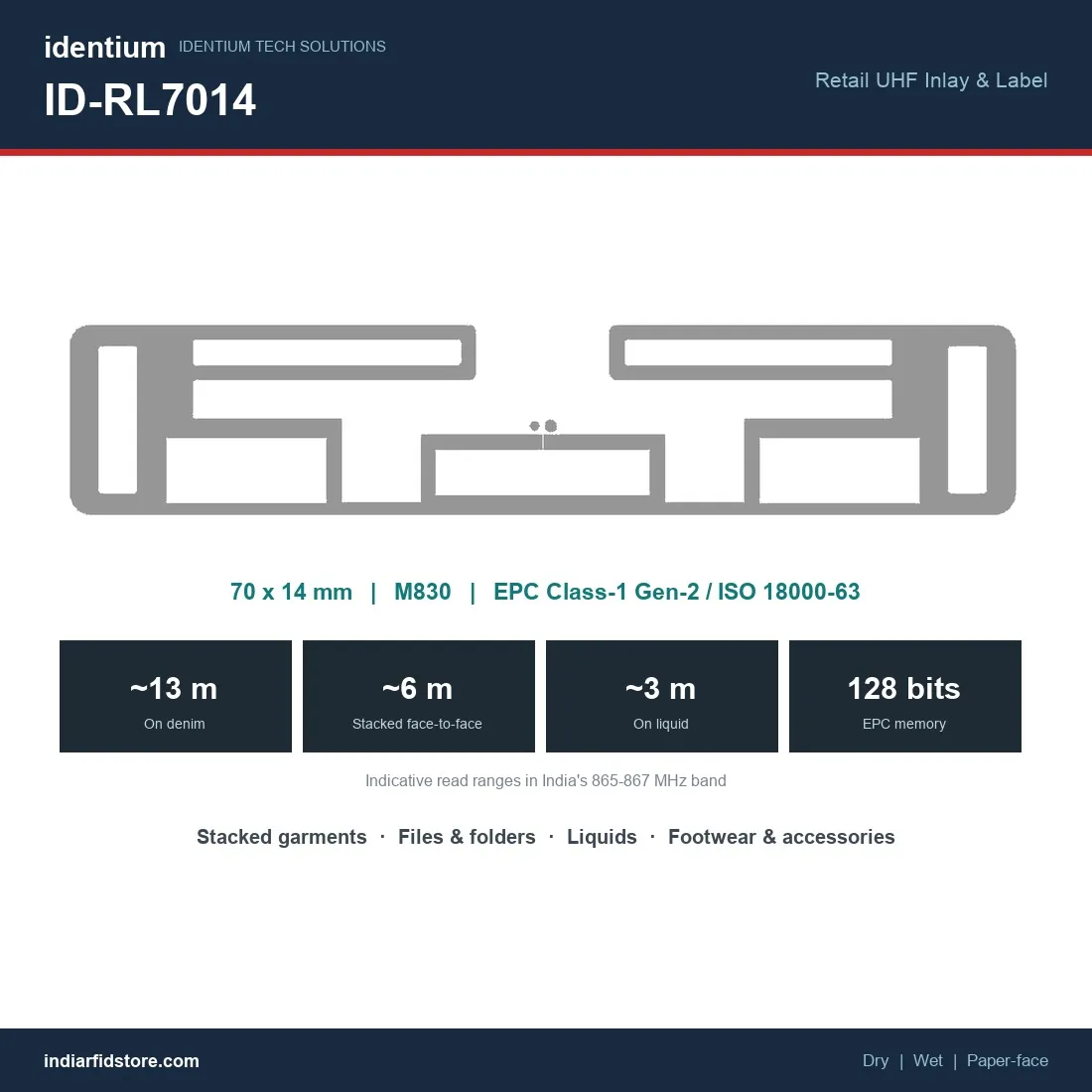
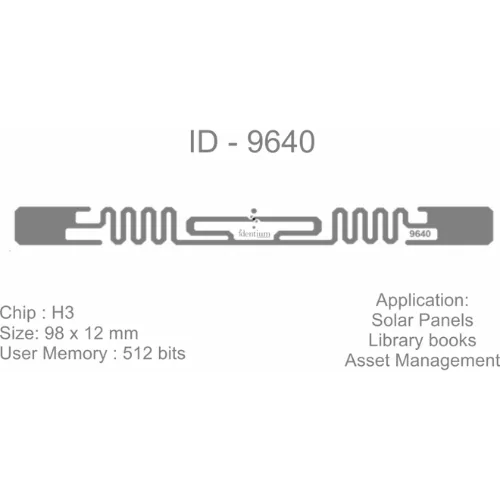
That is why you should evaluate the finished UHF RFID inlay or label, not just the chip name on the spec sheet.
Memory and serialisation
For most Indian retail and asset-tracking projects, a 96- or 128-bit EPC is plenty: it holds a globally unique serialised number (SGTIN). Both brands support self-serialisation: the chip carries a factory-programmed, unique TID that lets you generate unique EPCs without a central database, which greatly simplifies encoding at scale.
If your application needs to store extra data on the tag itself (maintenance logs, batch data), choose a user-memory variant: M750, M770/M775 or UCODE 8m, or the higher-memory M780/M781 for more.
Brand protection and security
Both families offer anti-counterfeiting tools. NXP's Brand Identifier lets a reader confirm a genuine NXP chip and the brand that commissioned it. Impinj's Protected Mode (on M770/M775) and enhanced serialisation support similar authentication and privacy workflows. For pharma, luxury and spare-parts authentication in India, specify these features explicitly.
How to choose an RFID chip by application
- Apparel and retail inventory (millions of tags): Impinj M730 or NXP UCODE 9. Both give excellent range in dense stacks, so pick on inlay availability and price. Browse UHF RFID tags.
- Supply chain, cartons and pallets: UCODE 9 for fast anti-collision reads, or M770 where you also need write-heavy re-encoding and Protected Mode.
- Asset tracking on metal (IT assets, tools, cylinders): the chip matters less than the housing. You need a hardened on-metal RFID tag with a ground-plane antenna; both M700 and UCODE chips are used here.
- Small, high-value or embedded items (surgical tools, PCBs, jewellery): look at compact RFID PCB and ceramic tags, where miniaturised antennas make the chip's sensitivity especially valuable. M770 or UCODE 9 are strong picks.
- Cost-sensitive, general-purpose tagging: NXP UCODE 8 remains a proven, economical choice where you do not need the last metre of range.
Buying Impinj and NXP based tags in India
India RFID Store supplies inlays and converted tags on both Impinj M700 and NXP UCODE chips, tuned for the Indian 865–868 MHz band, with GST invoicing and datasheets on request. Whether you need paper labels or PCB, ceramic or on-metal tags, tell us your read-range, memory and budget requirements and we will match the chip to them.
You can request samples to test on your own items before you commit to volume.
Related
Frequently asked questions
Is Impinj M700 better than NXP UCODE 9?
Which RFID chip has the longest read range?
Do Impinj and NXP chips work with the same RFID readers in India?
What is self-serialisation and do both chips support it?
Which chip should I use for on-metal asset tags?
Are tags with these chips available from India RFID Store?
Impinj M700NXP UCODE 9UHF RFID chipRAIN RFIDRFID buyer guide IndiaGen2v2