On-Metal RFID Tags — How to Choose the Right Tag for Metal Assets (India 2026)
Published 18 Jul 2026Updated 8 Oct 20268 min read
If you have ever stuck a standard UHF RFID label onto a steel rack, an aluminium panel or a tool trolley and watched the read range collapse to almost nothing, you already know the core problem: metal and RFID do not get along. For Indian manufacturers, warehouses, IT asset teams and utilities moving to RFID-based tracking in 2026, choosing the right on-metal RFID tag is the decision that determines whether a project succeeds or quietly fails in pilot.
This guide explains why ordinary tags fail on metal, how anti-metal tags are engineered differently, and how to choose between PCB, ceramic and flexible on-metal tags on read range, size, IP rating and temperature. A comparison table and a four-question checklist help procurement and engineering teams specify the correct part the first time.
Why normal RFID tags fail on metal
A passive UHF RFID tag has no battery. It harvests the energy it needs from the reader's radio waves and reflects a modulated signal back, a process called backscatter. This works well in free air, but metal breaks it in three ways:
- Reflection and detuning: metal is a conductor. When a tag antenna sits on or near a metal surface, the metal reflects the incoming RF field and shifts the antenna's resonant frequency away from the 865–868 MHz band used in India. The tag is detuned and can no longer absorb power efficiently.
- Field cancellation: the wave reflected from the metal arrives out of phase with the incoming wave. The two partially cancel at the tag surface, so the electric field the antenna sees drops close to zero. No field means no power, and no power means no read.
- Eddy currents: the changing RF field induces circulating currents in the metal that oppose the field and absorb energy that should have reached the chip.
The result: a general-purpose wet inlay or paper label that reads at 6–8 metres in air may read at a few centimetres, or not at all, once it touches steel. This is not a defect. It is physics, and it is exactly why a dedicated category of on-metal RFID tags exists.
How on-metal (anti-metal) tags work
Anti-metal tags do not fight the metal; they use it. An on-metal tag is engineered so that the metal surface becomes part of the antenna system. Three design techniques make this possible:
- A spacer or isolation layer: a dielectric material (foam, ceramic, FR4 PCB substrate or a special polymer) separates the antenna from the metal by a controlled distance. This lifts the antenna out of the zone where field cancellation is strongest.
- A ground-plane design: the antenna is built as a microstrip or patch structure that expects a conductive plane beneath it. When the tag is mounted on metal, the metal completes the intended antenna geometry, so the tag performs better on metal than off it.
- Retuned antenna geometry: the antenna is pre-compensated for the frequency shift that metal causes, so it resonates correctly in the Indian UHF band (865–868 MHz) when it is on a metal asset.
Because of this, a good on-metal tag can be only a few millimetres thick yet read from about 1 m to more than 12 m directly on steel, depending on its size and the reader. A standard label cannot get close.
The three main types of on-metal tags
PCB (hard) anti-metal tags
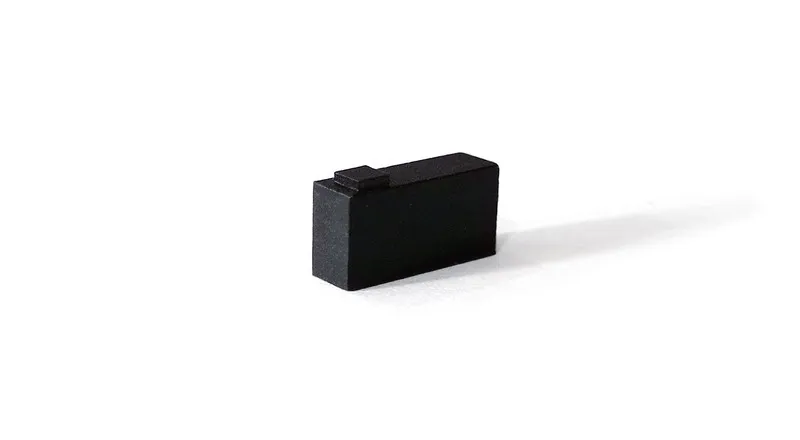
PCB tags use a rigid FR4 printed-circuit-board substrate as both the antenna carrier and the dielectric spacer. They are the workhorse of industrial asset tracking: strong, consistent read ranges (typically 4–12 m on metal), rugged encapsulation, and good resistance to impact, moisture and chemicals.
Sizes run from tiny 12 mm tags for tools and IT hardware to large 90 mm-plus tags for long-range yard and rack applications. Compare the family under RFID PCB and ceramic tags.
Ceramic anti-metal tags
Ceramic tags use a high-permittivity ceramic substrate, which allows a very small footprint while keeping usable read range. Their strengths are miniaturisation and durability: they tolerate high temperatures, screw or rivet fixing, and harsh outdoor exposure.
They suit small tools, surgical instruments, jewellery, firearms and any asset that needs a tag under 20 mm. They cost more per piece than PCB tags but pack the most performance into the smallest area.
Flexible anti-metal tags (labels)
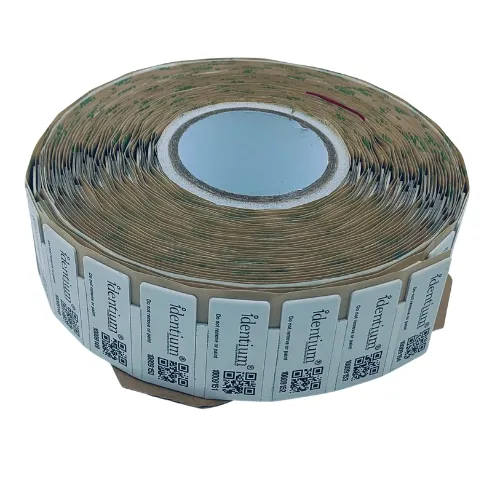
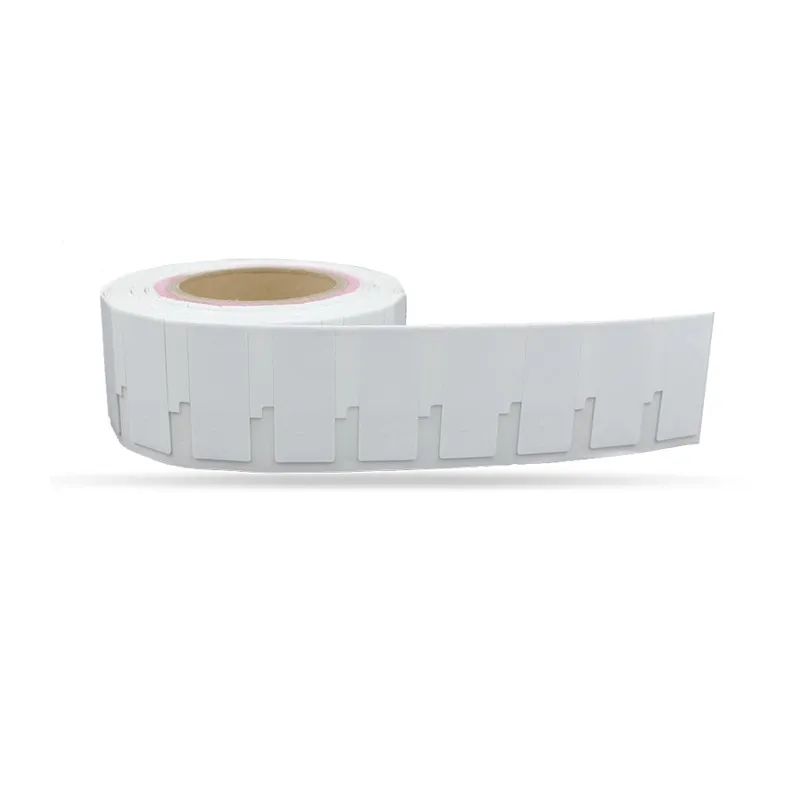
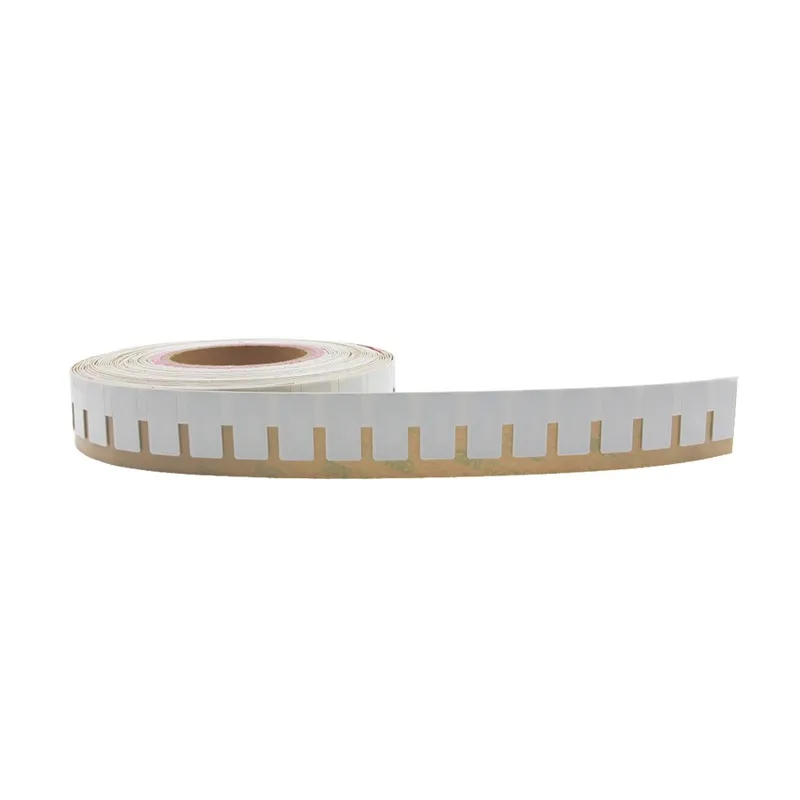
Flexible on-metal tags use a thin foam or polymer spacer with a printable label face. They bend to curved surfaces such as pipes, cylinders, gas bottles and drums, and can be printed on site with an RFID label printer to carry barcode, human-readable text and RFID in one label.
Read ranges are usually lower (1–5 m) and durability is moderate, but they are the most economical option and the easiest to apply at scale. They work well for returnable transport items, cylinders and other curved metal assets.
Size vs read range: the core trade-off
The most important rule for on-metal tags is simple: a bigger antenna gives a longer range. There is no way around it in passive UHF. A 12 mm ceramic tag might give 0.5–1.5 m on metal; a 90 mm PCB tag can give 10–15 m. Specify the smallest tag that still meets your required read distance, because smaller tags cost less, mount more easily and look neater on the asset.
Practical sizing guidance for Indian deployments:
- Handheld reads at 0.3–1 m (IT assets, tools, files): 12–35 mm tags are plenty.
- Fixed portal or dock reads at 2–5 m (returnable containers, trolleys): 50–70 mm tags.
- Long-range yard or gantry reads at 6 m and beyond (vehicles, large racks, cable drums): 75–95 mm tags.
Always add margin. Real warehouses have interference, dense metal and moving stock, so specify a tag rated for roughly 1.5 times your nominal read distance.
IP and temperature ratings: don't skip these
On-metal tags usually live in tougher environments than office labels, so ingress protection (IP) and temperature ratings matter as much as read range.
- IP65: dust-tight and protected against water jets. Suitable for most indoor industrial and covered outdoor use.
- IP67: withstands temporary immersion. Good for washdown areas, food processing and monsoon-exposed yards.
- IP68 / IP69K: continuous immersion and high-pressure, high-temperature washdown, for the harshest environments.
- Temperature: standard tags typically handle −20 °C to +85 °C. For autoclaving, paint ovens, powder coating and foundry work, specify high-temperature ceramic or PPS-housed PCB tags rated up to about +200 °C (or higher for short cycles). Outdoor metal surfaces in an Indian summer can exceed 70 °C in direct sun, so do not under-specify the upper limit.
Also confirm which mounting methods the tag supports: adhesive (such as 3M VHB), screw or rivet holes, cable-tie slots, or embedding. Screw or rivet mounting is strongly recommended for permanent, high-vibration or outdoor metal assets, where adhesives degrade in heat and dust.
On-metal RFID tag selection table
| Tag type | Typical size | Read range on metal* | IP / temperature | Mounting | Best for |
|---|---|---|---|---|---|
| Mini PCB / ceramic | 12–20 mm | 0.5–2 m | IP67 / up to 200 °C (ceramic) | Adhesive / screw | Tools, IT assets, instruments, jewellery |
| Compact PCB | 25–40 mm | 2–5 m | IP67 / −40 to +85 °C | Adhesive / screw | Laptops, servers, panels, valves |
| Standard PCB | 50–70 mm | 5–10 m | IP68 / −40 to +120 °C | Screw / rivet / adhesive | Racks, trolleys, returnable containers |
| Long-range PCB | 75–95 mm | 10–15 m | IP68 / −40 to +85 °C | Screw / rivet | Vehicles, cable drums, yard assets |
| Flexible anti-metal label | 50–95 mm | 1–5 m | IP65 / −20 to +80 °C | Adhesive (curved surfaces OK) | Pipes, cylinders, drums, RTIs |
| High-temperature ceramic | 18–35 mm | 1–4 m | IP68 / up to +230 °C | Screw / embed | Autoclaves, paint lines, foundries |
*Indicative ranges for the tag class with a standard fixed reader at 865–868 MHz and the 2 W e.r.p. permitted in India. Actual range depends on the specific tag, reader, antenna, orientation and environment; check each product's specifications and validate with a site pilot.
Which on-metal tag should you choose?
Work through these four questions in order and the right tag usually becomes obvious:
- How far do you need to read? This sets your minimum tag size. Handheld inventory needs far smaller tags than a fixed dock portal.
- How small must the tag be? If the asset is tiny (a drill bit, a surgical tool), ceramic wins. If space is available, PCB gives more range per rupee.
- How harsh is the environment? Washdown, heat, chemicals or outdoor sun push you towards higher IP ratings, screw mounting and ceramic or PPS housings.
- Is the surface flat or curved? Curved assets (pipes, cylinders) need flexible anti-metal labels; flat assets take rigid PCB or ceramic tags.
For most Indian B2B asset-tracking projects (IT hardware, tools, racks and returnable containers) a compact-to-standard PCB tag with screw mounting and IP67/68 is the safest default. For high-value small tools and medical or high-temperature use, choose ceramic. For cylinders and curved returnables, choose flexible.
If you are still comparing chips and antenna designs, browse the full UHF RFID tags range and match the inlay chip (Impinj, NXP) to your reader ecosystem; our Impinj vs NXP chip guide covers the trade-offs.
Frequency matters: buy tags tuned for India
RFID frequency bands differ by region, and this point is often missed. India's licence-exempt UHF RFID band is 865–868 MHz (G.S.R. 853(E), 2021), the same band Europe uses, while the US uses 902–928 MHz. A tag tuned narrowly for the US band will underperform on Indian readers.
Specifying tags tuned for 865–868 MHz, and readers set to the India band, avoids a whole class of "why is my range so short?" problems.
Approvals sit with the reader, not the tag. Passive tags need no type approval and there is no BIS category for them. The reader is the transmitter, so ask for the WPC Equipment Type Approval of the exact reader model you are buying.
Buying on-metal tags from an Indian supplier
Sourcing on-metal RFID tags from a domestic supplier gives Indian buyers practical advantages:
- Band-correct tuning: tags specified for 865–868 MHz rather than re-labelled US-band stock.
- Samples before volume: test candidate tags on your own assets and readers before you commit. You can request RFID samples.
- Local engineering support: help with tag selection, site pilots and mounting for your specific metal assets, in your time zone.
- GST invoicing and rupee pricing: clean procurement for enterprise and government buyers.
Ready to specify the right tag?
The right on-metal RFID tag turns a failed pilot into a reliable, scalable asset-tracking system. Match your read range and size needs to the selection table, confirm the IP and temperature ratings for your environment, and insist on 865–868 MHz tuning for India.
Browse the on-metal RFID tags, compare PCB and ceramic tags, and send us photos of your assets with the read distance you need for a tag recommendation and a pilot plan.
Related guides
Frequently asked questions
Can I use a normal RFID label on metal if I just add foam behind it?
What read range can I realistically expect on metal in India?
PCB or ceramic: which lasts longer?
Do on-metal tags work on aluminium and stainless steel too?
How should I mount on-metal tags for outdoor Indian conditions?
on-metal rfidanti-metal tagsuhf rfidpcb tagsceramic rfidasset tracking indiaindustrial rfidrfid selection guide