EU Digital Product Passport and RFID: What Indian Exporters Need to Do in 2026
Published 9 Aug 2026Updated 22 Oct 20269 min read
Written and maintained by the RFID team at Identium Tech Solutions Pvt Ltd, New Delhi (India RFID Store).
Short answer: The EU Digital Product Passport (DPP) is a machine-readable record of a product — identity, materials, origin, care, repair and end-of-life information — that anyone in the value chain reaches by scanning a data carrier attached to the item. Textiles and apparel are first in line: the EU's Joint Research Centre published the first complete DPP content specification for textiles in May 2026, covering 49 data points across four categories. CEN/CENELEC JTC 24 has designated five approved DPP data carriers, and RAIN RFID — the UHF technology already used for item-level retail tagging — is one of them.
This guide is written for Indian garment, home-textile and made-ups exporters shipping to the EU, and for the sourcing, compliance, packing and IT teams who will actually have to produce the data and put a carrier on every item. It explains what a DPP is, who gets hit first, how QR, NFC and RAIN RFID compare as carriers, and what you can sensibly start doing in the next two quarters without betting the factory on a timeline that is still phasing in.
What exactly is a Digital Product Passport?
A Digital Product Passport is a structured, machine-readable dataset about one product, hosted online and linked to the physical item through a data carrier such as a printed 2D code or an RFID tag. Scanning the carrier resolves to the record. It travels with the product across manufacture, retail, resale, repair and recycling.
The DPP sits inside the EU's ecodesign policy framework, whose purpose is to make products more repairable, more recyclable and more transparent. Instead of a paper hangtag with a fibre percentage, a buyer, customs officer, recycler or consumer can pull a consistent digital record.
Two things matter for you as a supplier:
- The content — what data fields must exist. This is a compliance and data-management problem.
- The carrier — what physical thing gets scanned. This is a tagging and production-line problem, and it is the one with a hardware lead time, which is why it should not wait.
Which Indian exporters will be affected first?
Textiles and apparel are the first major consumer category with a complete DPP content specification, so garment, knitwear, home-textile and made-ups exporters are in the front row. Exporters in the Tiruppur, Ludhiana, Noida, Bengaluru, Karur and Surat clusters shipping to EU brands and retailers will see DPP language appear in buyer manuals before it appears in any Indian rule.
Legally, the obligation attaches to whoever places the product on the EU market — the importer or brand. Practically, Indian exporters will experience it as a contractual requirement flowing down the purchase order: the buyer will ask you to supply specified data fields per style or per item, and to apply a carrier they nominate.
Vendors who can already serialise at item level will be asked fewer questions and will get fewer chargebacks. Others will be told, at short notice, to retrofit. If you already run item-level tagging for retail, you are most of the way there — see our guide to RFID in apparel and fashion in India.
What data does the textile DPP actually ask for?
The JRC's May 2026 textile specification defines 49 data points grouped into four categories. Broadly, the shape is what you would expect of an ecodesign instrument: product and party identification, material and composition information, sustainability and durability characteristics, and circularity information covering care, repair and end-of-life handling. Treat the exact field list as something to read in the published specification rather than something to take second-hand from a vendor.
You do not need to memorise the field list to start preparing. You need to answer a more basic question: can you attach any data to a single physical piece at all? Most Indian factories today can identify a style, a colour and a size — a SKU. A DPP is anchored to a unique item instance, or at minimum to a batch that can be resolved unambiguously. The practical work is therefore:
- Assign a globally unique identifier per item (or per batch, if your buyer allows it).
- Keep that identifier joined to your fabric, dye, trim and process records — that is where composition and circularity data comes from.
- Decide who hosts the record: the brand, a service provider, or you.
- Make sure the carrier on the garment resolves to that identifier reliably at any point in its life.
QR code, NFC or RAIN RFID — which data carrier should we use?
CEN/CENELEC JTC 24 has designated five approved DPP data carriers, and RAIN RFID is one of them — a point the RAIN Alliance has actively promoted. For most Indian textile exporters the realistic shortlist is a printed 2D code, an NFC tag, or a RAIN (UHF) RFID inlay. Confirm the exact approved carrier list and any per-category restrictions against the current standard before you buy tooling.
| Factor | Printed 2D / QR | NFC tag | RAIN (UHF) RFID |
|---|---|---|---|
| How it is read | Camera or phone | Phone tap, at very close range | Reader and antenna, at a distance |
| Line of sight needed | Yes | Near contact | No |
| Read many items at once | No | No | Yes — bulk reading is the point |
| Reads inside a sealed carton | No | No | Usually yes |
| Consumer access without an app | Yes | Yes on most phones | No — needs a reader |
| Added unit cost | Effectively nil | Highest per piece | Modest; falls with volume |
| Survives industrial laundry | Poor once a printed label fades | Depends on encapsulation | Good with a laundry-rated tag |
| Extra operational value | None beyond the link | Anti-counterfeit, engagement | Inventory accuracy, dispatch verification, shrinkage control |
The trade-off is simple. A 2D code is the cheapest way to satisfy a consumer-facing scan. NFC is a premium, one-item-at-a-time tap suited to brand engagement and authentication. RAIN RFID is the only one of the three that also pays you back operationally, because the same tag that carries the passport link lets you count a carton without opening it.
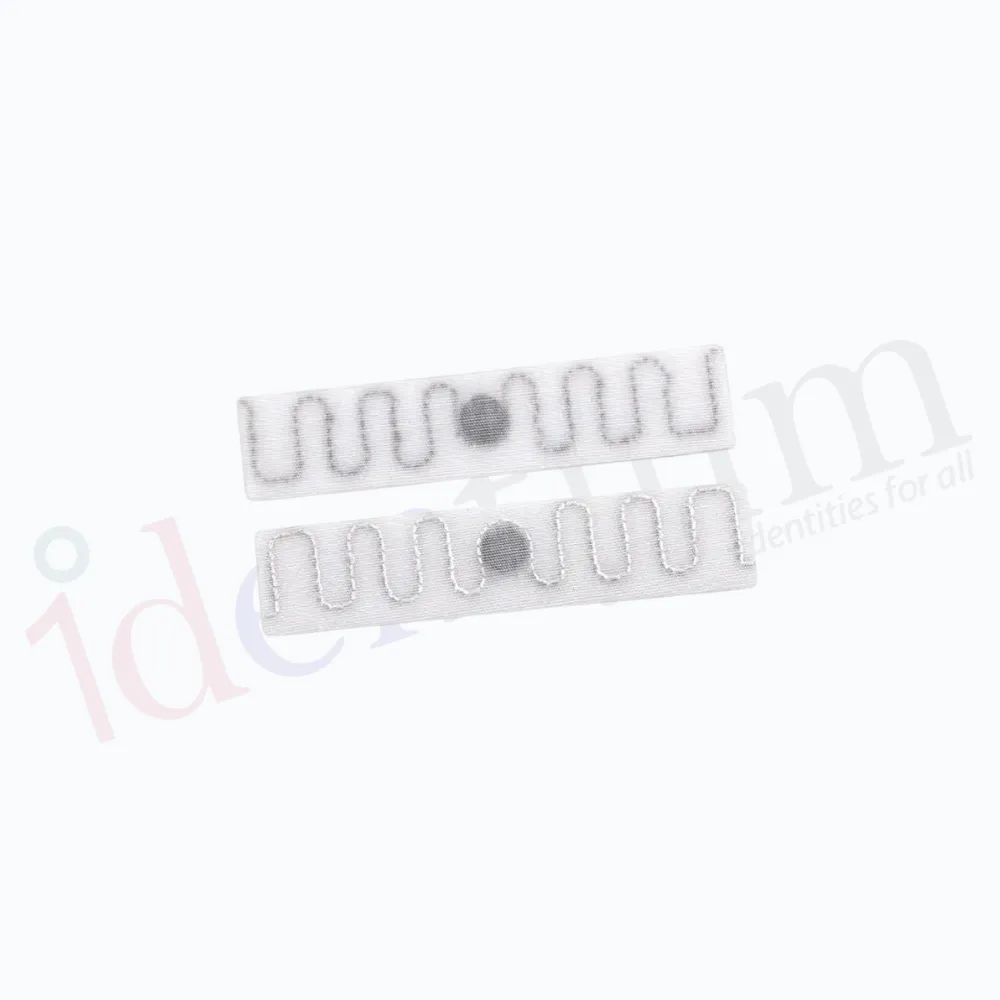
Many EU brands are likely to specify a 2D code plus RAIN RFID, so plan for the possibility of both on one label. Our UHF RFID inlays and labels range covers the standard apparel form factors, and washable laundry tags cover items that go through repeated industrial wash cycles. Examples are the ID-1530-M830 inlay label for swing tags and the washable woven textile tag for garments that are laundered.
Will EU-facing RFID tags work under Indian radio rules?
Yes for tags, with care for readers. Passive UHF RFID tags are designed to operate across the global UHF band used for RAIN RFID worldwide, so a tag encoded and applied in India can be read in the EU and vice versa. India's licence-exempt UHF RFID band, 865–868 MHz under G.S.R. 853(E), 2021, is the same range as the EU's ETSI band.
The regional difference lives in the reader, not the tag. A reader sold for use in India must be set to the Indian band and must carry the right approvals — WPC ETA, and BIS where applicable. Do not import a reader configured for another region and assume it is compliant here; it is a common and avoidable procurement mistake.
Check the current band and power conditions in the applicable WPC notification rather than relying on a datasheet summary. We cover the paperwork in detail in our guide to WPC ETA and BIS certification for RFID readers in India.
Which tag and chip should an exporter specify?
Specify by application, not by brand:
- Hangtags and care labels on garments — a standard passive UHF inlay with a mainstream chip.
- Linens, uniforms and hospitality textiles that see industrial laundering — a purpose-built laundry tag.
- Cartons and pallets — a plain paper UHF label is enough.
Avoid on-metal or ceramic tags here — they solve a different problem.
Two chip characteristics matter for DPP work. First, a factory-programmed unique serial in the chip gives you an item identity that cannot be duplicated by re-encoding, which supports authentication claims. Second, user memory and any URL or digital-link features vary by chip family, so check the datasheet before you promise a buyer that the passport URL sits on the tag itself rather than being resolved from the identifier.
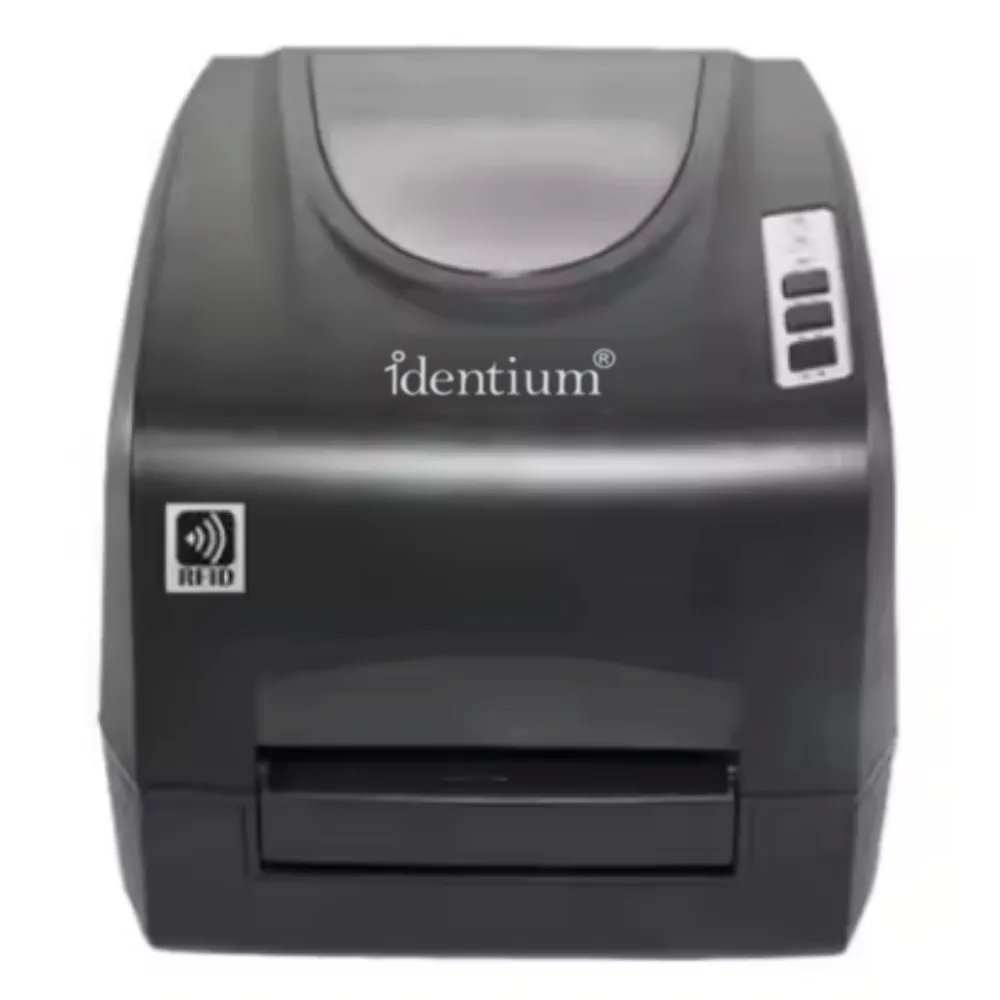
Our comparison of Impinj and NXP UHF chips for the Indian market walks through where each family fits. For encoding at the factory, you will also need RFID label printers that print and encode in one pass. The IT4RL desktop printer-encoder is one in-house option.
How do we start preparing our tagging now?
Start with a pilot on one style, one line and one buyer, not a factory-wide rollout. The goal in the first quarter is to prove you can produce a uniquely identified garment, read it reliably in a carton, and export a clean data file — long before any specific field list becomes binding on your shipments.
- Pick the pilot. One export style and one EU buyer who is already talking about DPP.
- Get the buyer's intent in writing. Which carrier they intend to specify, and who will host the record.
- Order samples. Inlays and labels in the two or three form factors that fit your product — hangtag, sewn-in care label and carton label.
- Test on your actual product. Dense denim, metallic trims, wet fabric and foil packaging all change read results.
- Trial print-and-encode on the line. Measure the throughput hit at packing.
- Fix your identifier scheme first. Data fields can be filled in later, but the identifier is hard to change once tags are in the market.
- Keep an encoding log. Record what you encoded on which shipment — buyers will audit this.
What should we not assume about DPP deadlines?
Do not assume a single hard cut-off date. The DPP is phasing in by product group, and content specifications, delegated acts and carrier standards are landing at different times. What is confirmed is the direction: textiles first, a published content specification with 49 data points across four categories as of May 2026, and RAIN RFID formally recognised among the approved carriers.
Treat any date you hear from a vendor — including a dramatic one — as unverified until you see it in an official EU instrument or your buyer's contract. The commercially safe position is that your EU customers will require DPP data before any regulator asks you directly, so buyer manuals, not gazettes, are your real deadline.
Verify with the official source: DPP requirements, approved carrier standards and product-group scopes are still evolving, and nothing here is legal advice. Confirm the current position against official EU publications and the applicable CEN/CENELEC standards, and confirm Indian radio and certification requirements with WPC and BIS, before committing to hardware, tooling or process changes.
Identium Tech Solutions manufactures RFID hardware in India and supplies UHF inlays, labels, laundry tags, RFID printers and Indian-band readers to exporters, warehouses and manufacturers across India. If you want to test carriers on your own product before committing, request RFID samples and our team will recommend an inlay, label and reader combination for your export line.
Related guides
Frequently asked questions
Is the Digital Product Passport already mandatory for Indian exporters?
Does RAIN RFID replace the QR code on a garment?
Will an RFID tag applied in India read correctly in Europe?
How much does DPP-ready tagging add per garment?
Can we use one tag for both DPP compliance and warehouse inventory?
What is the first thing we should do this quarter?
Digital Product PassportRAIN RFIDTextile ExportsEU ComplianceUHF RFID Tags
Cite as: India RFID Store (Identium Tech Solutions Pvt Ltd), “EU Digital Product Passport and RFID: What Indian Exporters Need to Do in 2026”, https://www.indiarfidstore.com/rfid-resources/digital-product-passport-rfid-india-exporters-2026, updated 22 Oct 2026.
Keep reading
More guides
 RFID Sensor Tags in 2026: Temperature, Humidity and Strain, What Is Real and What You Can Buy in India9 min read
 RFID Tyre Tags in India: ISO 20909 Embedded vs Patch vs Sticker, and What Tyre Makers, Retreaders and Fleets Should Specify7 min read
 Will 5G Ambient IoT Replace RFID? India Buyer's View 20267 min read
More in Regulations & tenders
- E-Way Bill and RFID Gate Readers: What Indian Transporters Need in 2026
- RFID E-Seals for Export Containers in India: CBIC Circular 14/2026 and the SEZ Sealing Instruction