RFID Sensor Tags in 2026: Temperature, Humidity and Strain, What Is Real and What You Can Buy in India
Published 22 Oct 20269 min read
Prices checked on 22 Oct 2026 against the catalogue.
Short answer: Battery-free RFID sensor tags are real, and temperature is the one you can buy off the shelf. Humidity, moisture and strain sensing exist in research, in pilots and in specialised products, and in August 2026 the RAIN Alliance announced a Sensor Working Group to move them towards wider adoption. Our store sells two temperature sensor tags today: a passive UHF label that reports the temperature when it is read, and an NFC label that logs temperature for later readout. We list no humidity or strain sensor tags yet, and this guide explains why, how the technology works, and what to ask before you buy any sensor tag.
Search for "RFID sensor" and you will find big claims: tags that report freshness, moisture inside concrete, the load on a hip implant. Some of that is working in the field, some is in trials, and some is still in papers. As a tag maker we would rather tell you which is which than sell you a promise. We use three kinds of source below: the RAIN Alliance's own description of its sensor work, a notice about the European Commission's Digital Product Passport registry, and a peer-reviewed review of antenna-based RFID sensors.
How a battery-free RFID sensor tag works
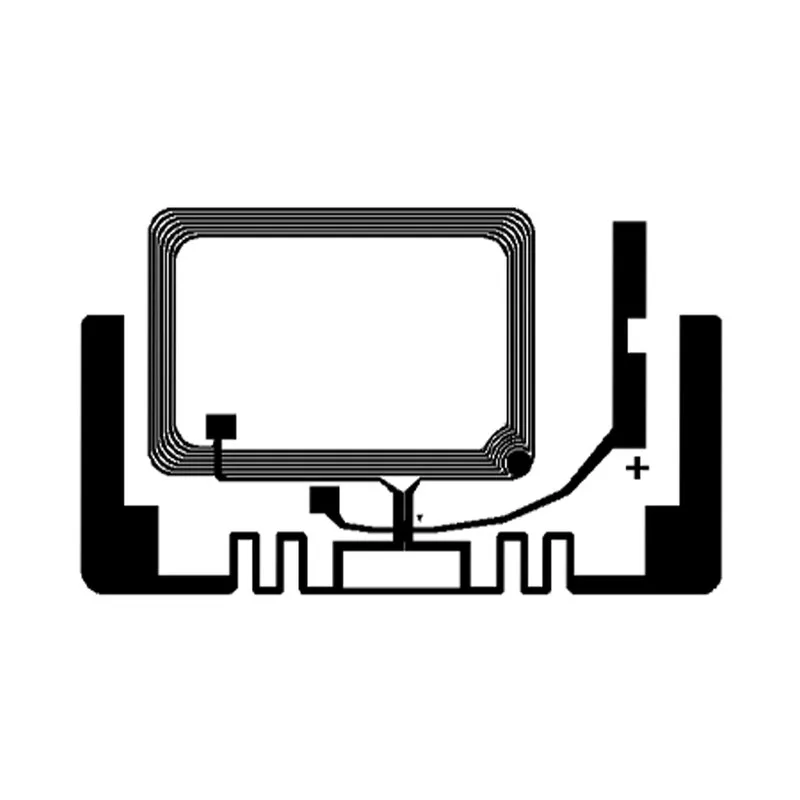
A passive RFID tag has no battery. When a reader's radio field reaches it, the chip wakes up, takes its energy from that field and replies by modulating the signal it reflects. A sensor tag adds a measurement to that reply, and there are two ways of doing it.
| Chip-based sensing | Antenna-based sensing | |
|---|---|---|
| Where the sensor is | Inside the tag's chip, or in a sensor chip wired to it | In the antenna itself, or in a material placed on it |
| How the value reaches the reader | As data, read from the chip like any other memory | As a change the reader measures: a shift in resonant frequency, in reflected power (RSSI) or in phase |
| Strengths | A calibrated number comes back with the ID; standard readers can be used if their software supports the chip | The tag can be cheap and simple; it suits strain, cracks and other changes in a structure |
| Weak points | Needs a sensor chip, and the reader software must understand it | Readings depend on the radio channel, the mounting and the distance; many high-performance designs need special receivers |
The review we cite, on passive antenna-based sensors for structural health monitoring, is frank about the limits of the second approach. Reflected power varies with the radio channel, so readings based on it are easily disturbed; resonant-frequency methods are more robust; resolution falls as the read distance grows; and many of the best-performing laboratory designs rely on a vector network analyser or a dedicated receiver, and some are not compatible with the EPC Gen2 standard that ordinary UHF readers speak. That is the gap between a paper and a product.
One practical rule applies to both kinds: taking a sensor reading usually needs more power than reading an ID, so plan for a shorter distance when sensing than the tag's listed ID read range.
Temperature: what the catalogue has today
Temperature is where RFID sensing is most mature, and it is the only sensor type in our RFID sensors range. The two tags do different jobs.
| Feature | UHF temperature sensor label ID-SE-AS3213T | NFC temperature logger label ID-SE-FM13DT160 |
|---|---|---|
| Interface | UHF, EPC Class 1 Gen2 / ISO 18000-6C, 860–960 MHz (covers India's 865–868 MHz band) | NFC, 13.56 MHz |
| What it reports | The temperature at the moment it is read | Logged temperature data for later readout |
| Power | Passive, battery-free | Ask for the datasheet with your quote |
| How it is read | A UHF reader, from a distance, many tags per pass; up to 6 m listed for the ID read | An NFC reader or phone app that supports the chip, a few centimetres away, one tag at a time |
| Memory | 192-bit EPC | 160 kbit |
| Size | 94 × 20 mm | 77 × 44 mm |
| Best for | Spot checks at receiving, in cold rooms and pharma stores | Proving the temperature history of a shipment |
| Price | ₹45 + GST | ₹45 + GST |
Both are sold at a minimum order of 500 pcs. We do not publish accuracy, logging-interval or calibration figures for either tag on the product pages, so ask for the datasheet with your quote and test a sample on a real shipment before ordering in volume. The UHF label keeps no history: without a battery it cannot record between reads. If you need the record of a whole journey, that is the logger label's job. Our guide to RFID cold-chain temperature monitoring covers the wider choice, including passive versus semi-passive tags and where each fits in a cold chain.
Humidity and moisture: how it is done, and why we list none yet
The RAIN Alliance's announcement of its Sensor Working Group, as reported by IoT Insider, lists humidity and moisture among the conditions its members want to sense:
- Pharmaceuticals: linking the condition of individual vaccines, biologics and medicines to their identity and chain of custody, including temperature and humidity inside primary packaging such as blister packs.
- Food and perishables: temperature, moisture and freshness-related conditions at product or package level, to reduce spoilage.
- Concrete and infrastructure: temperature, moisture and strain from within concrete and structural components.
Both sensing methods above can be used for moisture: a sensor chip that measures it, or a tag whose antenna response changes as the material around it takes up water. Either way, the reading only means something once it has been calibrated for the actual packaging or material, and the reader software has to turn the raw value into a number you can act on.
That is why we do not list humidity or moisture tags. We list a product when we can give you its specification from a datasheet and point you to a reader that reads it. For humidity, the tag, its calibration and the reader software are a project, not a catalogue line. If you have an application, tell us about it and we will say honestly whether we can supply anything for it.
Strain, concrete and machines
Strain sensing is the classic antenna-based application. When a structure stretches, the antenna stuck to it stretches too, its electrical length changes and so does its resonant frequency, which a reader can measure. The review describes stretchable dipoles and patch antennas used this way, along with crack and corrosion sensing, and also the practical problems: sensitivity to the air gap under the antenna, difficulty mounting on metal, and readings that depend on the radio channel.
The RAIN working group's list goes further: tyre temperature and pressure, battery condition, temperature and mechanical change on bearings and turbines, and the loading on orthopaedic implants and prostheses inside the body. These are aims for the industry, stated by its association. They are not products in our catalogue, and we do not claim that any of them is ready to buy off the shelf in India today.
Readers that read sensor data
A sensor tag is only as useful as the reader and software that decode it.
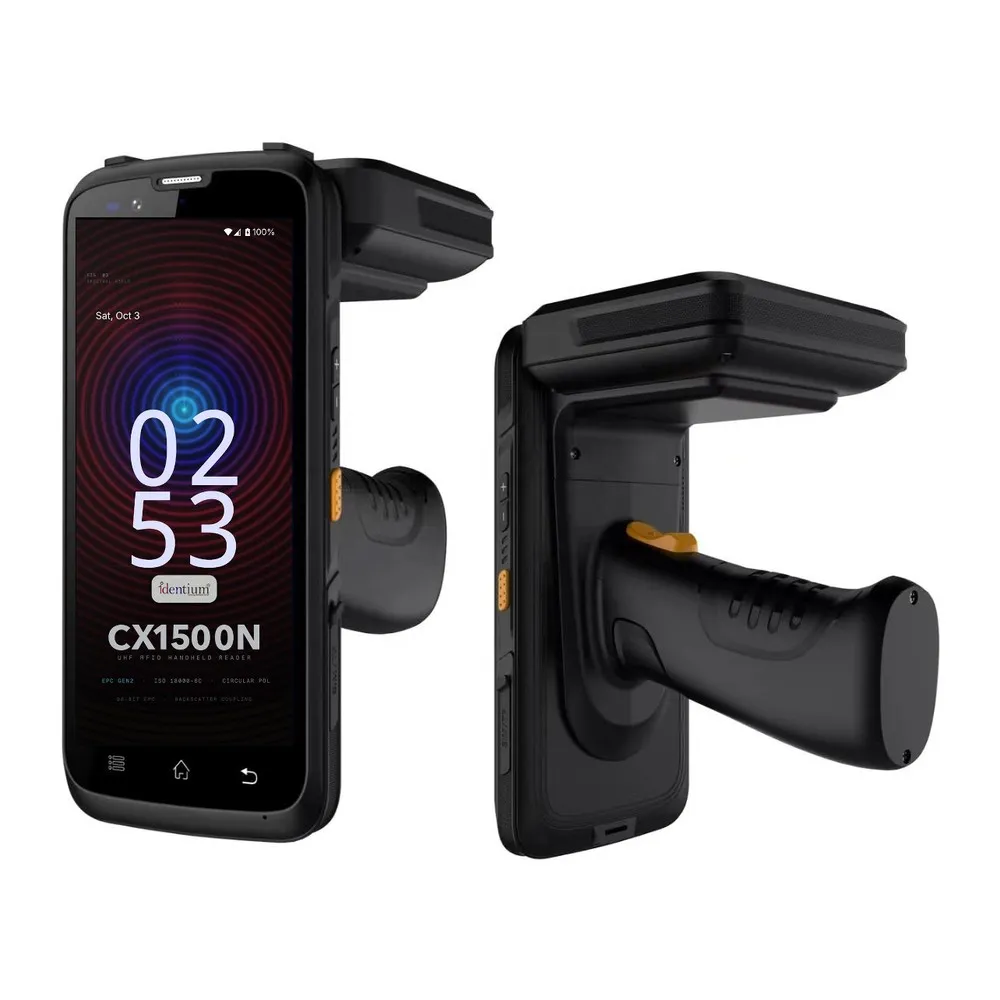
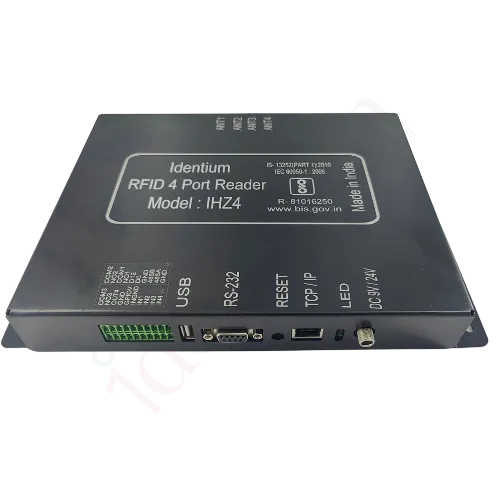
- UHF sensor labels: any EPC Gen2 reader will read the ID. The temperature value needs reader firmware or middleware that supports the sensor chip. Before you buy readers such as the CX1500N handheld for spot checks or an IHZ4 fixed reader for a cold-room door, confirm with us that your planned reader and software can read the sensor value, or test it with a sample.
- NFC logger labels: an NFC reader, or a smartphone running an app that supports the logger chip, reads the stored data at close range. UHF readers do not read NFC tags.
Our middleware guide explains how sensor values travel from reader to ERP alongside ordinary tag reads.
What drives the price of an RFID sensor tag
A plain UHF label is a commodity. A sensor tag is not, for four reasons:
- The chip. A chip with a sensor and its calibration costs more than an ID-only chip.
- Logging. Recording over time needs memory and a way to keep time between reads, which a read-on-demand tag avoids.
- The format. Labels for cartons are the cheapest; encapsulated tags for harsh places cost more.
- Software. The reader-side support to decode and store sensor values is part of the cost of the system, not the tag.
In our catalogue, the UHF label is ₹45 + GST and the NFC logger label ₹45 + GST. For a whole system, including readers and software, our RFID project cost guide shows how to budget, or request samples to test on your own packaging.
Questions to ask before you buy any sensor tag
Whether you buy from us or anyone else, a sensor tag is only worth its price if these questions have clear answers in writing:
- What exactly does it measure, and over what range? Temperature, humidity or strain, with the operating range stated on the datasheet.
- How accurate is it, and how was that checked? Ask for the accuracy figure and the calibration method; a figure without a method is a marketing number.
- How far does it read when sensing? The listed range is often the ID range; ask for the sensing range with the reader you plan to use.
- Does it log, or report only when read? If it logs, ask for the interval, the memory and the power source.
- Which readers and software decode the value? Get the names of the reader models and the software that have been tested with it.
- What surface will it sit on? Label-format tags do not read reliably directly on metal, and liquids can reduce performance; trial on your real packaging.
- Can you test a sample first? Test on a real shipment or structure before any volume order.
The Digital Product Passport and the RAIN Sensor Working Group
Sensor tags and the EU's Digital Product Passport are often mentioned together, so it is worth separating the dates.
- The working group. The RAIN Alliance says its Sensor Working Group was created to speed up market adoption of sensor-enabled RAIN RFID. It brings together chipmakers and sensor-chip providers, reader makers, system integrators and end users, and its first project is a white paper, "RAIN Sensors – From Vision to Adoption", mapping the technology, the gaps and the opportunities. IoT Insider reported the launch on 27 August 2026.
- "Early 2027" is RAIN's phrase. The same announcement says that batteries, tyres and textiles are among the first sectors required to adopt Digital Product Passports "from early 2027". That is the association's summary, not a legal date.
- The Commission's dated milestone. A notice on the European Circular Economy Stakeholder Platform about the Commission's Digital Product Passport registry, which is live in a testing phase, gives 18 February 2027 as the first implementation deadline, for certain types of large batteries. It lists textiles, steel and aluminium, tyres, furniture, ICT and energy-related products among the groups the registry will support under the Ecodesign for Sustainable Products Regulation, without dates on that page.
- No sensor mandate. A Digital Product Passport is about identifying a product and giving access to information about it. Nothing in either source says it requires sensors.
For what the passport means for Indian exporters, read our Digital Product Passport guide; for the platform side, see the Digital Product Passport solution page.
Sources
All fetched on 22 October 2026.
- RAIN Alliance: RAIN RFID Sensors (Sensor Working Group page)
- IoT Insider, 27 August 2026: RAIN Alliance launches Working Group to support the growing RAIN RFID Sensor ecosystem
- European Circular Economy Stakeholder Platform (European Commission): New Digital Product Passport Registry goes live
- Zhang J, Tian GY, Marindra AMJ, Sunny AI, Zhao AB. A Review of Passive RFID Tag Antenna-Based Sensors and Systems for Structural Health Monitoring Applications. Sensors 2017;17(2):265
Frequently asked questions
How does an RFID sensor tag work without a battery?
Do you sell RFID humidity or moisture sensor tags?
Can any UHF reader read the temperature from a UHF sensor label?
What is the price of an RFID temperature sensor tag?
Does the EU Digital Product Passport require RFID sensor tags?
What is the difference between a sensor tag and a logger label?
RFID SensorsTemperature MonitoringCold ChainRAIN RFIDDigital Product Passport
Keep reading
More guides
More in Tags, labels & cards
- RFID Tyre Tags in India: ISO 20909 Embedded vs Patch vs Sticker, and What Tyre Makers, Retreaders and Fleets Should Specify
- RFID Cards & Fobs for eSSL, ZKTeco & Door Readers: Printing & Compatibility
- RFID Tags for Liquids: Where to Place Tags on Bottles, Cosmetics, Cans and Foil Packs (India Guide)
- NXP UCODE X vs Impinj M800: The 2026 UHF RFID Chip Guide for Indian Buyers
- Impinj vs NXP RFID Chips — M700 vs UCODE 9 Comparison (India Buyer Guide 2026)
- RFID Cards Explained — UHF vs HF vs LF vs MIFARE (India Buyer Guide 2026)
- On-Metal RFID Tags — How to Choose the Right Tag for Metal Assets (India 2026)