-500x200.png "India RFID Store — RFID Manufacturer India")
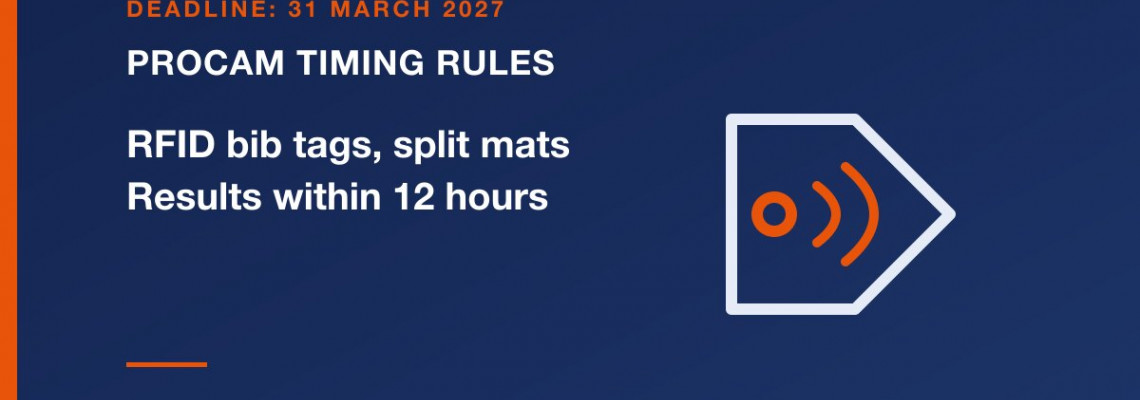
Short answer: Procam's undated Road Race Technical Standards & Timing Recognition Guidelines decide whether your race's certificates count for entry to Procam events such as the Tata Mumbai Marathon. Every runner must be RFID-timed, with the tag fixed to the bib before distribution. Beyond start and finish mats, a marathon needs at least 3 split mats, 25 km and the half 2, and 10 km and 5 km 1. Provisional results are due within 12 hours of official race close. The transition period ends on 31 March 2027.
Written for organisers of city, corporate, club, college and defence runs whose finishers use timing certificates to enter Procam races, and for the timing companies they hire. How chip timing works, and what it costs to rent or buy, is in our RFID race timing system guide for Indian organisers. This post covers Procam's timing certificate rules and the kit, process and paperwork they demand.
What do Procam's timing recognition guidelines require from a race?
We read the guidelines on the Tata Mumbai Marathon (TMM) guidelines page on 3 October 2026. It carries a 2026 copyright line but no publication or revision date, so we give it none. The same timing clauses appear in the current Vedanta Delhi Half Marathon (VDHM) Open 10K criteria and the TMM 2027 marathon criteria. Procam may reject certificates from any event that does not follow them, and its decision is final.
| Clause | What the page requires (numbers exact) | Does RFID timing kit solve it? |
|---|---|---|
| 1–2. Date and claims | Race held within the 18 months before the Procam race day, per each event's window; no claim, even implied, to be an official Procam qualifier | No |
| 3. Course measurement | AIMS / World Athletics Grade A or B measurer, calibrated bicycle method; certificate public on the event website | No |
| 4.1 RFID timing | All runners RFID-timed; tags fixed to the bib before distribution; loose chips not handed to runners | Yes, if the tag is on or in the bib |
| 4.2 Split mats | Start and finish mats, plus minimum split-point mats: full marathon (42.195 km) 3; 25 km 2; half marathon (21.097 km) 2; 10 km and 5 km 1 | Yes: mats, readers, power |
| 4.3 Results | Provisional results within 12 hours of the official race close time; final results and downloadable certificates online; required splits visible | Partly: software and process |
| 5. Verification and anti-cheat | Proof the registrant ran (e.g. bib-photo matching, ID check at collection); functional split mats, cameras at key junctions, officials on course | Partly: bib binding at collection |
| 7. Accepted events | On-ground 5 km to full marathon, and relays with at least 5 km per runner; no virtual, trail or uncertified races; net (chip) time | No |
Two clauses change hardware. Clause 4.1 says tags must be "securely affixed to the bib prior to distribution", which ends the handed-out chip. Clause 4.2 counts split mats, so a race timed only at start and finish no longer produces a certificate Procam will consider.
Which dates matter between now and 1 April 2027?
Dates are from each official event site, read on 3 October 2026.
| Date | What happens | Source |
|---|---|---|
| 18 October 2026 | VDHM 2026. Its Open 10K criteria accept races held on or after 1 October 2024 and already list the bib-tag, split-mat and 12-hour rules | VDHM confirmation criteria |
| 20 December 2026 | Tata Steel World 25K Kolkata | TSW25K site |
| 17 January 2027 | Tata Mumbai Marathon 2027. Marathon qualifying races must be held on or after 17 July 2025; applicants are confirmed by 9 December 2026 at the latest | TMM marathon confirmation criteria |
| 31 March 2027 | Transition period ends. Certificates from courses without AIMS certification still count for any Procam event whose registration cycle officially opens on or before this date | Procam guidelines |
| 1 April 2027 | Only fully compliant events considered; Procam starts publishing AIMS-certified editions found short | Procam guidelines |
| 25 April 2027 | TCS World 10K Bengaluru 2027 | TCS World 10K site |
The transition period covers the technical standards as a whole, but the only relaxation the page spells out is for course certification, and its example is blunt: a certificate from a September 2026 race without an AIMS-certified course works for a Procam event whose registration opens in February or March 2027, but not for VDHM 2027, Tata Steel World 25K 2027 or TMM 2028. The page does not say how strictly the timing clauses are applied before 1 April 2027, yet the VDHM 2026 and TMM 2027 criteria already list them. Our reading: treat them as live now.
That example also shows the test is applied when a runner uses the certificate, not when your race was run. With an 18-month qualifying window, a race you stage this winter will feed registrations that open after 31 March 2027, when only fully compliant events count. Compliance is a job for this season, not for April 2027. One sentence on the live page still reads like an internal editing note, so expect revisions and re-read it before you print anything.
Which races and timing companies does this affect?
Any on-ground road race from 5 km to the full marathon whose finishers might use the result to enter a Procam race: corporate, college, club and defence runs as well as city marathons. Nothing bans a non-compliant race; Procam can simply refuse its certificates, and it tells runners to ask organisers whether the guidelines are followed.
One clause is about marketing. A race must not state or imply that it is an official Procam qualifier on its website, social media, marketing material, press releases, email or certificates. A "TMM qualifier" line on a finisher certificate could cost every runner theirs, so check certificate templates as well as banners.
Which RFID tag formats meet the bib-mounted rule?
The test: is the tag on or in the bib when the runner receives it, and does it stay there? Prices are store list prices ex tax, read on 3 October 2026; volume pricing differs.
| Format | Listed on the store | Meets clause 4.1? | Notes |
|---|---|---|---|
| Bib with integrated chip | RFID marathon bibs, Rs 30 per bib; Tyvek or polyester, Impinj Monza R6 chip, full-colour print | Yes | Tag and number are one item, made before distribution |
| Race label applied to the bib | UHF High Performance Race Label (RT6-P), Rs 30 | Yes, if your team applies it before kit handover | Apply at the packing table, never loose in the kit bag |
| Disposable shoe tag | RFID Race Timing Shoe Tag, Rs 25; listed for shoe-lace loop or bib clip | Only if clipped to the bib before handover | Handed out for runners to lace on, it reads as a loose chip |
A reusable chip issued separately and collected at the finish is the plainest case of a loose chip; keep it for club series nobody will use for Procam entry. Procam does not define "loose timing chip", so the third column is our reading; if in doubt, ask Procam in writing before you buy. The full line is in our RFID race timing solutions category.
Bib-mounting also changes the pre-race check. A dead tag now means a runner with no splits and an unusable certificate, so read every bib at the packing table, not a sample per carton, and keep the log. Brief runners to wear the bib flat, outside any jacket, and not to pin through the tag.
How many split mats and readers does each distance need?
Procam sets the split minimums; the start and finish mats come on top. The last two columns are our planning suggestion, not Procam's rule.
| Category | Procam minimum split mats | Mat lines incl. start and finish | Suggested build with a backup finish line | Fixed readers (one per location) |
|---|---|---|---|---|
| Full marathon, 42.195 km | 3 | 5 | 6 | 5, plus a spare |
| 25 km | 2 | 4 | 5 | 4, plus a spare |
| Half marathon, 21.097 km | 2 | 4 | 5 | 4, plus a spare |
| 10 km | 1 | 3 | 4 | 3, plus a spare |
| 5 km | 1 | 3 | 4 | 3, plus a spare |
A mat line is mat antennas across the full road width, cabled to a fixed UHF reader, with its own power and laptop. Split points sit kilometres apart, so each needs its own reader and crew; if start and finish share a site, one reader may serve both. Procam's text says mats, so treat side-mounted panels as backup only. Our store lists the RFID UHF mat antenna system at Rs 2,75,000 and the 8.5 dBi UHF RFID mat antenna at Rs 2,45,000, both ex tax; confirm the configuration with us before ordering.
- Put splits where shortcuts are possible: turnarounds, loop entries and where two legs run close together. Procam also wants cameras at key junctions, so put a camera at each split.
- Shared courses: Procam counts split mats per distance and does not say whether one line can serve two categories. Our reading: it can, if each category's certificate shows its own required splits. Confirm with Procam if your layout depends on it.
- Band and approval: India's licence-exempt UHF RFID band is 865–868 MHz (G.S.R. 853(E), 10 December 2021), the same as ETSI, with readers allowed up to 2 W e.r.p. Set readers to the India or ETSI region and use readers with WPC Equipment Type Approval.
Missed reads are now a compliance problem. Procam may refuse certificates from an event where a substantial number of finishers lack split data, and missing or malfunctioning mats shown to have materially affected timing are grounds for refusal too.
How do you publish provisional results within 12 hours?
The clock starts at the official race close time: close the course at 10:00 and provisional results are due by 22:00. Five lines across a city make that tighter than one finish line, because split data must come back from every point and be checked. A workable flow:
- Freeze the bib manifest the evening before: tag ID, bib number, registrant, category and wave, loaded on every reader controller.
- Synchronise clocks on every reader and laptop before the start; splits are only as good as those clocks.
- Bring split data in early over mobile data, with a copy sent back by hand where coverage fails.
- Reconcile before publishing. List every finisher with a missing split, check footage and marshal sheets, and record each decision.
- Publish provisional results, labelled provisional, with net time and every required split visible.
- Issue final results and certificates online, one stable link per runner, showing net (chip) time and each required split.
Course measurement, ID checks and cameras: where does RFID stop?
Most of the guidelines are not about timing hardware, and no RFID fixes a short course.
- Measurement: an AIMS / World Athletics Grade A or B measurer using the calibrated bicycle method; AIMS's course measurement page explains it and links the measurer list. The certificate must show race name and distance, certificate number, measurer name and grade, and measurement date and validity.
- Course changes: any deviation from the certified course needs re-measurement and re-certification. A short course loses its certificates. The standalone guidelines page applies that to the affected category of that edition; the VDHM 2026 and TMM 2027 criteria say any race category of that edition. Plan for the stricter wording.
- Identity: RFID helps with controlled distribution. Read each bib at the collection counter, bind it to the registrant whose ID you just checked, and photograph the runner holding it: bib-photo matching and an audit trail in one step.
- People and cameras: officials at crucial points, cameras at key junctions with footage available for verification, and, as Procam encourages, a named Observer on race day.
What do the rules add to your timing budget?
They change the inputs, not the rent-or-buy method: more read points, and a bib-mounted tag for every entrant. A half marathon timed only at start and finish now needs at least four mat lines. At list price, bib tags for a 2,000-runner field come to Rs 60,000 ex tax before volume pricing (2,000 × Rs 30). Our RFID race timing services are listed at Rs 150 per head ex tax, with bibs, antennas and readers included for start, split and finish points. To own kit, the RFID race timing system (RTUS) is listed at Rs 35,00,000 ex tax, its bibs supplied with the tag already fitted. Run the break-even from the organiser's guide linked above, but price owned kit for five or six read points, not two.
What should your compliance checklist cover before 31 March 2027?
| Requirement | Action | Evidence to keep |
|---|---|---|
| Measured course | Book an AIMS / World Athletics Grade A or B measurer early in the season | Course certificate, live on the event website |
| No qualifier claims | Remove "qualifier" wording from site, social, press, email and certificate templates | Screenshots of each channel |
| Bib-mounted tags | Order integrated bibs, or apply labels before kit handover; read every bib | Bib manifest and 100% read log |
| Split mats | Plan the minimum split lines per category, plus a backup finish | Course map with mat positions |
| Identity checks | ID check, bib binding and photo at collection | Collection log |
| Anti-cheat | Cameras at key junctions, officials at crucial points, a race-day Observer | Footage index, marshal sheets |
| 12-hour results | Rehearse the data flow, including split uploads | Time-stamped provisional results page |
| Certificates | Net time and every required split on each certificate, online and verifiable | Sample certificate per category |
Identium Tech Solutions has manufactured RFID in New Delhi since 2010 and supplies bib tags and mats, or runs timing as a service. Send your course map, categories and field size through our contact page and we will size the mat lines, readers and bibs.
Procam's guidelines are its own entry policy and carry no publication date. Confirm the current text on the official event sites before acting. This is not legal or certification advice.
Frequently asked questions
Does Procam require RFID timing for a timing certificate to count?
Yes. Procam's Road Race Technical Standards & Timing Recognition Guidelines say every runner must be timed with RFID, with the tag fixed to the bib before distribution. They also require start and finish mats, minimum split mats by distance, and provisional results within 12 hours of the official race close time.
Can a race hand out loose chips or shoe tags under Procam's rules?
Not if it wants its certificates considered. The guidelines say loose timing chips must not be handed directly to runners and that tags must be on the bib before distribution. A shoe tag handed out for the runner to lace on, or a chip issued and collected separately, does not meet that on a plain reading.
How many split mats does a half marathon need under Procam's rules?
At least two split-point mats, in addition to the start and finish mats, so four mat lines in total. A full marathon needs at least three split mats, a 25 km race two, and 10 km and 5 km races one each. Certificates with missing or insufficient split data are not accepted.
What is Procam's 12-hour results rule?
Provisional results must be published within 12 hours of the official race close time. Final results and downloadable timing certificates must then be available online, with split timings from the required mats clearly visible. Plan how split data gets back from every mat line before race day, not after it.
When does the transition period for Procam's timing rules end?
On 31 March 2027. From 1 April 2027 Procam says only fully compliant events will be considered. Certificates from courses without AIMS certification remain acceptable only for Procam events whose registration cycle opens on or before 31 March 2027; Procam names VDHM 2027, Tata Steel World 25K 2027 and TMM 2028 as falling outside that.
Can our race advertise itself as a Tata Mumbai Marathon qualifier?
No. The guidelines bar any event from stating or implying that it is an official qualifier for a Procam race, across the website, social media, marketing material, press releases, email and certificates. Procam says misleading claims can lead to the event's timing certificates being disqualified.
Are Procam's timing guidelines a legal requirement for Indian races?
No. They are Procam International's entry policy for its own events, not a government regulation. A race that ignores them can still go ahead. Its finishers simply cannot rely on their certificates to enter the Tata Mumbai Marathon, TCS World 10K Bengaluru, Vedanta Delhi Half Marathon or Tata Steel World 25K Kolkata.
Leave a Comment