
RFID Race Timing System in India: A 2026 Organiser's Guide
Published 6 Sept 2026Updated 8 Oct 20267 min read
Short answer: An RFID race timing system puts a passive UHF tag on every runner's bib or shoe, mat or side antennas at the start, finish and split points, and a reader that timestamps each tag as it crosses. Timing software matches tag IDs to bib numbers and produces both gun time and net (chip) time. In India you can book a per-runner timing service or buy the tags, mats and readers outright; the choice comes down to how many runners you time in a year.
How does RFID marathon chip timing work?
Chip timing has four moving parts. Each runner carries a passive UHF RFID tag with a unique ID. Antennas at a read point energise it as the runner passes. A reader records the ID with a precise timestamp. Software matches IDs to bibs, subtracts the start crossing from the finish crossing and publishes a result.
The tag has no battery. It draws power from the field the antenna puts out, which is why antenna placement and read-zone shape matter more on race day than anything else. The software then resolves each crossing into a single time per read point.
Gun time runs from the official start signal. Net time starts at that runner's own start crossing, which is why a start read point is not optional. The building blocks are ordinary UHF RFID tags and fixed UHF RFID readers, configured for a very different read zone from a warehouse dock door: wide, shallow and tuned to a crowd moving at speed.
Bib tag, shoe tag or hard tag: which suits your race?
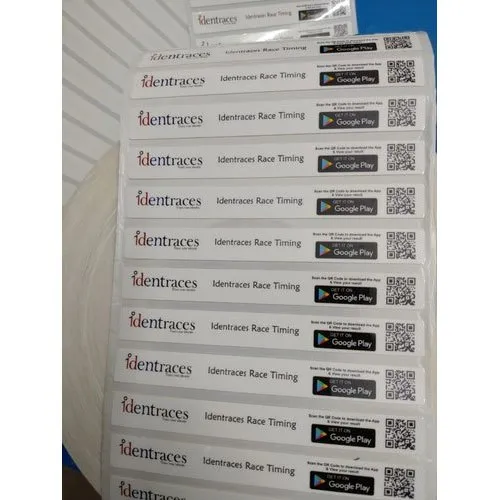
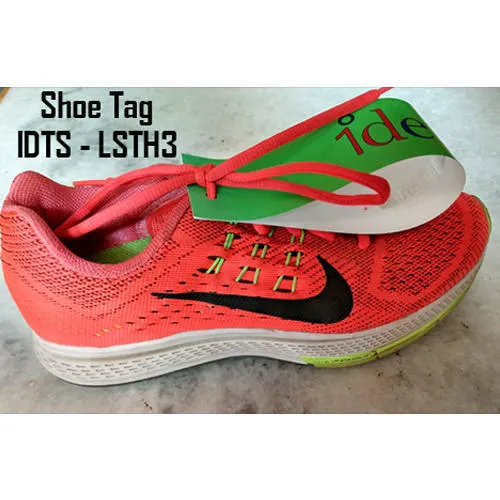
There are three practical formats, and India RFID Store lists all three in its race timing range: a disposable label attached to the numbered bib, a disposable shoe tag that laces on low to the ground, and a heavier re-issuable race timing tag that only makes sense if you collect it and issue it again. RFID marathon bibs with the chip already built into the race number are also available.
| Tag format | How it is supplied | Best fit | What to watch |
|---|---|---|---|
| UHF High Performance Race Label (bib tag) | Disposable label attached to the bib; in the same low per-piece band as the shoe tag | Mass single-use city, corporate and charity 5K and 10K runs | Nothing to collect at the finish, but the bib must be worn flat, never folded |
| RFID Race Timing Shoe Tag | Disposable UHF tag designed to attach to a runner's shoe | Runs where jackets or hydration packs cover the bib; trail events | Needs a lacing instruction at bib collection and a spot-check |
| Race Timing Tag (re-issuable) | Hard tag costing roughly ten times a disposable per piece; its listing states a 30–40 ft range | Club series, school and college athletics, repeat corporate events | Only pays back if you collect and re-issue it |
A disposable tag is a consumable, so cost scales with entries. At ten times the per-piece price, a hard tag pays back only across many races, and only if you get it back. Per-unit cost moves with volume, so bulk RFID pricing is quoted per project.
What hardware does a start and finish line need?
A read point is one or more antennas laid across the running surface or mounted at the side, cabled to a fixed UHF reader, with a laptop running your timing software. Mat antennas are the standard build for race timing because the antenna sits under the runner.
India RFID Store lists two ground mat antennas for this job: the ID-ANT-85CP 8.5 dBi mat antenna, marked for both the FCC and ETSI bands, and the IDTS-UMAT mat antenna system, whose mats detach and fold for transport.
| Read point | Why you need it | Typical build |
|---|---|---|
| Start line | Gives every runner their own start moment | Mats across the corral width; reader and laptop under cover |
| Finish line | The result itself; never run this one single-string | Mats across the finish plus a second reader or side-antenna line |
| Split or turnaround | Proves runners completed the course; feeds live tracking | A single mat line on battery or generator |
| Lap point (cyclothons, stadium meets) | Lap counting and leaderboards | Mat line or overhead antenna |
Antenna count follows the width of the crossing, not the size of the field. Gain, beam shape and polarisation decide how tall and wide the read zone is. For a side-mounted backup line rather than a second mat, the broader RFID antenna range covers the panel options.
Will a mat antenna sold for FCC markets work at an Indian race?
India's licence-free UHF RFID allocation is 865–868 MHz, notified by WPC, and it sits inside the European ETSI band of 865–868 MHz. An antenna or reader marked ETSI is therefore the India-band unit; equipment built only for the US band (902–928 MHz) is not, and the reader must be set to the India or ETSI region rather than a factory default.
If you are importing or specifying for a tender, confirm the band and approval position from the official WPC source and our overview of WPC ETA and BIS requirements for RFID readers before raising a purchase order.
Should you rent per-runner timing or buy your own system?
Rent while timing is occasional. Buy when timing is your business, or when you run a series where the kit leaves the store every month. India RFID Store lists three routes, and what each includes is only what its product page states.
| Route | What the listing says | Fits |
|---|---|---|
| RFID Race Timing Services (charged per head) | Includes the automatic timing system, bibs, antennas, readers and machinery | First editions, one-off corporate runs, agencies that will not own kit |
| Identium Race Timing Solution | Works with a uniquely identifiable tag attached to the numbered bib | Clubs and small timing companies moving from rented to owned kit |
| RFID Race Timing System (automated) | An automated race timing system; the product page is the only source for what is included | Established operators, multi-point deployments |
Do the break-even yourself: divide the purchase price of a system by the per-head service rate (both are on the product pages) and you get the number of timed runners at which ownership starts to pay. Then add what rental hides: crew, transport, spare tags, storage and the morning someone re-cables a mat in the rain.
Tell us your entry count and read points and we will run the sum against current pricing.
What belongs on the organiser's timing checklist?
- Commission tags to bib numbers before pack collection, and keep the mapping file in two places, not on one laptop.
- Build redundancy into the finish. A backup line, plus spare bibs, tags and cable, costs less than one unresolved podium.
- Test-read a sample from every carton of bibs in race week, not on race morning.
- Plan power and weather. Put a UPS or generator at every read point, tape and ramp the cables, and seal mats against dew, monsoon tails and coastal humidity.
- Check what is under the mat. Metal plates and manhole covers change the field, so move the read point rather than fight it, and keep a tag troubleshooting checklist to hand.
- Tell runners how to wear the tag: bib flat, not folded or covered; shoe tags laced as instructed.
- Agree the results flow: leaderboard, messaging push, e-certificates and data retention.
When should you book timing for the 2026–27 season?
The Indian running calendar runs roughly from September to February, so plan procurement and crew around the window your event sits in. The Vedanta Delhi Half Marathon is dated 18 October 2026 on its official event page, and the Tata Mumbai Marathon 17 January 2027 on its own.
Treat those as calendar anchors, not customer references: smaller city, corporate, college and charity runs cluster in the same window, and those are the events that need timing quotes. Event dates change, so confirm them on the organiser's official page.
Confirm tag and hardware availability against your bib-collection date before you commit to a results timeline. Many of these events also want entry control, cashless payment and wristbands at the expo and finish village; the guide to RFID for events and festivals in India covers that side, which uses different hardware.
India RFID Store, the storefront of Indian RFID manufacturer Identium Tech Solutions, stocks the race timing line: bib labels, shoe tags, hard tags, mat antennas, readers and complete systems. Tell us your headcount and read points through the quote request form and we will send the current scope and price.
Related guides
- Procam timing certificate rules: RFID bib tags, split mats and 12-hour results by 31 March 2027
- RFID chip running test for police recruitment PET: how boards time candidates, catch chip swaps and what tenders ask agencies for
Frequently asked questions
Can the same kit time a cyclothon or a stadium meet?
What is the difference between gun time and chip time?
What does chip timing cost per runner in India?
Do runners have to return the timing tag?
Will an RFID bib tag still read in the rain?
Do I need a licence to run RFID equipment at a race in India?
RFID race timingmarathon chip timingrace timing tagsUHF mat antennaevent RFID Indiarace timing cost
_Zu1DMF.webp)
_1lmJeJ.webp)