FSSAI Non-Retail Container Labels 2027: Lot Numbers and RFID
Published 22 Oct 202610 min read
Short answer: from 1 July 2027, packaged food meant for non-retail sale in India must carry five particulars on the container or on a label pasted to it, one of them a lot, batch or code number, and a container that is not obviously non-retail must say so. FSSAI does not ask for RFID.
What RFID adds is a machine-readable copy of the same lot number: encoded into a UHF label in the same pass that prints it, it lets a reader confirm the lot on every sack, carton or drum at dispatch and at the customer's receiving bay. This guide quotes the amended Regulation 10, then maps it to labels, printers and readers from the catalogue.
This guide is for food processors, bulk packers, contract manufacturers, FMCG warehouses and 3PLs that move food between businesses in sacks, drums, cartons, crates and pallets. It is a packaging and traceability guide, not legal advice: confirm your own labelling obligations with your food safety consultant or FSSAI. The regulation text quoted below is from the Gazette of India copy of the notification, read on 22 October 2026, and every source is listed at the end.
What the amendment requires, and from when
FSSAI notified the Food Safety and Standards (Labelling and Display) First Amendment Regulations, 2026 in March 2026. The Gazette of India, Extraordinary issue that carries them is dated 24 March 2026 (reference CG-DL-E-27032026-271283), the notification is signed by FSSAI's Chief Executive Officer, and regulatory trackers reported it from 30 March. Regulation 1(2) is short: the rules "shall come into force on 1st July, 2027". They amend the Labelling and Display Regulations, 2020, and the part that matters here substitutes Regulation 10, which covers food "meant for non-retail sale".
Under the new Regulation 10(1), every such package must provide the following mandatory information "either on the container or pasted on the label thereto":
- (a) name of the food;
- (b) FSSAI logo and licence number;
- (c) date marking and storage instructions, when required for the safety or integrity of the product;
- (d) "Lot number or Batch number or Code number"; and
- (e) name and address of the manufacturer or packer, including country of origin for imported packages.
Two provisos matter for mixed loads. A non-retail container holding several types of food must carry the information for all of them. And a container that gives access to all the Regulation 10(1) information on the labels of the pre-packaged foods inside it, a shipper of labelled retail pouches for example, does not need the information repeated on the outer.
Regulation 10(2) moves three items off the container: the list of ingredients, the veg or non-veg declaration and the net quantity, if not on the label, "shall be provided in the accompanying documents", provided the information is "traceable to the food in non-retail container". A new Regulation 10(5) asks that label information be "clear, prominent, readily legible" and applied so that "any tampering with it will be evident", and that the 10(1) items sit in a prominent position, "readily accessible under normal handling and use of the container".
"NON-RETAIL CONTAINER": when the words are needed
The substituted Regulation 10(4) opens: "Every package meant for non-retail sale shall be clearly identifiable as such." If it is not, the container must either bear a statement that the food is not intended to be sold directly to the consumer, with the examples "NON-RETAIL CONTAINER" and "NON-RETAIL CONTAINER - NOT FOR DIRECT SALE TO CONSUMER", or "carry any other mark" that shows the same thing. A plain 25 kg paper sack of flour is identifiable on sight. A case of retail pouches with retail-style graphics on the outer is the kind of pack that needs the words.
Be clear about scope. The Regulation 10 changes apply to non-retail packages. The same amendment also changes some retail-label provisions (nutrition information exemptions, logos on packs of up to 100 square centimetres, the fortification statement and some sweetener warnings), which this guide does not cover. Nothing in the notification names RFID, barcodes or any other data carrier, and nothing quoted here sets out penalties, so this guide makes no claim about enforcement.
Electronic accompanying information: where RFID fits
The clause that opens the door to data carriers is the third proviso to Regulation 10(2). For a non-retail container "used as a food transportation unit that is not amenable to possess a label", all the 10(1) and 10(2) information "shall be provided in the accompanying documents or through appropriate other means (e.g. electronically between food businesses)" and "shall be effectively traceable to the food in such containers". That is the same test a warehouse already applies when it matches a delivery challan to the pallet it came with: can you prove which document belongs to which load?
An RFID label does not replace the printed lot number; on an ordinary sack or carton the lot must still be on the container in readable form. What the label adds is a machine copy of the same number.
Printed with the lot in text and barcode and encoded with the lot in the chip in the same pass, it lets a handheld or dock-door reader confirm "this is lot L2706 of product X from licence Y" without line of sight and without one scan per carton. A reader at a dock door counts every tagged carton on a pallet as it passes; a barcode gun needs a scan per carton. That is the practical link between Regulation 10's traceability language and the hardware below.
How you encode the lot is a design choice. Retail suppliers use GS1's SGTIN-96 scheme, which carries a GTIN and a serial number in the chip's EPC memory; our GS1 and EPC encoding guide explains it. For bulk food a plant-level scheme also works: an item code, the lot and a running serial, so every carton or drum is unique and its lot is readable at once. Chips with user memory can hold the lot separately; the labels below differ on that point, so fix the data layout before you order.
Label designs for sacks, cartons, pallets and drums
Three carriers cover most non-retail packs.
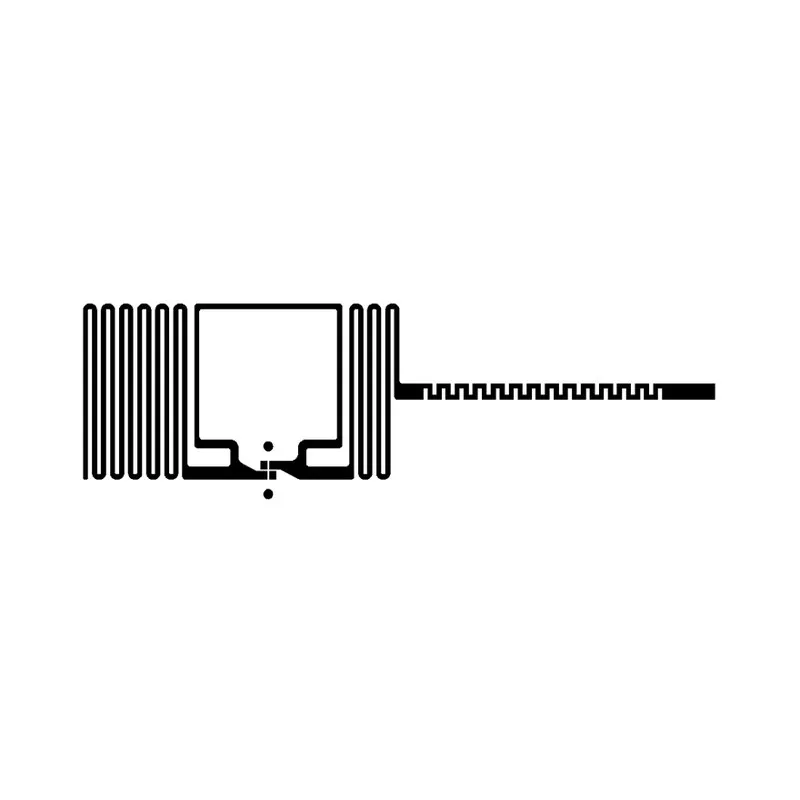
Printed and encoded UHF labels for cartons and sacks. The UHF RFID Label 50 × 30 mm (₹8 + GST, minimum order 500 pcs) has a white, thermal-printable face for the name of the food, the licence number, the lot and the date marking, with a 96-bit EPC behind it for the encoded lot and serial.
The printable UHF label ID-1142 prints barcode, text and EPC in one printer pass, and the printable UHF label ID-1222-M6 is made for print-on-demand carton labels on an in-house RFID printer. The three cost ₹6–₹8 + GST per label. Choose the face by how much you must print, not by read range: a lot and licence line fits 50 × 30 mm; the full five-item panel may need a larger label. All three are for non-metal surfaces; tins and steel drums need the strap tag below.
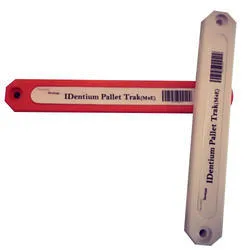
Pallet tags for shippers. A pallet that travels as a unit deserves its own identity. The UHF RFID Pallet Tag IDTS-UPT (₹45 + GST) is a slim 128 × 19 mm hard tag for wooden and plastic pallets, with 128 bits of user memory beside the EPC.
The UHF RFID Pallet Tag IDTS-8654 (₹89 + GST) is an 86 × 54 mm white ABS plate with four corner holes for screws or rivets and pre-applied double-coated tape, for returnable pallets and crates. Encode the pallet with its own ID, link it to the carton lots in your warehouse system, and the accompanying document for the load can be generated from one scan.
Strap tags for drums, IBCs and crates. Oils, syrups, pulps and ghee move in drums and intermediate bulk containers that come back to be refilled, and a paper label rarely lasts. The Reusable UHF RFID Cable Tie Tag ID-CTT-960 (₹115 + GST) is a waterproof, chemical-resistant ABS strap in 285 mm or 448 mm lengths that loops through a handle or lug, opens without damage and moves to the next container, where it is encoded with the new lot. The printed lot still goes on the drum, by label or stencil; the strap carries the machine copy.
Browse the full range in UHF RFID labels and inlays and UHF RFID tags. All of them work in India's 865–868 MHz UHF band.
Printing and encoding on the line or at a desk
On a packing line, print and encode in one pass so the lot in the print and the lot in the chip cannot drift apart. The IT4RL desktop RFID printer and encoder (₹1,35,000 + GST) prints at up to 8 inches per second, prints and encodes up to 6,000 labels an hour, and comes with free Labelsoft software that imports from Excel, MySQL, SQL or text files, so the lot list your ERP exports is the list the printer writes.
The iX4R industrial UHF RFID printer and encoder (₹2,25,000 + GST) is the 104 mm (4-inch) unit for long shifts, at up to 14 inches per second, with USB, RS-232, Ethernet and Wi-Fi. Our RFID printer price guide compares the options.
If you label at a desk rather than on a line, for example a godown that re-labels imported sacks before dispatch, the UHF RFID Desktop Reader 120L for bulk Excel encoding (₹28,000 + GST) imports a sheet with its free utility and encodes pre-printed labels one after another over USB. Pair it with ordinary thermal printing for the human-readable face. All printers and encoders are in RFID printers and encoders.
Receiving at the customer: lot against purchase order
The receiving bay is where a lot number earns its keep. With the UHF Handheld RFID Reader CX1500N (₹58,000 + GST), a receiver walks the pallet and sees every carton's lot against the purchase order and the accompanying document. The CX1500N also has a 1D/2D barcode imager, so it reads the printed barcode on packs that carry no RFID label, which matters while suppliers move at different speeds. Wrong lots, short counts and expired date marks show up before stock is put away.
The same handheld runs the dispatch check at your end: scan the pallet, compare the carton lots with the picking list, issue the accompanying document, and keep the read log as the record that the information left with the goods. Other handhelds are compared in RFID handheld readers, and the end-to-end pallet workflow is described on our RFID pallet tracking system page.
The pharma parallel: Schedule H2
Food is not the first sector to put a mandatory identifier on a pack and leave the carrier to industry. Our guide to Schedule H2 and case and pallet aggregation explains the drug-labelling version: there the obligation is a printed barcode or QR code, RFID cannot replace it, and case-to-pallet RFID is an operational choice rather than a compliance one.
FSSAI's Regulation 10 sits the same way. The lot number on the container is the obligation; the RFID copy is how a busy warehouse checks it at speed. A food plant that already aggregates carton lots to pallet IDs is ready for 1 July 2027 with time to spare, and the Revised Schedule M warehouse guide shows the batch-segregation side of the same discipline.
Shop the products in this guide
- UHF RFID Label 50 × 30 mm: printable carton and sack label, lot in print and in the chip.
- Printable UHF RFID Label ID-1142 and ID-1222-M6: print-on-demand carton labels.
- UHF RFID Pallet Tag IDTS-UPT and IDTS-8654 ABS pallet tag: one identity per shipper.
- Reusable UHF RFID Cable Tie Tag: drums, IBCs and returnable crates.
- IT4RL desktop and iX4R industrial RFID printer-encoders, and the 120L desktop encoder for spreadsheet batches.
- UHF Handheld RFID Reader CX1500N: lot-against-order checks at dispatch and receiving.
Tell us your pack types, the lot format you print today and your monthly label count, and request label samples to test on your own cartons and drums well before July 2027. Volume pricing is on the RFID price list.
Sources
- Gazette of India, Extraordinary, Part III, Section 4, No. 209, 24 March 2026 (CG-DL-E-27032026-271283): FSSAI notification F. No. STD/SP-08/A1.2022/N-01, Food Safety and Standards (Labelling and Display) First Amendment Regulations, 2026
- TaxGuru: FSSAI revises labelling norms with key changes in RDA, packaging and non-retail rules (reproduction of the notification)
- CliniExperts regulatory update, 30 March 2026: gazette reference and 1 July 2027 enforcement date
- Khaitan & Co, Food Safety Bulletin, Issue 2, 2026: FSSAI notification dated 24 March 2026, in force from 1 July 2027, revising Regulation 10 on non-retail containers
Frequently asked questions
Does FSSAI require RFID on non-retail food containers?
From when do the non-retail container rules apply?
Do the non-retail rules apply to retail packs?
Can the ingredients list go in a document instead of on the sack?
Which RFID tag suits a returnable drum or IBC?
FSSAIFood LabellingLot TraceabilityUHF RFID LabelsRegulation
Keep reading
More guides
More in Regulations & tenders
- FASTag Parking System: How to Accept FASTag at Your Parking Lot
- Procam Timing Certificate Rules: RFID Bib Tags, Split Mats, 12-Hour Results by 31 March 2027
- RFID Tag for Solar Modules in India: MNRE Field List, ALMM List-II Cells and the 2027 Cut-off
- Sugar Stock Limit 2026: Proving the 15-Day Holding Rule (1,000 Quintals)