Schedule H2 in 2026: four new drug categories, the 2027-28 clock, and what changes in your warehouse
Published 5 Sept 2026Updated 12 Oct 202610 min read
Short answer: G.S.R. 506(E), dated 22 June 2026 (the Drugs (Seventh Amendment) Rules, 2026), adds all vaccines, all antimicrobials, all narcotic and psychotropic (NDPS) drugs and all anticancer drugs to Schedule H2 of the Drugs Rules, 1945. Compliance runs from 1 July 2027 for vaccines, anticancer and NDPS drugs and from 1 July 2028 for antimicrobials. The requirement is a barcode or QR code printed on the packaging, a labelling obligation under Rule 96. It is not an RFID mandate: RFID does not satisfy Schedule H2 and cannot substitute for the printed code.
This guide is written for manufacturing, packaging, QA and warehouse leads at mid-size Indian formulators and CMOs, and for the 3PLs that hold their stock. The first half is the regulation. The second half is what lands in your warehouse once the artwork is approved: where case- and pallet-level identification genuinely helps, as an operational choice and never a compliance one.
What did G.S.R. 506(E) actually change?
G.S.R. 506(E), dated 22 June 2026, notified the Drugs (Seventh Amendment) Rules, 2026. It brings four entire therapeutic categories into Schedule H2 of the Drugs Rules, 1945: all vaccines, all antimicrobials, all narcotic and psychotropic (NDPS) drugs, and all anticancer drugs. Each carries a fixed compliance date, and there are only two dates.
| Category added to Schedule H2 | Compliance date | Approximate runway from September 2026 |
|---|---|---|
| Vaccines | 1 July 2027 | About 10 months |
| Anticancer drugs | 1 July 2027 | About 10 months |
| Narcotic and psychotropic (NDPS) drugs | 1 July 2027 | About 10 months |
| Antimicrobials | 1 July 2028 | About 22 months |
Schedule H2 is not new machinery. The Drugs (Eighth Amendment) Rules, 2022 already made a barcode or QR code mandatory on the top 300 drug brands under Schedule H2, effective 1 August 2023. What the 2026 amendment changes is scope: from a named brand list to four whole therapeutic categories. If your portfolio sits in any of them, you are now inside a rule you may have watched from the sidelines.
The obligation is a labelling one, under Rule 96 of the Drugs Rules, 1945. Schedule H2 carries a defined set of product- and batch-level data elements; check the current Schedule H2 text for the exact list that applies to your pack. Do not build artwork or a printing specification from a summary article, this one included.
Does RFID satisfy Schedule H2?
No. Schedule H2 requires a barcode or QR code printed on the packaging. RFID is not named in it, does not satisfy it, and cannot replace the printed code on the pack. We supply RFID for a living and will still say it plainly: the printed 2D code is the compliance artefact.
That constraint is why this article exists. Most coverage stops at the printed code, which is where the compliance question ends and the operations question begins. Once every pack carries a code, someone downstream has to prove which packs went into which shipper, which shippers onto which pallet, and whether the pallet that left the dock is the one on the picking record. That is where RFID belongs, and only there.
Premises, storage and GMP obligations are a separate subject, covered in our guide to Revised Schedule M and the pharma warehouse.
Is Schedule H2 serialisation, or something smaller?
Schedule H2 is a product- and batch-level requirement, not unit-level serialisation. That distinction is the most commercially consequential thing in the amendment, and vendors selling serialisation platforms routinely blur it. India has not mandated domestic unit-level serialisation, unlike export-market regimes such as the US DSCSA and the EU FMD.
In practice, that splits your portfolio in two. A product made only for the Indian market has to satisfy a batch-level identification requirement. A product that also ships into a market with its own serialisation regime carries that obligation too, and both travel on the same pack. The trap is treating them as one project and over-engineering the domestic line, or treating them as unrelated and building something that cannot be extended when an export customer asks for serialised data.
What you settle on now decides how painful an export requirement is later: how you allocate product identifiers, how the product master is structured, and whether your line records can carry a pack-to-case relationship at all. Batch level is the floor, not the ceiling, and the cheapest time to leave room above it is while the artwork is already open. If serialised identifiers and EPC encoding are on your roadmap, the mechanics are in our SGTIN-96 and EPC encoding guide.
What work has to start now, 10 and 22 months out?
Artwork and printing changes in pharma are slow by design: every one passes through approval and change control. Ten months is not a long runway for a category-wide artwork revision, and 22 months is not long for a broad antimicrobial portfolio. What follows is advisory sequencing, not a compliance checklist; your QA function owns the plan.
- Artwork revision and approval cycles. Every affected SKU needs revised artwork, reviewed and approved. This is the long pole, and a queue problem before it is a technology problem.
- Code placement on small packs. Vials, ampoules, blister foils and small cartons have very little uncommitted surface. Placement, quiet zone and module size are decided per pack format, not once for the portfolio.
- Print method and on-line verification. Pre-printed, laser-marked and inline-applied codes behave differently on each substrate. Decide how a bad code is caught and rejected on the line, not after the pallet is built.
- Master data readiness. Identifier allocation and product-master hygiene are the quiet failure mode: duplicate, stale or inconsistent item records produce codes that are technically readable and commercially wrong.
- Vendor and change-control timelines. Printing systems, verification equipment and label suppliers all need time to deliver, and each change carries its own qualification effort, defined by your own quality system.
What happens at the case and the pallet once every pack carries a code?
A printed 2D code is read optically, one pack at a time, in line of sight. That is fine on the packing line, where every pack passes a fixed station. It becomes a problem the moment the pack is inside a shipper, the shipper is inside a stretch-wrapped pallet, and someone at the dock door is asked what is in front of them.
You then have two choices. You can open cases and scan, which is slow, adds handling to sealed packs and reintroduces human error. Or you can carry the container's identity in a form that is readable without opening it. A UHF RFID label on the shipper and the pallet gives you that hands-off read.
Be precise about what the tag does. The pack-to-case relationship (aggregation) is created by the packing-line record at the moment of packing; the tag neither creates nor infers it. What the tag does is give that recorded relationship a physical handle you can verify at speed later: read the shipper, look up what the line said was inside, and confirm the container without breaking the pack down. If the packing record is weak, RFID verifies a weak record faster; it does not repair it.
| Layer | What carries the identity | Purpose | Required by Schedule H2? |
|---|---|---|---|
| Pack (compliance layer) | Printed barcode or QR code | The labelling requirement under Rule 96 | Yes: this is the requirement |
| Case or shipper (operations layer) | UHF RFID label, optionally alongside a printed code | Hands-off verification of a sealed container against the packing record | No |
| Pallet (operations layer) | UHF RFID label or reusable tag | Dock-door and despatch verification, movement history | No |
| Storage location, tote, cage or rack (operations layer) | On-metal UHF tag | Location accuracy, cycle counting, asset control | No |
One row is a legal obligation. The three below it are throughput and accuracy decisions you make for your own reasons and, for a 3PL holding stock for several principals, a commercial argument too.
Where does a UHF read pay for itself in a pharma warehouse?
In four places. None of them are compliance activities. All are things a pharma warehouse already does slowly, with clipboards and handheld barcode scanners.
- Goods-in verification against the ASN. An inbound consignment arrives with an advance shipping notice claiming a set of cases. A portal read at receipt shows within seconds whether what arrived matches what was announced, instead of a sampled check that surfaces the gap weeks later.
- Despatch verification at the dock door. The pallet that physically leaves should be the pallet on the picking record. A read at the door catches the wrong-pallet-on-the-wrong-truck error at the only moment it is still cheap to fix.
- Cycle counts and stock accuracy. Counting without breaking down and rebuilding pallets is the largest labour saving most warehouses see, and it makes counting frequent enough to be useful.
- Custody and location history for controlled categories. For NDPS stock especially, knowing where a consignment sat, for how long and who moved it is an internal control question, not a Schedule H2 question. Say that plainly inside your organisation: it is a control you may want for your own reasons.
Keep the claim narrow. A UHF read tells you a tagged container is present and identifies it; it does not inspect the contents. Every benefit above is a speed and coverage gain on top of records you already keep, which is why it must never be sold as compliance. The mechanics of read points, counts and reconciliation are in our RFID warehouse inventory management guide.
What about vaccines and the cold chain?
Vaccines carry the earliest date, 1 July 2027, and the tightest handling of the four categories. They also live in a chain where identity and condition sit in separate systems, which is why an excursion investigation so often turns into a paper hunt for which batch was in which box.
Sensor-enabled RFID tags can log condition alongside identity, so the record travels with the container instead of being reconstructed afterwards. What a given tag can demonstrate depends entirely on its specification and on your own qualification work, so verify any sensing claim against a datasheet and a validation protocol rather than a brochure. Our guide to RFID cold chain temperature monitoring in India covers the design questions.
What hardware survives a real pharma warehouse?
Pharma warehouses are hostile to naive RFID deployments. Racking is steel, cages and totes are metal, and many packs are foil-heavy. Metal and liquid detune an ordinary paper label badly, so hardware choice is not a catalogue exercise.
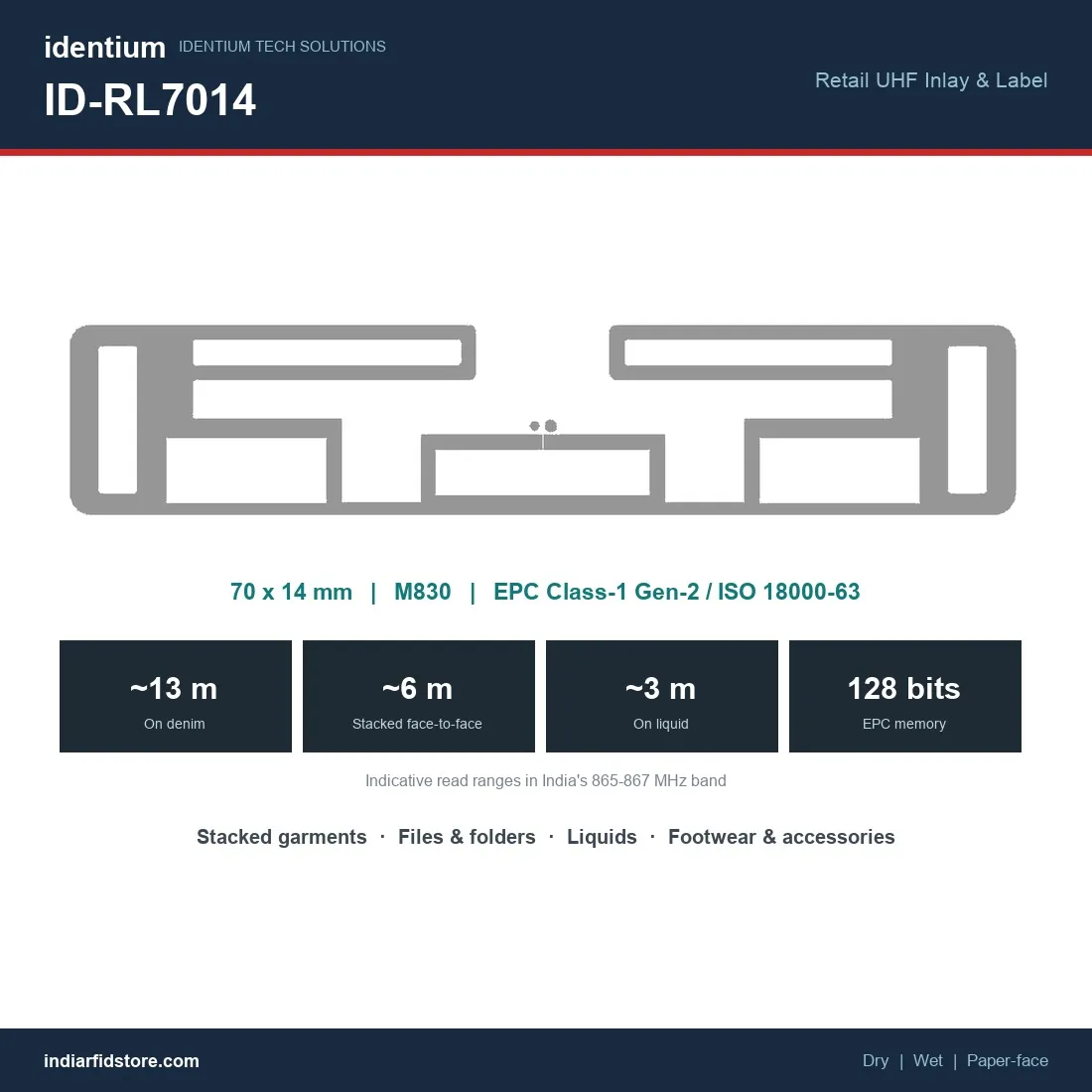
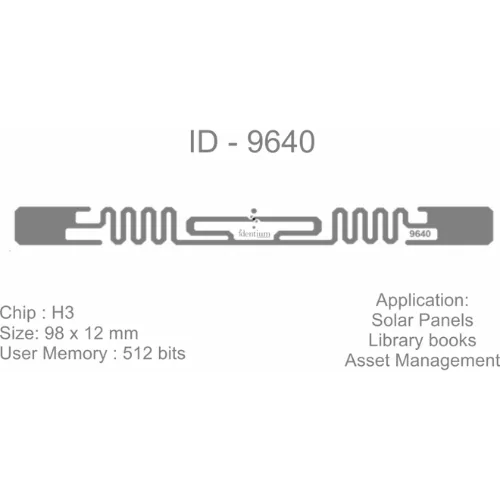
- Shippers and pallets: standard UHF RFID inlays and labels, sized and placed for the carton, away from foil-dense faces.
- Racking, cages, totes and equipment: on-metal RFID tags, engineered to work with the metal behind them rather than against it.
- Dock doors and goods-in: fixed and gate readers with antennas set for tight read-zone control, so an adjacent bay or a passing forklift is not counted into your consignment. See our RFID gate, portal and tunnel reader guide.
- Counting and exception hunting: handheld and sled readers, for cycle counts and for finding the one case the fixed reader disagreed about.
- Label production: RFID printers that print and encode a shipper label in one pass, so the human-readable data and the encoded identity cannot diverge.
One India-specific point: the licence-exempt UHF band here is 865–868 MHz (G.S.R. 853(E), 2021), the same as the ETSI 865–868 MHz range. That is a narrower slice than deployments designed for other regions assume, so where several dock doors sit close together, channel and power planning matters. India RFID Store, the storefront of Identium Tech Solutions (founded in 2010 and based in New Delhi), supplies readers, tags and labels for that band.
What this article does not claim
To be unambiguous, because in a regulated industry ambiguity is expensive: there is no RFID requirement in Schedule H2. The printed barcode or QR code on the pack is the compliance artefact under Rule 96. Everything from the case upward in this article is operational, and it neither satisfies nor substitutes for the printed code.
Nor is any of this a legal opinion. Read G.S.R. 506(E) and the current Schedule H2 text directly, and confirm what applies to your packs with CDSCO and your own regulatory affairs function before committing artwork, equipment or a compliance plan.
If the second half of this article is the part that lands (the case, the pallet, the dock door, the count), talk to us about case and pallet reads. Send your shipper dimensions and a photograph of your racking with your quote request, and we will tell you what reads reliably at 865–868 MHz and what does not.
Frequently asked questions
What did the Drugs (Seventh Amendment) Rules, 2026 change?
Which categories are covered, and by when?
Is Schedule H2 unit-level serialisation?
Does RFID meet the Schedule H2 requirement?
What was the earlier top-300-brands requirement?
Where does RFID actually help, if not for compliance?
Schedule H2pharma compliancebarcode QR codeRFID aggregationpharma warehouseUHF RFIDIndia pharma regulationcase and pallet tracking