FASTag Readers at a Private Warehouse Gate: What CWC's Smart Warehousing Rollout Shows (2026)
Published 22 Oct 20269 min read
Prices checked on 22 Oct 2026 against the catalogue.
Short answer: On 18 June 2026 the Department of Food and Public Distribution launched a Smart Warehousing System for foodgrain storage. The government's release says it runs in 215 bag-based warehouses of the Central Warehousing Corporation (CWC), with the Food Corporation of India (FCI) deploying it in 150 more, and that it uses FASTag and ANPR-based gate automation. A PTI report of the launch gives 216 CWC warehouses and says the gate automation is integrated with the VAHAN-SARATHI databases, so the safe figure is about 215–216 warehouses (sources differ).
For a private godown, the lesson is that the FASTag on a truck's windscreen is a UHF RFID tag that a gate reader can detect. Reading its ID to log a gate-in is not a toll transaction, but whether you may use FASTag IDs as an access credential is a question for IHMCL and your bank, which this article does not answer.
Warehouse gates in India still run on paper: a guard writes the truck number, the driver shows a challan, and the time in and out goes into a register that nobody analyses. CWC's rollout matters because it puts the gate first. The government's own description lists faster vehicle turnaround among the expected benefits. This guide sets out what was launched, then turns it into a hardware and software checklist for a private warehouse, CFS or factory gate. Lane hardware for paid parking is a different job, covered in our FASTag parking guide; here we keep to what is specific to a warehouse.
What CWC switched on, and the 215 versus 216 question
| Detail | What was reported | Source |
|---|---|---|
| Launch | 18 June 2026, Bharat Mandapam, New Delhi; inaugurated by Union Minister Pralhad Joshi | PIB release, 18 Jun 2026 |
| Scope | 215 bag-based foodgrain warehouses of CWC; FCI deploying the system in an additional 150 warehouses | PIB release, 18 Jun 2026 |
| 216 CWC warehouses; about 150 FCI warehouses to be under the system by October, according to the Food Secretary | PTI via Outlook Business, 18 Jun 2026 | |
| Gate | FASTag and ANPR-based gate automation | PIB release, 18 Jun 2026 |
| Gate automation integrated with the VAHAN-SARATHI databases | PTI via Outlook Business | |
| Gate and weighbridge | The system was to support automation of gate and weighbridge operations, digital access management and real-time oversight through dashboards | PIB curtain-raiser, 17 Jun 2026 |
| Inside the godown | Geo-tagged smart locks, AI bag counting, face recognition, object detection, IoT monitoring of environmental conditions, and AI surveillance for fire, smoke and rodents; ERP integration and automated records | PIB release, 18 Jun 2026 |
| IoT gas sensors for carbon dioxide and phosphine | PTI via Outlook Business | |
| Expected results | Shorter vehicle turnaround time, more transparency, compliance monitoring, better manpower productivity, early hazard detection and real-time visibility | PIB release, 18 Jun 2026 |
This is not CWC's first gate project. In November 2025 the government described CWC's Smart EXIM Warehouse System for container freight stations, inland container depots and general warehouses: gate automation integrated with port and rail systems to fetch vehicle and container details automatically, FASTag-based entry, automatic record generation, yard management with a digital twin, and inventory linked to the ERP and WMS. The foodgrain rollout applies the same gate idea at a much larger number of sites.
Neither release names the reader or camera suppliers, and we make no claim about them.
Why FASTag shows up at a warehouse gate
A FASTag is a passive UHF RFID sticker on the inside of a vehicle's windscreen. Our vehicle RFID and FASTag explainer covers how it works. For a gate, three facts matter:
- A UHF reader can detect it. Like any EPC Gen2 tag, a FASTag answers a UHF reader in range, and the reader can read its tag identifiers. That is all a gate needs to recognise a returning truck.
- Reading is not paying. Logging the tag ID at your gate moves no money and involves no bank. FASTag payments at a parking lot are a separate, regulated route with acquirer onboarding and approved lane equipment.
- The tag is not yours. It was issued to the vehicle owner for tolling. Whether a private site may use FASTag IDs as an access credential, and on what terms, is a question for IHMCL and your bank. We do not advise on NPCI or IHMCL rules; you can sidestep the question by issuing your own tags to regular vehicles (below).
What the read buys you is speed and a clean log: the truck is recognised without the driver stopping to show papers, the read is matched to the plate camera and to your appointment list, and the time in and out lands in your system automatically. That is the turnaround-time benefit the CWC release talks about.
What a warehouse gate needs beyond a parking lane
A parking lane reads a car and opens a barrier. A warehouse gate has to link the truck to a transporter, a consignment and a dock, often with a weighbridge in between. These are the items that are specific to a warehouse:
- A trigger. A ground loop or an infrared beam tells the reader that a vehicle is in the lane, so it reads only then and ignores trucks queued behind. Our integrated readers support a trigger or relay: the IF9C has a trigger work mode and a relay, the IF9A has an optional relay, and the IHZ4 has three inputs and three relay outputs.
- An antenna aimed at the windscreen zone. Use a high-gain antenna for India's 865–868 MHz band, mounted on a pole or gantry so that its beam covers the windscreen of a cab at the stop line, and test with your actual trucks: high cabs and low pickups sit at different heights.
- Separate in and out read points. Two read points, or one reader with two antennas, give you direction and dwell time. A single read point gives you only a time stamp.
- The weighbridge. CWC's curtain-raiser mentions automating gate and weighbridge operations together. If you weigh trucks, a read at the weighbridge ties the weight to the vehicle without a typed number; our weighbridge automation guide shows the pattern.
- Mapping in the WMS or ERP. Tag ID to vehicle number to transporter to appointment to gate pass. Plate-camera results are a cross-check, and mismatches go to a guard's screen as exceptions rather than stopping the lane. Our RFID middleware guide covers how reads become records.
- Vehicles without a readable FASTag. Some tags are damaged, some vehicles have none, and some will not read through metallised sun-control film on the windscreen. Give your own fleet and contract transporters your own windshield labels, and log every manual entry with a reason.
- The log. Keep tag ID, plate, time in, time out, lane and the guard's action for each visit. Turnaround time is then a report, not an estimate.
If your gate also handles e-way bills, our guide to e-way bill RFID gate readers covers that link, and RFID gate and portal readers covers antenna placement and stray reads in more depth.
Reader and antenna options, with prices
| Option | What the listing says | Fits | Price |
|---|---|---|---|
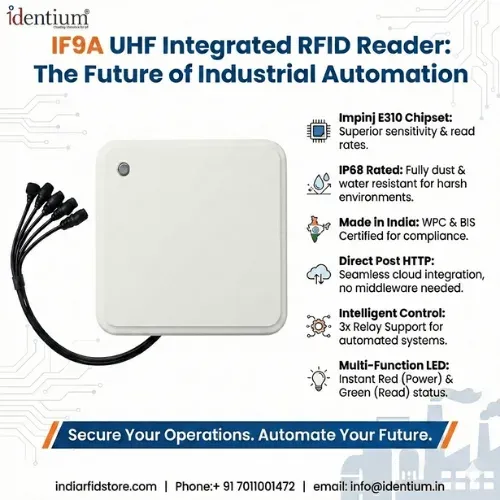
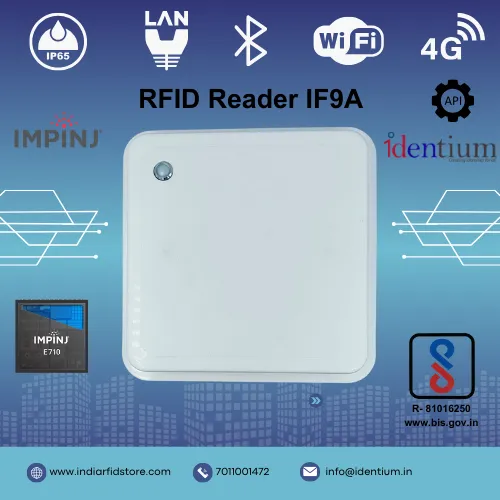
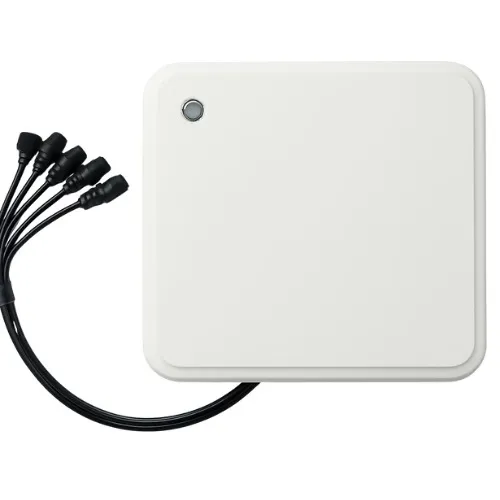
| IF9A integrated reader | Reader and 9 dBi antenna in one die-cast case; up to 25 m effective; USB, RS232, Wiegand, Ethernet and PoE; optional relay; reads EPC, TID and user memory; SDKs for .NET, Java, Python and others | A single lane with a network point | ₹24,000 + GST |
| IF9A 4G reader | The same reader with a built-in 4G modem that pushes reads directly to a cloud server | Remote godowns without a LAN at the gate | ₹40,000 + GST |
| IF9C integrated reader | 9 dBi built-in antenna; up to 12 m; Ethernet, RS232, RS485 and Wiegand 26/34; relay; active, command and trigger modes | Barrier and access-controller integrations | ₹16,000 + GST |
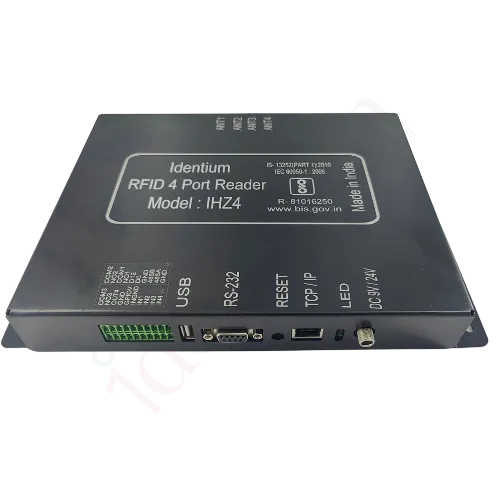
| IHZ4 four-port reader with 12 dBi circular antennas | Four antenna ports, three inputs and three relays; the antenna is IP67 for 865–868 MHz, listed at up to 30 m with an Identium four-port reader | An in lane and an out lane, or a gate plus a weighbridge, from one reader | ₹55,000 + GST plus ₹11,000 + GST per antenna |
Read ranges are the listed figures and depend on the tag, the windscreen and the mounting. Every UHF reader model used in India needs WPC Equipment Type Approval; the IF9A and IHZ4 models are BIS-registered and WPC type-approved, and our certifications page lists the details. The IF9A product page's software section also includes a C# reference application for reading FASTag tag IDs (EPC, EPC with TID, or EPC with TID and user memory), which is a quick way to test reads on your own trucks.
For your own fleet, the tamper-proof windshield label (₹25 + GST) cannot be removed and refitted intact and is listed at over 8–10 m when fixed inside the windscreen; the full-colour printed windshield label (₹25 + GST) carries the vehicle number, department or logo and reads at 1–5 m in gate lanes. Both are sold at a minimum order of 500 pcs, and the full range is under RFID vehicle tags and windshield stickers.
A sample gate-in, step by step
- The truck stops at the line and breaks the beam; the reader starts reading.
- The reader returns a tag ID (the truck's FASTag or your own windshield label) and the camera returns a plate.
- The gate software looks up the tag and plate, finds the transporter and today's appointment, and shows the guard a green or amber result.
- On green, the barrier opens and the time in is logged; on amber, the guard checks documents and records why.
- At the weighbridge and the dock, further reads tie the weight and the dock to the same visit.
- At exit, the out-lane read closes the visit, and turnaround time is calculated for the transporter and the shift.
The RFID warehouse management system page shows how gate reads join stock and dock events, and the RFID vehicle and parking management system covers barrier-lane software.
Run a short pilot before you buy for every lane
Gate projects fail on details that only show up with real trucks, so test one lane first:
- Survey the vehicle mix. For a week, note how many trucks arrive with a FASTag, how many are regulars you could tag yourself, and how many are one-off visitors.
- Test reads with the real vehicles. Mount one reader and antenna temporarily at the stop line and log every read for a few days: tag ID, time, and how many times each tag was read. A tag read only once or twice is a tag you will miss on a bad day.
- Check the cab heights. Look for misses on high cabs, low pickups and vehicles with sun-control film, and adjust the antenna height and tilt before you fix the pole.
- Watch for stray reads. Trucks queued behind the line, or parked beside the lane, should not register; if they do, tighten the trigger logic or the antenna aim.
- Time the guard's workflow. Measure how long a visit takes with and without the read, and agree what the guard does on an amber result.
The numbers from that week tell you how many windshield labels to order for your own fleet and whether a second read point is worth it.
What this guide does not cover
We do not advise on NPCI or IHMCL rules, on whether a FASTag may be used as an access credential at your site, or on FASTag payments. For payments at parking lots, start with our FASTag parking guide; for highway tolling, our barrier-free tolling guide. For gate hardware, ask for a quote with your lane drawings and the vehicles you handle.
Sources
All fetched on 22 October 2026.
- PIB, Ministry of Consumer Affairs, Food and Public Distribution, 18 June 2026: Union Minister launches Smart Warehousing System for foodgrain storage
- PIB, 17 June 2026: Union Minister to launch Smart Warehousing System for foodgrain storage
- PIB, 18 November 2025: Digital upgrades to food storage and logistics, including CWC's Smart EXIM Warehouse System
- Outlook Business (PTI), 18 June 2026: Food Minister Pralhad Joshi launches smart warehousing system of CWC
Frequently asked questions
How many warehouses does CWC's smart warehousing system cover?
Can a UHF RFID reader read a truck's FASTag?
Is reading FASTag at my gate the same as accepting FASTag payments?
What hardware does an RFID warehouse gate need?
What about trucks without a readable FASTag?
What are VAHAN and SARATHI, and why are they linked to CWC's gates?
WarehousingFASTagGate AutomationUHF RFID ReadersLogistics
Keep reading
More guides
More in Industries & use cases
- Pet Microchips in Chennai: The Rs 10,000 Abandonment Fine, Scanners in 40 Vehicles and ISO 11784 Chips Explained
- NICU Infant Security with RFID Wristbands: What Surat's New Civil Hospital Switched On (2026)
- RFID Chip Running Test for Police Recruitment PET: Lap Timing, Anti-Swap Checks and What Tenders Ask For
- Stray Cattle and Dog RFID Tagging for Municipal Corporations in India (2026 Guide)