Pet Microchips in Chennai: The Rs 10,000 Abandonment Fine, Scanners in 40 Vehicles and ISO 11784 Chips Explained
Published 22 Oct 202610 min read
Short answer: The Greater Chennai Corporation (GCC) has approved a Rs 10,000 penalty for owners who abandon a licensed, microchipped dog or cat, and Business Today reports that microchip scanners are being provided in all 40 of the corporation's dog-catching vehicles. A microchip has been a condition of the GCC pet licence since a council resolution reported in February 2025. Reports differ on when the corporation starts collecting the new fine, so check with your zonal veterinary officer rather than relying on a date in the press.
Below: what was reported, how an ISO 11784/11785 microchip number is built, which scanner reads it, what a vet or NGO orders, why a chip is only as good as the register behind it, and what a municipal corporation should specify.
Chennai is not the first Indian city to talk about pet microchips, but it is the first large one where a chip, a licence, a scanner on every catching vehicle and a fine have been reported as one system. That makes it a useful template for owners, veterinary clinics, animal-welfare groups and other corporations. We sell implantable chips and animal scanners, so we keep to what the reports and the published standards say, and we do not give implant-procedure advice: that is a veterinarian's job.
What changed in Chennai
The figures below come from three reports and the GCC's own website. Where they differ, we say so rather than merge them.
| Detail | What was reported | Source |
|---|---|---|
| Microchip as a licence condition | A council resolution made microchipping mandatory for pet dogs to get a GCC pet licence, to curb abandonment; implanting began at the corporation's six pet clinics, with the veterinary university hospital and private clinics to follow | Pashu Sandesh, 1 Feb 2025 |
| Licence fee | Rs 50 at the time; the microchipping charge had not been decided | Pashu Sandesh, 1 Feb 2025 |
| Licensed owners | 78,238 pet owners held GCC licences as of 30 July 2026 | DT Next, 25 Sep 2026 |
| Abandonment fine | Proposed at Rs 25,000; the standing committees on public health and on taxation and finance recommended Rs 10,000 | DT Next, 25 Sep 2026 |
| GCC approved Rs 10,000 for abandoning licensed and microchipped dogs or cats on roads or in public places; no start date is given | Business Today, 6 Oct 2026 | |
| Scanners | Microchip scanners to be provided in all 40 dog-catching vehicles run by the corporation | Business Today, 6 Oct 2026 |
| Other fines | Rs 5,000 for an unlicensed pet; Rs 500 for a dog without a leash in a public place | Business Today, 6 Oct 2026 |
| Missing pets | An owner who reported the pet missing is not penalised for abandonment if the corporation later rescues it | Business Today, 6 Oct 2026 |
| Collection | Zonal veterinary officers, sanitary officers or health inspectors collect fines on the corporation's POS machines | DT Next, 25 Sep 2026 |
| Stray-dog load | 15,477 stray-dog complaints, and 26,498 dogs caught under the animal birth control programme, in the first six months of 2026 | DT Next, 25 Sep 2026 |
The GCC veterinary department's website lists six corporation pet clinics (Thiru-Vi-Ka Nagar, Nungambakkam, Kannammapet, Meenambakkam, Pulianthope and Lloyds Colony), open from 8 am to 3 pm, and links to its online pet licence registration. That matches the six clinics named in the 2025 report.
What the reports leave open
None of the reports names the microchip or scanner supplier, gives the price of a chip, or says which software runs the licence register, and this article makes no claim about any of them. The start of the Rs 10,000 fine is also unclear: Business Today gives no date, and an earlier report quoted an official on when collection would begin. Treat any date you read as provisional until the corporation publishes it.
How a pet microchip number is built (ISO 11784 and ISO 11785)
A pet microchip is a passive, low-frequency RFID transponder sealed in a glass capsule about the size of a grain of rice. It has no battery: the scanner's field powers it, and the chip answers with its number. Two international standards make chips and scanners from different makers work together. ISO 11784 fixes how the code is structured, and ISO 11785 fixes how chip and reader talk. Chips that follow both use the FDX-B (full-duplex) method at 134.2 kHz, which is what our AMC134 microchip and RA91 scanner are built to.
The number a scanner shows is 15 digits long:
| Digits | What they mean | Why it matters to you |
|---|---|---|
| First 3 | A manufacturer code, allocated after conformance testing through ICAR (the International Committee for Animal Recording), or a country code | Country codes are restricted to countries that run an authorised, central system for allocating numbers; elsewhere chips carry a manufacturer code |
| Remaining 12 | The individual animal's number | Under the ICAR code of conduct, the maker guarantees that every number is unique |
| 999 at the start | A test code | Restricted to testing; it should not appear on a chip sold for use |
The World Small Animal Veterinary Association (WSAVA) publishes a short note written by the Chair and Secretary of the ISO working group that develops these standards. Its history lesson is blunt: early chips from different makers could not be read by each other's scanners, some signals were encrypted so that only one maker's reader could decode them, and that damaged public confidence in pet identification. Since the ISO standards arrived, responsible makers have sold only conformant chips. For a city starting a programme today, insisting on ISO 11784/11785 FDX-B chips is the single most important line in the specification.
Which scanner reads a pet microchip?
Any handheld built to read ISO 11784/11785 FDX-B chips at 134.2 kHz will read an ISO pet chip, whoever made the chip. Two mix-ups come up often:
- A phone cannot read an implant. NFC in a phone works at 13.56 MHz, and a 134.2 kHz implant does not answer it. NFC is useful for collar tags (below), not for chips under the skin.
- An access-card reader is not an animal scanner. Office card readers at 125 kHz are built for card formats and will not necessarily decode an FDX-B implant. Buy a reader whose specification names ISO 11784/11785 and FDX-B.
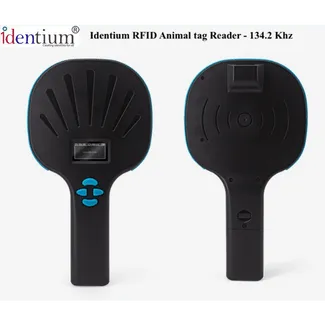
Our RA91 animal tag reader (₹14,500 + GST, minimum order 1 unit) reads FDX-B and EMID tags at 134.2 kHz and 125 kHz and shows the number on an OLED display. Its listed read distance is more than 15 cm for 2–12 mm glass implants and more than 25 cm for 30 mm ear tags, with a read in under 100 ms. It connects by cable, 2.4G wireless or Bluetooth, so the number can go straight into an app or clinic software instead of being copied by hand, and it also has a 1D/2D barcode imager, which matters at the clinic, as the next section explains.
Short read distances are normal for low-frequency implants: the small coil inside the capsule couples with the scanner only at close range. Scan methodically and slowly, and do not conclude that an animal has no chip after one quick pass. If you will scan pets that came from abroad, ask whether the scanner also reads older, non-ISO formats; the WSAVA note recommends asking exactly that.
Implant kit and syringe: what a vet, NGO or clinic orders
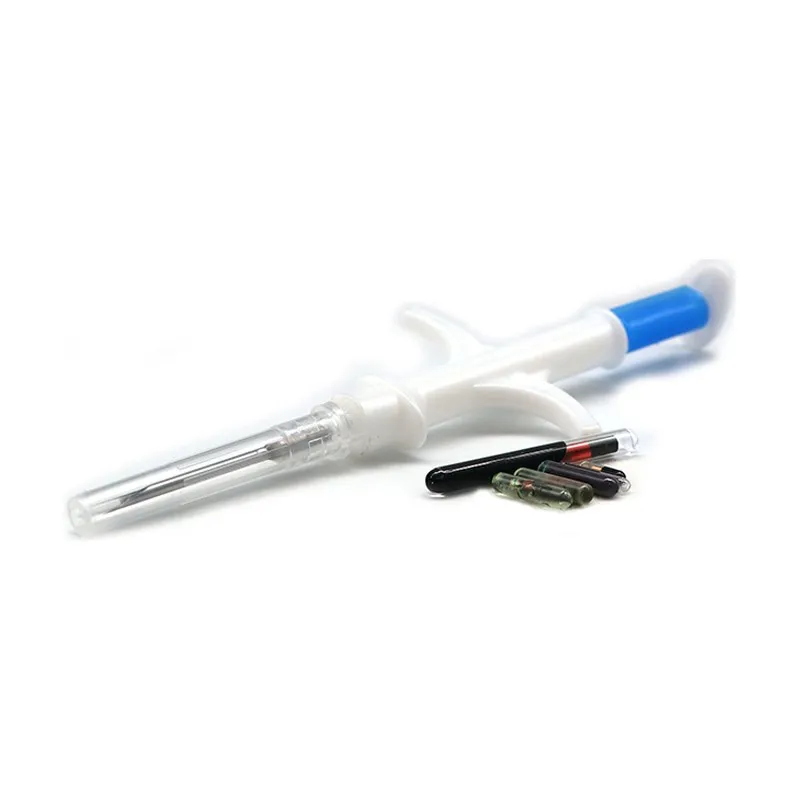
Clinics and animal-welfare groups buy chips pre-loaded in single-use syringes. Our AMC134 animal microchip with syringe is listed as follows:
- 134.2 kHz FDX-B to ISO 11784/11785, with a 15-digit number.
- Three capsule sizes: 2.12 × 12 mm, 1.4 × 8 mm and 1.25 × 7 mm, in a bioglass capsule with an anti-migration coating.
- A single-use syringe with a fixed needle, sterilised with ethylene oxide (the sterilisation is valid for five years), each one individually packed.
- A pack that shows the sterilisation date, the expiry date and the chip's 15-digit number as a barcode.
The barcode is the practical detail. Scanning it with the RA91's imager, or any barcode scanner, when the chip is implanted puts the exact number into the licence record without anyone typing 15 digits, which removes transcription errors. The AMC134 is quoted per order (price on request), minimum order 500 pcs; tell us the species, the sizes and the quantities when you ask for a quote. Implanting is for a veterinarian, or a trained handler working under one.
Whoever supplies your chips, ask the questions the WSAVA note lists: is the chip FDX-B, does it meet ISO 11784 and ISO 11785, which manufacturer code does it carry, and how will the details of each animal and its owner be recorded?
A chip is only useful if the number is on a register
An ISO chip transmits a number, not an address book. When reports say Chennai's chip holds the owner's name, address and vaccination record, the practical meaning is that those details sit in the licence record that the number unlocks; Business Today describes them as details linked to the pet's registration. The WSAVA note lists four conditions for electronic identification to work, and only one of them is the chip itself:
- A unique number in every chip.
- A chip any reader can read, whoever made the reader.
- The owner's and the pet's details recorded on a database that is available 24 hours a day, every day.
- The record kept up to date when the owner moves house or the pet changes hands.
In Chennai the register is the corporation's pet licence system; the 2025 report said the GCC would build software and a mobile app linked to its online licensing portal. For owners, three habits follow. Keep the licence number and the chip number together. Update the address when you move. Report a missing pet promptly, because Business Today reports that an owner who reported the pet missing is not penalised if the corporation later rescues it.
These are the Greater Chennai Corporation's licence conditions. Other cities set their own pet-licence rules, so check with your local body before assuming that the same fines or deadlines apply.
Collar tag or implant: they do different jobs
An implant is permanent proof of identity that corporation and clinic scanners read. It does nothing for the neighbour who finds your dog at the gate, because a phone cannot read it. That is the job of a collar tag.
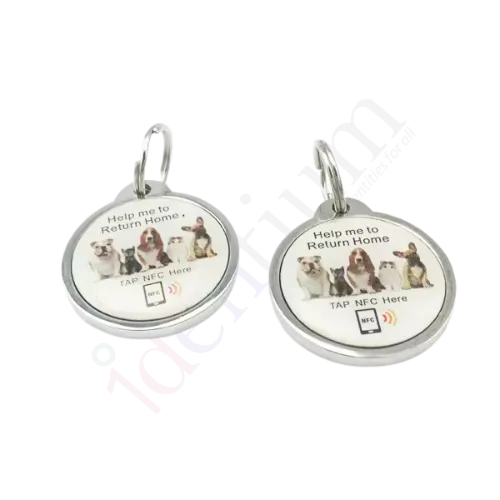
Our PETID NFC pet identification tag is a 13.56 MHz ISO 14443A tag in PVC or PET, worn on the collar. Program it with a link to the pet's profile or the owner's phone number, and anyone with an NFC phone can tap it and see the details, with no app or special reader needed. Sizes and artwork are made to order, so pet shops and clinics can supply the tags under their own name: ₹80 + GST, minimum order 500 pcs.
| Implanted microchip | NFC collar tag | |
|---|---|---|
| Frequency | 134.2 kHz (FDX-B) | 13.56 MHz (NFC) |
| Read by | ISO animal scanners at the corporation, clinic or shelter | Any NFC phone |
| What it gives | A 15-digit number to look up in the licence record | Whatever you program: a profile link or contact details |
| Can it be lost? | No; it stays under the skin | Yes, along with the collar |
| Who fits it | A veterinarian | The owner |
All our animal identification products, from pet tags and implants to livestock ear tags, are grouped under animal and pet RFID tags; the wider low-frequency range is under LF RFID tags.
For municipal corporations: what to specify
Chennai's combination of a licence, a chip and a scanner on every catching vehicle is a pattern other corporations can copy. If you are writing the specification, these are the points that decide whether it works in the field:
- Chips: ISO 11784/11785 FDX-B at 134.2 kHz, with a manufacturer code and a written commitment to unique numbers; reject test-code (999) chips at registration.
- A scanner per vehicle: an ISO FDX-B handheld that can send the number to a phone or tablet by Bluetooth, so the catcher does not type 15 digits at the roadside.
- Lookup: the scanned number queries the licence record and shows the owner's name and contact, the licence status and the vaccination status; plan for weak mobile coverage.
- Licence fields: chip number, licence number, owner's name and address, species, breed, colour, sex, age and vaccination status, the fields the 2025 report listed.
- Clinic intake: scan the barcode on the chip pack into the licence record when the chip is implanted, then scan the animal to confirm that the chip reads.
- Missing-pet reports: record them against the chip number, so that a rescued pet is matched to its report before any penalty is raised.
For the stray side of the same problem, including cattle chips, ear tags and how a pound traces an owner, read our guide to stray cattle and dog RFID tagging for municipal corporations. Dairy and herd projects are covered in RFID livestock and cattle ear tags and on the RFID livestock tracking system page.
Microchips, scanners and pet tags
- AMC134 animal microchip with syringe: 134.2 kHz FDX-B, three capsule sizes, price on request.
- RA91 animal tag reader: ISO FDX-B and EMID, barcode imager, Bluetooth, ₹14,500 + GST.
- PETID NFC pet tag for collars: ₹80 + GST.
- Browse animal and pet RFID tags or LF RFID tags, or contact us about a municipal or clinic programme.
Sources
All fetched on 22 October 2026.
- Business Today, 6 October 2026: Rs 10,000 fine for abandoning pets in Chennai, how microchips will help to track owners
- DT Next, 25 September 2026: Abandoning pets in Chennai to cost owners Rs 10,000
- Pashu Sandesh, 1 February 2025: Microchipping mandatory for pet dog licence in Chennai
- Greater Chennai Corporation, Veterinary department: pet clinics and pet licence registration
- WSAVA: Microchipping, the importance of ISO (with ICAR manufacturer codes and code of conduct)
Frequently asked questions
Is a microchip compulsory for a pet licence in Chennai?
What is the fine for abandoning a pet in Chennai?
Can my phone read my dog's microchip?
What do the 15 digits of a pet microchip number mean?
Which scanner do vets and corporations need for pet microchips?
Does the microchip store the owner's address?
Pet MicrochipAnimal RFIDISO 11784/11785Municipal CorporationsTamil Nadu
Keep reading
More guides
More in Industries & use cases
- NICU Infant Security with RFID Wristbands: What Surat's New Civil Hospital Switched On (2026)
- RFID Chip Running Test for Police Recruitment PET: Lap Timing, Anti-Swap Checks and What Tenders Ask For
- Car Dealer Stock Audit with RFID: VIN-Level Stockyard and Floor-Plan Verification in India