NICU Infant Security with RFID Wristbands: What Surat's New Civil Hospital Switched On (2026)
Published 22 Oct 20269 min read
Short answer: On Monday 6 July 2026, New Civil Hospital (NCH) in Surat, one of Gujarat's largest government hospitals, switched on an RFID security system in its neonatal intensive care unit. Every baby admitted to the NICU wears an RFID tag, and sensors at the entry and exit points sound a siren if a tagged baby is carried out. The Times of India put the cost at Rs 1.45 lakh and reported that the gynaecology ward is next. Below: what the reports say, how such systems work, what India's labour-room quality checklist asks for, and what a hospital should plan, including the lesson that an earlier system there had stopped working.
Hospital authorities told the Times of India that the system follows incidents of newborns being kidnapped from hospital wards. Busy government hospitals, with patients, attendants and visitors passing through all day, are hard to watch at every exit. Surat's step is useful for any hospital weighing the same decision because it was reported in unusual detail: the ward, the tag, the alarm, the procedure for authorised moves and the cost. We set out the facts as reported, then turn them into a planning checklist.
What Surat's New Civil Hospital switched on
Three reports published on 6 and 7 July 2026 describe the same system, with small differences in detail, so we list what each says rather than merge them. None of the reports names the supplier, and this article makes no claim about who supplied or installed the system.
| Detail | What was reported | Source |
|---|---|---|
| Where and when | The NICU of New Civil Hospital, Surat; activated on Monday 6 July 2026 after a demonstration for senior officials | Times of India |
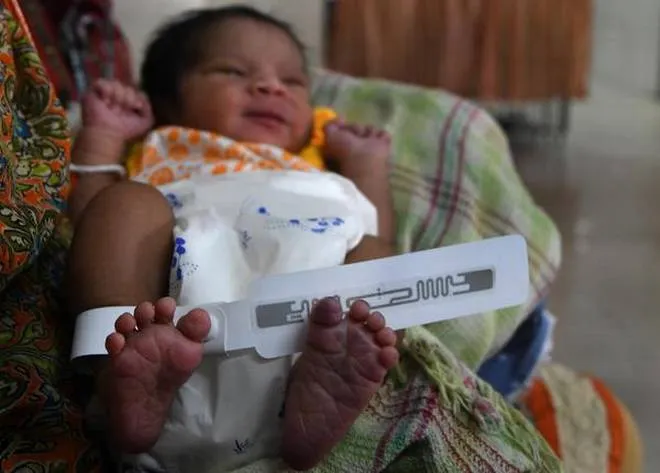
| The tag | An RFID band on each baby's wrist | Times of India |
| The tag | A special RFID tag on each newborn's hand or foot | Loktej |
| Detection | Sensors at entry and exit points detect the band if an infant is taken out of the ward; a siren alerts security personnel, and staff verify who is carrying the child | Times of India |
| Detection | An RFID machine installed outside the NICU; if a tagged baby is taken out through the exit gate, it sounds a buzzer and security goes on alert | IANS |
| Cost | Rs 1.45 lakh | Times of India |
| Next ward | A similar system for the gynaecology ward | Times of India |
| Next ward | The maternity (gynaecology) ward, where many newborns stay, within 10 to 15 days | Loktej |
| Earlier system | An earlier version installed three years ago became defunct over time; the new one is upgraded | Times of India |
| Other layers | Stronger CCTV coverage, security personnel trained to watch visitors and bags, nurses trained to be more vigilant | Times of India |
| Other layers | Female security staff at the NICU entrance and 24-hour CCTV run from the hospital control room | Loktej |
| Authorised moves | For a CT scan, MRI or other test, nursing staff inform security first, documents are checked and a doctor usually goes with the baby | Loktej, IANS |
| Tag removal | The tag is fitted so that only authorised doctors or nurses can remove it | Loktej |
| Tag removal | Officials acknowledged that a determined offender could try to remove a band, so vigilance by nurses and security remains critical | Times of India |
IANS also reported the load: the head of the paediatrics department said the hospital has permission for 42 beds but has arranged 60 for babies and for patients referred from elsewhere, who come from Surat, the rest of south Gujarat and the parts of Maharashtra bordering Gujarat, with a separate NICU team on duty round the clock.
What the cost figure does and does not tell you
The Rs 1.45 lakh reported by the Times of India is for the NICU system. None of the reports says how many doors it covers, how many tags were bought, or whether installation, software or maintenance are included, so it is not a figure to compare quotes against line by line. What it does show is that a government hospital bought exit-alarm protection for one high-risk unit for that sum. Any quote depends on the exits to cover, the readers and antennas at each, the number of bands per month and the alerting you need.
Why the NICU first
In a NICU, babies are under medical supervision and parents are often not allowed inside, so, as the Times of India report notes, monitoring rests on staff. Babies there also leave the ward for scans and tests, which is why the hospital wrote a procedure for authorised moves rather than relying on staff to silence the alarm.
Both local reports refer to past incidents. The Times of India recalls a case in which an infant was smuggled out in a bag; CCTV footage helped identify the suspect and the child was recovered. Loktej quotes the in-charge superintendent as saying that a newborn was taken from the hospital about a year earlier and recovered safely two days later, and that RFID was adopted as a lasting technical answer. The hospital presents RFID as one layer among several: in the in-charge medical superintendent's words to the Times of India, multilayered security will prevent kidnapping incidents.
How an exit-alarm infant security system works
Surat's description matches the simplest design, which the Loktej report compares to the anti-theft gates in shopping malls: the tag is the article, and the ward door is the gate. Built properly, it has five parts.
- Tag the baby. A small band with an RFID tag goes on the wrist or ankle at admission or birth, with a closure that cannot be undone and refitted on another baby without showing. The band is linked to the baby's and the mother's records.
- Cover every way out. Readers and antennas at each door, lift lobby and staircase leading out of the ward create read zones. A band passing through any of them is detected.
- Decide what an alarm means. At the least, a siren and an alert to security, with staff checking who is carrying the baby. Fuller systems also check that the baby is with the right mother and track where each baby is.
- Write the authorised-move procedure. Babies go for CT, MRI and other tests. Surat's answer is simple and worth copying: nursing staff tell security first, documents are checked, and a doctor goes with the baby.
- Plan for tampering. A band can be cut. Surat relies on a fitting that only authorised staff can remove, on trained staff, on guards at the entrance and on CCTV. No tag replaces people watching.
Two ways to build it
Passive UHF wristbands read at the doors. A passive UHF band has no battery, so it can be single use, and fixed UHF readers at the doors detect it. The limit is physics: a small band on a small limb sits close to the body, which shortens UHF read distance, so reader positions must be tested on site with real bands, cots, blankets and the ward's steel trolleys. Our read-range guide explains the sums behind that.
A dedicated infant monitoring system. A complete system adds its own tags, readers installed in the hospital and alerting software that flags a mother–baby mismatch or a baby moved where it should not go. Our RFID Infant Monitoring System is built this way and sized to the ward, the exits covered and the readers and tags needed.
What India's quality checklist asks for
LaQshya, the National Health Mission's labour room quality improvement initiative (2017), covers labour rooms and maternity operation theatres in government medical college hospitals, district hospitals, designated first referral units and high case-load community health centres rather than NICUs, but its checklists show what assessors look for around newborns. Under the standard for vulnerable patients (measurable element E5.1), assessors check the measures taken to prevent newborn theft and baby falls. Under security (D3.4), the labour-room checklist asks for dedicated security guards, preferably female, and CCTV cameras at the entrance and circulation areas. The guideline's annexure on respectful maternity care also lists preventing baby swapping and theft among the roles of the birth companion.
LaQshya does not prescribe a technology. Surat's three layers, RFID at the exits, female security staff at the entrance and CCTV watched from a control room, map onto those checkpoints. RFID is the layer that raises the alarm while the baby is still inside the building; CCTV mostly helps identify people afterwards, as in the earlier Surat case.
Lessons for hospitals planning infant security
- Map every exit first. Doors, lifts, stairwells and service corridors decide how many read zones, readers and antennas you need.
- Write the procedures before go-live. Authorised moves for tests, who answers the alarm, how a band is fitted after birth and removed at discharge.
- Budget for upkeep, not just installation. The Times of India reports that the hospital's earlier version, installed three years before, became defunct. Before ordering, agree in writing who tests the alarm, how often, and who services readers and replaces faulty parts. Test each door regularly with a spare band.
- Extend to where most newborns are. Surat's next step is the gynaecology ward, where, as Loktej notes, many newborns stay.
- Match mother and baby. A band on the mother, printed with matching details and read by the same readers, lets staff confirm the pair at every handover and at discharge.
- Stock the consumables. Infant bands are single use, so plan stock against births per month.
- Keep people in the loop. As the Surat officials said, a determined offender can try to remove a band; trained nurses and guards remain the last line.
Questions to ask before you buy
Whoever you buy from, these questions turn the Surat lessons into a specification:
- Which doors, lifts and stairwells are covered, and how is each read zone tested and signed off at handover?
- How does a nurse authorise a baby's move for a scan or a transfer, and is the move recorded?
- What happens when a band is cut or removed, and who is told?
- Where does the alarm go: a siren at the door only, or also to the security desk and the nursing station?
- What maintenance is included, who carries it out, and how quickly is a faulty reader or antenna repaired or replaced?
- How are bands printed and encoded so that the baby's and the mother's bands match, and how many are needed per month?
- Which reader models are used, and does each hold WPC Equipment Type Approval? Our WPC ETA checklist explains what to ask for.
Wristbands and systems for maternity and newborn units
- UHF wristband for infants: soft, non-allergic PVC with a tamper-proof, single-use closure, printable with names, barcodes or QR codes and pre-encoded on request. ₹28 + GST, minimum order 500 pcs.
- UHF patient wristband for adults from the same range, for the mother: ₹25 + GST.
- NFC / HF hospital wristband for bedside identity checks with an HF reader or an NFC phone: ₹30 + GST.
- PVC tamper-proof RFID wristband: ₹25 + GST.
- RFID Infant Monitoring System: tags, readers and real-time alerts for mother–baby mismatch and abduction attempts, sized per ward. All options are on the RFID infant monitoring page, and every band is under hospital and patient wristbands.
For RFID across a hospital, from patient wristbands to equipment and linen, see RFID for healthcare and hospitals, the healthcare patient tracking system and our guide to RFID in Indian hospitals. Wristband prices across the range are compared in the wristband price guide.
Sources
- The Times of India, Surat, 7 July 2026: NCH activates RFID system to guard its tiniest patients, accessed 22 October 2026
- Loktej (Hindi), 6 July 2026: Hi-tech RFID system started at Surat Civil Hospital for the safety of newborns, accessed 22 October 2026
- Medical Dialogues (Hindi, with inputs from IANS), 7 July 2026: RFID system for newborns at Surat's New Civil Hospital, accessed 22 October 2026
- LaQshya: Labour Room Quality Improvement Initiative, National Health Mission, 2017 (checklists for labour room and maternity OT: ME D3.4, ME E5.1; Annexure A), accessed 22 October 2026
Frequently asked questions
What did Surat's New Civil Hospital install in its NICU?
How does an RFID infant security system prevent baby theft?
Can a baby's RFID band be removed?
Does an RFID infant security system replace CCTV and guards?
What does the LaQshya checklist ask hospitals to do about newborn theft?
Which RFID wristband suits newborns?
HealthcareInfant SecurityRFID WristbandsHospital RFIDGujarat
Keep reading
More guides


More in Industries & use cases
- RFID Chip Running Test for Police Recruitment PET: Lap Timing, Anti-Swap Checks and What Tenders Ask For
- Stray Cattle and Dog RFID Tagging for Municipal Corporations in India (2026 Guide)
- Car Dealer Stock Audit with RFID: VIN-Level Stockyard and Floor-Plan Verification in India
- RFID Self-Checkout and Billing Counters for Indian Retail