UHF Integrated Reader IF9C (9 dBi, Ethernet, RS485, Wiegand, Relay)
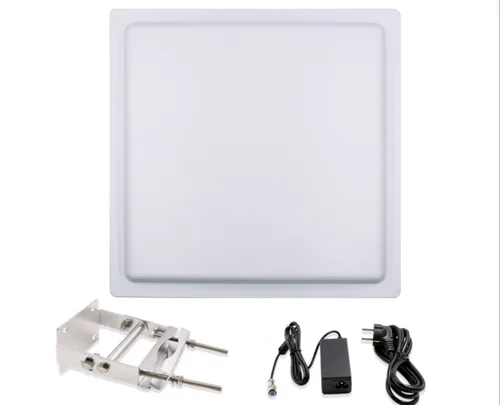
A UHF RFID reader and 9 dBi antenna in one die-cast aluminium case, for parking lanes, gates and boom barriers. It reads up to 12 m and reports over Ethernet, RS232, RS485 or Wiegand 26/34, with a relay to trigger a barrier.
₹16,000
per piece + 18% GST
Minimum order: 1 piece · the final price for your quantity is confirmed in the quote
View datasheet PDF · 192 KB- 7-day replacement · 1-year warranty against manufacturing defects
- Blue Dart next-day delivery
Key features
- Built-in 9 dBi antenna; read range up to 12 m (tag and mounting dependent)
- Ethernet (TCP/IP), RS232, RS485 and Wiegand 26/34 outputs
- One relay (COM/NO/NC) to trigger a boom barrier or gate controller
- Compatible with ID Tech and ZKRFID software; SDK for your own application
- Same case, 9 dBi antenna and LED as the IF9A
- 865–868 MHz India UHF band; output power adjustable from 0 to 26 dBm
- Protocol
- ISO 18000-6C (EPC Gen2)
- Frequency
- 865–868 MHz (India UHF band)
- Frequency hopping
- FHSS or fixed frequency
- RF chip
- K9
Overview
What the IF9C UHF integrated RFID reader does
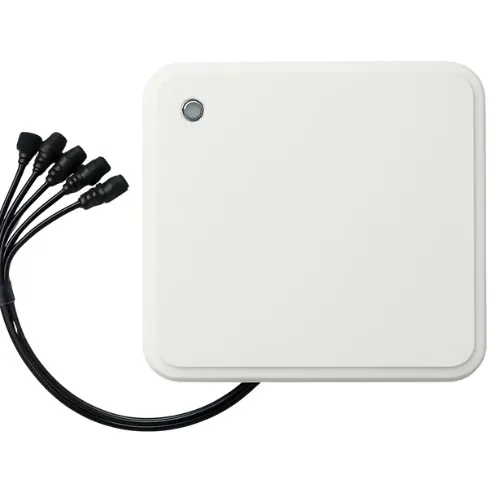
The IF9C is a long-range UHF RFID reader for parking lanes, vehicle gates and other access-control points. It reads and writes ISO 18000-6C (EPC Gen2) tags. Read range is up to 12 m, depending on the tag and how the unit is mounted. The reader board and a 9 dBi antenna share one die-cast aluminium case, so each lane needs a single unit on its pole or wall and no antenna cable to route.
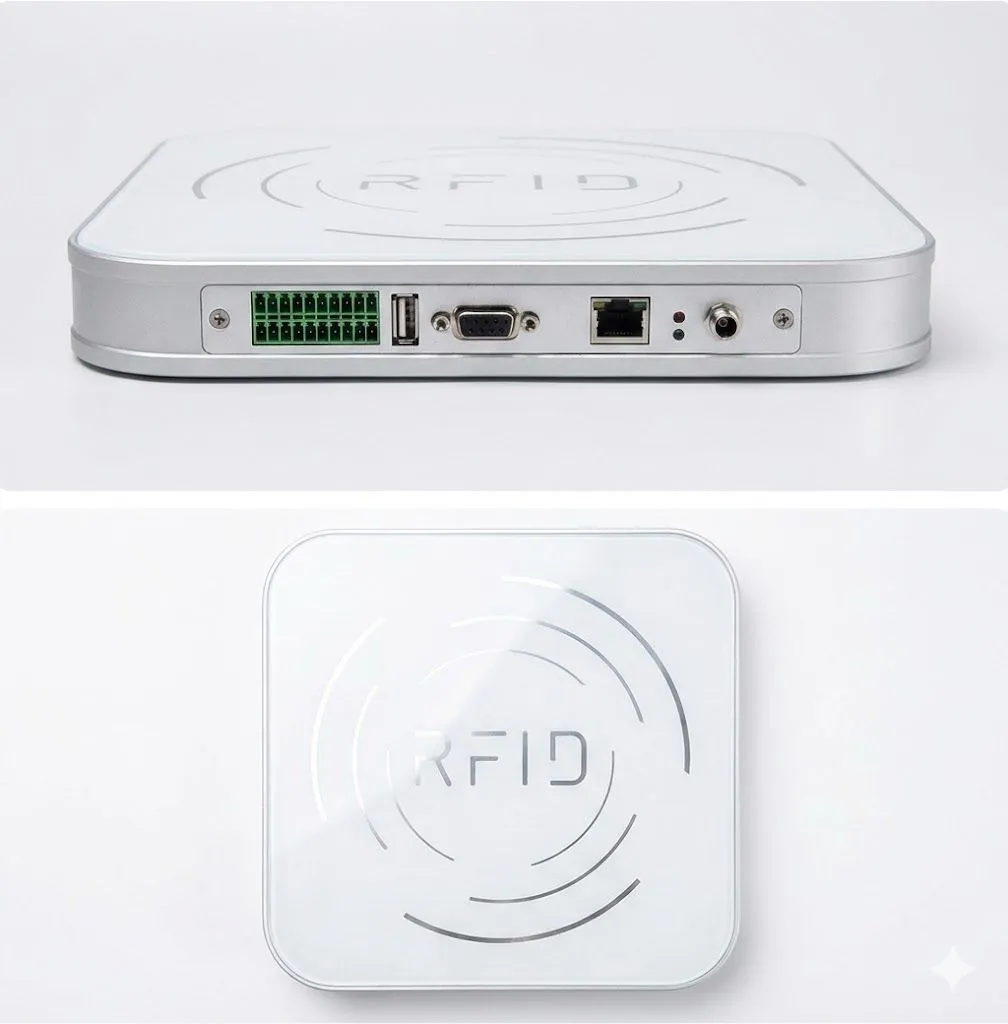
Housing, built-in antenna and multi-function LED (red for power, green for each read) are the same as on the IF9A. The difference is inside: the IF9C carries the reader board of the IDTS-RM26 module, which is laid out for access-control wiring.
How it fits into a parking lane or gate
A typical installation puts one IF9C on the pole beside each barrier and connects it in one or more of these ways:
- Existing access controller: Wiegand 26 or 34 goes into the controller's reader input, so a windshield tag arrives the way a card number does and the controller's own rules decide who enters.
- Barrier: the relay's contacts go to the barrier controller's open input to trigger the boom.
- Parking or gate server: Ethernet over the site network, or RS485 when the run back to the guard cabin is long. RS232 covers a short link to a local panel or PC.
In active mode the reader reports each tag on its own; in passive mode it reads only when host software sends a command; a trigger mode is also available. On a multi-lane site, turn the output power down (adjustable from 0 to 26 dBm) so each reader stays inside its own lane.
IF9C or IF9A?
| Feature | IF9C | IF9A |
|---|---|---|
| Housing, 9 dBi antenna, LED | Same | Same |
| Read range | Up to 12 m | Up to 25 m |
| Connectivity | Ethernet, RS232, RS485, Wiegand 26/34, relay | USB, RS232, Wiegand, Ethernet with PoE; optional relay |
| Software | ID Tech and ZKRFID software; SDK | SDKs for .NET, Java, Linux, Python and more |
Choose the IF9C, the lower-cost of the two, for parking lanes, society gates and boom barriers where 12 m is enough and you want RS485, a built-in relay or ID Tech/ZKRFID software. Choose the IF9A for longer range, power over Ethernet or bulk reads at a dock door. Other boxed readers are in the integrated RFID readers range.
Typical applications
- Parking entry and exit
- Vehicle access control
- Boom barrier control
- Residential society gates
- Factory and campus gates
Specifications
Datasheet (PDF)| Model | IF9C |
|---|---|
| Type | Integrated UHF reader: reader board and antenna in one case |
| Function | Read and write |
| Protocol | ISO 18000-6C (EPC Gen2) |
| Frequency | 865–868 MHz (India UHF band) |
| Frequency hopping | FHSS or fixed frequency |
| RF chip | K9 |
| Output power | 0–26 dBm, adjustable |
| Antenna | Built-in 9 dBi |
| Read range | Up to 12 m (depends on tag, mounting and environment) |
| Interface | TCP/IP (Ethernet), RS232, RS485, Wiegand 26/34 |
| Relay | 1 group, COM / NO / NC |
| Work modes | Active, passive (command), trigger |
| Indicators | Multi-function LED: red for power, green for tag read |
| Compatible with | ID Tech and ZKRFID software |
| SDK | Available for secondary development |
| Power | DC 9–24 V; consumption ≤ 4 W |
| Wiring | Wiring details are supplied with the unit; ask us before planning the installation |
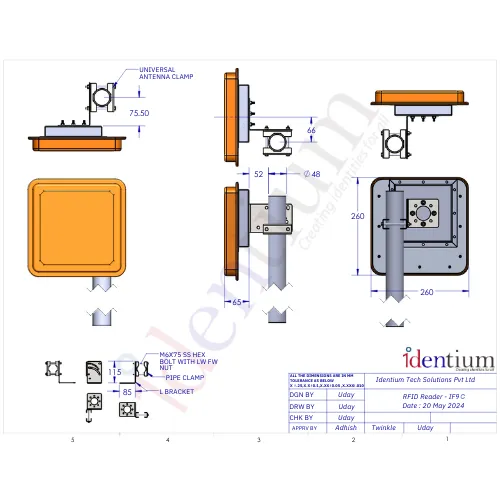
| Dimensions | About 260 × 260 mm front face (see the mechanical drawing) |
| Material | Die-cast aluminium case |
| Mounting | Universal antenna clamp (pipe clamp) for a pole, or L bracket; M6 hex bolts |
| Reader board operating temperature | −20 °C to +70 °C |


_2jEWwo.webp)
_Z7eD4S.webp)
_Z1zygRc.webp)