-500x200.png "India RFID Store — RFID Manufacturer India")
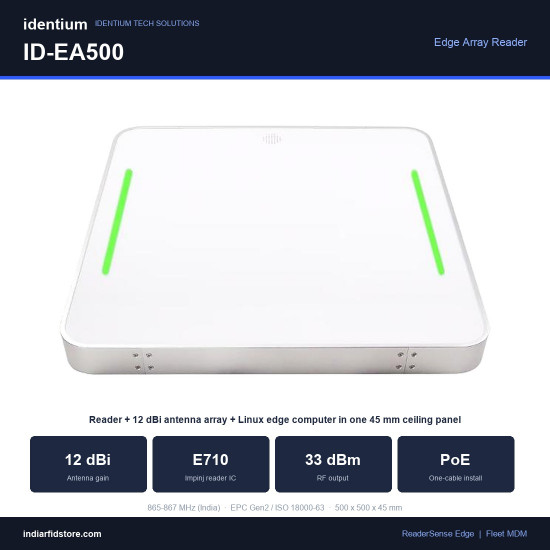
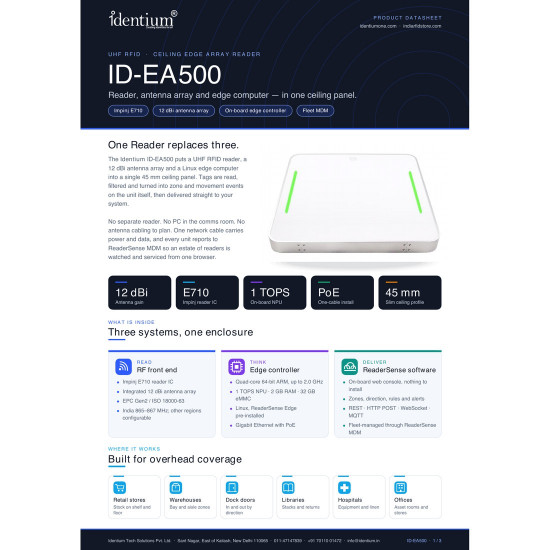

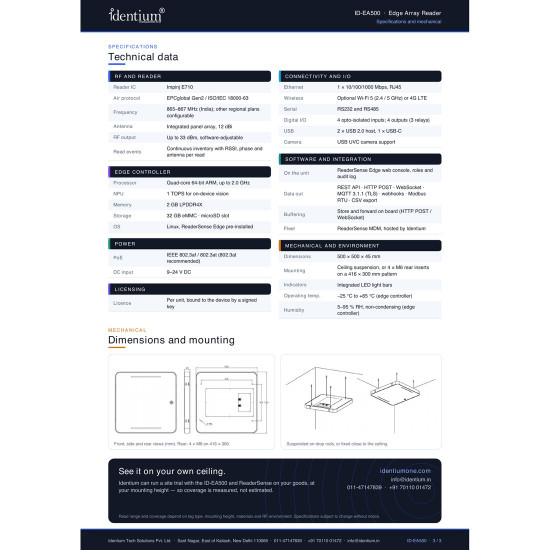
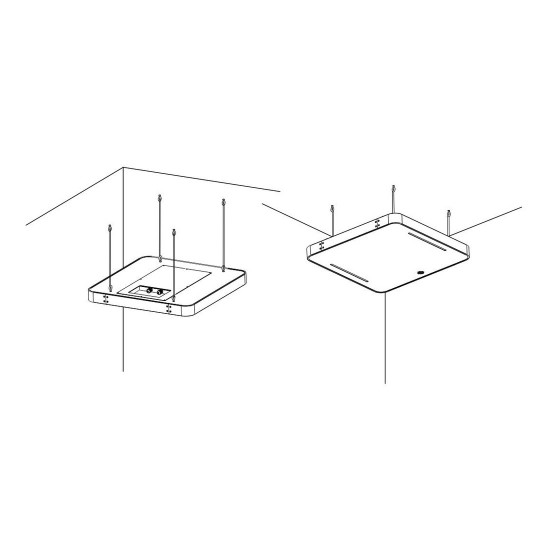


The ID-EA500 Edge Array Reader puts a UHF RFID reader, a 12 dBi antenna array and a Linux edge computer into a single 45 mm ceiling panel. Tags are read, filtered and turned into zone, direction and dwell events on the unit itself, then pushed straight into your systems. No separate reader. No PC in the comms room. No antenna cabling to plan. One network cable carries power and data, and every unit reports to ReaderSense MDM for fleet management.
Read · Think · Deliver
- Read — RF front end: Impinj E710 reader IC · integrated 12 dBi antenna array · EPC Gen2 / ISO 18000-63 · India 865–867 MHz, other regions configurable
- Think — edge controller: quad-core 64-bit ARM up to 2.0 GHz · 1 TOPS NPU · 2 GB RAM · 32 GB eMMC · Linux with ReaderSense Edge pre-installed · Gigabit Ethernet with PoE
- Deliver — ReaderSense software: on-board web console with nothing to install · zones, direction, rules and alerts · REST, HTTP POST, WebSocket and MQTT · fleet-managed through ReaderSense MDM
What ReaderSense Edge Does On The Unit
- Live inventory: every tag in view with RSSI, antenna and last-seen, updated in real time in the on-board web console
- Zone presence: tags placed in zones with hysteresis and hold-times, so items do not flicker between areas at a boundary
- Direction of travel: phase-based motion tells approaching from receding and moving from static — the basis for in / out counting at doors
- Rules and alerts: trigger relays, stack lights and webhooks on tag events, with an alert log in the console
- Store and forward: if the network drops, events queue on board (up to 200,000) and are delivered in order when the link returns (HTTP POST / WebSocket)
- Analytics and reconciliation: dwell, counts and trends, plus expected-versus-found reconciliation, with CSV export
- Industrial I/O: 4 isolated inputs, 4 outputs (3 relays) and a Modbus RTU master over RS485 for PLCs and gates
- Roles and audit: admin, operator and viewer roles with a full audit trail of every change made on the unit
Stated Plainly — What It Does And Doesn't Give You
- Yes: zone-level presence and dwell
- Yes: direction of travel from RF phase
- No: it does not give x, y coordinates across a floor. This is zone and direction, not a real-time location system
ReaderSense MDM — The Whole Estate From One Browser
- Outbound-only secure tunnel — no inbound ports to open on site
- Token enrolment: issue an enrolment token, power the unit, and it joins the fleet
- Fleet health: CPU, memory, disk, temperature, reader link and inventory, per unit
- Remote console: open any unit's own console through the tunnel
- Remote software updates: push ReaderSense updates across the fleet
Specifications
RFID
- Reader IC: Impinj E710
- Air protocol: EPCglobal Gen2 / ISO/IEC 18000-63
- Frequency: 865–867 MHz (India); other regional plans configurable
- Antenna: Integrated panel array, 12 dBi
- RF output: Up to 33 dBm, software-adjustable
- Read events: Continuous inventory with RSSI, phase and antenna per read
Edge controller
- Processor: Quad-core 64-bit ARM, up to 2.0 GHz
- NPU: 1 TOPS
- Memory: 2 GB LPDDR4X · Storage: 32 GB eMMC with microSD slot
- OS: Linux, ReaderSense Edge pre-installed
Power
- PoE: IEEE 802.3af / 802.3at (802.3at recommended)
- DC input: 9–24 V DC
- Licence: per unit, bound to the device by a signed key
Connectivity and I/O
- Ethernet: 1 × 10/100/1000 Mbps, RJ45
- Wireless: optional Wi-Fi 5 (2.4 / 5 GHz) or 4G LTE
- Serial: RS232 and RS485
- Digital I/O: 4 opto-isolated inputs; 4 outputs (3 relays)
- USB: 2 × USB 2.0 host, 1 × USB-C · USB UVC camera support
Software and integration
- On the unit: ReaderSense Edge web console, roles and audit log
- Data out: REST API · HTTP POST · WebSocket · MQTT 3.1.1 (TLS) · webhooks · Modbus RTU · CSV export
- Buffering: store and forward on board (HTTP POST / WebSocket)
- Fleet: ReaderSense MDM, hosted by Identium
- Data goes straight to your systems — no Identium account is required for the data path. ReaderSense MDM fleet management is optional and hosted by Identium; the per-unit licence key above is required either way
Mechanical and environment
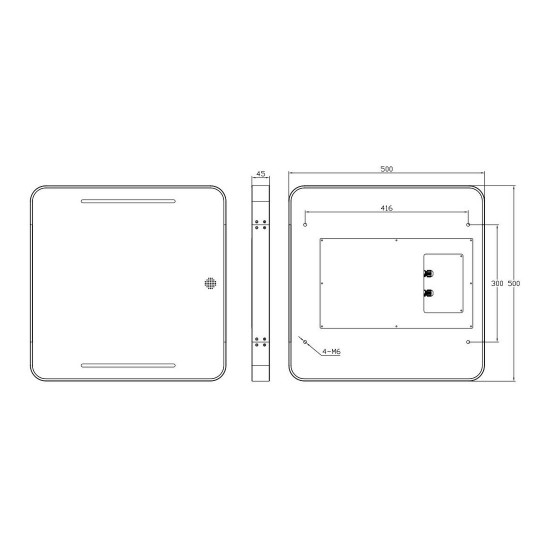
- Dimensions: 500 × 500 × 45 mm
- Mounting: ceiling suspension, or 4 × M6 rear inserts on a 416 × 300 mm pattern
- Indicators: integrated LED light bars
- Operating temperature: −25 °C to +65 °C (edge controller)
- Humidity: 5–95 % RH, non-condensing (edge controller)
Where It Goes
- Warehouses: bay and aisle zones
- Dock doors: in and out by direction
- Libraries: stacks and returns
- Hospitals: equipment and linen
- Offices: asset rooms and stores
Why A Ceiling Array Instead Of Reader Plus Antennas
- One cable: PoE carries power and data, so there is no antenna coax to route, terminate or lose budget in
- Nothing in the comms room: the reader, the antenna and the computer are the same 45 mm panel
- Events, not raw reads: zone, direction and dwell are resolved on the unit, so your systems receive decisions rather than a tag firehose
- Survives the network: up to 200,000 events queue on board and deliver in order when the link returns
- Managed as a fleet: enrolment, health, remote console and updates for every unit from one browser
Read range and coverage depend on tag type, mounting height, materials and RF environment. Identium can run a site trial with the ID-EA500 and ReaderSense on your goods, at your mounting height, so coverage is measured rather than estimated. Specifications are subject to change without notice.
- Stock: In Stock
- Model: ID-EA500
- Weight: 6.00kg
- Dimensions: 50.00cm x 50.00cm x 4.50cm
- SKU: ID-EA500

BIS Certified RFID Products

ISO Certified RFID Manufacturer

WPC Approved RFID Products

Made in India RFID Products


-250x250.png "UHF Integrated Reader IF9A")
-250x250.png "RFID Ceiling Phase Reader CP310")
-250x250.png "2 Port Integrated Reader IF9A")