RFID Laundry & Linen Management System — Complete Guide (India 2026)
Published 18 Jul 20268 min read
Every hotel, hospital and commercial laundry in India shares the same quiet problem: linen goes missing. A five-star property circulates tens of thousands of bed sheets, towels, napkins and staff uniforms; a 300-bed hospital pushes thousands of kilograms of soiled linen through the wash every week. When counting is manual, annual losses of 5–20% are common, disputes between the property and the outsourced laundry are constant, and nobody knows how many wash cycles a sheet has survived. RFID laundry management replaces the clipboard with an automatic, item-level record, and it is one of the clearest-payback uses of UHF RFID in India.
This guide explains how washable UHF laundry tags survive industrial washing, extraction and ironing, how tunnels and cabinets read hundreds of items in seconds, what a deployment workflow looks like and how to work out payback. It is written for facility managers, laundry owners, hospital administrators and procurement teams planning a first rollout.
The linen tracking problem in Indian laundries
Linen is a high-value, high-volume rotating asset. A hotel bath towel may cost ₹250–₹600, a duvet ₹1,500–₹4,000, and a surgeon's gown far more. Across a large property the linen stock can be worth several crore rupees, and every item is washed, dried, ironed and redistributed dozens of times a year. Three failures repeat across the industry:
- Shrinkage and loss. Items disappear on guest floors, in transit vans, or at a shared third-party laundry serving several clients. Without item-level tracking, the loss stays invisible until stock runs short.
- Billing disputes. Outsourced laundries bill per piece. When the property's count and the laundry's count disagree, there is no neutral record. RFID gives both sides the same automatic tally at dispatch and return.
- No lifecycle data. Hospitals in particular need to retire linen after a set number of washes for hygiene and fabric strength. Manual systems cannot tell you that a sheet has crossed 200 cycles.
Barcodes were the first attempt to fix this, but printed or sewn-in barcodes fade, need line of sight one item at a time, and rarely survive months of caustic detergent and hot ironing. UHF RFID solves all three: no line of sight, bulk reading, and tags built to outlive the linen itself.
Washable UHF laundry tags: how they survive the wash
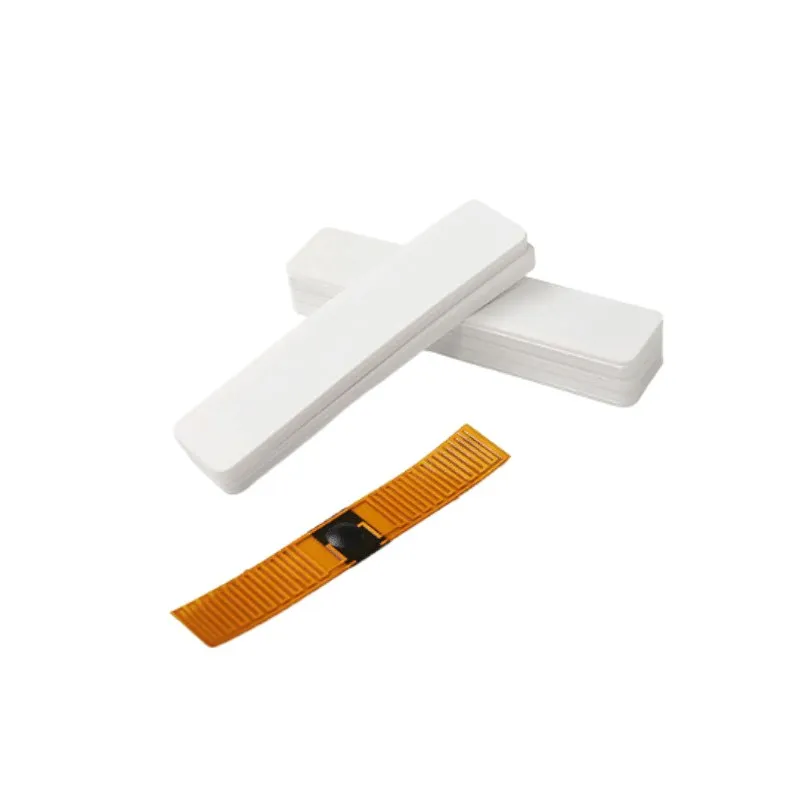
A laundry tag is not an ordinary UHF label. It is a purpose-built transponder, read in India in the 865–868 MHz UHF band, with an EPC Gen2 / ISO 18000-63 chip (commonly from the NXP UCODE or Impinj Monza families). The inlay is sealed inside a body that has to survive water, heat, tumbling, detergents and flatwork ironers. Three body styles dominate.
Silicone or rubber laundry tags (heat-sealed or sewn)
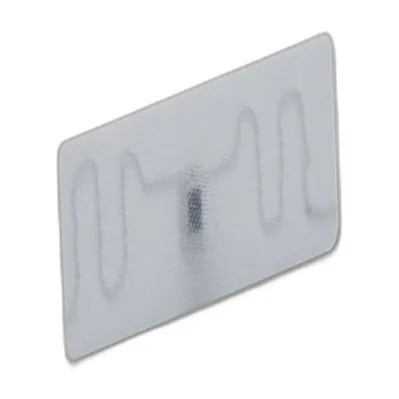
A flexible sealed patch, typically 60–90 mm long, heat-pressed or stitched into a hem. Silicone tags are the standard choice for hotel and hospital flatwork such as sheets, towels and tablecloths, because they lie flat, pass through mangle ironers and tolerate pressing temperatures of roughly 180–200 °C. They are typically rated for 200 or more wash cycles and several years of service.
Fabric or woven textile tags
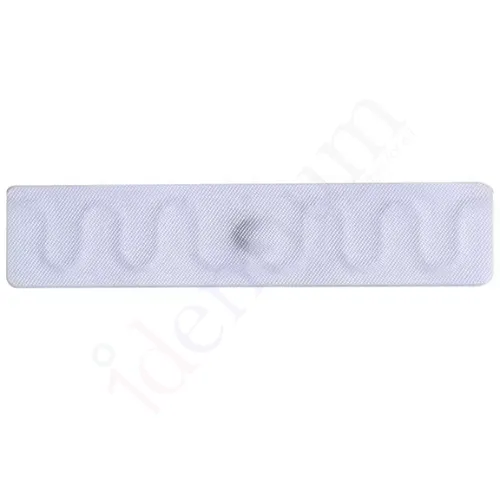
An ultra-thin, soft laminated label sewn into a garment seam. Fabric tags are the most comfortable against skin and almost invisible in uniforms, gowns and delicate items, but are usually rated for slightly gentler conditions than a thick silicone body. They suit items where wearer comfort matters: staff uniforms, patient gowns and spa robes.
Button or hard laundry tags
A rigid disc or button, often PPS or polycarbonate, sewn or riveted on. Button tags are the toughest option. They survive harsh industrial extraction and drum washing and are common on workwear, mats and heavy industrial garments. They tolerate the highest wash counts, often 300 or more, but they are visible and add a small hard point to the item.
Whatever the body, the survival mechanism is the same: the chip and antenna are sealed against water, the encapsulation absorbs mechanical shock in the tumbler, and the material keeps its shape through the ironing rollers. The full range is in washable laundry tags.
Laundry tag comparison
| Tag type | Typical size | Max ironing temperature | Wash cycles (rated) | Read range | Best for |
|---|---|---|---|---|---|
| Silicone / rubber | 60–90 mm strip | About 180–200 °C | 200+ | Up to about 4–6 m | Hotel and hospital flatwork: sheets, towels, tablecloths |
| Fabric / woven | 50–75 mm label | About 160–180 °C | About 150–200 | Up to about 3–4 m | Uniforms, gowns and robes where comfort matters |
| Button / hard | 20–30 mm disc | About 200 °C and above | 300+ | Up to about 3–5 m | Industrial workwear, mats, heavy garments |
Ranges and cycle counts vary with chip, orientation, reader power (up to 2 W e.r.p. is permitted in India) and antenna. Always validate against your own wash chemistry and equipment.
Laundry tags in our catalogue
- UHF RFID Silicone Laundry Tag SLT62 (85 × 25 mm): hotel, spa and club linen; rated for 200 washes or 3 years, whichever comes first.
- Silicone UHF RFID Laundry Tag ID-SLT-5512 (55 × 12 mm): hospital and uniform laundries; up to 200 industrial washes and autoclave compatible.
- UHF RFID Fabric Laundry Tag UFLT-7515 (75 × 15 mm): woven polyester tag rated for 200+ industrial wash cycles at 95 °C.
- Sew-in and iron-on UHF laundry tags ID-L5815 (58 × 15 mm): towels, bed linen, uniforms and workwear.
- Nylon UHF RFID Laundry Fabric Tag (60 × 15 mm): workwear and PPE; rated for 200+ industrial washes at 95 °C.
Reader tunnels, cabinets and handhelds
Tags are only half the system. The reading infrastructure decides throughput and accuracy. Indian deployments typically combine three kinds of read point.
Tunnel or conveyor readers
A shielded tunnel with several internal antennas reads a whole trolley or bag of linen in one pass, commonly 200–500 items in a few seconds, as it moves through on a conveyor or cart. Tunnels are the backbone of high-volume commercial laundries. Because the RF-shielded enclosure focuses energy and blocks stray reads from nearby stock, a well-tuned tunnel achieves near-complete bulk read rates.
Reading cabinets
A shelved RF cabinet where staff place a stack or bundle and get an instant count. Cabinets suit dispatch and receiving desks at hotels and hospitals, where linen moves in bundles rather than on a continuous conveyor. Both tunnels and cabinets are built around fixed UHF readers with 4–8 antenna ports, such as the IHZ4 4-port fixed reader (BIS-registered, with WPC ETA), driving RFID antennas mounted inside the enclosure.
Handheld readers for spot checks
An RFID handheld reader lets housekeeping or ward staff audit a linen cupboard, locate a specific tagged item or reconcile a trolley on the floor without bringing it back to a fixed read point. Handhelds are the flexible complement to fixed tunnels and are essential for cycle counts and loss investigations.
A typical RFID laundry workflow
A well-designed system records linen at every change of custody, so responsibility is always clear:
- Tagging and commissioning. Each item is tagged once, heat-sealed or sewn, and its unique EPC is linked in software to item type, owning department and purchase date.
- Soiled dispatch. Dirty linen passes through a tunnel or cabinet on the way out, and the system logs an exact outbound count per department or per client.
- Wash and process. Items go through washing, extraction, drying and ironing. The tags stay on; nothing is removed.
- Clean receiving. Processed linen is read again on return, and the clean count is reconciled against dispatch, exposing any shortfall immediately.
- Redistribution. Clean stock is issued to floors or wards and read again at the point of issue, completing the chain of custody.
- Lifecycle and retirement. Every read adds to the item's wash count. When it crosses the hygiene or wear threshold, the system flags it for retirement, which matters most in hospitals.
The result is a live, auditable ledger: how many pieces each department holds, how many are in the wash, how many are lost and how old each item is.
ROI: what RFID laundry management saves
Payback comes from four levers, and many Indian hotel and hospital deployments recover their cost within 12–24 months:
- Loss reduction. Item-level accountability typically cuts linen shrinkage from double digits to low single digits. On a linen inventory worth ₹1 crore, a 10-point improvement is ₹10 lakh a year.
- Billing accuracy. A neutral piece count ends disputes with outsourced laundries and recovers over-billing.
- Labour savings. Hand-counting trolleys stops. A tunnel read that takes seconds replaces staff-hours of counting every shift.
- Longer linen life and right-sizing. Lifecycle data lets you retire linen at the right time and buy the correct par stock instead of over-buying buffer inventory.
A practical cost model: a tag costing a few tens of rupees, spread over 200 or more washes, works out to well under ₹1 per wash per item, while loss and labour savings for a mid-to-large facility run into lakhs a year. The RFID ROI calculator gives a first estimate for your own volumes.
Choosing the right setup for your facility
Match the hardware to your operation:
- Hotels and resorts: silicone tags on flatwork plus fabric tags on uniforms and robes; a reading cabinet in the linen room and a handheld for floor audits.
- Hospitals: silicone tags with strict wash-count tracking for infection control; a cabinet or tunnel at central linen and handhelds for ward cupboard counts.
- Commercial and industrial laundries: button or silicone tags depending on how tough the garments are, and a conveyor tunnel for high-throughput sorting and per-client billing.
Start with a pilot on one high-loss linen category, confirm read rates and wash survival on your own equipment, then scale.
Buying laundry RFID in India: what to check
- Frequency: tags built for 860–960 MHz work in India, but readers must be set to the 865–868 MHz band, which is licence-exempt for RFID under G.S.R. 853(E), 2021.
- Reader documents: for hospital and government purchases, ask for the reader model's BIS registration and WPC Equipment Type Approval. Laundry tags are passive and have no BIS category.
- Wash trial: run sample tags through your own detergents, extraction pressure and ironer before a full order. You can request RFID samples for this.
- Commissioning: plan for on-site tuning of tunnels and cabinets. Antenna layout and shielding decide read rates as much as the hardware does.
India RFID Store is run by Identium Tech Solutions in New Delhi, which makes and supplies UHF laundry tags, fixed and handheld readers, and antennas. Browse washable laundry tags, UHF fixed readers and handheld readers, or request a quote with your linen volumes.
Related guides
Frequently asked questions
How many wash cycles can an RFID laundry tag survive?
Which RFID frequency is legal for laundry systems in India?
Can the tags survive the hot ironing or calender press?
How accurate is bulk reading in a tunnel?
What is the typical payback period for an Indian hotel or hospital?
Can I use a handheld reader to find a specific missing item?
RFID LaundryLinen ManagementUHF TagsWashable TagsHospital RFIDHotel RFIDIndia RFIDAsset Tracking
_2E5Nh.webp)