How Long Do RFID Tags Last? Lifespan and Data Retention
Published 25 Oct 20268 min read
Written and maintained by the RFID team at Identium Tech Solutions Pvt Ltd, New Delhi (India RFID Store).
Prices checked on 22 Oct 2026 against the catalogue.
Short answer: A passive RFID tag has no battery, so it does not run down: its life is usually set by the housing, the adhesive and the environment rather than by the chip. Chip makers rate stored data for 10 years or more and for 10,000 to 100,000 rewrites depending on the chip (10 years for Impinj M730 and M750, 20 years at up to 55 °C for NXP UCODE 9, 50 years for the chip in our silicone laundry tag), laundry tags are rated in wash cycles, and active and BLE tags last as long as their battery, which our BLE tag pages state with their test conditions; for 2.4 GHz active tags, ask us for an estimate.
"How long will these tags last?" is one of the first questions in any RFID project, and the honest answer has three parts. Every tag has a chip whose memory has a rated life, a body (label face, plastic case, fabric or silicone) that protects the chip and antenna, and, in active tags only, a battery. Whichever gives out first decides the tag's life. This guide takes the three in turn, with figures from the chip makers' data sheets and from the specification rows of the tags in our catalogue, and ends with how to write tag life into a tender.
Three lifetimes in every tag
| Lifetime | What sets it | Where to find the figure |
|---|---|---|
| Chip memory | Data retention (how long stored data is kept) and write endurance (how many times it can be rewritten) | The chip maker's data sheet |
| Housing and antenna | Adhesive, abrasion, washing, heat, chemicals, water, bending | The tag's own specification: wash cycles, temperature range, IP rating |
| Battery (active and BLE tags only) | Transmit power and how often the tag transmits | BLE tag product pages, with their test conditions; for 2.4 GHz active tags, ask us |
For a passive tag the first two apply. For an active or BLE tag the battery usually comes first.
Lifetime 1: the chip's data retention and write endurance
Two figures describe a chip's memory. Data retention is the minimum time the maker guarantees that data written to the chip stays readable, at a stated temperature. Write endurance is the minimum number of times the memory can be rewritten. Neither is an expiry date. They are guarantees, and reading a tag uses up neither of them: only writing counts against endurance.
| Chip | Used in | Write endurance | Data retention |
|---|---|---|---|
| Impinj M730 | UHF labels and tags | 10,000 cycles | 10 years |
| Impinj M750 | UHF labels and tags | 10,000 cycles | 10 years |
| Impinj M770, M775, M780, M781 | UHF labels and tags | 100,000 cycles | 20 years |
| NXP UCODE 8 and 8m | UHF labels and tags | 100,000 cycles (minimum) | 20 years at up to 55 °C |
| NXP UCODE 9 | UHF labels and tags | 100,000 cycles (minimum) | 20 years at up to 55 °C; 10 years at up to 85 °C; 1 year at up to 125 °C |
| NXP NTAG213, 215, 216 | NFC stickers, cards and keyfobs (13.56 MHz) | 100,000 cycles at 22 °C | 10 years at 22 °C |
Three lessons follow from the table.
- Chips differ, even from one maker. Within Impinj's M700 series, the M730 and M750 are rated for 10,000 writes and 10 years, the M770 to M781 for 100,000 writes and 20 years. A label described only as "Impinj" or "NXP" does not tell you which; ask for the exact chip. Our Impinj vs NXP chip comparison covers the rest of their specifications.
- Heat shortens retention. The UCODE 9 data sheet gives 20 years at up to 55 °C, 10 years at up to 85 °C and 1 year at up to 125 °C. A tag that lives somewhere hot, on an engine, a kiln trolley or a sterilised tray, needs a chip and a housing rated for that temperature, not a figure quoted at room temperature.
- Endurance matters only if you rewrite. A retail label written once uses one cycle. A returnable crate re-encoded on every trip uses one a trip: even at 10,000 cycles, rewriting a tag every day would take more than 27 years to reach the rating.
Finished tags also carry ratings of their own, which can be more conservative than the chip's. Our UFLT-5610 laundry tag, for example, uses a UCODE 8 chip, and its specification lists "100,000 writes; 10-year data retention" for the tag. Plan to the finished tag's figure.
Lifetime 2: the housing, which is what usually fails
A passive tag stops working when its antenna, the bond between chip and antenna, or the thing holding it in place fails. The common causes:
- Adhesive. A label is made to stay where it was first applied. Heat, cold, dust and oily or textured surfaces shorten its hold, and a label peeled off and stuck elsewhere is rarely reliable.
- Abrasion and impact. Labels on cartons and crates scuff at the corners; hard ABS, PC or PCB tags exist for the places where labels wear away.
- Water, chemicals and washing. An IP rating and a wash rating tell you what the tag was built for. A tag not built for washing will not survive the laundry.
- Heat beyond the rating. The housing has an operating temperature range just as the chip has a retention temperature.
- Bending. Cards and flexible tags crack where the chip sits if they are folded or flexed often.
A tag that is mounted on metal or behind liquid and does not read has not worn out: it is detuned. Our troubleshooting guide explains how to tell the difference.
Lifespan by form factor, from our product specifications
These rows are copied from the specifications on each product page; they show what each tag is rated for and how it is priced.
| Tag | What its specification says about life | List price |
|---|---|---|
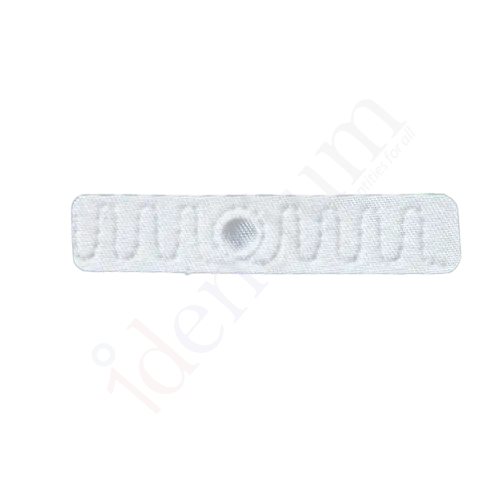
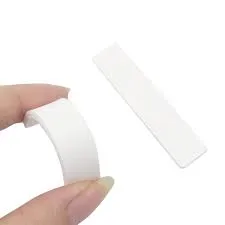
| UFLT-5610 fabric laundry tag, sewn on | More than 200 wash cycles; 200 °C ironing for 10 seconds; −25 °C to +70 °C operating; IP68; 100,000 writes and 10-year data retention | ₹32 + GST |
| Silicone laundry tag | 200 washes or 3 years, whichever is earlier; the chip itself is rated for 50 years of data retention and 100,000 write cycles | ₹35 + GST |
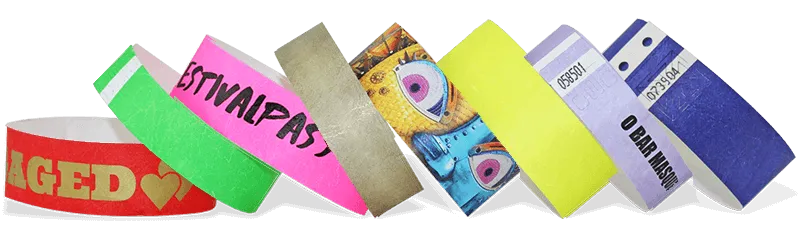
| Tyvek / paper wristband | Disposable, with a single-piece closure: made for one event | ₹22 + GST |
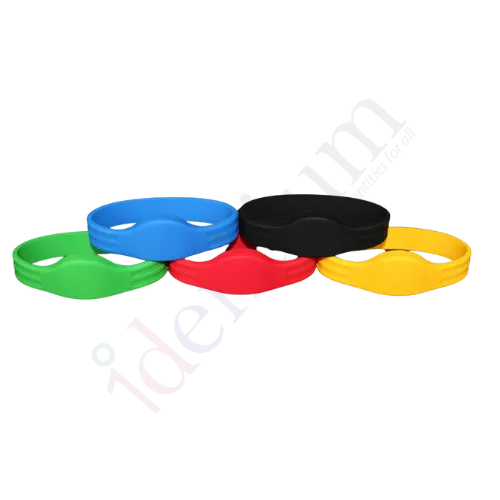
| C03 UHF silicone wristband | Medical-grade silicone, IP68, adjustable snap-fit closure: a reusable band | ₹65 + GST |
| 13.56 MHz HF card, plain PVC | No battery; life is set by the PVC body and the chip's rating | ₹10 + GST |
| IDTS-7545 on-metal asset tag, screwed on | ABS housing, 75 × 45 × 6 mm; −20 °C to +80 °C operating | ₹89 + GST |
| UHF crate tag | ABS/PC, IP68, −25 °C to +85 °C operating; 100,000 write cycles | ₹30 + GST |
The silicone laundry tag shows the whole point of this guide in one row: a chip rated for 50 years inside a housing rated for 200 washes or 3 years. The housing decides. For wristbands, the material decides the use: Tyvek for a single event, silicone for a season pass or a locker band. Cards follow the same logic: the chip outlasts the plastic, so keep cards in a holder if they are tapped many times a day.
Active and BLE tags: battery life
An active tag carries a battery and transmits on its own, which buys range at the cost of a finite life. Every battery figure on our product pages is stated with its conditions, because the life changes with how often the tag transmits and at what power:
- BLE asset tag ID-BLE-T01 on a CR2032 cell: up to 3 years at 0 dBm, transmitting every 10 seconds (₹1,250 + GST).
- Round IP68 BLE beacon ID-BLE-T03: 2.5 years at 0 dBm, transmitting every 500 ms, at 25 °C.
- Large BLE asset tag ID-BLE-X62 with a 2,700 mAh battery: 5 years at 0 dBm, transmitting every 10 seconds.
- AT508 2.4 GHz active tag: an ultra-low-power design with an average working current below 10 µA; its life depends on how often it transmits and the settings you use, so ask for an estimate for your configuration (₹1,177 + GST, minimum order 100 pcs).
Two rules of thumb follow from those rows: a tag set to transmit more often lasts less long, and a bigger battery lasts longer at the same settings. When you compare quotations, compare battery life at the same transmit power and interval. The full range is under BLE beacons and asset tags and active RFID tags and readers; passive vs active RFID explains when a battery is worth it.
How to specify tag life in a tender or purchase order
- Describe the environment. Temperature range, washing (cycles, temperature, ironing or tunnel pressing), chemicals, outdoor exposure, and the surface the tag goes on.
- State how often tags will be rewritten, so the chip's write endurance can be checked against it.
- Ask for the chip by name and its data sheet, and read the data retention and write endurance at your temperature, not only at room temperature.
- Ask for the finished tag's ratings: wash cycles, IP rating, operating temperature, and for active tags the battery life with its transmit power and interval.
- Test with your own items and process. A short pilot, with tags read after real washes, real handling or real heat, is worth more than any table.
- Read the warranty for what it covers. Ours is the warranty against manufacturing defects described on our terms page; wear from use beyond a tag's rating is a matter of choosing the right tag, which is what the steps above are for.
Related guides
Sources
- Impinj: M700 series spec table (write cycles and data retention for M730, M750, M770, M775, M780, M781), accessed 25 October 2026
- NXP: UCODE 9 (SL3S1206) product data sheet, Rev. 3.5, 12 February 2025 (Table 12, memory characteristics), accessed 25 October 2026
- NXP: UCODE 8/8m (SL3S1205_15) product data sheet, Rev. 3.6, 2 December 2021 (Table 16, memory characteristics), accessed 25 October 2026
- NXP: NTAG213/215/216 product data sheet, Rev. 3.2, 2 June 2015 (retention time and write endurance at 22 °C), accessed 25 October 2026
Cite as: India RFID Store (Identium Tech Solutions Pvt Ltd), “How Long Do RFID Tags Last? Lifespan and Data Retention”, https://www.indiarfidstore.com/rfid-resources/how-long-do-rfid-tags-last-lifespan-india, published 25 Oct 2026.
Frequently asked questions
How long do passive RFID tags last?
Do RFID tags expire?
How long does an RFID card last?
How many washes does an RFID laundry tag survive?
How long does the battery in an active RFID or BLE tag last?
Does reading an RFID tag wear it out?
RFID TagsTag LifespanData RetentionLaundry TagsActive RFID
Keep reading
More guides

More in Tags, labels & cards
- RFID Sensor Tags in 2026: Temperature, Humidity and Strain, What Is Real and What You Can Buy in India
- RFID Tyre Tags in India: ISO 20909 Embedded vs Patch vs Sticker, and What Tyre Makers, Retreaders and Fleets Should Specify
- RFID Cards & Fobs for eSSL, ZKTeco & Door Readers: Printing & Compatibility
- RFID Tags for Liquids: Where to Place Tags on Bottles, Cosmetics, Cans and Foil Packs (India Guide)
- NXP UCODE X vs Impinj M800: The 2026 UHF RFID Chip Guide for Indian Buyers