UHF Tag Memory: EPC, TID, User Memory, Lock & Reuse
Published 25 Oct 20268 min read
Written and maintained by the RFID team at Identium Tech Solutions Pvt Ltd, New Delhi (India RFID Store).
Short answer: Yes, a UHF EPC Gen2 tag can be rewritten: the EPC bank is writable until someone locks it, the TID is a serial number the chip maker writes and locks at the factory, and user memory, on chips that have it, holds your own data. Whether a tag can be reused depends less on the chip, which is rated for 10,000 to 100,000 writes, than on its housing and adhesive and on whether a previous user locked or killed it.
A passive UHF tag looks like a sticker or a piece of plastic, but inside it is a small, structured memory. Knowing how that memory is laid out answers most of the questions buyers ask before encoding: which number the reader sees, which number can be trusted, whether a tag can be reused, and what "lock" and "kill" actually do. This guide explains it in plain words, with the memory sizes from the chip makers' data sheets and the rules from the GS1 EPC Tag Data Standard, listed at the end.
The four memory banks of a Gen2 tag
Every tag built to the EPC Gen2 standard (ISO/IEC 18000-63) organises its memory in four banks. Readers address each bank by number.
| Bank | Name | What it holds | Can you change it? |
|---|---|---|---|
| 00 | Reserved | The 32-bit kill password, needed to kill the tag, and on most chips the 32-bit access password, needed for privileged operations | Yes, until locked |
| 01 | EPC | A checksum, a protocol-control word and the EPC itself: the number readers return in every inventory | Yes, until it is locked or permalocked |
| 10 | TID | The chip's identity: its class, mask designer (maker) and model, and on current chips a unique serial number | No: written and locked at the factory |
| 11 | User | Optional extra memory for your own data | Yes, until locked; many chips have none |
The GS1 EPC Tag Data Standard describes the same layout and calls the TID bank "information about the tag itself, as opposed to the physical object to which the tag is affixed". Locking a bank stops it from being rewritten; it does not hide the EPC, which readers still see in every inventory.
Memory by chip, from the data sheets
| Chip | EPC | User memory | TID | Passwords | Writes / retention |
|---|---|---|---|---|---|
| Impinj M730 | 128 bits | 0 | Factory-locked | Access and kill: "shared" | 10,000 / 10 years |
| Impinj M750 | 96 bits | 32 bits | Factory-locked | Access and kill: "shared" | 10,000 / 10 years |
| Impinj M770, M775 | 128 bits | 32 bits | Factory-locked | Access and kill: "shared" | 100,000 / 20 years |
| Impinj M780 | 496 bits | 128 bits | Factory-locked | Access and kill: "shared" | 100,000 / 20 years |
| Impinj M781 | 128 bits | 512 bits | Factory-locked | Access and kill: "shared" | 100,000 / 20 years |
| NXP UCODE 8 | Up to 128 bits | 0 | 96 bits, incl. 48-bit serial | 32-bit access, 32-bit kill | 100,000 min / 20 years at up to 55 °C |
| NXP UCODE 8m | 96 bits | 32 bits | 96 bits, incl. 48-bit serial | 32-bit access, 32-bit kill | 100,000 min / 20 years at up to 55 °C |
| NXP UCODE 9 | 96 bits | 0 | 96 bits, incl. 48-bit serial | 32-bit kill; access password fixed at zero | 100,000 min / 20 years at up to 55 °C |
Two details are easy to miss. Impinj's spec table lists the access and kill password as "shared" on every M700 chip, so check the chip data sheet before you plan different access and kill passwords. And the UCODE 9 data sheet lists its access password as hardwired to zero, so that chip cannot hold a password of your own: on a UCODE 9, protecting the EPC from rewriting means locking it permanently. The life figures in the last column are explained in our guide how long RFID tags last.
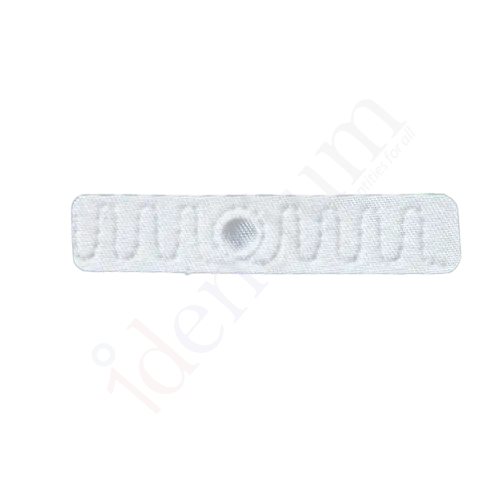
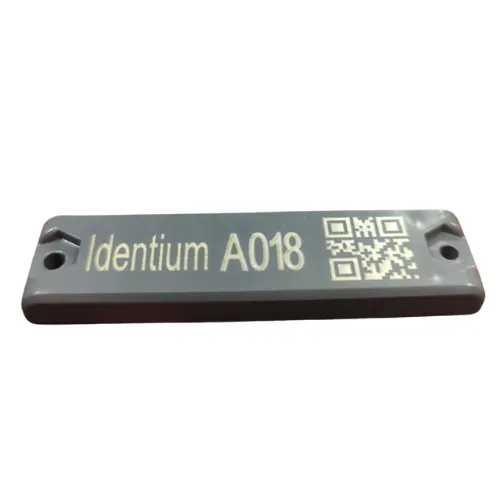
Our product pages state the memory of each tag. A few examples: the UFLT-5610 laundry tag has a 128-bit rewritable EPC, a 96-bit read-only TID, 32-bit access and kill passwords and no user memory; the UHF crate tag has an EPC of up to 496 bits and 512 bits of user memory; the IDTS-7545 on-metal tag has a 128-bit EPC and a 96-bit TID.
EPC vs TID: which number to use
The EPC is your number. You choose what goes in it: an item or asset number in a closed system, or a GS1 identity such as an SGTIN when tagged goods leave your hands (our SGTIN-96 encoding guide covers retail numbering). Readers return the EPC every time they see the tag, so it is the number your software works with.
The TID is the chip's number. The GS1 EPC Tag Data Standard, Release 2.3 (October 2025), sets out what it holds. Its first 32 bits carry the class identifier E2h, a 9-bit mask-designer identifier (MDID, the chip maker) and a 12-bit tag model number, and they must be permalocked at manufacture. An extended TID (XTID) can follow, with a serial number and a description of the chip's optional features, and it too is permalocked at manufacture. The standard adds that, as of Gen2v3, tags with class E2h shall support a serialised TID with a unique serial number. The UCODE 8 and UCODE 9 data sheets show this in practice: a 96-bit, factory-locked TID with a 48-bit unique serial number.
Use them together. Because the TID is written and locked at the factory, recording it next to the EPC when you encode lets your software spot a tag whose EPC matches your records but whose TID does not, and tell a dead tag from one that was badly encoded. For cloning and protection, see our RFID data security guide.
Write, lock, permalock and kill, in plain words
- Write. A reader sends new data to the EPC or user bank. Each write uses one of the chip's rated write cycles; reading uses none.
- Access password. A 32-bit password in the reserved bank. The default is zero. Once a non-zero password is written, a reader has to present it before it can change locked memory.
- Lock. Makes a bank writable only by a reader that presents the access password. It can be undone by whoever holds that password.
- Permalock. Makes the lock state permanent. A permalocked EPC can never be changed again, by anyone, including us, so permalock only data that is final.
- Kill. A reader that presents the tag's kill password can kill it, and a killed tag never responds again. The kill password defaults to zero, and a tag whose kill password is zero cannot be killed this way, so one has to be written first. The UCODE 9 data sheet describes its 32-bit kill password as there "to permanently disable the tag".
Can you reuse a UHF tag? Three real cases
Reuse is mostly about the housing, because the chips in this table allow at least 10,000 writes. Three cases where reuse works well:
- Returnable crates, kegs and bins. A hard tag such as our UHF crate tag (ABS/PC, IP68, 100,000 write cycles; ₹30 + GST) stays on the crate for its life. Most systems keep its EPC fixed as the crate number and record each trip in software; re-encoding is there if a crate changes owner or pool. See proving reuse targets on returnable packaging.
- Jewellery trays and hard tags. Jewellery tags are re-encoded as stock changes; our JT3515 jewellery hard tag lists 100,000 write cycles and 20 years of data retention. See the jewellery inventory guide.
- Event wristbands. A reusable C03 silicone wristband (₹65 + GST) can be re-issued for the next event, either re-encoded or re-mapped to a new attendee in the event system; a Tyvek band (₹22 + GST) is made for one event. See RFID for events.
Four things stop reuse: an adhesive label that has already been stuck down, an EPC that a previous user permalocked, a tag that was killed, and an antenna damaged by use. A tag bought from another supplier may also arrive locked with a password you do not have; ask before you buy second-hand stock.
How to put your own number on a tag
- At one PC: the UHF desktop reader 103 is a USB reader-writer that needs no driver or separate power supply, with a reading radius adjustable up to 30 cm and multi-tag reading and writing: ₹15,000 + GST.
- Batches from Excel: the 120L desktop reader comes with free utility software that imports data from an Excel sheet and writes it into tags in sequence: ₹28,000 + GST.
- Print and encode labels: the IT4RL desktop RFID printer and encoder prints a label and writes its chip in one pass, and its free Labelsoft software can print the tag's EPC or TID on the label for cross-checking: ₹1,35,000 + GST.
- Check in the field: the CX1500N handheld comes with CX Flow Pro on every unit, and CX Flow Pro is provided free with the CX1000. It covers inventory, finding an item, and importing a list to tally what is present and what is missing, which is how you confirm that a batch was encoded as planned.
Whichever you use, encode in a fixed order: write the EPC, read it back, record the EPC and TID together, and lock only once the batch checks out.
Related guides
Sources
- GS1: EPC Tag Data Standard (TDS), Release 2.3, ratified October 2025, section 16 (TID memory bank, XTID, serialised TID as of Gen2v3), accessed 25 October 2026
- Impinj: M700 series spec table (EPC and user memory, access/kill password, write cycles and data retention), accessed 25 October 2026
- NXP: UCODE 9 (SL3S1206) product data sheet, Rev. 3.5, 12 February 2025 (memory sections and map), accessed 25 October 2026
- NXP: UCODE 8/8m (SL3S1205_15) product data sheet, Rev. 3.6, 2 December 2021 (memory sections), accessed 25 October 2026
Cite as: India RFID Store (Identium Tech Solutions Pvt Ltd), “UHF Tag Memory: EPC, TID, User Memory, Lock & Reuse”, https://www.indiarfidstore.com/rfid-resources/uhf-rfid-tag-memory-epc-tid-user-memory-reuse-india, published 25 Oct 2026.
Frequently asked questions
What is the difference between EPC and TID?
Can RFID tags be reused or rewritten?
How many times can a UHF RFID tag be rewritten?
What is user memory on an RFID tag used for?
What happens when an RFID tag is locked or killed?
How do I write my own number onto a UHF RFID tag?
UHF RFIDEPCTIDTag EncodingEPC Gen2
Keep reading
More guides
 How Long Do RFID Tags Last? Lifespan and Data Retention8 min read
 RFID Tag for Solar Modules in India: MNRE Field List, ALMM List-II Cells and the 2027 Cut-off10 min read
 RFID Inventory Management for Indian Retail in 2026: How to Hit 99% Stock Accuracy, Cut Shrinkage, and Stay ONDC & GST-Ready10 min read
More in Technology explained
- RFID vs BLE vs UWB vs GPS: Which Tracking Tech to Use
- 10 Things People Get Wrong About RFID in India
- NFC Tag Detected on Your Phone: Meaning & How to Use It
- Is RFID Blocking Necessary? An RFID Maker's Honest Guide to E-Passports, Contactless Cards and Wallets in India
- Why Your Zudio, Westside or Decathlon Clothes Carry an RFID Tag, and What Garment Vendors Supply