Is RFID Blocking Necessary? An RFID Maker's Honest Guide to E-Passports, Contactless Cards and Wallets in India
Published 22 Oct 20269 min read
Short answer: For most people in India, an RFID-blocking wallet is a nice-to-have, not a necessity. The chip in an Indian e-passport holds digitally signed data protected by Public Key Infrastructure, and reading it needs a key printed inside the passport. Contactless card payments without a PIN are capped by the RBI at Rs 5,000 per transaction, and your bank lets you switch contactless off or set a limit.
A blocking sleeve does no harm and closes the gap that remains, so if it gives you peace of mind, use one. The bigger wins are the controls your bank and the passport already give you, and, for organisations, issuing ID cards that cannot be copied easily.
RFID-blocking wallets, passport holders and cards are sold on fear: a stranger with a hidden reader brushes past you and empties your account or copies your passport. We make RFID cards, tags and readers, so we know what a reader can and cannot do. This guide looks at the three things people usually want to protect, what each one exposes, what already protects it, and when a blocking product actually adds something.
What RFID blocking actually blocks
Passports, bank cards, metro cards and most office ID cards use 13.56 MHz high-frequency RFID. The card has no battery: a reader's magnetic field powers it from a few centimetres away, and the card answers. An RFID-blocking sleeve or wallet puts a continuous metal layer, usually aluminium, around the card. While the card is fully inside, the field cannot reach it, so the chip never wakes up.
Researchers from Radboud University Nijmegen and Lausitz University of Applied Sciences made the same point about passports: aluminium foil in the cover prevents access to the chip when the passport is closed, which is why some countries build shielding into the cover. The limits follow from the same physics. A sleeve protects only what is fully inside it; a card half out of the pocket is unprotected; and a product designed and tested for 13.56 MHz cards tells you nothing about other frequencies. Check which frequency a product claims to block, and test it yourself (below).
Your e-passport: what the chip holds and who can read it
Passport Seva's own FAQ describes the Indian ePassport as a combined paper and electronic passport with an RFID chip and an antenna embedded as an inlay, holding the holder's personal particulars and biometric information. It is marked by a small gold symbol printed below the front cover. The data is printed in the booklet and also digitally signed in the chip, so immigration officials anywhere can check that it has not been altered; the FAQ names Public Key Infrastructure as the technology behind that check.
Existing passports stay valid until they expire, and the FAQ says passport offices switch to ePassports as each one is technically enabled. Indian missions abroad are switching too: Gulf News reported that applications at the Embassy in Abu Dhabi and the Consulate in Dubai have been processed as ePassports since 28 October 2025.
So can someone read yours in a crowd? The Radboud paper, written when European countries were rolling out their first e-passports, sets out the realistic picture:
- Range. Passport chips use ISO 14443, the proximity-card standard, designed for 1–10 cm. Typical commercial readers work at 1–2 cm. Researchers have woken a chip at about 25–27 cm with purpose-built antennas and amplifiers.
- Access control. Under Basic Access Control, the reader must first know a key derived from the machine-readable zone printed inside the passport, so the chip's data is not handed to a reader that has not seen the open page, and the conversation is encrypted.
- Known weaknesses. The paper notes that in some early passports the printed key had too little randomness and could be guessed by brute force, and that a reader can detect that a passport is present, and even its country, from how the chip responds before access control starts. Eavesdropping on a legitimate reading, for example at a border desk, has been demonstrated from several metres, but that happens while the passport is open and being read.
The paper also describes relay attacks, in which the conversation with a card or passport is passed live to a reader somewhere else. A relay still has to power the chip from close by, so this is the one scenario where a closed, shielded cover or sleeve is a direct defence rather than an extra layer.
Our reading: the data on the chip is well protected and digitally signed, so copying it would not produce a passport that passes a border check. The realistic residual risk is someone detecting that you carry a passport. A metal-lined passport cover removes that while the passport is closed. It is cheap insurance for frequent travellers, not a necessity.
Contactless debit and credit cards
Here the RBI has already done much of the work. Its circular of 4 December 2020 raised the limit for contactless card payments without an additional factor of authentication (such as a PIN) from Rs 2,000 to Rs 5,000 per transaction, from 1 January 2021, and kept the cardholder's choice of using contactless or contact mode. The same circular refers to the RBI's January 2020 instructions, under which cardholders can switch card features on or off and set limits, including for contactless transactions.
The RBI's FAQ on card transactions repeats the Rs 5,000 per-transaction ceiling for contactless payments at shops (not ATMs), and advises registering for SMS or e-mail alerts. It attaches one condition to the no-PIN allowance: the transaction must follow the EMV standards, the international chip-card standards that bank cards and payment terminals use. Above Rs 5,000, or at an ATM, the PIN or another factor is still required.
What that means in practice:
- A tap still needs a reader within a few centimetres of your card.
- Without your PIN or another factor, the most a single contactless payment can be is Rs 5,000.
- You can switch contactless off, or set a lower limit, in your banking app if you never tap.
- Alerts tell you about every transaction, so anything unexpected shows up at once.
A blocking sleeve adds a layer on top of those controls. Switching contactless off, if you never use it, does the same job for free.
Office ID cards, hostel cards and hotel keys
This is where an RFID maker's view differs most from the wallet adverts. The cards that are easiest to copy are not bank cards, which use payment-grade cryptography, but older access-control cards: 125 kHz proximity cards and some early 13.56 MHz cards carry little or no protection. Someone with brief, close access to such a card can read its number and, with the right tools, write it to another card. Our guide to RFID data security, cloning and encryption explains how that works and what stops it.
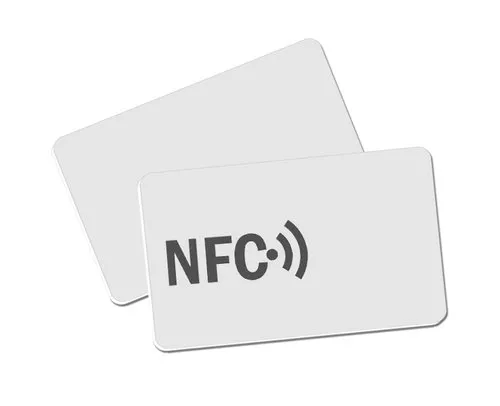
For an employee, a sleeve for the office card is sensible if the site still uses old cards. For the organisation, the real fix is the card itself: issue cards whose chips use encryption and mutual authentication. Our 13.56 MHz NFC card (₹20 + GST, minimum order 500 pcs) is available with MIFARE DESFire EV1 or EV2 chips as well as NTAG, MIFARE Classic and ICODE SLIX, so the security level is chosen at the order, and the HF cards range covers printed and plain options. The reader has to support the chip you choose; our RFID card buyer's guide covers matching cards to readers.
FASTag and other long-range tags: do not block them
A FASTag is a UHF tag on your windscreen, built to be read from metres away at toll plazas and parking lanes. It is not something to keep in a wallet, and shielding it would only stop legitimate reads. The same goes for the UHF tags on clothes and parcels: they carry product codes, not personal data, as our guide to RFID tags in clothes explains.
What protects you more than a sleeve
If you do one thing after reading this, make it one of these rather than buying a wallet:
- Turn on transaction alerts for every card, as the RBI advises, so that any payment you did not make is visible at once.
- Set your contactless limit, or switch contactless off, in your bank's app if you never tap to pay. The RBI's 2020 instructions give you that control for each card.
- Keep the passport closed when you are not using it. The chip's data cannot be read without the key printed inside, and a closed passport in a metal-lined cover cannot even be detected.
- Ask what your office card is. If your employer still issues old proximity cards, a sleeve helps you, but the lasting fix is for the organisation to move to encrypted cards.
- Report a lost card at once. Blocking a lost card through your bank or employer does far more than any sleeve, because it stops the card working for everyone.
Blocking products are not useless; they are simply the last layer, not the first. If you already have a blocking wallet, keep using it, and test it as described below.
Do you need RFID blocking? A quick decision table
| What you carry | What a stranger's reader could get | What already protects it | Is blocking worth it? |
|---|---|---|---|
| Indian e-passport | The fact that a passport is present; data only with the printed key | ISO 14443 short range, access control keyed to the printed page, digitally signed data | Optional; a metal-lined cover stops all reads while closed |
| Contactless debit or credit card | A tap payment, from a few centimetres | Rs 5,000 per-transaction cap without PIN, alerts, on/off and limit controls | Optional; use your bank's controls first |
| Old 125 kHz or early HF office card | The card number, enough to copy some cards | Little, depending on the card | Useful for the holder; the organisation should upgrade the cards |
| Metro or campus card with stored value | Depends on the issuer's system | The issuer's security | Low priority |
| FASTag | Its tag ID, by design | Not applicable | No; it must be readable |
If you buy a blocking product, test it
- Check the claim: a product designed for 13.56 MHz cards and passports should say so. Treat vague claims about "all frequencies" with care unless you can test them.
- Test with your own phone: turn on NFC, put a contactless card fully inside the sleeve or wallet, and hold it to the back of the phone. If the phone no longer detects the card, the shield works for that card.
- Test at the edges: slide the card part-way out and try again; you will see how much of the card has to be covered.
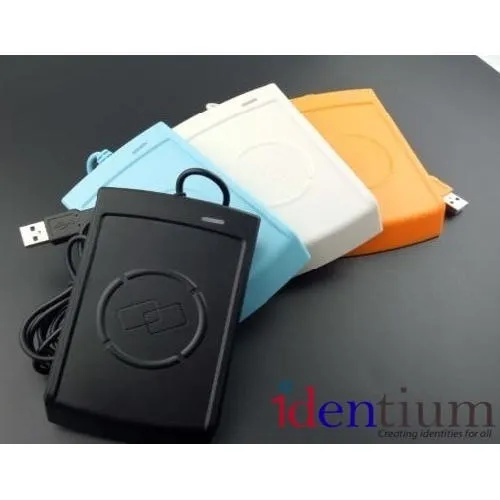
- For an office: a USB desktop reader such as the HRD20 HF reader (₹2,000 + GST), listed at a read range of 5–10 cm, lets you check cards and sleeves in bulk and enrol cards into your access system.
Sources
All fetched on 22 October 2026.
- Passport Seva, Ministry of External Affairs: ePassport FAQ
- Gulf News, updated 31 October 2025: Indian ePassport with new design, what Indian expats in the UAE need to know
- Reserve Bank of India, circular RBI/2020-21/71, 4 December 2020: Card transactions in contactless mode, relaxation in requirement of additional factor of authentication
- Reserve Bank of India: FAQs on card transactions
- Richter H, Mostowski W, Poll E (Lausitz University of Applied Sciences; Radboud University Nijmegen): Fingerprinting Passports (PDF)
Frequently asked questions
Is RFID blocking necessary in India?
Can someone read my e-passport from a distance?
Can someone take money by tapping my contactless card?
Does an RFID-blocking card or sleeve actually work?
Should I put my FASTag in a blocking sleeve?
Which RFID cards are easiest to clone?
RFID SecurityE-PassportContactless CardsNFCConsumer Guide
Keep reading
More guides
More in Technology explained
- How Far Will My UHF RFID Tag Read? Link Budget Explained for India
- Will RFID Tags Made in India Work in Europe, the UK, the Gulf or Africa? The ETSI 865-868 MHz Compatibility Guide
- GS1 and EPC Encoding for Indian Retail Suppliers: SGTIN-96 Explained