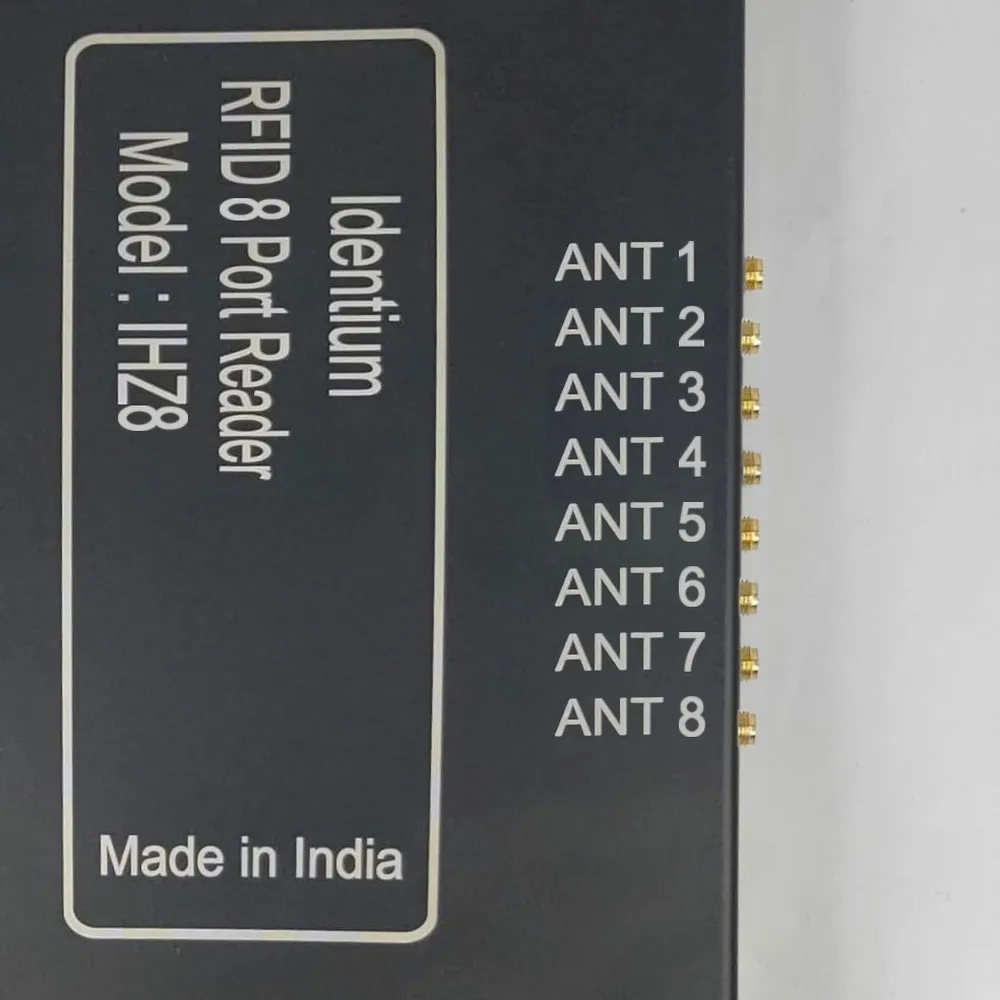
UHF RFID 8-Port Fixed Reader IDTS-IHZ8 (Impinj E710)
An eight-port fixed UHF RFID reader on the Impinj E710, reading up to 1,000 tags a second at up to 30 m, with Ethernet, serial, Wiegand and relay I/O for attendance, access, library and toll systems.
Price on request
Minimum order: 1 piece · the final price for your quantity is confirmed in the quote
View datasheet PDF · 228 KB- 7-day replacement · 1-year warranty against manufacturing defects
- Blue Dart next-day delivery
Key features
- Impinj E710 platform with dual power-amplifier circuit
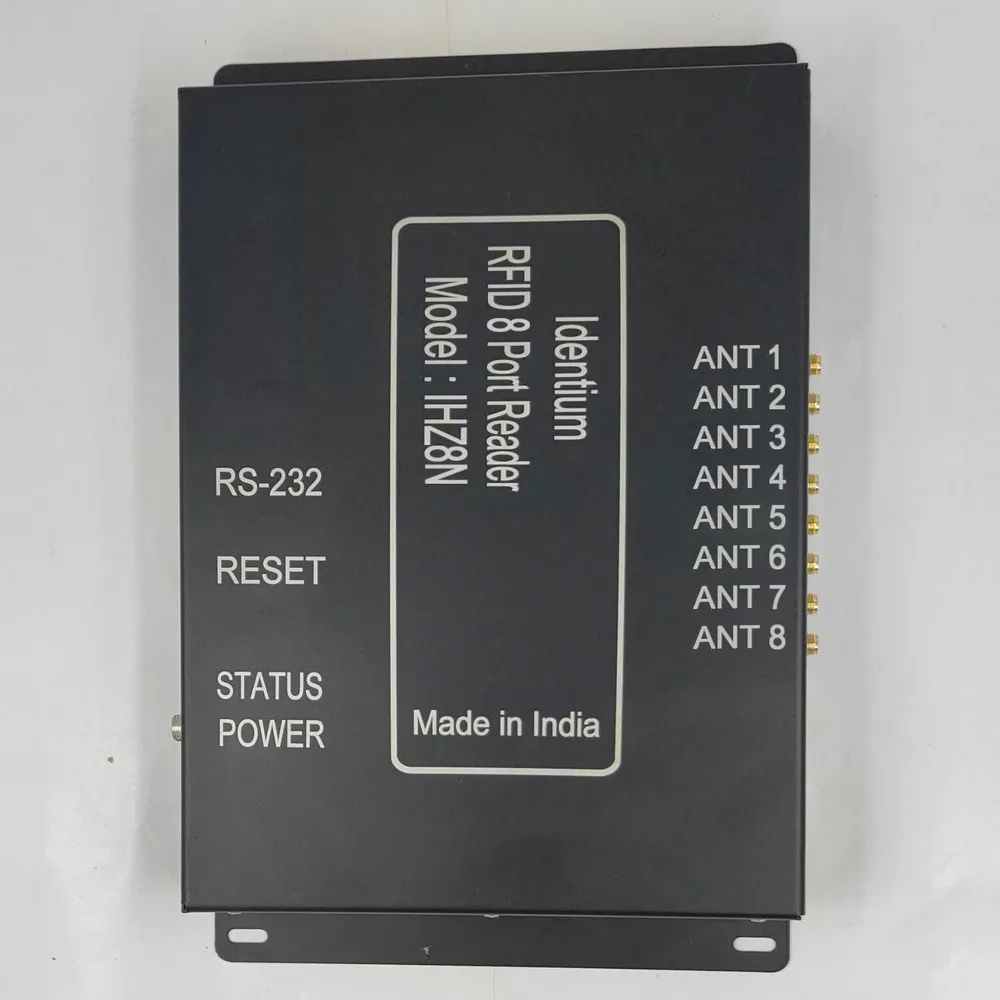
- 8 × SMA antenna ports; reads up to 30 m, writes up to 8 m (site dependent)
- Up to 1,000 tags per second with multi-tag anti-collision
- RJ45, RS-232, RS-485, Wiegand and USB 2.0; 3 inputs and 3 relay outputs
- Java,.NET and C++ APIs plus a direct post API
- Aluminium, anti-shock housing, 170 × 120 × 25 mm
- Chip
- Impinj E710, dual power-amplifier circuit
- Protocol
- ISO/IEC 18000-6C (EPC C1 Gen2), ISO/IEC 18000-6B, Impinj Gen2X
- Frequency
- 865–868 MHz (India, ETSI EN 302 208); 902–928 MHz (FCC Part 15) version
- Frequency stability
- ≤ ±10 ppm
Overview
IDTS-IHZ8 8-port UHF RFID reader for fixed read points
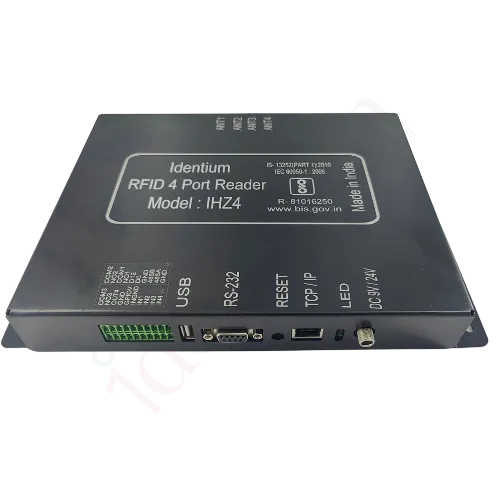
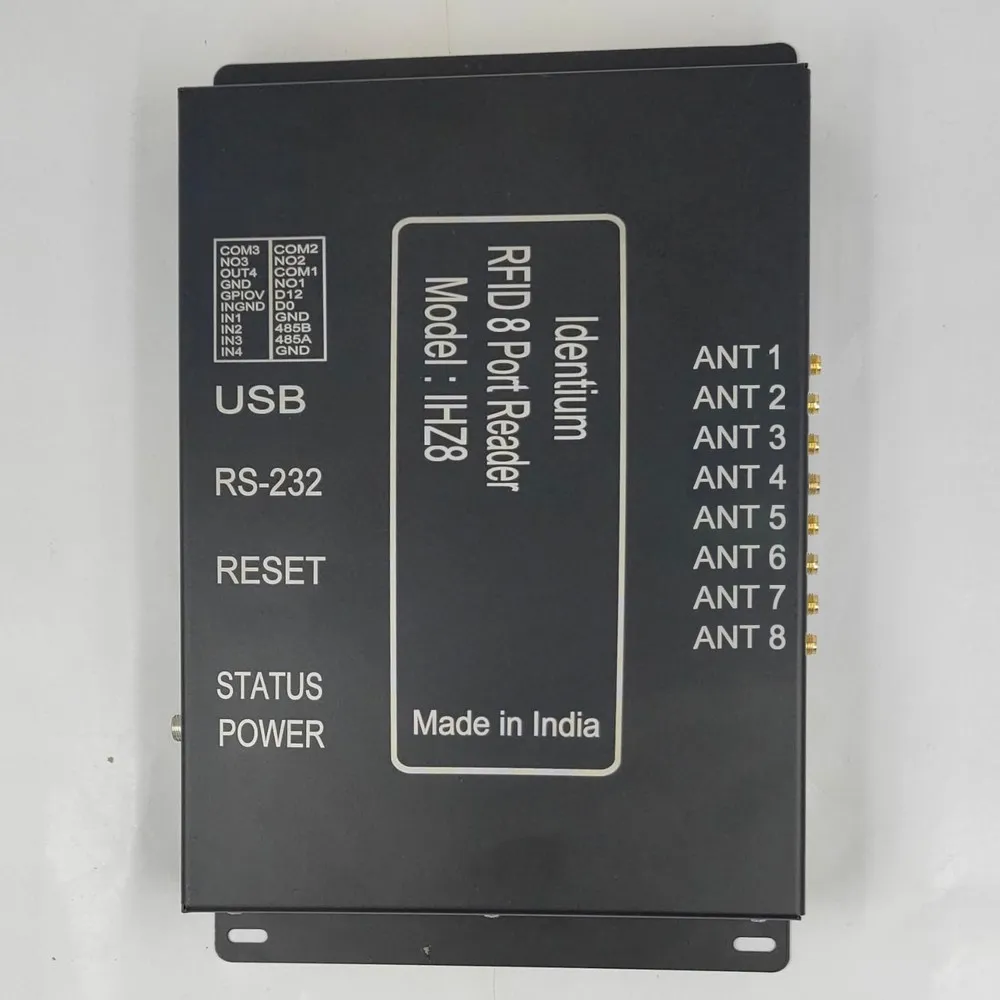
The IDTS-IHZ8 is the IHZ4 with eight SMA antenna ports and is otherwise the same reader. It is a fixed UHF RFID reader that drives up to eight external antennas from one unit. The engine is an Impinj E710 with a dual power-amplifier circuit, good for up to 1,000 tags a second; with suitable antennas and tags the listed read range is up to 30 m. Eight ports make sense where a site has more read points than a four-port reader can serve: school and factory entrances, library exits, access-controlled doors or toll lanes.
Wiring eight zones into your system
Eight read zones on one reader still need only one set of connections:
- RJ45 Ethernet brings the reads from all eight antennas to your server or software, or sends them through the direct post API
- Wiegand passes a tag ID to the access or attendance controller of a door the reader covers, in the same way as a card read
- RS-485 or RS-232 connects a PLC or serial controller; use RS-485 when the cable run is long
- USB 2.0 is for configuring and testing on the bench
- 3 inputs and 3 relay outputs take sensor signals and switch a boom barrier, hooter or lamp at the zones that need one
Developers get Java, .NET and C++ APIs. RSSI reporting, antenna detection, data filtering and online updates are built in, and antenna detection is a quick check on all eight cables at commissioning.
Planning the read zones
Eight SMA ports let one reader cover more read zones than a four-port unit: several dock doors, the lanes of a multi-lane gate, a portal with antennas on several sides, or a set of shelf or cabinet zones. Output power can be set from 0 to 33 dBm in 1 dB steps, so the read field can be trimmed until tags outside the zones stop being picked up. Its aluminium, anti-shock housing suits factory and warehouse sites.
Place the reader where every antenna cable stays short, because long coaxial runs lose RF signal. Choose an antenna for each of the eight zones from the RFID antenna range.
Which port count to choose
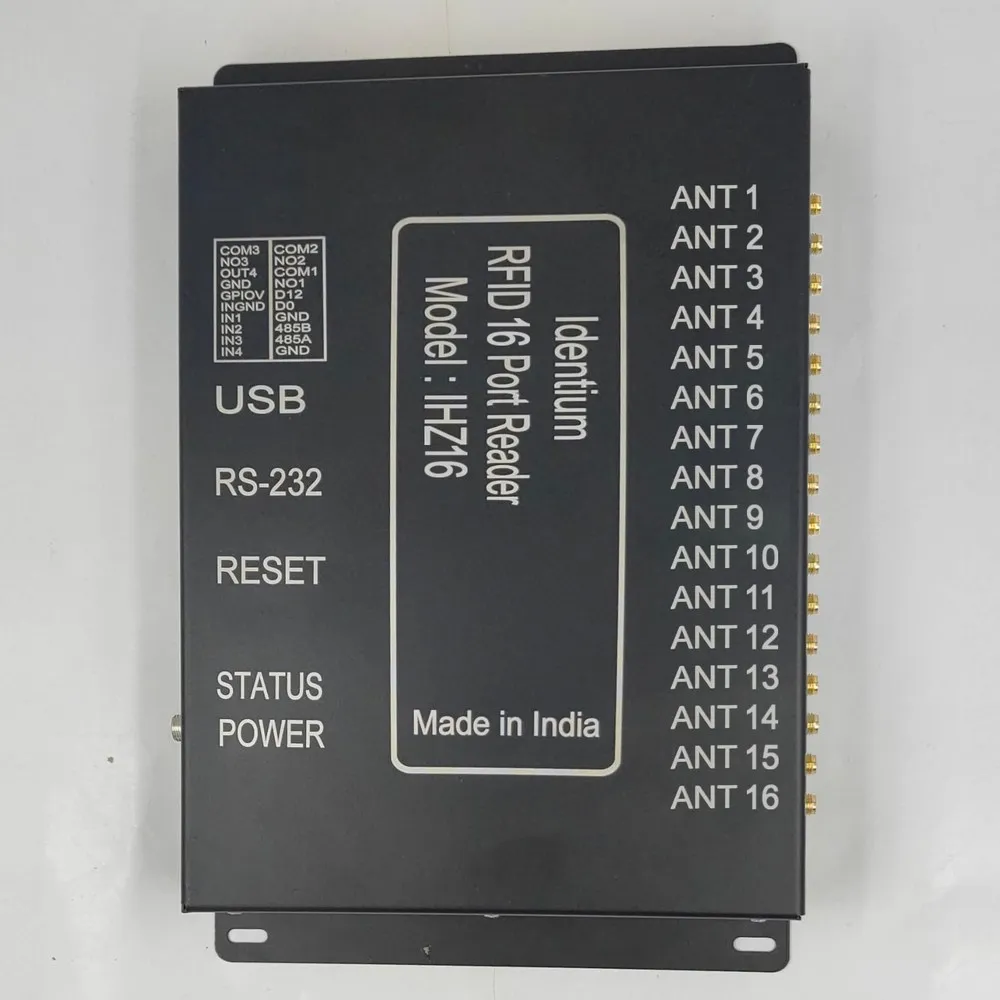
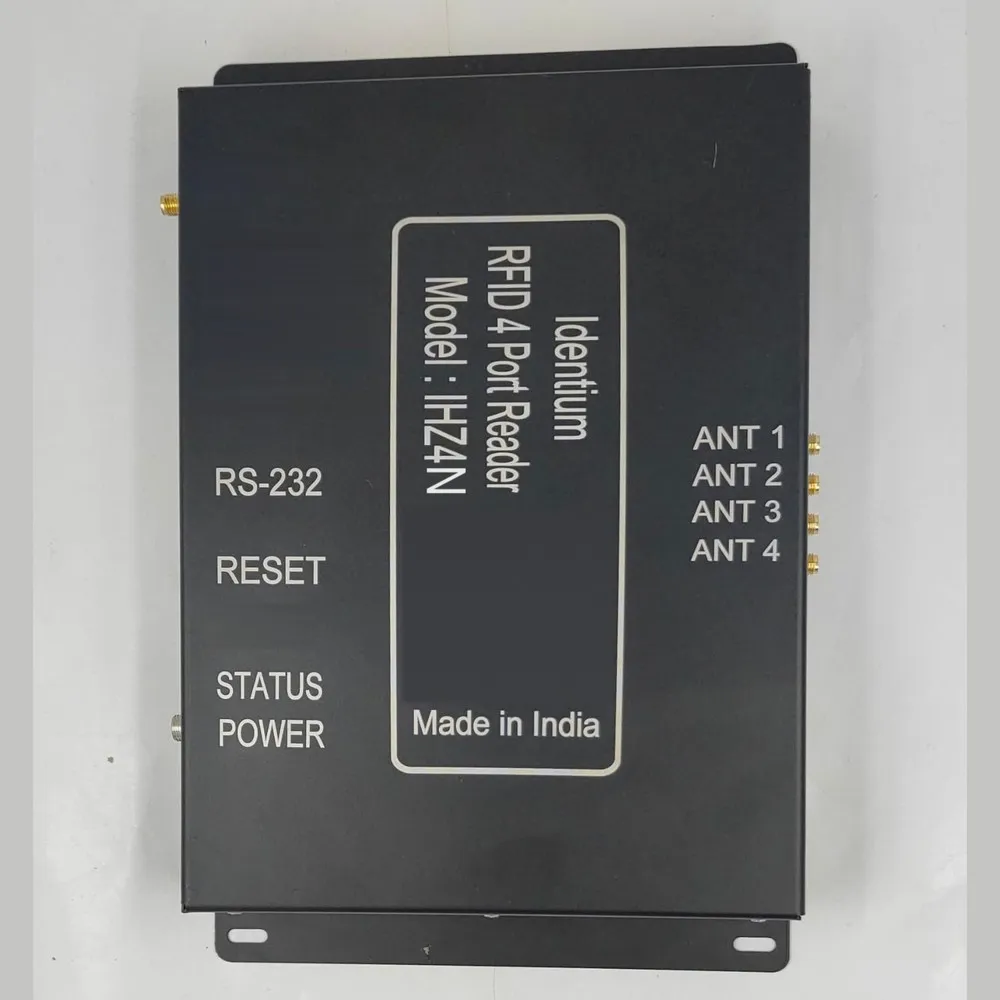
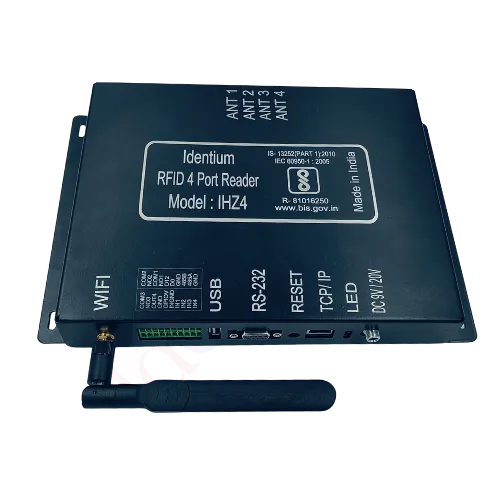
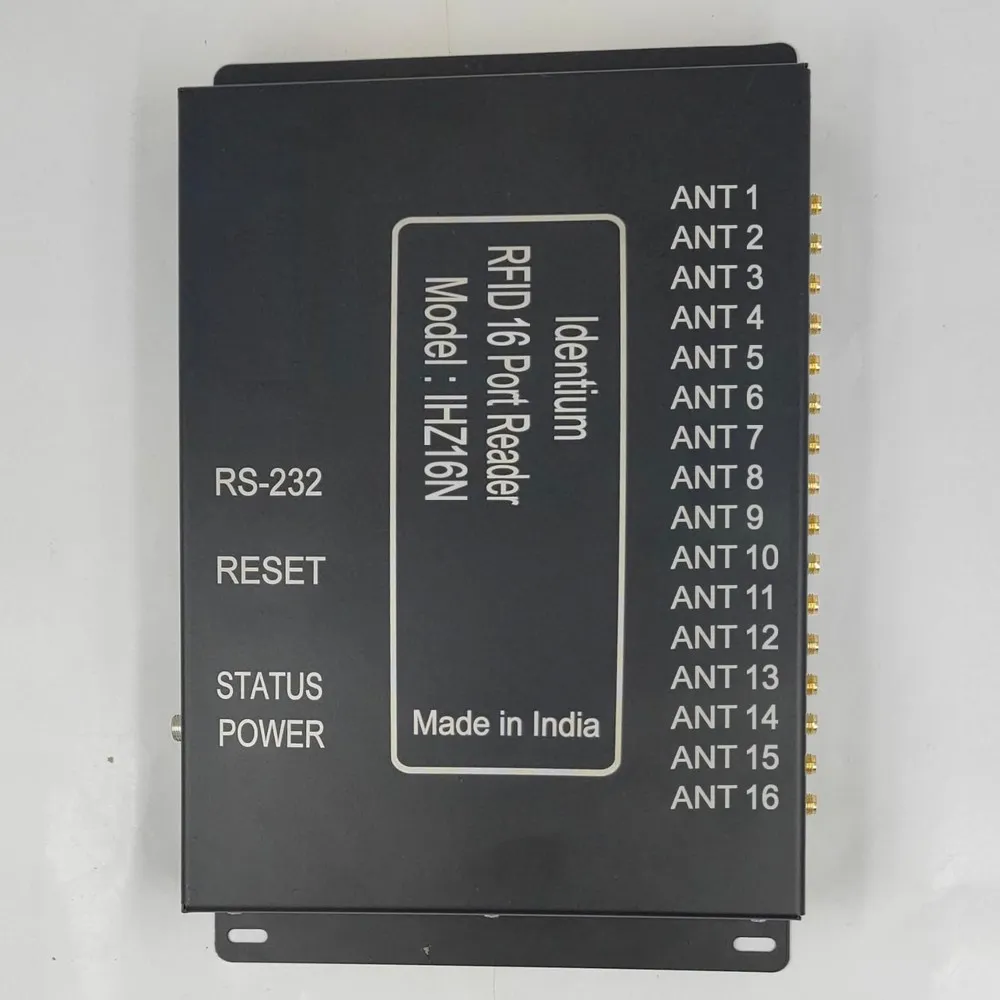
Count the read zones one reader has to serve. The 4-port IHZ4 covers up to four, such as both sides of a gate; the IDTS-IHZ8 covers up to eight; and the 16-port IDTS-IHZ16 suits larger layouts. Apart from the number of antenna ports they are the same reader.
Typical applications
- School time attendance
- Personnel tracking in plants
- Library security gates
- Door access control
- Toll plaza lanes
- Warehouse dock doors
Specifications
Datasheet (PDF)| Model | IDTS-IHZ8 |
|---|---|
| Chip | Impinj E710, dual power-amplifier circuit |
| Protocol | ISO/IEC 18000-6C (EPC C1 Gen2), ISO/IEC 18000-6B, Impinj Gen2X |
| Frequency | 865–868 MHz (India, ETSI EN 302 208); 902–928 MHz (FCC Part 15) version |
| Output power | 0–33 dBm (±1 dBm), adjustable in 1 dB steps |
| Channel bandwidth | < 200 kHz |
| Frequency stability | ≤ ±10 ppm |
| Work mode | Fixed or hopping frequency |
| Read speed | Up to 1,000 tags/s |
| Anti-collision | Multi-tag reading |
| Read range | Up to 30 m (antenna, tag and environment dependent) |
| Write range | Up to 8 m (environment dependent) |
| Ports | 8 × SMA antenna ports |
| Interface | RJ45, RS-232, RS-485, Wiegand, USB 2.0 (Wi-Fi, Bluetooth can be added) |
| I/O | 3 inputs, 3 relay outputs |
| Software | RSSI, antenna detection, online update, data filtering |
| API | Java,.NET, C++, direct post API |
| Housing | Aluminium, anti-shock design |
| Indicators | Power and status |
| Operating temperature | -20 °C to +70 °C |
| Storage temperature | -40 °C to +85 °C |
| Atmospheric pressure | 86–108 kPa |
| Humidity | Non-condensing |
| Dimensions | 170 × 120 × 25 mm |
| Weight | 0.5 kg |
Software, SDK and manuals
4 downloads for the IDTS-IHZ8.
Identium ReaderSense — Windows Installer Desktop software
Windows · Setup .exe · 85.0 MBDownloadIdentium ReaderSense — Windows Portable Desktop software
Windows · Portable .exe · 84.7 MBDownloadIdentium ReaderSense — macOS (Apple Silicon) Desktop software
macOS · M1/M2/M3 · 103.8 MBDownloadIdentium ReaderSense — macOS (Intel) Desktop software
macOS · Intel · 111.6 MBDownload
Frequently asked questions
How is the IDTS-IHZ8 different from the IHZ4?
What read range should I expect from the IDTS-IHZ8?
Can the IDTS-IHZ8 connect to an attendance or door controller?
Does the IDTS-IHZ8 work in India's UHF RFID band?
Which software can I use with it?
Buying guides