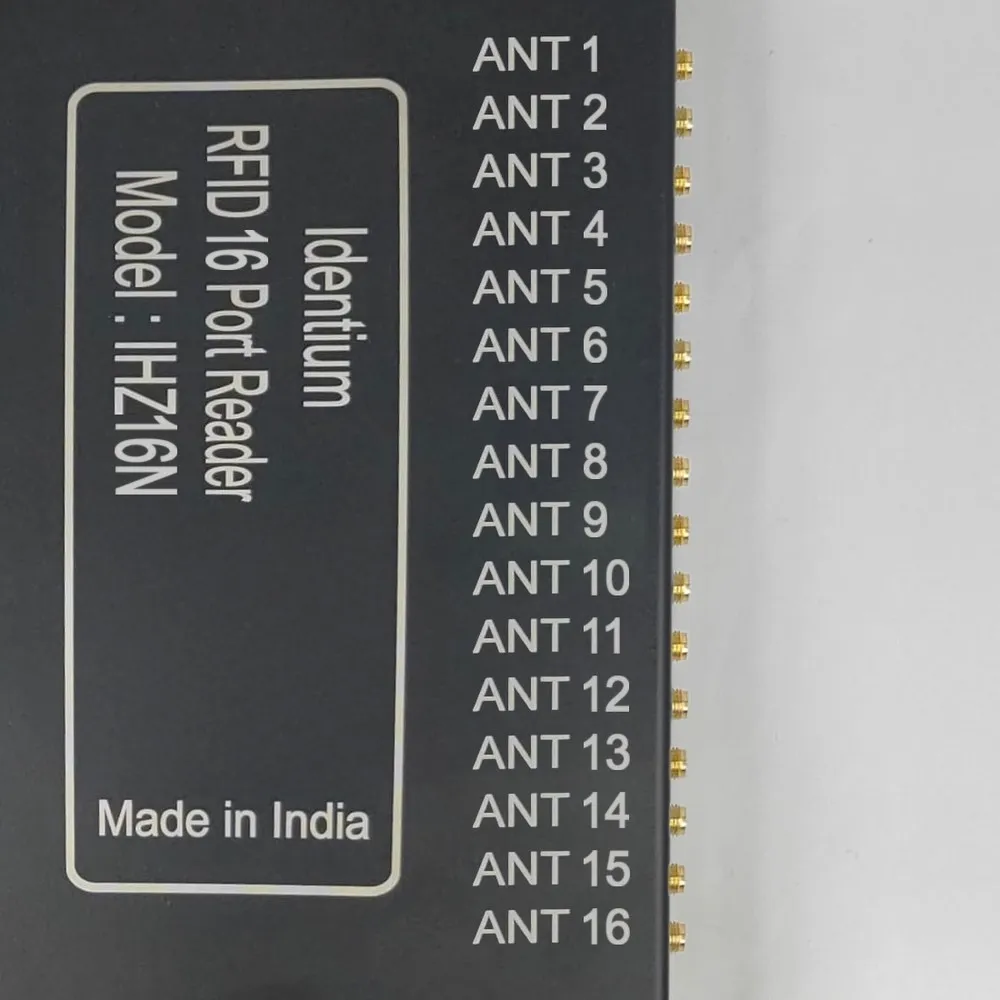
UHF RFID 16-Port Fixed Reader IDTS-IHZ16N (N704)
A sixteen-port fixed UHF RFID reader for dock doors, conveyors and production lines, built on the N704 module in the IHZ4 housing. Its 865–868 MHz version reads ISO 18000-6C and 6B tags at over 400 a second and connects over Ethernet, RS-232 or RS-485.
Price on request
Minimum order: 1 piece · the final price for your quantity is confirmed in the quote
View datasheet PDF · 234 KB- 7-day replacement · 1-year warranty against manufacturing defects
- Blue Dart next-day delivery
Key features
- N704 third-generation UHF RFID reader chip
- 16 × SMA ports, > 30 dB isolation, up to 33 dBm, −85 dBm sensitivity
- 865–868 MHz India (ETSI-band) version; up to 20 m read in the maker's 9 dBi antenna test
- Read rate > 400 tags/s; a 600-tag group identified within 3 s (multi-tag)
- Ethernet 10/100, RS-232 and RS-485; Wiegand on request
- 2 opto-isolated inputs and 2 relay outputs for sensors, lamps and gates
- Chip
- N704 third-generation UHF RFID reader chip
- Protocol
- ISO 18000-6C (EPC C1 Gen2), ISO 18000-6B
- Frequency
- 865–868 MHz (India/ETSI-band version); 902–928 MHz (US-band version)
- Read range
- Up to 20 m (EPC tags; maker's test with a 9 dBi linear antenna, cable loss < 1 dB, no interference); depends on antenna, tag and site
Overview
What is inside the IDTS-IHZ16N 16-port UHF RFID reader
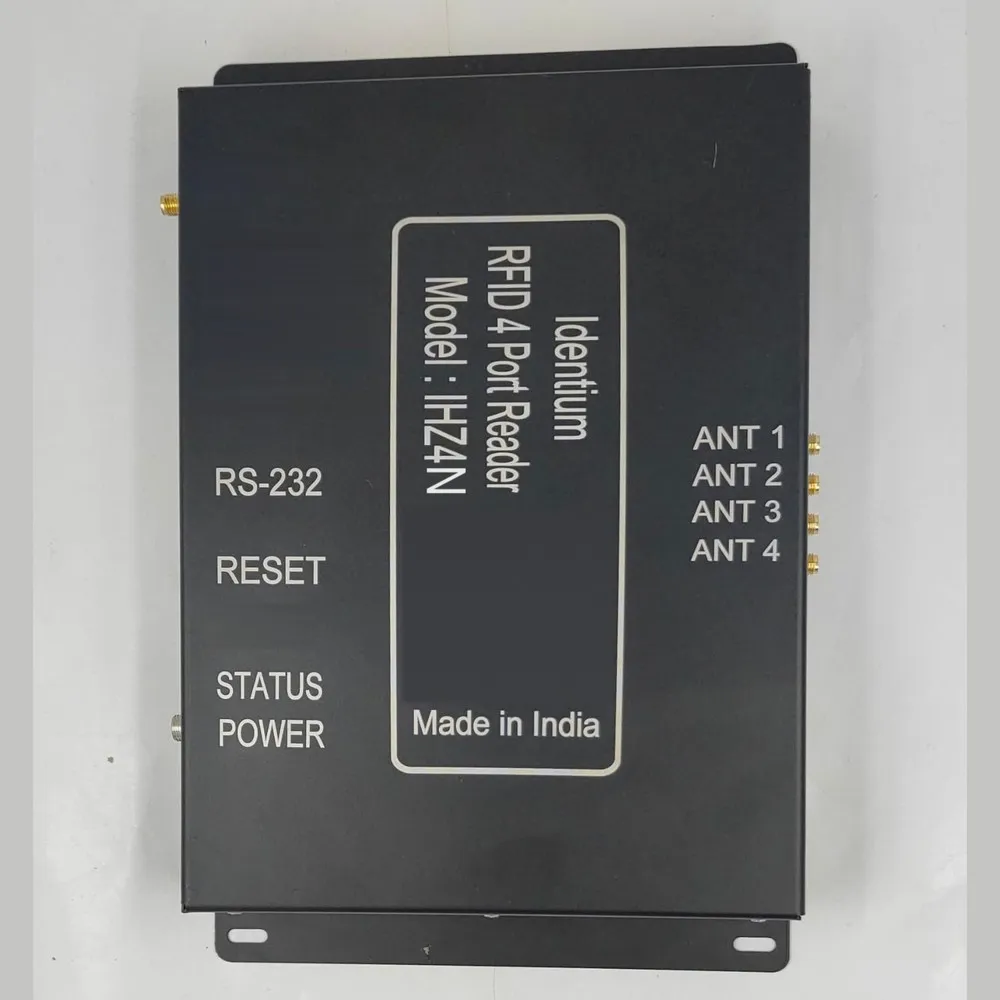
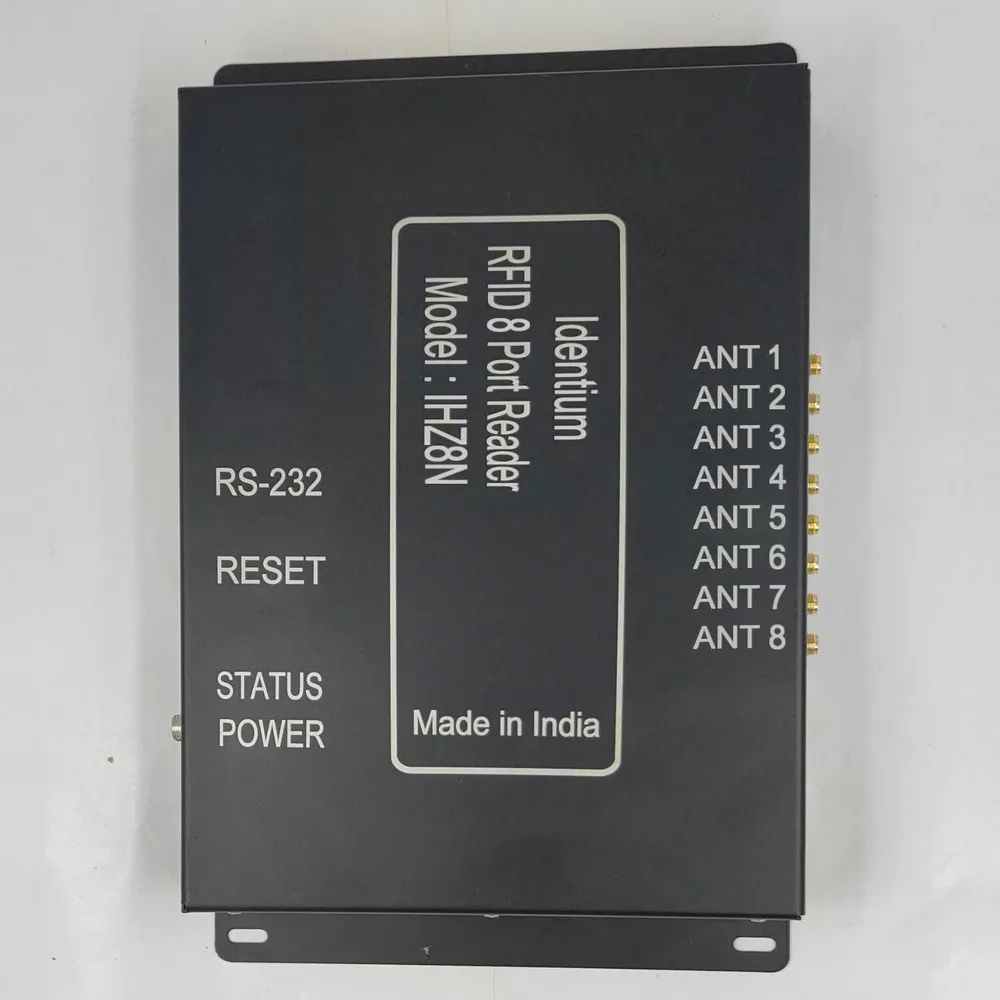
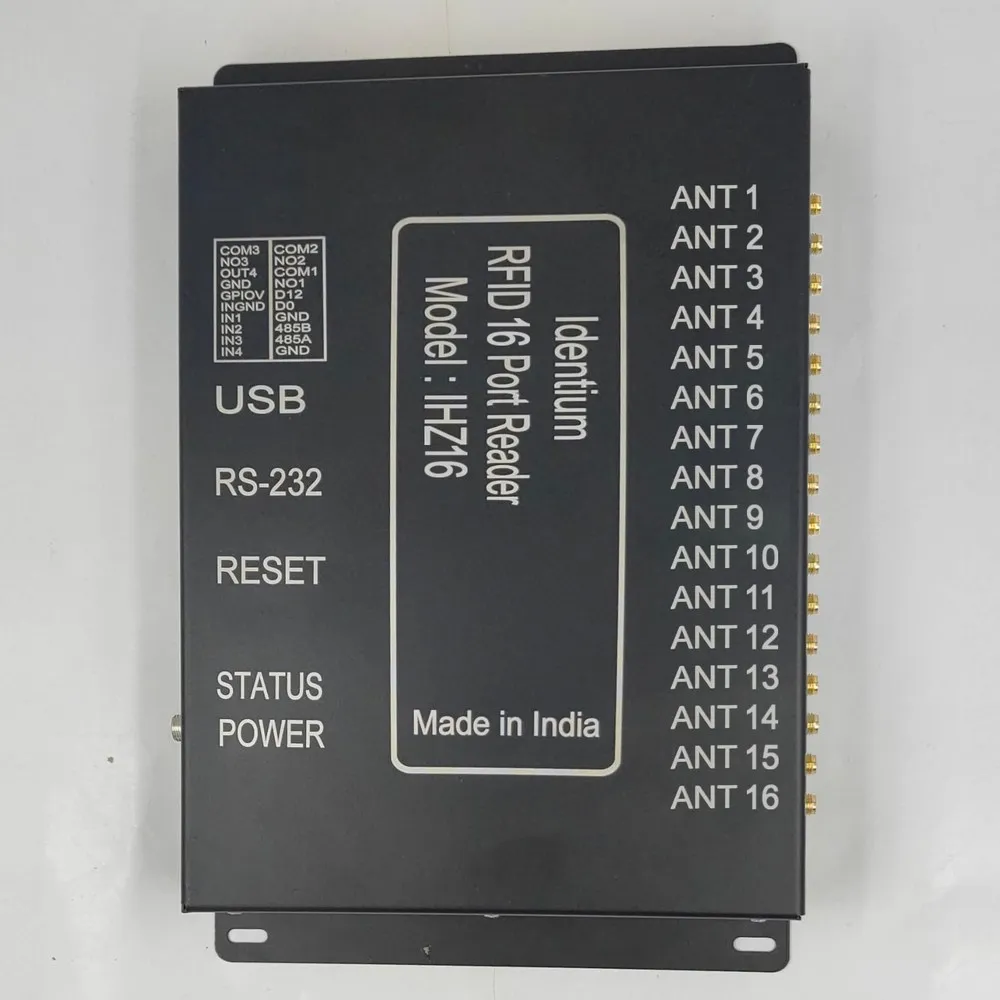
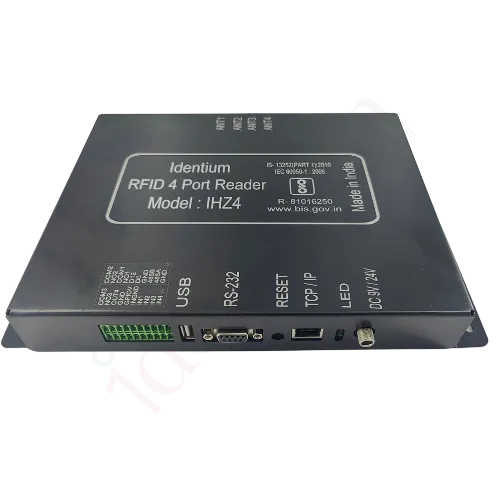
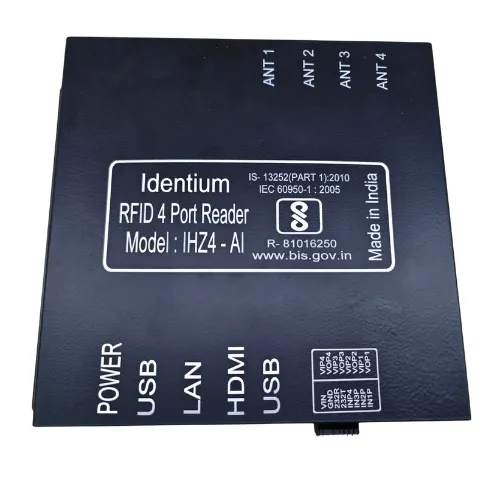
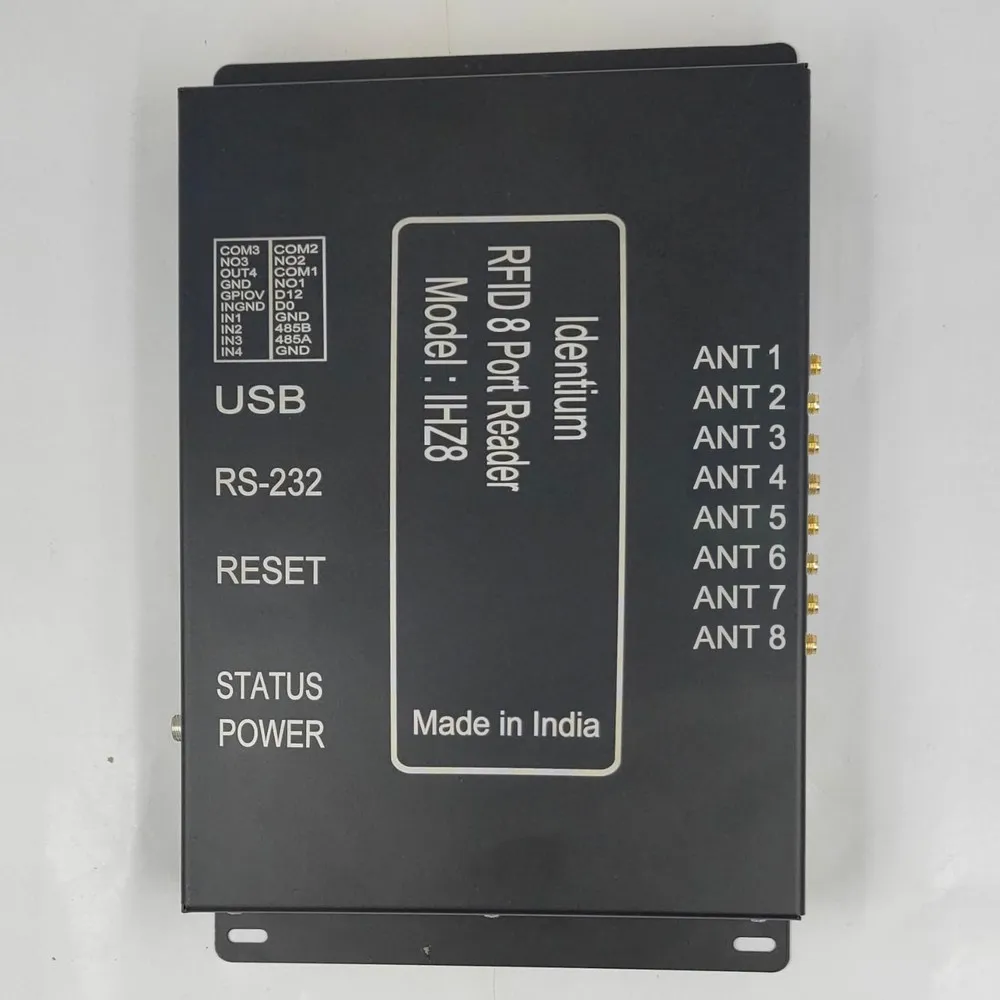
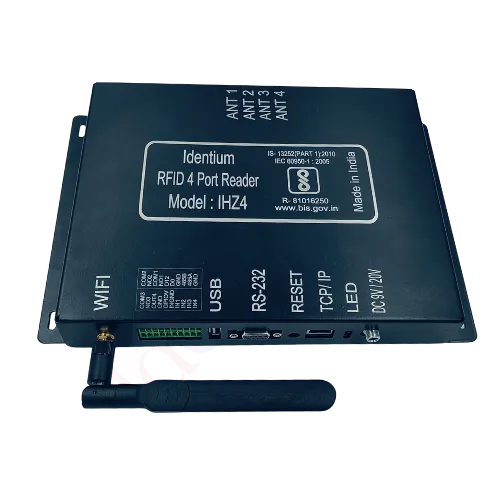
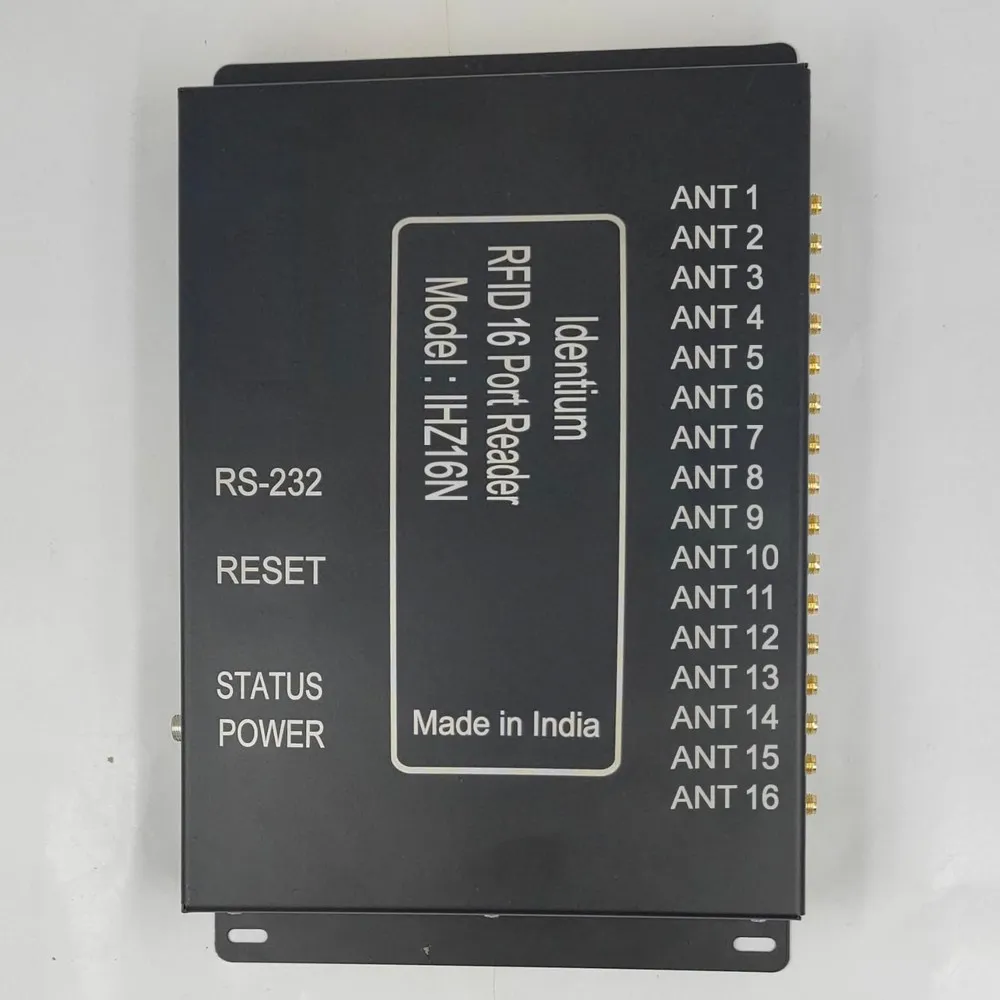
The IDTS-IHZ16N is the IDTS-IHZ4N with sixteen SMA antenna ports and is otherwise the same reader. Its housing is the IHZ4's aluminium, anti-shock case, here carrying sixteen SMA jacks marked ANT 1 to ANT 16. The RF side is an N704 third-generation reader module, and an interface board adds Ethernet, serial and I/O. It reads and writes ISO 18000-6C (EPC Gen2) and ISO 18000-6B tags.
Planning read points with sixteen antennas
Sixteen ports let one reader serve many read zones: a row of dock doors, every lane of a multi-lane gate, portals with antennas on several sides, or many shelf and cabinet zones in a stock room. Give each antenna its own zone and mount the reader centrally so the coaxial runs stay short. More than 30 dB of port-to-port isolation limits leakage between the reader's antenna ports; separating the zones themselves is down to antenna placement and output power.
Dense-reader mode helps where several readers share a hall. Range is the maker's test figure, so survey the site with your own tags before fixing the layout, and confirm each of the sixteen cables with antenna-connection detection before the trays are closed. Antennas for each zone are in our RFID antenna range.
One connection for sixteen zones
All sixteen zones report over a single Ethernet 10/100 link to the server, WMS or middleware on your LAN. RS-232 serves a nearby PC or controller, and RS-485 a PLC or serial network on a long cable run. Wiegand, for access or attendance controllers, comes only as an ordered customisation.
Two opto-isolated inputs and two relay outputs serve the whole layout, so plan which zones get them. A photo-eye, loop detector or door switch on an input lets your software start reading when something reaches that zone, and a relay can then light a lamp, sound a hooter or signal a barrier controller there. Relay ratings are in the specs table; bigger loads need a contactor.
IHZ16N or IHZ16: which to choose
IDTS-IHZ16N
N704 engine; Ethernet, RS-232 and RS-485; a pair of inputs and a pair of relays; Wiegand by customisation. Pick it when those links and two I/O pairs cover all sixteen zones.
IDTS-IHZ16
Impinj E710 engine in the same housing, also with sixteen antenna ports. Compared with the IHZ16N, it brings USB for bench set-up, Wiegand as standard, three inputs with three relays, and a higher listed read rate and read range. Choose the IDTS-IHZ16 when you need any of those.
For fewer zones, the IDTS-IHZ4N (four antenna ports) and the IDTS-IHZ8N (eight) are the same N704 reader.
Typical applications
- Warehouse dock doors
- Conveyor lines
- Production lines
- Library and file rooms
- Attendance and access gates
- Apparel stock rooms
- Vehicle and asset gates
Specifications
Datasheet (PDF)| Model | IDTS-IHZ16N |
|---|---|
| Chip | N704 third-generation UHF RFID reader chip |
| Protocol | ISO 18000-6C (EPC C1 Gen2), ISO 18000-6B |
| Frequency | 865–868 MHz (India/ETSI-band version); 902–928 MHz (US-band version) |
| Output power | 0–33 dBm (±1 dB), adjustable in 1 dB steps |
| Receive sensitivity | −85 dBm |
| Port isolation | > 30 dB, port to port |
| Modulation | DSB-ASK, PR-ASK |
| Decoding | FM0, Miller 2/4/8 |
| Data rate | 40 / 160 / 320 / 400 kbps (baseband) |
| Work mode | Fixed frequency or frequency hopping |
| Read speed | > 400 tags/s |
| Multi-tag | 600 tags in 3 s (anti-collision) |
| Read range | Up to 20 m (EPC tags; maker's test with a 9 dBi linear antenna, cable loss < 1 dB, no interference); depends on antenna, tag and site |
| Write range | Up to 10 m (same test conditions); depends on antenna, tag and site |
| Ports | 16 × SMA antenna ports |
| Interface | Ethernet 10/100 Mbps (TCP), RS-232 (9,600–460,800 baud, default 115,200), RS-485; Wiegand on request (customisation) |
| I/O | 2 opto-isolated inputs, 2 relay outputs (DC 30 V / 1 A, AC 125 V / 0.75 A) |
| Functions | RSSI, tag data filtering, dense-reader mode (DRM), antenna-connection detection, temperature/humidity protection, auto-idle power saving |
| Power input | DC 5–24 V, from a supply of at least 30 W; recommended adapter 12 V / 2 A (100–240 V AC input) |
| Power consumption | 9 W (reader module at +33 dBm) |
| SDK | SDK packages for several development languages, plus demo software |
| Housing | Aluminium, anti-shock design |
| Indicators | Power and status |
| Dimensions | 170 × 120 × 25 mm |
| Operating temperature | −20 °C to +70 °C |
| Storage temperature | −40 °C to +85 °C |
| Humidity | 10–95% RH, non-condensing |
Frequently asked questions
Does the IDTS-IHZ16N work in India's UHF RFID band?
What read range will I get from the IDTS-IHZ16N?
Can it send Wiegand to an access or attendance controller?
How do I integrate it with my own software?
How is the IDTS-IHZ16N different from the IHZ4N?
Buying guides