Skip to content
India RFID Store

UHF RFID Reader Module ID-UM3210 (2-Port, UART, 26 dBm)
Model ID-UM3210Brand Identium

UHF RFID Reader Module ID-UM3210 (2-Port, UART, 26 dBm)

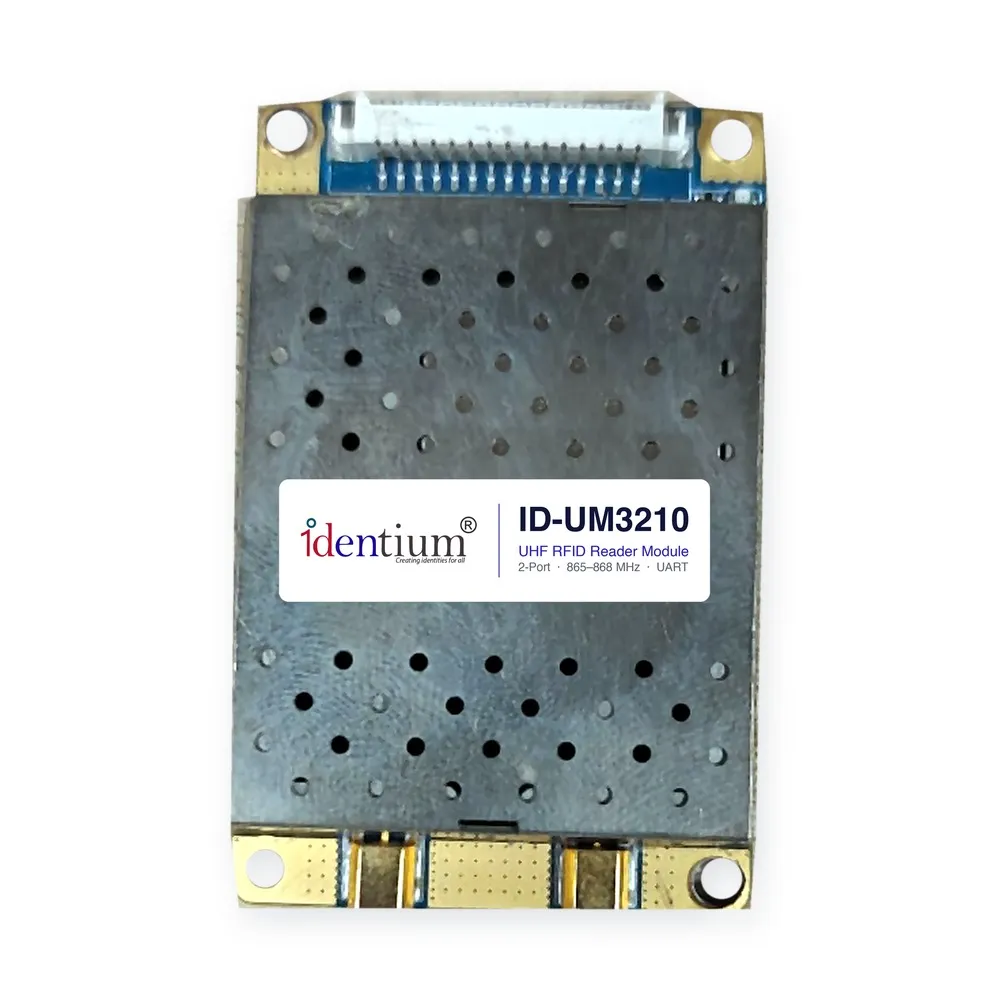
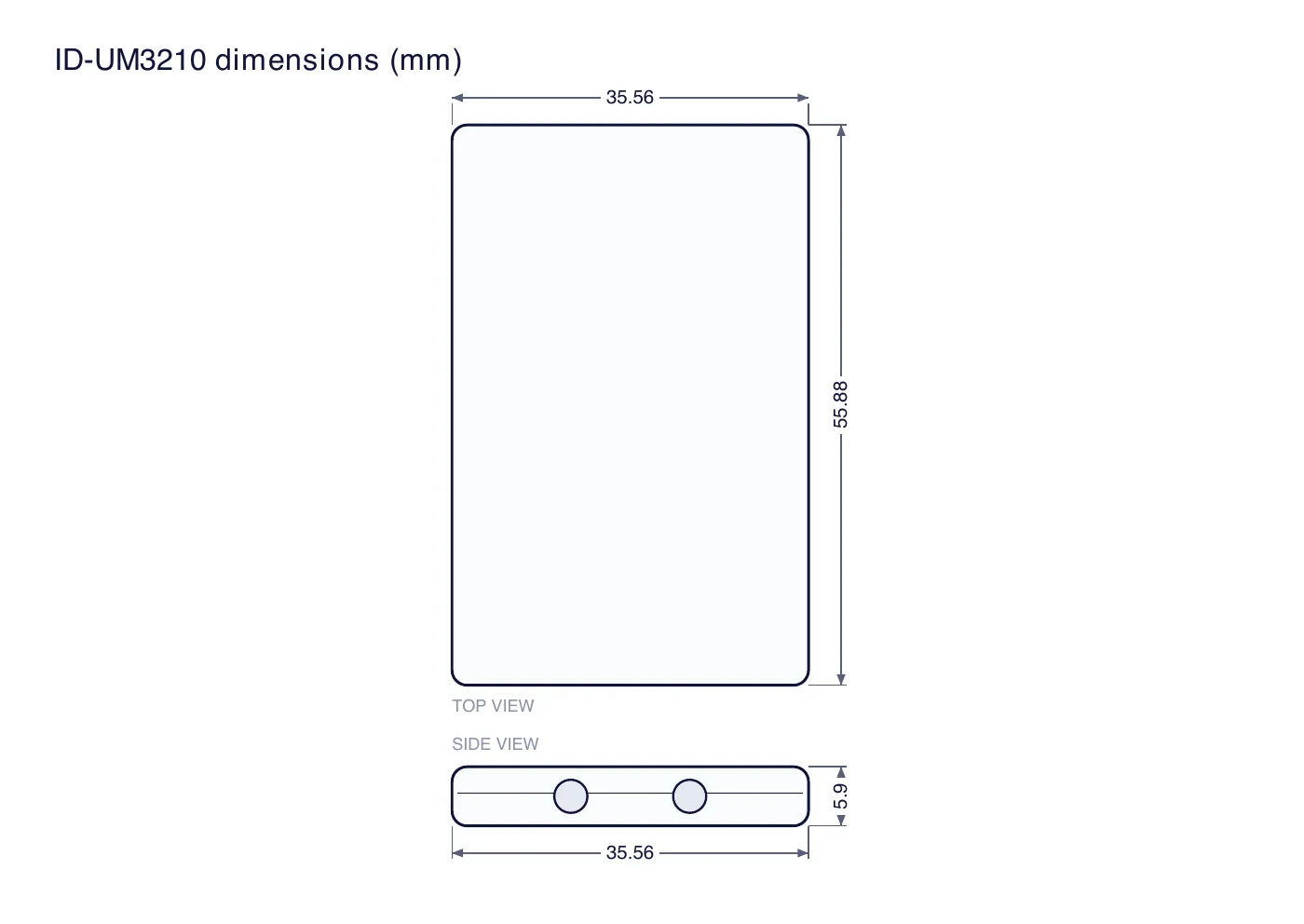
A slim two-port UHF RFID reader module for engineers building UHF reading into printers, handhelds, robots and smart cabinets: E310 chip, two MMCX antenna ports, 5–26 dBm output, over 300 tags/s, a 3.3 V UART and a 3 W peak draw in a 55.88 × 35.56 × 5.9 mm board.

Model:
ID-UM3210
Brand:
Identium
Chip:
Impinj E310
Protocol:
EPCglobal UHF Class 1 Gen 2 (ISO 18000-6C)
Frequency:
India build 865–868 MHz; other regional bands within 860–960 MHz on request; confirm the band with your order
Read range:
Over 3 m with a 2.5 dBi ceramic antenna; depends on the antenna, tag and surroundings
Datasheet:
PDF · 104 KB
Listing updated:

₹9,145

per piece + 18% GST

₹10,791.10 incl. GST

Min. order 1 pieceRequest a quote and pay by NEFT or UPI against the quotation

  • 7-day replacement · 1-year warranty against manufacturing defects
  • Blue Dart next-day delivery
  • Ordered by quotation · in-stock items are dispatched the same day after payment · shipping is shown in your quotation

Sold by India RFID Store, the online catalogue of Identium Tech Solutions Pvt Ltd, an RFID manufacturer in New Delhi, India, in business since 2010.

Key features

  • Two MMCX antenna ports: two shelves, trays or read zones from one module
  • E310 chip, EPC Gen2; over 300 tags/s and a 1,000-tag buffer at 96-bit EPC
  • 5–26 dBm output, adjustable; over 3 m with a 2.5 dBi ceramic antenna, depending on the tag
  • Low power: 3 W peak (0.6 A at 5 V) at full output, 0.75 W standby
  • 3.3 V TTL UART at 9600–921600 bps and 2 in / 2 out GPIO on a 15-pin FPC
  • India build for 865–868 MHz; host API for C, C#/.NET and Java

Overview

The ID-UM3210 is a UHF RFID reader module with two antenna ports: a 55.88 × 35.56 × 5.9 mm board carrying an E310 reader chip and two MMCX connectors, driven over a 3.3 V UART. It reads EPC Gen2 tags at over 300 tags per second, and at over 3 m with a 2.5 dBi ceramic antenna, depending on the tag and its surroundings. It is sold from 1 unit at ₹9,145 + GST.

What the ID-UM3210 two-port UHF RFID module is for

It is made to be built into RFID label printers, handheld terminals, robots and AGVs, smart cabinets, desktop encoders and kiosks. Two ports let one module cover two read points, such as two shelves of a cabinet, two trays on a counter or both sides of a conveyor, with one UART link to your host. At 3 W peak and 0.75 W in standby it is easy on batteries and on small power supplies, and its 5.9 mm height fits slim enclosures.

Reading and diagnostics

  • Anti-collision: over 300 tags per second, moving or stationary, with a 1,000-tag buffer at 96-bit EPC.
  • Output power: 5–26 dBm (±1 dB), adjustable, so you can keep reads close to an encoder or tray, or open up for a wider zone.
  • Diagnostics: RSSI per tag, antenna detection and real-time module temperature for your software to log.
  • Frequency: fixed frequency or frequency hopping, selectable.

Connectors, power and pinout

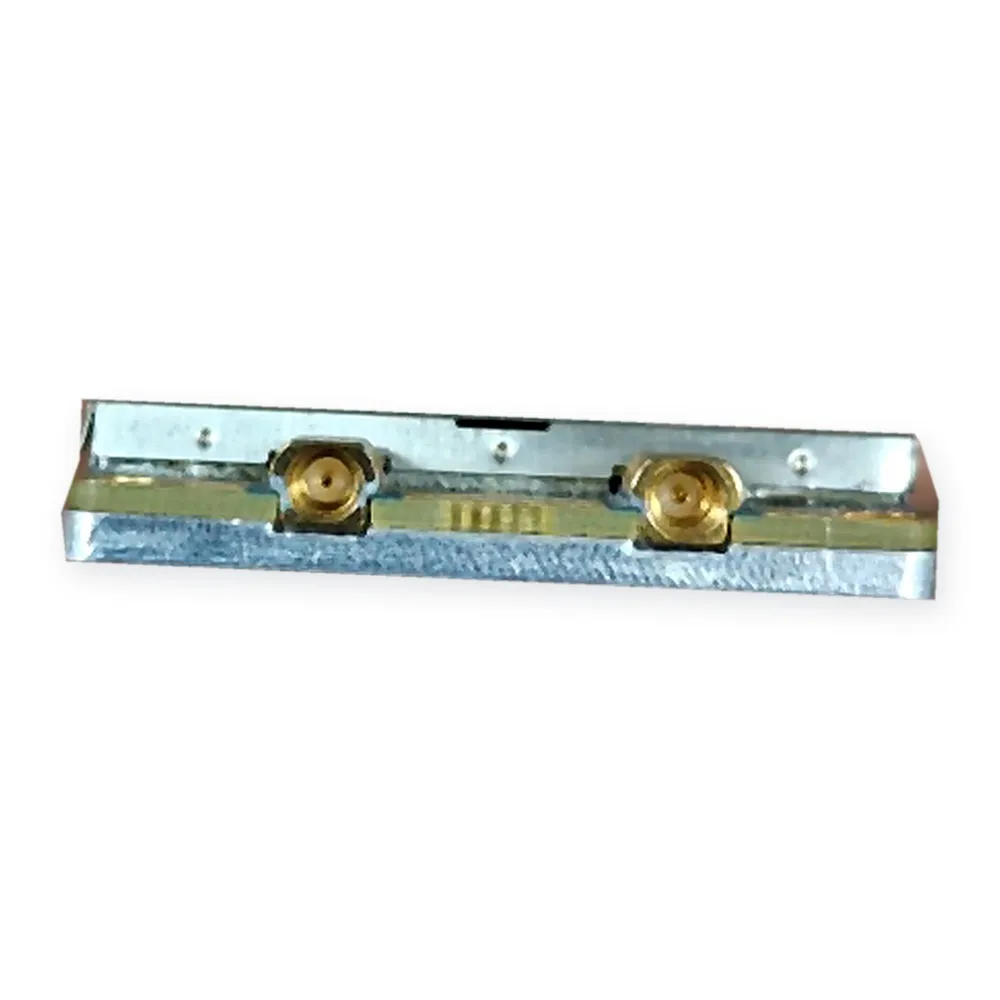
  • Antennas: two MMCX ports. Connect each antenna with an MMCX cable; choose antennas from our UHF RFID antennas, and we quote the cables with your order.
  • Host link: UART at 3.3 V TTL, 9600–921600 bps (default 115200), plus two inputs and two outputs at 3.3 V TTL, all on a 15-pin FPC connector.
  • Control: drive SHUTDOWN (pin 14) high to run the module; nRST (pin 15) resets it when pulled low.
  • Supply: 3.6–5 V DC, sized for 3 W peak (0.6 A at 5 V).
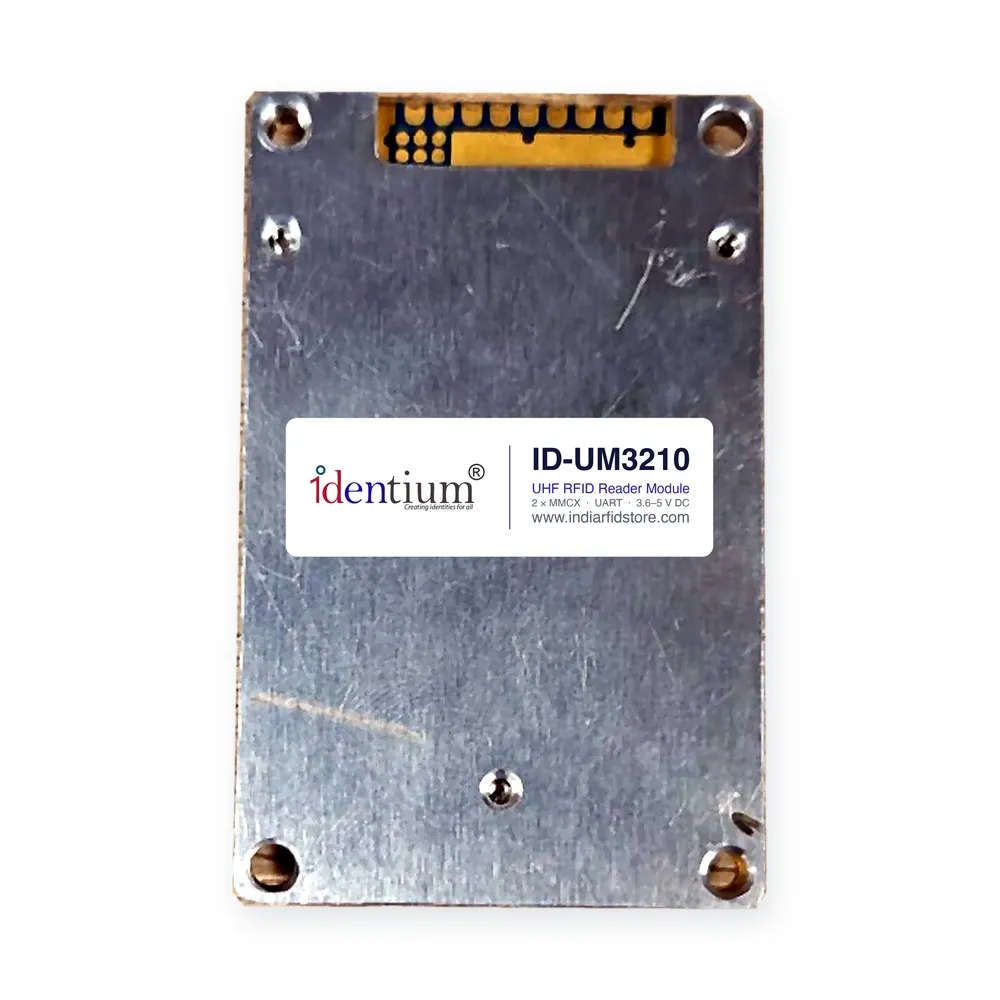
  • Mounting: four corner holes and a metal base plate.

Frequency band in India

The India build works in the 865–868 MHz band used for UHF RFID in India. Other regional bands within 860–960 MHz are available on request for export products, so tell us the destination market when you order. Use EPC Gen2 tags tuned for the same band from the UHF RFID tags range.

Software and ordering

A host API for C, C#/.NET and Java lets you build the module into your own application on Windows, Linux or Android hosts. The datasheet on this page has the full pinout and dimension drawing.

When you order, tell us the destination market, the band, your host platform and the antennas you plan to use. For API access and integration support, request a quote.

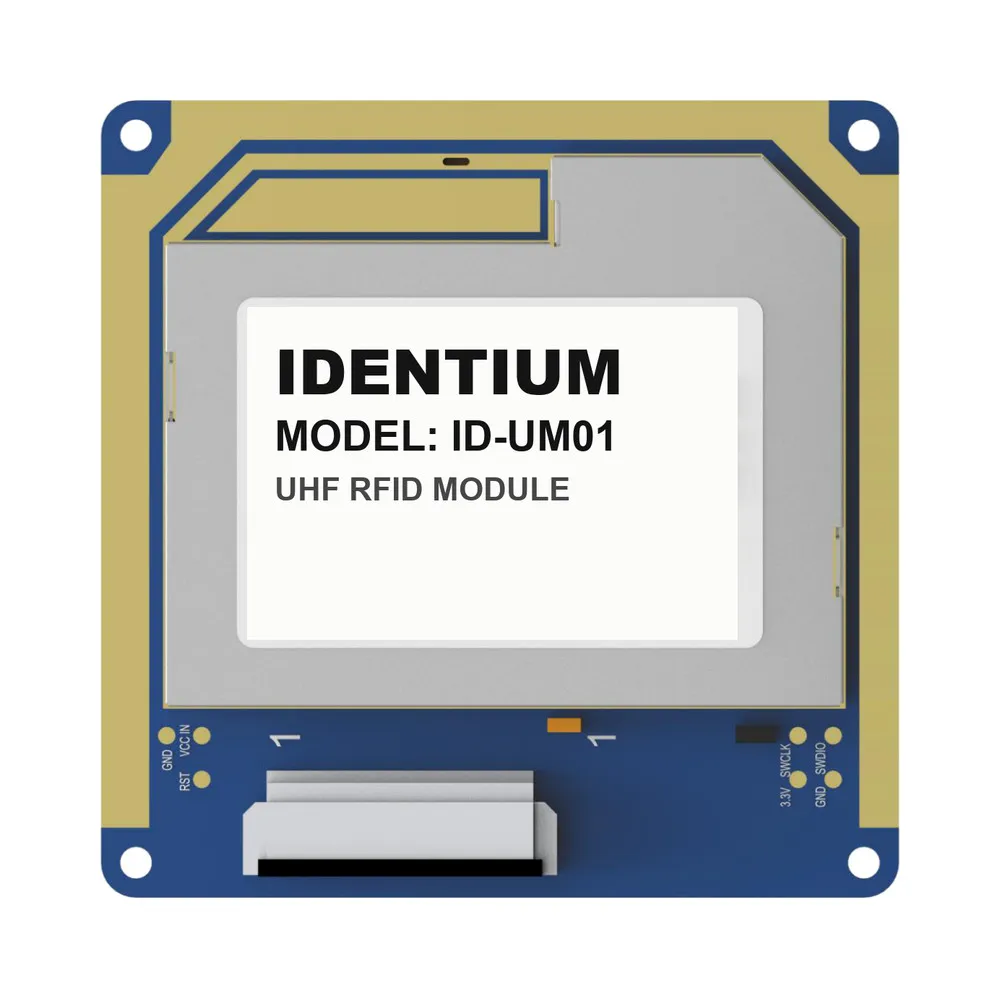
For a module with its antenna built in, see the ID-UM01; for Ethernet, RS485 or Wiegand, see the IDTS-RM26 and the other UHF RFID reader modules.

Where the ID-UM3210 is used

  • RFID label printers
  • Handheld RFID terminals
  • Robots and AGVs
  • Smart cabinets and shelves
  • Desktop tag encoders
  • RFID kiosks
  • Production-line stations
  • Two-zone counters

Specifications

Datasheet (PDF)
ModelID-UM3210
TypeUHF RFID reader module with two antenna ports, for embedding in your own device
ChipImpinj E310
ProtocolEPCglobal UHF Class 1 Gen 2 (ISO 18000-6C)
FrequencyIndia build 865–868 MHz; other regional bands within 860–960 MHz on request; confirm the band with your order
Operating modeFixed frequency or frequency hopping, selectable
Output power5–26 dBm (±1 dB), adjustable
Receive sensitivity−73 dBm at 10 % BER
Antenna ports2 × MMCX
Read rangeOver 3 m with a 2.5 dBi ceramic antenna; depends on the antenna, tag and surroundingsEstimate range for your set-up →
Read rateOver 300 tags/s
Tag buffer1,000 tags at 96-bit EPC
DiagnosticsTag RSSI, antenna detection, real-time module temperature
InterfaceUART, 3.3 V TTL, 9600–921600 bps; default 115200 bps
GPIO2 inputs and 2 outputs, 3.3 V TTL
Connector15-pin FPC
15-pin FPC pinout1–2 GND, 3–4 VCC (+5 V), 5 OUT1, 6 OUT2, 7 IN1, 8 IN2, 9 RXD, 10 TXD, 11–13 not connected, 14 SHUTDOWN (high = run), 15 nRST (reset, active low)
Host APIC, C#/.NET and Java
Supply voltage3.6–5 V DC
Consumption, peak3 W (0.6 A at 5 V) at full output
Consumption, standby0.75 W
Dimensions55.88 × 35.56 × 5.9 mm (L × W × H)
Mounting4 corner mounting holes; metal base plate
Weight21 g
Operating temperature−25 °C to +65 °C
Storage temperature−40 °C to +85 °C
Humidity5–95 % RH, non-condensing at +25 °C

Frequently asked questions

How many antennas can I connect to the ID-UM3210?
Two, one on each MMCX port. Each port can serve its own read point, such as two cabinet shelves, two trays or both sides of a conveyor, all reported over one UART. Connect each antenna with an MMCX cable; we quote cables with your order, and antennas are in our UHF RFID antennas range.
How far does it read?
Over 3 m with a 2.5 dBi ceramic antenna, as rated. The range you get depends on the antenna, the output power, the tag, what it is fixed to and the surroundings, so test with your own tags. In an encoder or tray, turn the output down to keep reads close.
How does it connect to my host board?
Over a 3.3 V TTL UART at 9600–921600 bps (default 115200 bps). The 15-pin FPC connector carries power, the UART, two inputs and two outputs at 3.3 V TTL, a SHUTDOWN line (drive it high to run) and a reset line (active low). The full pinout is in the specifications and on the datasheet.
What power supply does it need?
3.6–5 V DC. It draws 3 W at peak (0.6 A at 5 V) at full output and 0.75 W in standby, which suits battery-powered handhelds, printers and robots.
Which frequency band does it use in India?
The India build works in the 865–868 MHz band used for UHF RFID in India. Other regional bands within 860–960 MHz are available on request for export products; tell us the destination market with your order.
Which software can I use with it?
A host API for C, C#/.NET and Java lets you build the module into your own application. API access and integration support come with your quotation.
How is it different from the ID-UM01?
The ID-UM3210 has two MMCX ports for external antennas, 5–26 dBm output, a 3 W peak draw and a 5.9 mm height, which suits printers, robots and two-zone cabinets. The ID-UM01 has a 2.5 dBi ceramic antenna built in and up to 33 dBm output, for handhelds, encoders and kiosks with one read zone.

Your quote list

Saved on this device. No payment is taken online.

Your list is empty. Use “Add to quote” on any product, then send one request for everything.