DEFSAC RFID Smart Cards: What Defence Suppliers Should Prepare
Published 22 Oct 20269 min read
Short answer: on 7 September 2026 the Defence Acquisition Council accorded Acceptance of Necessity to a set of capital acquisition proposals, and among the Indian Air Force items was the installation of the Defence Forces Secure Access Card (DEFSAC) system, which "will replace existing paper-based identity cards, passes and permits" with "interoperable Radio Frequency Identification-based smart cards".
That is an approval to proceed, not a contract or a tender. This guide explains what such a system is made of, what the Navy's earlier AFSAC project looked like, what Air Force units already buy as RFID tags, and how a card, reader or tag supplier should prepare. India RFID Store does not supply the FIT 210 and FIT 400 tags named in some of those bids.
This guide is for RFID card, reader and tag suppliers, system integrators and MSMEs that sell to defence establishments, and for the station security and stores officers who write specifications. It reads the September 2026 approval and the earlier Navy programme as reported, and keeps the two apart. It makes no claim about the DEFSAC system's design, integrator, card technology or timeline beyond what the sources say.
What the DAC approved on 7 September 2026
DD India reported on 7 September 2026 that the Defence Acquisition Council, chaired by Defence Minister Rajnath Singh, "accorded Acceptance of Necessity (AoN) for various capital acquisition proposals", with "around 98 per cent of the procurements to be sourced from Indian industry". Under the Indian Air Force, the report lists enhancements to the "war-fighting capabilities of fighter aircraft, transport aircraft and helicopters", the procurement of "Ground-Based Multi-Purpose Jammers (GBMPJ)", and the installation of the DEFSAC system. "The DEFSAC system will replace existing paper-based identity cards, passes and permits with interoperable Radio Frequency Identification-based smart cards."
News On AIR's report of 8 September 2026 uses near-identical wording: DEFSAC "will replace existing paper based Identity Card, Passes, Permits" with "an interoperable Radio Frequency Identification-based smart cards system", listed under the approvals for the Indian Air Force. Neither report gives the DEFSAC line's value, the number of cards, the chip technology, the integrator or a date, and this guide does not guess at them.
AoN is a beginning, not an order
Acceptance of Necessity is the first approval in a defence capital procurement: it records that the need is accepted and lets the case move to the later stages. For a supplier that means two things. Nothing has been tendered yet, so there is no document to respond to and no "DEFSAC-compliant" product to advertise. And whoever eventually builds the system will source cards, readers, printers and enrolment hardware through a supply chain, which is where card and reader makers come in.
The word to watch is "interoperable". Our reading, not stated in the reports, is that it implies a common card specification that readers across establishments must accept. That would fix the chip family, the data layout and the key scheme for the whole system and leave suppliers a specification to meet exactly, rather than a range of acceptable chips. Treat this as inference until a specification is published.
AFSAC: the Navy's earlier programme
The closest public precedent is the Navy's Armed Forces Secure Access Card (AFSAC) project. Its integrator announced the contract on 21 May 2019: an "RFID (Radio Frequency Identification) based Access Control System" across all naval bases and ships, a secure application run from a data centre to manage the access control devices, network devices and cards, and the issuance, administration and life-cycle support of AFSAC cards on a turnkey basis over about two years. The AFSAC card was to replace the paper-based identity card for Navy personnel, dependants and ex-servicemen.
Keep the two programmes apart. AFSAC was a Navy project contracted in 2019; DEFSAC is a 2026 approval listed under the Air Force with "Defence Forces" in its name, and no source we have read links the two. What the 2019 announcement shows is the shape of such a contract: not a card purchase, but an access-control system with the card as its credential, plus a data centre, readers on every base and a multi-year card life cycle.
What an RFID smart-card access system is made of
Any such system, whether at a base or a factory gate, has the same five layers, and a supplier should know which one it sells into.
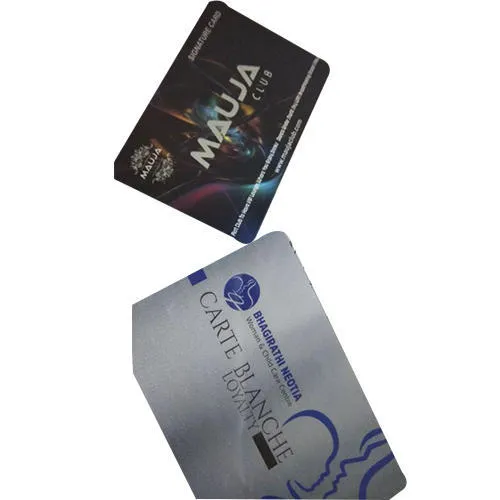
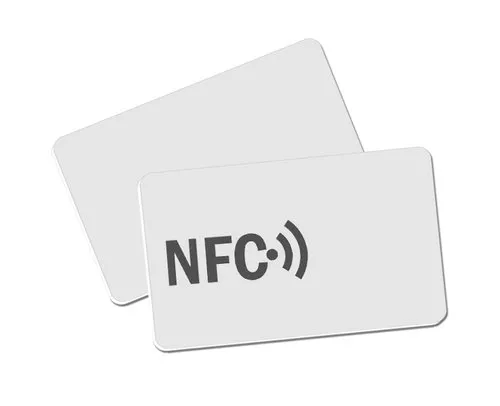
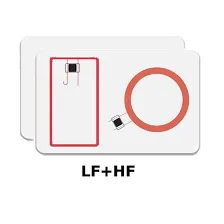
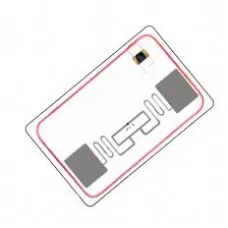
- The card. A contactless 13.56 MHz smart card with a secure chip, printed with the holder's photo and details, sometimes with a second technology for older readers. Our Printed RFID ID Card (₹30 + GST) is the printed CR80 form with an HF or LF chip, personalised with logo, name, photo and card number. The NFC Card 13.56 MHz (₹20 + GST) is ordered in the chip family a system specifies, with DESFire EV1/EV2 adding AES-128 encryption. The LF + HF dual-frequency card (₹28 + GST) carries a 125 kHz chip beside a MIFARE Classic EV1 or DESFire chip for a site that still runs proximity readers, and the HF + UHF dual-frequency card (₹30 + GST) adds a UHF number for reading at vehicle gates and entry lanes.
- Readers at doors, turnstiles and gates. A reader on each controlled point, wired to a controller or the network. The RFID IP Reader IDTS-HRW560 with Wi-Fi and PoE (₹10,000 + GST) sends every tap to a server over Wi-Fi or TCP/IP with no PC at the door, in an HF or LF version. See HF RFID readers and our guide to setting up RFID door access.
- The enrolment desk. A USB reader to register cards, and a card printer. The HF RFID Desktop Reader HRD20 (₹2,000 + GST) is a slim USB desk reader for enrolment counters. Our card printing guide explains matching the card to the installed readers before anything is printed.
- Back office and key management. The identity database, the access rules and, for a secure card, the keys. These belong to the system owner and its integrator; a card supplier's job is to deliver cards that the owner can key, never cards left on default keys for live use.
- Passes and permits. The DAC wording names passes and permits as well as identity cards: visitor passes, vehicle permits and gate passes. These are the consumable layer, where short-life cards and printed vehicle labels sit, and they turn over far faster than an identity card. The UHF RFID Card IDTS-IDC62 (₹20 + GST) reads at 1–5 m for hands-free vehicle lanes, and UHF windshield labels carry a vehicle permit on the glass.
What Air Force units already buy: tool tags on GeM
While DEFSAC goes through its procurement stages, defence establishments already buy RFID through GeM, and the visible bids are for tags rather than cards. Two listings we read on a tender aggregator:
- GEM/2026/B/7837424, buyer Indian Air Force, Pathankot, published 27 July 2026 with bids due 10 August 2026: heat-shrinkable sleeves (12.7 mm and 50 mm), RFID tags "fit 210" and "fit 400", and glue, total quantity 715, evaluated on total value.
- GEM/2026/B/7818737, buyer Indian Air Force, Jalandhar, published 22 July 2026 with bids due 11 August 2026: RFID tags "fit 210", total quantity 1,200.
Two things a supplier must understand about such bids. First, FIT 210 and FIT 400 are not generic specifications. They are model names from one manufacturer's catalogue of small rugged tags, so a bid written around them is a bid for that make. India RFID Store does not supply FIT 210 or FIT 400 tags, and nothing in our catalogue is offered as their equivalent or substitute; if a bid names them, quote that make through its authorised channel or do not quote.
Second, the heat-shrink sleeves and glue in the same bid show the application: tags fitted to tools, cables or equipment and sealed in place. That is tool-room and stores accounting, not personnel access, and it is a separate business from the card system above.
For a unit's own stores and tool-room tagging written to a generic specification (surface, size, temperature and read range), our catalogue tags are judged only on their own published figures, never as stand-ins for a named part: for example the ceramic UHF on-metal tag CR400 (₹445 + GST), 10 × 5 × 3 mm and IP68, the high-temperature on-metal tag IDTS-UMHT (₹450 + GST), rated for continuous use at +200 °C, and the reusable UHF cable tie tag (₹115 + GST) for cable bundles and racks.
The workflow is on our RFID tool tracking system page, and the full range is in on-metal RFID tags.
How a supplier should prepare
Four preparations cost little now and matter when documents appear.
- Get the local-content paperwork right. The DAC's 98 per cent Indian-industry figure is the policy direction; purchase preference under the public procurement Make in India order is how it reaches a bid. Our guide to selling RFID to Indian government buyers covers local-supplier classes, the local-content declaration and the documents public buyers check.
- Know your chip families, and say so. A card specification will name a chip class and a security level. Keep datasheets, sample cards in each family and a written answer on key handling ready.
- Keep card and tag offers separate. The bids above show units buying tool tags today; credentials, if and when they come, will arrive under a system contract. Listings that mix the two, or that describe a generic tag with another maker's model name, invite rejection.
- Start with passes and permits. Visitor and vehicle passes are the consumable layer and the one most likely to stay a local purchase. Printed cards, UHF vehicle labels and the readers that go with them fit that need.
Two cautions. Do not describe any product as "approved for DEFSAC" or "AFSAC-compatible": no public specification exists for the first, and the second is one integrator's system. And check every reader against the WPC and BIS position before you offer it; our WPC ETA and BIS checklist explains what a buyer is entitled to ask for. For the wider picture of access cards and readers, see our RFID access control and attendance system page.
Shop the products in this guide
- Printed RFID ID Card and NFC Card 13.56 MHz: identity and pass cards.
- LF + HF and HF + UHF dual-frequency cards, and the UHF card IDTS-IDC62 for vehicle lanes.
- RFID IP Reader IDTS-HRW560 for networked doors and the HRD20 desktop reader for the enrolment desk.
- CR400 ceramic on-metal tag, IDTS-UMHT high-temperature tag and cable tie tag: stores and tool tags for generic specifications.
Cards are consumables with a minimum order of 500 pcs; see RFID cards. Supplying or specifying for a defence establishment? Send us the bid document or draft specification and request card and tag samples; we will tell you plainly which items we can quote and which we cannot.
Sources
- DD India, 7 September 2026: DAC clears defence acquisition proposals
- News On AIR, 8 September 2026: DAC clears acquisition proposals for Forces
- Tender18 listing of bid GEM/2026/B/7837424, Indian Air Force, Pathankot: heat-shrinkable sleeves, RFID tags fit 210 and fit 400, glue
- Tender18 listing of bid GEM/2026/B/7818737, Indian Air Force, Jalandhar: RFID tags fit 210
- Integrator's press release, 21 May 2019: RFID-based access control system for the Indian Navy's AFSAC project
Frequently asked questions
What is DEFSAC?
Is DEFSAC the same as the Navy's AFSAC card?
Can India RFID Store supply the FIT 210 and FIT 400 tags in Air Force bids?
Which card suits a site that still runs 125 kHz readers?
What should a supplier do before any DEFSAC tender appears?
Defence ProcurementRFID Smart CardsAccess ControlPublic SectorGovernment Tenders
Keep reading
More guides

More in Regulations & tenders
- Haryana RFID House Tags for Waste Collection and the SWM Portal
- FSSAI Non-Retail Container Labels 2027: Lot Numbers and RFID