
RFID for Manufacturing — WIP Tracking & Industry 4.0 (India 2026)
Published 18 Jul 2026Updated 4 Oct 20268 min read
Indian manufacturing is under pressure to move faster, prove quality and cut waste, and the shop floor is where most of that is won or lost. Barcodes and manual registers still dominate many plants, but they need line-of-sight scanning, struggle on metal surfaces and break down as production speeds up.
RFID addresses these problems directly: it reads dozens of tagged items at once, works on greasy metal parts with the right tags, survives paint booths and welding heat in its industrial forms, and feeds real-time data into your MES or ERP. This guide is for Indian plant managers, production engineers and MSME owners who want a practical, specification-accurate route to RFID-enabled work-in-progress (WIP) tracking and Industry 4.0.
Why RFID beats barcodes on the shop floor
A barcode is a printed label that a worker must point a scanner at, one item at a time, with a clean line of sight. On a live production line that friction adds up: missed scans, smudged labels, queues at each station and no data when someone forgets to scan. RFID (radio frequency identification) uses radio waves, so a fixed reader can capture every tag that passes through a gate, with no aiming, no stopping and no human trigger.
For Indian factories, the practical wins are concrete:
- Bulk reads: a single UHF portal can read 50–200 tagged items in seconds as a trolley or pallet rolls through.
- No line of sight: tags read through packaging, plastic bins and around corners.
- Rugged survivability: industrial tags withstand oil, coolant and vibration, and specialised variants handle temperatures from −40 °C to +200 °C and beyond.
- Automatic capture: data logs itself, closing the "someone forgot to scan" gap that undermines barcode traceability.
The dominant standard for manufacturing is UHF RFID (860–960 MHz, EPC Gen2 / ISO 18000-63). In India the licence-exempt band is 865–868 MHz (G.S.R. 853(E), 2021), so every reader and tag you deploy must be tuned for it. US-band (902–928 MHz) gear bought off a marketplace often means poor read range and a reader without Indian type approval, which is a genuine reason to source India-tuned hardware and check the reader's WPC ETA.
Work-in-progress (WIP) tracking, station by station
WIP tracking is the heart of RFID in manufacturing. Tag the item, the carrier (jig, fixture, pallet, trolley) or the batch traveller card, then place fixed readers at each process station. As the work order moves from cutting to machining to assembly to QC to dispatch, each read timestamps its arrival and exit automatically.
What this unlocks:
- Real-time visibility: know how many units sit at each station and where bottlenecks form, without walking the floor.
- Accurate cycle times: station-in and station-out timestamps give true takt and throughput data instead of estimates.
- Automatic WIP inventory: the value of goods locked on the floor is calculated continuously, improving working-capital decisions.
- Error-proofing (poka-yoke): if a part arrives at the wrong station or skips an operation, the system flags it immediately.
A typical mid-sized plant starts with 4–8 read points on its highest-value line, then scales. Because UHF tags are inexpensive at volume, tagging the reusable carrier (a fixture or pallet) rather than every disposable part often gives the best return: the tag is read thousands of times over its life.
Tool and asset tracking across the plant
The same infrastructure tracks the assets that keep production running: calibrated tooling, dies, moulds, gauges, jigs, fixtures, trolleys, gas cylinders and returnable containers. Tag each asset with a rugged on-metal RFID tag and you get quick answers to "where is die 47?" and "when was this gauge last calibrated?"
Handheld readers let a supervisor find a specific tool in a crowded tool crib using the reader's proximity (Geiger-counter) mode. This cuts daily search time and stops the quiet capital drain of lost or duplicated tooling. Our fixed asset audit guide covers the register-and-reconcile method.
On-metal tags: the make-or-break component
Most manufacturing assets are metal, and metal is RFID's classic enemy: it detunes and reflects ordinary wet-inlay label tags, cutting read range to near zero. The fix is a purpose-built on-metal (anti-metal) tag with a ferrite or foam spacer layer that isolates the antenna from the surface and uses the metal as a reflector.
Match the tag to the environment on your shop floor:
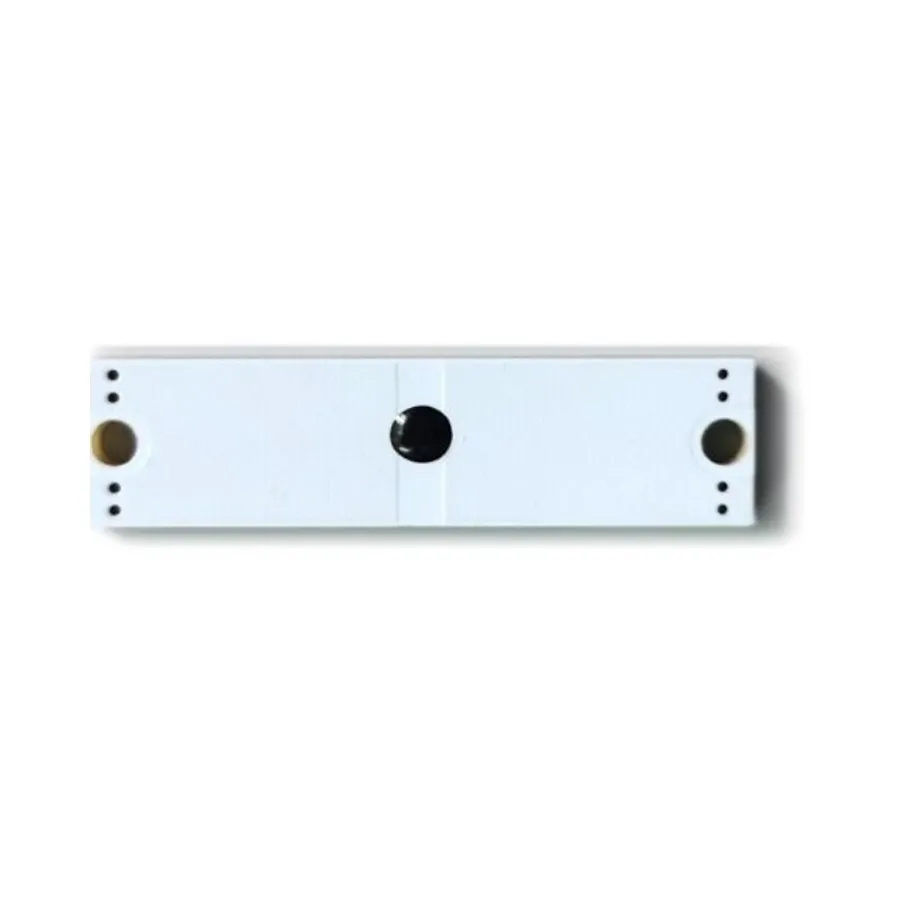
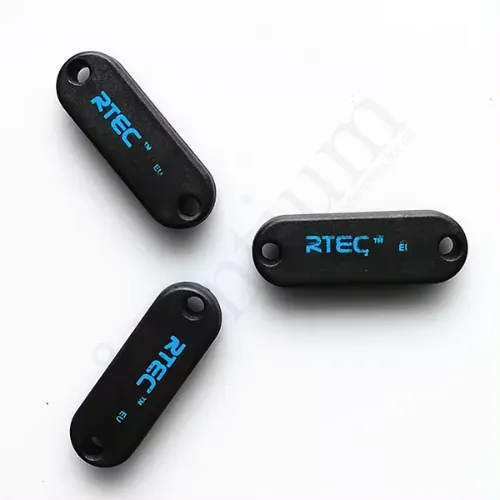
- Hard PCB / ABS on-metal tags: screw or rivet mount onto machinery, racks and heavy tooling; typically IP67/IP68, with read range of roughly 6–15 m on larger sizes.
- Ceramic tags: small footprint and heat-tolerant, suited to tooling, moulds and high-temperature or wash-down zones.
- Flexible on-metal labels: printable and adhesive-backed, for curved surfaces and lighter assets.
- High-temperature tags: built for paint-bake ovens, powder-coating and welding lines with +200 °C to +250 °C peaks.
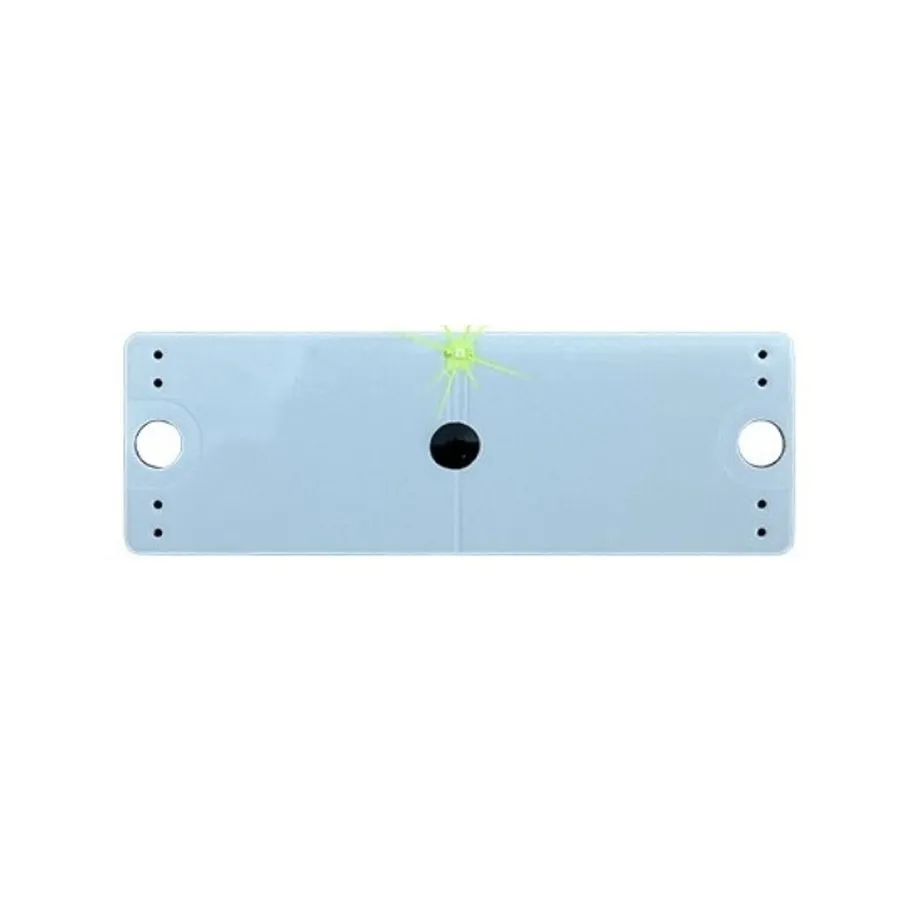
In our range, screw-mount PCB tags such as the IDTS-6015 (60 × 15 × 4 mm) suit machinery and tools, the IDTS-6020-LED has an on-tag LED that lights up when the tag is read, giving a visual confirmation at the asset itself, and the Steelcode ceramic tag is specified for −30 °C to +300 °C. Browse the full rugged range under On-Metal RFID Tags and PCB and Ceramic RFID Tags.
Fixed readers and antennas at each station
The reader is the brain of each read point. For fixed stations you typically use a fixed UHF reader with external antenna ports (usually 2 or 4), so you can cover a conveyor, a doorway or a work cell with correctly aimed antennas. Handhelds complement this for audits, cycle counts and tool location.
Key selection criteria for Indian deployments:
- Band: 865–868 MHz, with WPC ETA for the reader model. Confirm this explicitly.
- Antenna ports: 4-port fixed readers give the best coverage per rupee at busy stations.
- Connectivity: Ethernet/PoE for fixed installs; Wi-Fi, Bluetooth or 4G for handhelds; RS232 and GPIO for triggering light stacks, gates or PLCs.
- Antenna gain and polarisation: circular-polarised antennas (typically around 8 dBiC) tolerate random tag orientation on the line; higher-gain linear antennas suit fixed-orientation portals.
- IP rating: IP65 or better for dusty, humid plant floors.
The IHZ4 multi-port fixed reader (Impinj E710, 3 inputs and 3 relay outputs) is a typical station reader. Shop the full range under RFID Readers and pair each reader with the right RFID antennas for the station geometry.
Traceability, quality and compliance
For automotive components, pharma, electronics and defence supply, genealogy and traceability are non-negotiable. RFID gives every unit or batch a unique EPC that links to its full history: which machine and operator processed it, which raw-material lot went in, torque and test readings captured at each station, and pass/fail QC results. When a customer or auditor asks for a recall or root-cause report, you retrieve the affected serial range in minutes instead of days.
This supports the traceability that IATF 16949 (automotive), ISO 9001 quality systems, GMP and customer-mandated PPAP expect. It also enforces process order: the error-proofing described above keeps any unit from reaching dispatch without passing every required operation, so defects are contained on the line rather than escaping to the customer.
ROI: what to expect in an Indian plant
RFID is an investment, so the business case must be concrete. Returns usually come from four buckets:
- Labour saved: no manual scanning, register entry or physical WIP counts, which frees supervisor and operator hours every shift.
- Asset utilisation: less tool and mould search time, and fewer lost or duplicate-purchased tools.
- Quality cost avoided: fewer escapes, faster recalls, and lower rework and scrap through poka-yoke.
- Throughput gains: bottleneck visibility that lifts output from the same equipment.
A focused first deployment (one high-value line, 4–8 read points, tagged carriers plus tooling) is commonly planned to pay back within 8–18 months. The pattern that works: start small, prove the numbers on one line, then replicate. Test your own figures in the RFID ROI calculator.
Recommended hardware for one production line
A starter WIP and tool-tracking setup for a single line typically includes:
| Component | Recommended spec (India) | Purpose |
|---|---|---|
| On-metal asset tags | PCB/ABS anti-metal, IP67, 865–868 MHz, Gen2 | Tag fixtures, tooling, machinery, trolleys |
| Ceramic / high-temperature tags | Small ceramic, heat and wash-down tolerant | Moulds, dies, oven and paint-line assets |
| Fixed UHF reader | 4-port, 865–868 MHz, PoE Ethernet plus GPIO | Automatic reads at each station or gate |
| Reader antennas | Circular-polarised, around 8 dBiC, IP65 | Coverage at conveyors, doorways, work cells |
| Handheld UHF reader | Android, Wi-Fi/Bluetooth, around 4–10 m range | Audits, cycle counts, tool location |
| Middleware / MES link | Reads filtered and pushed to ERP or MES | Turns raw reads into WIP dashboards |
The middleware layer is often the part plants underestimate; our RFID software and middleware guide explains how reads become ERP transactions.
RFID vs barcode vs manual registers
| Criterion | Manual register | Barcode | UHF RFID |
|---|---|---|---|
| Line of sight needed | Yes | Yes | No |
| Read speed | Very slow | One at a time | Dozens per second |
| Works on metal, oil, dust | Manual only | Poor (label wear) | Good with on-metal tags |
| Automatic data capture | No | No (manual trigger) | Yes (fixed readers) |
| Typical read range | Not applicable | Contact to 0.3 m | 1–15 m |
| Tag reuse | Not applicable | Low (printed) | High (rugged, rewritable) |
| Traceability quality | Weak | Moderate | Strong (serial genealogy) |
Indian-band hardware and approvals
India RFID Store is the catalogue of Identium Tech Solutions Pvt Ltd, New Delhi, which makes and supplies RFID readers, tags, antennas and printers tuned for the 865–868 MHz Indian band. When you shortlist a reader, ask for the approvals against that exact model:
- WPC ETA: our CX1500N handheld, IF9A integrated reader, IHZ4 fixed reader and MUBR01 reader hold WPC Equipment Type Approval.
- BIS: BIS registration covers ten of our reader models, including the CX1500N, IF9A and IHZ4.
- Tags: tags and labels have no BIS category, so specify frequency, chip and mounting instead.
Our WPC ETA and BIS compliance checklist explains what to ask any supplier for.
Getting started
Start with a single high-value line and the right components: rugged on-metal tags, heat-tolerant PCB and ceramic tags, Indian-band RFID readers and correctly matched RFID antennas. Share your line layout and asset types with our engineering team for a site-specific hardware plan and a pilot that proves the numbers on your own line.
Related guides
- On-Metal RFID Tags: How to Choose the Right Tag for Metal Assets
- RFID for Gas Cylinder Tracking in India: PESO Rules and On-Metal Tags
- RFID Tag for Solar Modules in India: MNRE Field List and ALMM List-II
- Battery Pack Aadhaar (BPAN) and RFID Traceability
- RFID for Warehouse and Inventory Management in India
Frequently asked questions
What RFID frequency should I use for manufacturing in India?
Can RFID tags work on metal machinery and tooling?
How many readers do I need for WIP tracking?
Should I tag every part or the carrier?
How long until RFID pays for itself?
Is the hardware compliant with Indian regulations?
RFID ManufacturingWIP TrackingIndustry 4.0On-Metal TagsAsset TrackingIndia RFIDUHF RFIDTraceability
_1rNsTG.webp)