
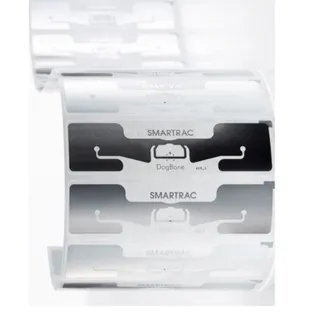
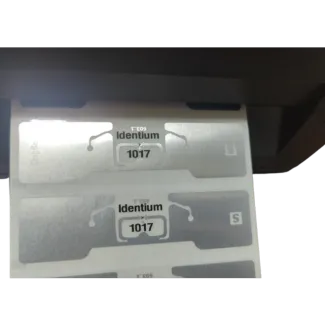
Dogbone RFID Tag
A dogbone-shaped UHF RFID inlay with the Impinj M730 chip, 97 × 27 mm and sized for 100 mm (4-inch) wide labels, for logistics, retail, sports timing and hard-to-tag goods.
₹25
per piece + 18% GST
Minimum order: 500 pieces · the final price for your quantity is confirmed in the quote
View datasheet PDF · 166 KB- 7-day replacement · 1-year warranty against manufacturing defects
- Blue Dart next-day delivery
- Samples ₹250 (1–2 pcs, incl. shipping) · request
Key features
- Impinj M730 chip with 128-bit EPC memory
- Autotune adaptive RF tuning for steadier reads on varied materials
- 97 × 27 mm, laid out for 100 mm / 4-inch wide labels
- GS1 UHF Gen2v2 compatible, with a privacy mode
- Broadband 860–960 MHz, covering India's 865–868 MHz band
- Read range up to 7 m, depending on reader and environment
- Frequency
- 860–960 MHz (covers India's 865–868 MHz)
- Protocol
- GS1 UHF Gen2v2
- Chip
- Impinj M730 (M700 series)
- Read range
- Up to 7 m (reader and environment dependent)
Overview
What the dogbone UHF RFID tag is
"Dogbone" describes the antenna: wide end sections joined by a narrower middle, like a bone. This inlay measures 97 × 27 mm, a footprint laid out for 100 mm (4-inch) wide converted labels, and its thin, flexible substrate goes onto flat or gently curved surfaces.
Why the Impinj M730 chip matters
- Autotune: the chip adapts its RF tuning to the material underneath, which keeps performance steadier from one product to the next.
- Better sensitivity: improved read and write sensitivity over the older Monza R6 and R6-P chips gives faster, more accurate bulk reading and encoding.
- 128-bit EPC with GS1 UHF Gen2v2 support, including a privacy mode used for loss prevention and consumer privacy in retail.
Where it performs well
The design tolerates the detuning that high-dielectric materials cause, so it copes better than basic inlays on difficult-to-tag goods in cartons, crates and retail packs. It is also made for sports timing, where tags on race bibs are read as runners cross the timing line — see our race timing solutions. Bare metal still needs a dedicated on-metal tag.
Formats, printing and encoding
The inlay comes in dry (no adhesive, for converting), wet (adhesive-backed) and paper tag formats, and can be supplied printed and encoded. If you are deciding between chip families, read Impinj M700 vs NXP UCODE 9 before you specify.
Typical applications
- Carton and pallet labels
- Supply chain logistics
- Sports and race timing
- Retail inventory
- Manufacturing tracking
- Field asset tagging
Specifications
Datasheet (PDF)| Frequency | 860–960 MHz (covers India's 865–868 MHz) |
|---|---|
| Protocol | GS1 UHF Gen2v2 |
| Chip | Impinj M730 (M700 series) |
| Memory | 128-bit EPC |
| Dimensions | 97 × 27 mm |
| Read range | Up to 7 m (reader and environment dependent) |
| Material | Flexible, thin substrate; RoHS-compliant materials |
| Formats | Dry inlay, wet inlay or paper tag |
Frequently asked questions
What is the read range of the dogbone tag?
Does it work on India's UHF frequency?
What is the difference between dry, wet and paper tag formats?
Can the dogbone tag be printed and encoded on an RFID printer?
Can it be used on metal?
Related products
All UHF RFID Inlays & Labels →
UHF RFID Label 50 × 30 mm (Impinj Monza R6)
₹8 + GST
Min. order 500 pcs
_Z4sCO.webp)

ID 73x21-H10
₹5 + GST
Min. order 500 pcs