_Z2s3Wdh.webp)
RFID Fixed Reader Evaluation Kit – IF9A UHF Reader + Sample Tags
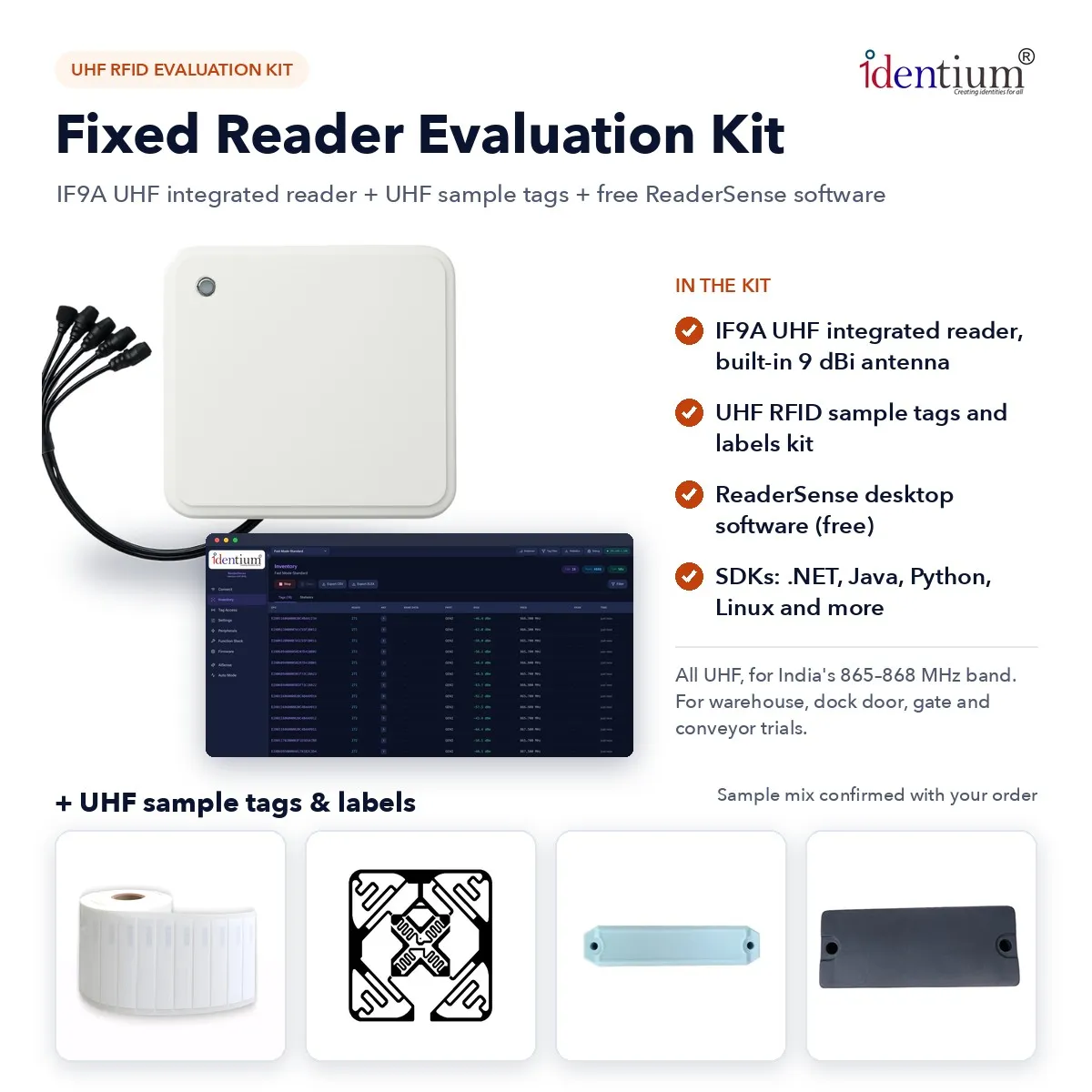
Prove automatic reads at a dock door, gate, conveyor or parking entry before you equip a whole site, using Identium's IF9A UHF integrated reader with its antenna built in, UHF sample tags and the ReaderSense desktop software, free with no licence fee.
₹24,995
per piece + 18% GST
₹29,494.10 incl. GST
Minimum order: 1 piece · buy online and pay by NEFT or UPI, or request a quote
View datasheet PDF · 242 KB- 7-day replacement · 1-year warranty against manufacturing defects
- Blue Dart next-day delivery
- Buy online, pay by NEFT or UPI · in-stock items are dispatched the same day after payment · shipping ₹300 per kg + GST
Key features
- Reader and 9 dBi antenna in one case for the read point; effective range up to 25 m
- ReaderSense desktop software is free: Windows installer and macOS build, no licence fee
- Sample kit: UHF tags selected for the goods passing your door or conveyor
- Auto Mode: the reader posts tag reads by HTTP POST, TCP or MQTT with no PC attached
- AISense measures settings on the real reader and writes the best one back
- Wire it to a network, PC or access controller: RJ45 with PoE, USB, RS232, Wiegand
- Frequency
- 865–868 MHz
- Read range
- Up to 25 m effective (depends on tag, mounting and environment)
- Interface
- USB, RS232, Wiegand, RJ45 Ethernet with PoE
- Indicators
- Multi-function LED: red for power, green for tag read
Overview
Testing a fixed RFID reader kit at your own door or gate
A fixed reader earns its place when nobody has to scan: a pallet crosses a dock door, a crate rides a conveyor, a tagged vehicle reaches a barrier, and the read is recorded on its own. This kit lets you mount one IF9A at a real choke point and measure whether the tags on your goods are caught every time, at the speed and distance they actually pass. Because the antenna sits inside the reader's case, the trial needs one unit at the read point, and the sample tags are chosen for the items and surfaces you describe.
Running the evaluation in ReaderSense
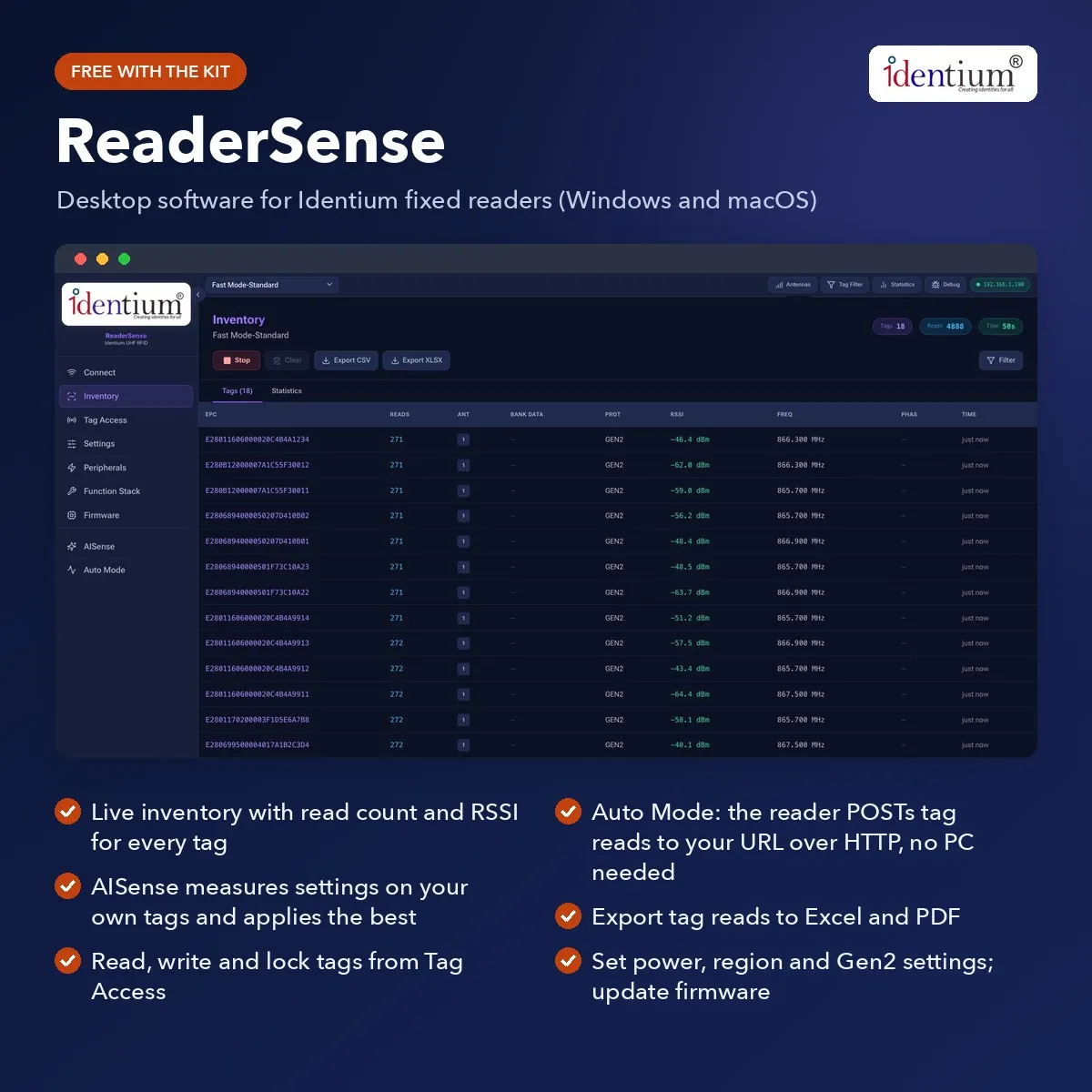
ReaderSense finds the reader on your network or on a port and opens a live inventory table, with a read count and RSSI for every EPC. That table is where a doorway test is won or lost. Walk a tagged carton through at working pace, then a full pallet or a dense stack, and check that every tag appears, and how strongly.
- Tune it. Try power levels by hand, or describe the door to AISense, covering the tags, distance, mounting, motion and RF environment, and let it test configurations on the reader and keep the one that performs.
- Check the installation. Run the VSWR sweep in Function Stack to confirm the antenna is matched before you trust a weak result.
- Keep the evidence. Export each run to Excel, CSV or PDF for the people who sign off the project.
- Prove the integration. Point Auto Mode at a test URL, unplug the PC and check that every pass arrives, with no middleware in between.
- Encode as you will in production. Give the sample tags your own EPC numbers and lock them, then check that the door reads show those numbers.
Doors, gates and conveyors: when a fixed reader kit fits
It suits sites where the question is whether something passed a point: dock doors, gates, conveyors, parking and access lanes. Treat the 25 m figure as an upper limit, not a forecast for your door. The IF9A takes PoE power on its RJ45 port, so plan for a PoE switch port or an injector at the mounting point.
If staff need to walk around counting shelves, a fixed reader is the wrong tool; the CX1500N inventory kit is built for that, and our comparison of fixed vs handheld readers covers the trade-off. Full specs are on the IF9A reader page.
Typical applications
- Warehouse dock doors
- Factory entry gates
- Conveyor belt reading
- Parking entry lanes
- Access control points
- Unattended read points
Specifications
Datasheet (PDF)| Kit contents | IF9A UHF integrated reader, sample kit of UHF RFID tags, ReaderSense desktop software |
|---|---|
| Reader | IF9A single-port UHF integrated reader, with the antenna in the same case |
| Sample kit | UHF RFID tags/labels picked for your application; sample mix confirmed with your order |
| Free software | ReaderSense for Windows (installer) and macOS; no licence fee |
| Software features | Reader discovery on the network or a port; live inventory table (EPC, read count, antenna, RSSI, frequency); Excel, CSV and PDF export; read any memory bank, write EPC, lock; power, region and Gen2 session/target/Q settings; firmware updates; Function Stack commissioning tools (e.g. per-antenna VSWR sweep); Antennas, Tag Filter, Statistics and Debug views; AISense; Auto Mode (HTTP POST, TCP or MQTT, no PC attached) |
| Frequency | 865–868 MHz |
| Read range | Up to 25 m effective (depends on tag, mounting and environment) |
| Read speed | Bulk reading, up to 1,000 tags/s |
| Antenna | Built-in 9 dBi |
| Memory | EPC, TID and User memory |
| Work modes | Active (plug and play, streams reads at power-up), Answer (command) |
| Interface | USB, RS232, Wiegand, RJ45 Ethernet with PoE |
| Outputs | Relay (optional) |
| Indicators | Multi-function LED: red for power, green for tag read |
| Power | PoE on the RJ45 port; tell us if you need a PoE injector with the kit |
| Material | Die-cast aluminium case |
| SDK | .NET, Java, Linux, Python, Arduino, Raspberry Pi |
| Compliance | BIS & WPC Approved |
Frequently asked questions
Does the IF9A need a computer running all the time?
How is the IF9A powered in the kit?
Can our developers integrate the IF9A directly?
How far will the IF9A read at our dock door?
Can the IF9A work with an access controller or barrier?
Which sample tags suit a dock door or conveyor trial?
Related products
All RFID Evaluation Kits →
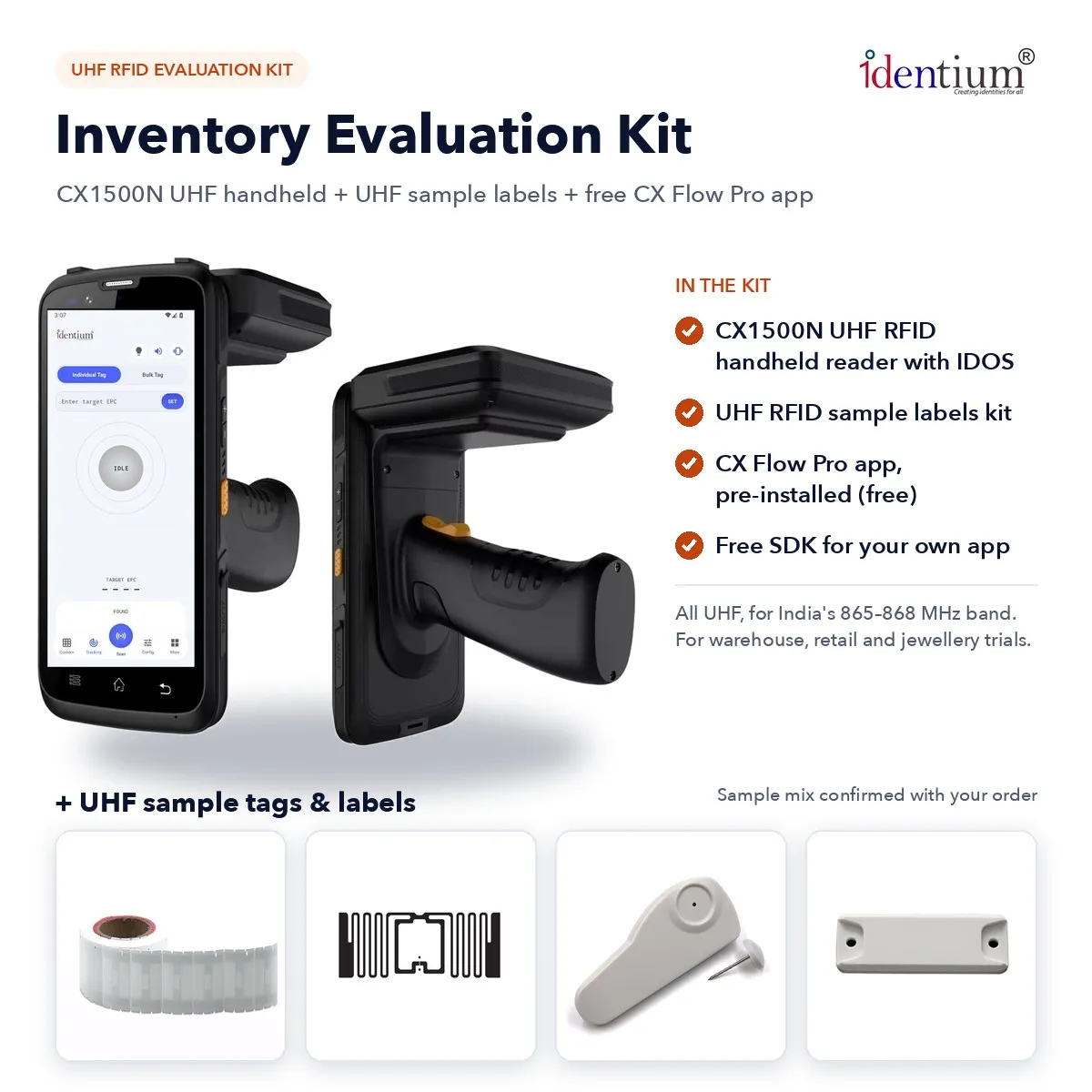
CX1500N-EVK
RFID Inventory Evaluation Kit – CX1500N UHF Handheld + Sample Labels
₹59,775 + GST
Per piece