RFID Library Management System — Book Tracking & Self-Checkout Guide (India 2026)
Published 18 Jul 2026Updated 4 Oct 20268 min read
Indian libraries, from university central libraries and engineering college resource centres to municipal public libraries and large school libraries, are moving from barcode-and-magnetic-strip circulation to RFID library automation. The reasons are practical: a librarian can issue a stack of books in one step, students can self-issue and self-return without queuing, security gates check actual checkout status instead of reacting to any strip that was not desensitised, and a shelf audit that once took a week can be done in an afternoon with a handheld reader.
This guide explains how an RFID library system works in India in 2026: ISO 15693 book tags, staff pad readers, self-check kiosks, security gates and inventory wanding, plus indicative costs and the questions Indian buyers ask most.
Why most libraries use HF RFID (13.56 MHz)
Most library deployments worldwide standardise on HF RFID at 13.56 MHz with the ISO 15693 air interface and the ISO 28560 data model. This is deliberate. At a pad or kiosk, HF's short, well-defined read field of roughly 5–15 cm is a feature, not a limitation:
- Precise single-item reads at the counter and kiosk: you read the book in front of you, not the ten on the returns trolley behind it.
- Tolerance of paper, moisture and metal shelving. UHF (860–960 MHz) signals are more affected by dense paper stacks, damp books and steel racks, which can cause missed or stray reads. HF is more forgiving.
- Anti-collision: an ISO 15693 reader can inventory a stack of 8–12 tagged books on a pad at once, which is what makes bulk issue and self-checkout possible.
- Interoperability: ISO 28560 data models let tags, kiosks and gates from different vendors work together, protecting your investment.
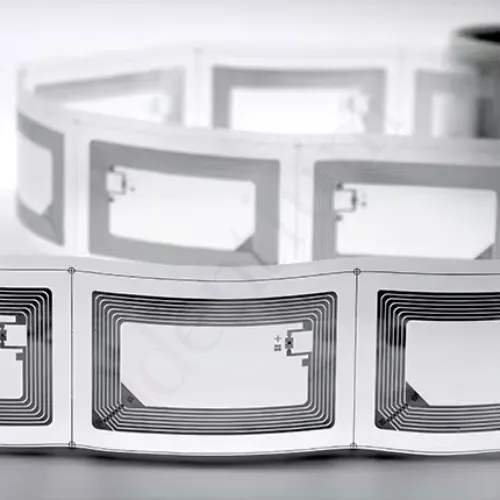
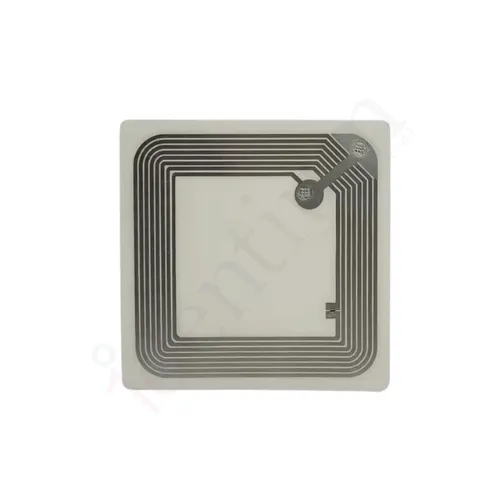
Typical library book tags use NXP ICODE SLIX or SLIX2 chips, with an EAS (electronic article surveillance) security bit and user memory for the accession number. The ICODE SLIX2 HF library label (80 × 50 mm) and its smaller 50 × 50 mm version are ISO 15693 labels with the EAS bit; more options are in HF RFID inlays and labels.
When UHF library tags make sense
Some libraries choose UHF instead, mainly to read spines from further away during shelf audits or to cover a wider exit with a UHF gate. The trade-offs are less precise counter reads, more care around metal racks, and fewer library-specific kiosks and data standards to choose from. If you go this way, slim spine labels such as the UHF RFID library label 125 × 7 mm or the UHF library book tag ID-9503-U9 (95 × 3 mm) pair with UHF handheld readers and a UHF gate such as the HLR200 gate reader.
The book tag: what goes inside every item
A library RFID tag is a thin paper or PET label, usually around 50 × 50 mm or 75 × 45 mm, with an etched aluminium or copper antenna and the HF chip. It carries three things: the item identifier (accession or barcode number) written to user memory, an EAS/AFI security flag switched at issue and return, and a locked, unique chip UID that resists cloning.
For AV media there are CD/DVD hub tags: ring-shaped ISO 15693 labels that stick to the centre of a disc without unbalancing it. For the few high-value or metal-cased items, on-metal variants are used.
How books get tagged (conversion)
Tagging existing stock is a one-time conversion project. A staff member or vendor team works through each item:
- Apply the tag. Fix the tag in a hidden, consistent spot, typically inside the back cover near the spine, staggered slightly from book to book so stacked books do not shield each other.
- Place it on the staff reader. Put the book on a staff pad reader linked to the library management system (Koha, SOUL 2.0, LibSys and similar).
- Encode and link. The software writes the accession number to the tag, sets the AFI/EAS security state and links the chip UID to the catalogue record.
A trained operator converts roughly 300–600 items a day, so plan tagging around your collection size before anything else.
Readers and hardware in a library RFID system
A complete deployment uses several device types, all built on the same HF reader core:
| Component | Where it sits | What it does | Reader type |
|---|---|---|---|
| Staff pad / counter reader | Circulation desk | Bulk issue and return, tagging, re-programming; reads a stack at once | ISO 15693 desktop pad reader (USB) |
| Self-check kiosk | Lobby or reading hall | Patron self-issue and self-return with touchscreen and card login | Embedded HF module and antenna |
| Security gate | Library exit | Detects items that were not issued; alarms on an active security flag | HF gate antenna pair |
| Handheld inventory wand | Between the shelves | Shelf audit, mis-shelf detection, stock-taking | Portable HF reader or smart wand |
| Book drop / return chute | External wall or lobby | Round-the-clock returns with automatic check-in and re-securing | Embedded HF antenna |
Staff pad readers
The workhorse. A flat antenna pad on the librarian's desk connects by USB and reads 8–12 stacked books in one pass. Issuing a student's whole pile becomes a single operation instead of ten barcode scans, and the same pad handles tagging and returns. When choosing a desk reader, confirm that it supports ISO 15693: many 13.56 MHz desktop readers are built only for MIFARE (ISO 14443A) access cards. Desk readers and modules are listed under HF RFID readers.
Self-check kiosks
A self-check kiosk pairs an embedded ISO 15693 reader and antenna with a touchscreen PC. The patron signs in with a library card (an HF MIFARE card or a barcode ID), places books on the read zone and confirms; the kiosk issues them against the library system over SIP2 and switches each tag's security bit off. Returns reverse the process and re-secure the tag. Kiosks cut counter queues sharply and free staff for reference work, and they are usually the feature students and management notice first.
Security gates
Electromagnetic strips alarm on any strip that was not desensitised. HF RFID gates instead read the tag's AFI/EAS security flag: properly issued books pass silently, while an item with an active flag triggers the alarm. Gate aisles are typically 80–90 cm wide, with detection up to about 1 metre. Because the gate checks the security state written at issue, false alarms drop and genuine theft attempts are caught.
Handheld inventory wands
This is where RFID changes library operations most. A librarian walks the aisles sweeping a handheld HF wand along the shelves, and it reads every tagged book without pulling any out. The device flags mis-shelved items, missing books and search hits in real time. A full-collection audit that took a team a week with barcodes is done in hours, which makes annual or even monthly stock verification realistic for libraries that previously skipped it.
Kiosks, HF security gates, book drops and circulation pads are usually specified and quoted as a system around your floor plan and library software rather than bought off the shelf. Send your collection size, number of exits and software with a request for quote.
How a full transaction flows
- Issue. The student signs in at the kiosk or counter and places the stack on the pad. The system reads all UIDs, checks availability in the library system, marks the books issued and switches each tag's security flag off.
- Exit. The student walks through the gate. Every flag reads "off", so there is no alarm.
- Return. The book goes into the drop box or onto the counter pad, is checked in automatically, and its security flag is switched back on.
- Audit. Staff wand the shelves periodically, reconcile against the catalogue and correct mis-shelved items.
Benefits for schools, colleges and public libraries
- Queue-free self-service, which matters most in colleges where hundreds of students borrow around exam time.
- Staff redeployment: routine issue and return is automated, so librarians can focus on cataloguing and helping students.
- Fast, honest stock-taking: wand audits make annual verification realistic and defensible for NAAC/NBA accreditation and government audits.
- Lower theft and better traceability, because every item's status is known.
- Round-the-clock returns through external book drops, without extra staffing.
- Long tag life: ISO 15693 tags remain readable for the life of the book.
What an RFID library system costs in India (2026)
Costs vary with collection size and the number of self-service points. Indicative 2026 market ranges:
| Item | Typical price range in India (2026) | Notes |
|---|---|---|
| HF ISO 15693 book tag | ₹12–25 per tag | Volume-dependent; the main per-item cost |
| Staff counter pad reader | ₹40,000–90,000 | One or two per circulation desk |
| Self-check kiosk | ₹2–3.5 lakh each | Touchscreen PC, reader and enclosure |
| Security gate (per aisle) | ₹2.5–5 lakh | One pair of pedestals per exit |
| Handheld inventory wand | ₹1.2–2.5 lakh | One shared unit is usually enough |
| Book-drop unit | ₹1.5–3 lakh | Optional, for round-the-clock returns |
| Middleware / SIP2 integration | ₹1–8 lakh | One-time; depends on the library system |
A worked example: a college library with 30,000 books, one staff pad, one self-check kiosk, one gate aisle and one wand typically lands at around ₹12–18 lakh all-in, with tags (₹4–6 lakh) the largest single line. Tags are the recurring cost as the collection grows; readers and gates are one-time capital. For what institutions are actually asking for, see our reading of four library RFID bids on GeM in October 2026, line by line.
How to phase a rollout on a budget
Many Indian libraries phase the project:
- Tag and circulate. Tag the collection and deploy a staff pad reader for faster circulation and tagging straight away.
- Secure the exit. Add the security gate.
- Add self-service. Add a self-check kiosk and a book drop.
Because every phase uses the same ISO 15693 tags, nothing is wasted.
Buying library RFID in India
- Tags: check chip (ICODE SLIX2 or equivalent), ISO 15693, EAS support and label size against your specification or tender. Book labels are passive and have no BIS category. Our ICODE SLIX2 library labels are produced in New Delhi.
- Readers: confirm ISO 15693 support, and for institutional tenders ask for the specific model's certification documents. Our certifications page lists which of our reader models are BIS-registered or hold WPC ETA.
- Software: confirm that your library system supports SIP2 or an API before ordering kiosks.
India RFID Store is run by Identium Tech Solutions in New Delhi. Browse HF book labels and HF RFID readers, request samples to test on your own books, or request a quote for your collection size.
Related guides
Frequently asked questions
Which RFID frequency and standard should a library use?
Can RFID replace both barcodes and magnetic security strips?
Will RFID work with our existing library software (Koha, SOUL, LibSys)?
How long does tagging a whole collection take?
Do RFID security gates cause false alarms?
Are the tags and readers certified and made in India?
RFID LibraryHF RFIDISO15693Library AutomationSelf-CheckoutEAS GatesMade in IndiaIndia RFID Store