Skip to content
India RFID Store

Dual Frequency RFID Cards HF-UHF Card
Model RFID CARDS HF-UHF CardIdentiumIn Stock

Dual Frequency RFID Cards HF-UHF Card

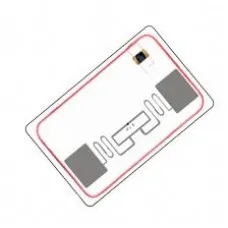
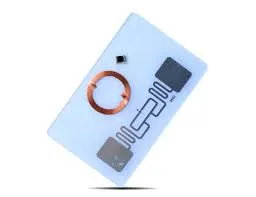
An ISO-format badge carrying a 13.56 MHz MIFARE Classic or DESFire chip for secure door access and a UHF EPC Gen2 chip for long-range identification, for sites already standardised on MIFARE.

₹30

per piece + 18% GST

Minimum order: 500 pieces · the final price for your quantity is confirmed in the quote

View datasheet PDF · 159 KB
  • 7-day replacement · 1-year warranty against manufacturing defects
  • Blue Dart next-day delivery
  • Samples ₹250 (1–2 pcs, incl. shipping) · request

Key features

  • 13.56 MHz chip: MIFARE Classic EV1, DESFire EV1 or DESFire EV2
  • UHF EPC Class 1 Gen 2 chip for long-distance identification
  • Keeps your MIFARE credential; adds a UHF number alongside it
  • HF read up close at doors; UHF read at gates and entry lanes
  • ISO 7816 card format
Frequency
13.56 MHz (HF) + UHF (read on India’s 865–868 MHz band)
Chip
HF: MIFARE Classic EV1, DESFire EV1 or DESFire EV2
Protocol
UHF: EPC Class 1 Gen 2 (ISO 18000-6C)

Overview

Why choose an HF + UHF dual frequency RFID card

If your doors, lifts or canteen already run on 13.56 MHz MIFARE or DESFire, you probably do not want to change that credential: keys are set, staff are enrolled and readers are installed. This card keeps an HF chip doing that job and adds a UHF EPC Gen2 chip beside it, so the same badge can also be identified at a distance by UHF readers at gates, entry lanes or portals.

Two chips, two read distances

HF side (13.56 MHz)

MIFARE Classic EV1, DESFire EV1 or DESFire EV2. Read when the card is presented close to the reader, which suits doors and payment points where a deliberate tap is wanted.

UHF side (EPC Gen2)

Read from a distance by a UHF reader on India’s 865–868 MHz band, for hands-free entry lanes, vehicle gates and movement logging.

Planning the rollout

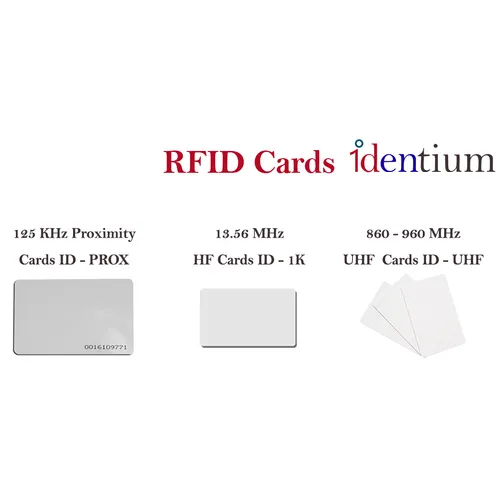
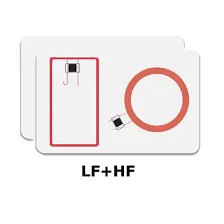
The two chips are encoded separately: MIFARE sectors or DESFire applications on an HF encoder, and the EPC on a UHF encoder. Decide early how the HF card number and the UHF EPC will be linked in your software. If your doors still run 125 kHz proximity, the LF + UHF card fits better; for a printed multi-purpose photo ID with an NTAG option, see the RFID hybrid card. The UHF vs HF vs LF guide covers the trade-offs.

Typical applications

  • Secure door access
  • Lobby entry lanes
  • Vehicle gate lanes
  • Hospital staff badges
  • Corporate campus IDs

Specifications

Datasheet (PDF)
ModelRFID Cards HF-UHF Card
Frequency13.56 MHz (HF) + UHF (read on India’s 865–868 MHz band)
ChipHF: MIFARE Classic EV1, DESFire EV1 or DESFire EV2
ProtocolUHF: EPC Class 1 Gen 2 (ISO 18000-6C)
FormatISO 7816 hybrid dual-frequency badge

Frequently asked questions

What is an HF + UHF dual frequency card?
An ISO 7816 format badge with two chips: a 13.56 MHz MIFARE Classic EV1 or DESFire EV1/EV2 chip for proximity identification, and a UHF EPC Class 1 Gen 2 chip for long-distance identification.
Do I have to change my MIFARE access system to use it?
No. The HF side is a standard MIFARE Classic or DESFire chip, so it is enrolled in your existing system with your own keys. The UHF chip is there for new long-range readers.
Which UHF band does it use in India?
UHF RFID in India runs on the licence-exempt 865–868 MHz band, and the card’s EPC Gen2 chip is read by UHF readers working on that band.
How is this different from the RFID hybrid card?
Both combine HF and UHF. This card is offered with MIFARE Classic EV1 and DESFire EV1/EV2 for secure access systems. The RFID hybrid card is a CR80 printed ID with MIFARE or NTAG on the HF side and an optional magnetic stripe.
Which reader reads the UHF side?
Any EPC Gen2 UHF reader on 865–868 MHz, for example a fixed reader at a gate lane or a UHF card reader with Wiegand output feeding an access panel.

Your quote list

Saved on this device. No payment is taken online.

Your list is empty. Use “Add to quote” on any product, then send one request for everything.